
Experimental Pharmacology — Simulated/Computer-Assisted Experiments
Learning Objectives
At the end of this chapter, the Phase II MBBS student will be able to:
- State the ethical framework of experimental pharmacology — CPCSEA, IAEC and the 3Rs — and explain why simulations have replaced animal work. (PH4.2 — Knows)
- Identify the classical experimental preparations and the instruments used to record them. (PH4.2 — Knows)
- Predict the blood-pressure tracing of each vasopressor and vasodepressor before and after specific blockers. (PH4.2 — Shows)
- Interpret an unknown blood-pressure tracing series and name the drug or blocker from the response pattern, including Dale's vasomotor reversal. (PH4.2 — Shows)
- Plot a graded dose-response curve from simulated data and read off EC50, Emax and shifts. (PH4.2 — Shows)
- Distinguish competitive from non-competitive antagonism and full from partial agonism on a dose-response curve. (PH4.2 — Shows)
- Explain bioassay principles and designs (matching, three-point, four-point) and perform a three-point assay calculation. (PH4.2 — Does)
- Analyse experimental tracings and numerical data and draw valid, cautious conclusions in practical-file format. (PH4.2 — Does)
Must-Know Summary
Experimental pharmacology in the modern curriculum is computer-assisted simulation — the ethics (CPCSEA, IAEC, 3Rs — Replacement, Reduction, Refinement) having replaced frogs, dogs and cats with software — but the reasoning that earns marks is unchanged. On the simulated blood-pressure tracing, adrenaline is biphasic (alpha-pressor then beta2-depressor overshoot); noradrenaline is purely pressor with reflex bradycardia; isoprenaline purely depressor with tachycardia; acetylcholine and histamine are depressors blocked respectively by atropine and mepyramine; tyramine is indirectly pressor and dies after reserpine (depleted stores) while direct-acting adrenaline survives. The two classic reversals: after the alpha-blocker phentolamine, adrenaline REVERSES to a pure depressor (Dale's vasomotor reversal); after the beta-blocker propranolol, adrenaline becomes a pure pressor. On the dose-response curve, EC50 reads potency, Emax reads efficacy; a competitive antagonist shifts the curve rightward, parallel, with the same Emax (quantified as pA2, the Schild measure), while a non-competitive or irreversible antagonist lowers Emax; a partial agonist has a lower ceiling and potency never implies efficacy. Bioassay estimates an unknown potency by comparing its effect with a standard in the same run: bracketing for speed, three-point (2+1) for routine work, four-point (2+2) to cancel curvature — the insulin mouse-convulsion (quantal) and oxytocin rat-uterus (graded) assays are the classics. Reading any tracing: check calibration, baseline stability, direction-amplitude-duration of the response, and the recovery — then conclude receptor by blocker.
- 3Rs — Replacement (simulate), Reduction (fewer animals), Refinement (less suffering)
- NMC rule — frog, dog and cat experiments only as computer simulations
- Adrenaline tracing — biphasic: sharp pressor (alpha) then depressor overshoot (beta2)
- Noradrenaline — pure pressor with reflex bradycardia; phenylephrine the same, pure alpha1
- Isoprenaline — pure depressor with tachycardia (beta1 + beta2)
- Dale's vasomotor reversal — after phentolamine, adrenaline becomes a pure DEPRESSOR
- After propranolol — adrenaline becomes a pure PRESSOR
- Acetylcholine depressor — blocked by atropine; histamine depressor — blocked by mepyramine
- Tyramine — indirect pressor; abolished by reserpine pretreatment (store depletion)
- EC50 — potency; Emax — efficacy; pD2 (minus log EC50) — agonist affinity
- Competitive antagonist — parallel rightward shift, SAME Emax; measured as pA2 (Schild)
- Non-competitive or irreversible antagonist — Emax FALLS (once spare receptors are spent)
- Partial agonist — lower ceiling; antagonist in the presence of a full agonist
- Therapeutic index — LD50/ED50 (quantal curves); margin of safety LD1/ED99
- Bioassay definition — potency of the unknown by comparing effect with a standard, same run
- Three-point (2+1) — two standard doses bracketing one unknown; assumes a linear segment
- Four-point (2+2) — two doses of each; cancels curvature; tests parallelism
- Insulin assay — mouse hypoglycaemic convulsion (quantal); rabbit blood glucose (graded)
- Oxytocin assay — rat uterus contraction against the WHO standard
- Frog heart — Ca2+ excess: systolic arrest; K+ excess: diastolic arrest
- Curare on nerve-diaphragm — progressive block, REVERSED by neostigmine
Classification
BOX 1 — EXPERIMENTAL PREPARATIONS AND THEIR DRUG TARGETS
Intact Blood Pressure Recording (simulated dog/rat)
- Vasopressors: adrenaline (biphasic), noradrenaline, phenylephrine, dopamine (high dose), tyramine (indirect)
- Vasodepressors: isoprenaline, acetylcholine, histamine, dopamine (low dose)
- Blockers for the series: phentolamine (alpha), propranolol (beta), atropine (muscarinic), mepyramine (H1), reserpine (store depleter)
Frog Heart
- Ions: calcium excess, potassium excess
- Drugs: adrenaline, acetylcholine, digoxin
Isolated Ileum (rat/guinea pig)
- Agonists: acetylcholine, histamine, 5-HT
- Antagonists: atropine, mepyramine, methysergide; papaverine (nonspecific relaxant)
Rat Uterus
- Oxytocin (bioassay), prostaglandins, beta-2 relaxants (ritodrine)
Vas Deferens
- Noradrenaline, phenylephrine; alpha-1 and alpha-2 preference by blocker
Phrenic Nerve-Diaphragm
- Tubocurarine (block), neostigmine (reversal), succinylcholine (persistent depolarisation)
BOX 2 — QUANTIFICATION AND ASSAY TOOLS
Dose-Response Parameters
- EC50, Emax, pD2 (agonist affinity), dose ratio
Antagonism Measures
- pA2 (Schild) for competitive; Emax fall for non-competitive/irreversible
Population (Quantal) Parameters
- ED50, LD50, therapeutic index (LD50/ED50), margin of safety (LD1/ED99)
Bioassay Designs
- Matching/bracketing; interpolation; three-point (2+1); four-point (2+2); six-point (3+3)
Standards and Ethics
- WHO international reference preparations; CPCSEA, IAEC, 3Rs; computer-assisted simulation
Core Concepts
1. Principles of experimental pharmacology
The ethical frame comes first. All animal experimentation in India is governed by CPCSEA (the Committee for the Purpose of Control and Supervision of Experiments on Animals) under the Prevention of Cruelty to Animals Act; every institutional project needs IAEC (Institutional Animal Ethics Committee) approval, with humane endpoints and trained personnel. The governing philosophy is the 3Rs: Replacement — use simulations, in vitro systems or computer models instead of live animals wherever possible; Reduction — design experiments to use the minimum number of animals for a valid answer (statistics, good design, shared controls); Refinement — minimise pain and distress (anaesthesia, analgesia, handling technique). The NMC curriculum operationalises Replacement directly: amphibian, dog and cat experiments are to be conducted only through computer-assisted simulation — which is why the Phase II practical hall runs CAL software rather than kymographs and frogs.
From kymograph to computer. The classical instrument was the kymograph — a rotating smoked drum on which a stylus, driven by a heart lever or tambour, inscribed the contraction or pressure pulse; the tracing was fixed with shellac and measured by ruler against a calibration mark. Its modern descendants are force and displacement transducers feeding a student physiograph or data-acquisition system, and now full computer-assisted learning (CAL) simulations (ExPharm and similar): the same experiments — blood-pressure effects, isolated-tissue dose-response, bioassay — with idealised, noise-free tracings, instant "dose" buttons, repeatability and zero animal cost. What the simulation teaches unchanged: the logic of dose, response, receptor and blocker.
The classical preparations (know what runs on what):
- Frog heart (perfused heart, Straub or cannula setups): rate and force; ions (calcium, potassium), adrenaline, acetylcholine, digoxin.
- Rat or guinea-pig ileum (isolated organ bath): acetylcholine and histamine dose-response curves; atropine and mepyramine antagonism; the standard preparation for pA2 studies.
- Rat uterus: oxytocin contraction — the graded bioassay for oxytocin.
- Vas deferens: alpha-adrenergic (and purinergic) transmission.
- Rat phrenic nerve-diaphragm: neuromuscular transmission — tubocurarine block and its neostigmine reversal.
- Intact anaesthetised animal (simulated dog/rat): arterial blood pressure with vasopressors, vasodepressors and blockers — the PH4.2 core experiment.
Vocabulary used throughout: agonist and antagonist; EC50 (concentration giving half-maximal effect), Emax (maximal effect); pD2 = minus log EC50 (agonist affinity — higher means more potent); pA2 = minus log of the molar concentration of a competitive antagonist that doubles the agonist dose requirement (antagonist affinity — the Schild measure).
2. Computer-assisted learning: effects on blood pressure
The setup. The simulated anaesthetised animal has a carotid arterial cannula connected to a pressure transducer (the arterial tracing with its pulse waves is the baseline) and a venous cannula for drug injection. Each drug injection is marked on the tracing; the response is read as direction, amplitude and duration, and the tracing recovers to baseline before the next dose.
The drugs and their tracings (the exam matrix):
- Adrenaline — biphasic. A sharp rise in blood pressure (alpha1 vasoconstriction) followed by a fall below baseline before recovery (beta2 vasodilatation in skeletal muscle beds), with tachycardia. At low doses the beta2 component dominates and the net effect is depressor.
- Noradrenaline — pure pressor with reflex bradycardia (baroreceptor response to the pressure rise; NA has little beta2 action).
- Phenylephrine — pure alpha1 pressor, also with reflex bradycardia; the clean alpha1 demo.
- Isoprenaline — pure depressor with tachycardia (beta1 on heart, beta2 on vessels).
- Dopamine — dose-dependent: low dose depressor (D1 renal and mesenteric vasodilatation), higher doses pressor (alpha1).
- Acetylcholine — depressor with bradycardia (muscarinic M3 vasodilatation and M2 cardiac slowing).
- Histamine — depressor (H1-mediated vasodilatation) with a reflex tachycardia.
- Tyramine — pressor, but indirectly: it enters sympathetic terminals and displaces noradrenaline from storage vesicles — no direct receptor action.
The blocker series (learn as drug-blocker pairs):
- After phentolamine (alpha-blocker): the pressor responses to noradrenaline and phenylephrine are abolished; and adrenaline REVERSES — the tracing now shows only the depressor phase. This is Dale's vasomotor reversal.
- After propranolol (beta-blocker): the isoprenaline response is abolished; adrenaline becomes a pure pressor (the beta2 depressor phase is clipped).
- After atropine (muscarinic blocker): the acetylcholine depressor response vanishes (and vagal-stimulation bradycardia is lost).
- After mepyramine (H1 blocker): the histamine response vanishes.
- After reserpine pretreatment (depletes noradrenaline stores): tyramine's pressor effect is abolished, while adrenaline (direct-acting) still works — the definitive direct-versus-indirect demonstration.
Vasomotor reflexes recorded alongside: carotid occlusion — pressor (baroreceptor unloading drives sympathetic outflow); vagal stimulation — depressor with bradycardia; both are blocked or blunted by their respective efferent blockers (ganglion blockers abolish both).
The four-step interpretation method (say it aloud in the exam): (1) read the direction — pressor, depressor or biphasic; (2) read the heart rate — tachycardia, reflex bradycardia, or neither; (3) apply the blocker — which response component disappeared or flipped; (4) conclude the receptor and, if asked, the drug.
3. Dose-response curves from simulated data
Two kinds of DRC answer two different questions. A graded dose-response curve plots the magnitude of response of a single tissue (or animal) against dose — "how much contraction at each concentration". A quantal dose-response curve plots the percentage of a population responding (all-or-none: convulsed or not, died or not) — "what fraction respond at each dose".
Plotting the graded curve. Response (as percentage of the maximum) is plotted on the y-axis against log dose on the x-axis, giving the characteristic sigmoid curve (a rectangular hyperbola on linear axes). Two numbers carry all the information: EC50 — the dose producing 50% of maximal response — measures POTENCY; Emax — the plateau height — measures EFFICACY. The exam trap, always: a more potent drug is not a better drug — potency only compares doses, not ceilings (a potent partial agonist is still a poor drug).
Reading shifts — the rules:
- Competitive (surmountable) antagonist: the curve shifts rightward, PARALLEL, with the SAME Emax — the agonist overcomes the block by occupying more receptors. The magnitude is the dose ratio (DR = the factor by which the agonist dose must increase); the antagonist's affinity is reported as pA2 = minus log [antagonist] at DR = 2 (from the Schild plot, whose slope is 1 for pure competition).
- Non-competitive or irreversible antagonist: the curve shifts right AND the Emax FALLS — no dose of agonist can restore the maximum, because receptors are functionally removed.
- Spare receptors refine the irreversible story: with a receptor reserve, low degrees of irreversible blockade first shift the curve rightward (parallel, same Emax — mimicking competition), and only when the reserve is exhausted does Emax fall.
- Partial agonist: a lower Emax even at full occupancy; in the presence of a full agonist it behaves as a competitive antagonist (two partials of the same receptor: effects add only up to the partial ceiling).
Quantal curves and safety. From all-or-none population data: ED50 (effective in 50%), LD50 (lethal in 50%); therapeutic index = LD50/ED50; the margin of safety = LD1/ED99 — more conservative. Caveat: TI assumes comparable slopes; non-parallel effective and lethal curves make TI misleading.
The plotting exercise: simulated ileum data — compute percent-maximal response for each acetylcholine dose, plot the semilog sigmoid, read EC50; add atropine, repeat, compute the dose ratio and pA2, classify the antagonism as competitive (parallel, same ceiling).
4. Bioassay principles
Definition. A bioassay is the estimation of the concentration or potency of a biologically active substance by measuring its effect on a living system and comparing that effect with the effect of a standard preparation of known potency.
Why bioassay at all, when chemistry exists: (1) no specific chemical assay exists for some agents (complex mixtures, extracts); (2) biological activity, not chemical quantity, is what matters — degradation products, isoforms and partial agonists weigh differently in a tissue than in a chromatogram; (3) standardisation of biologicals (insulin, heparin, vaccines) is anchored to WHO international reference preparations — the unknown is always compared with the standard in the same run, on the same tissue or animal group, so biological variability cancels.
Types by response measured:
- Graded-response assay: magnitude of a measured effect (contraction height, blood-glucose fall).
- Quantal (all-or-none) assay: fraction of subjects showing a defined end-point — insulin by mouse hypoglycaemic convulsion; tubocurarine by rabbit head-drop.
- End-point assay: dose titrated to a fixed end-point in each animal — digitalis to cardiac arrest in the guinea pig or cat.
Designs (in order of rigour):
- Matching (bracketing) assay: choose two standard doses (S1 and S2) that bracket the unknown's response (U), and interpolate between them — fast, approximate; assumes linearity between S1 and S2.
- Interpolation assay: construct a full standard curve, then read the unknown off the line.
- Three-point (2+1) assay: responses to S1, S2 and U; potency of the unknown = antilog of the interpolated position of u between s1 and s2 on the log-dose line. Assumptions: the dose-response segment between S1 and S2 is linear, and the test behaves identically to the standard (parallelism cannot be tested with one test dose).
- Four-point (2+2) assay: two doses of standard and two of the test, randomised; cancels curvature (uses the slope of each pair) and allows a validity check of parallelism (a t-test between slopes) before potencies are compared — the routine precise design.
- Six-point (3+3): three doses each — for curved relationships.
Classic assays (memorise the table):
- Insulin: mouse hypoglycaemic convulsion (quantal); rabbit blood-glucose fall (graded); modern replacement — immunoassay (but biological standardisation remains for products).
- Oxytocin: contraction of the isolated rat uterus (graded) against the WHO standard — the exam favourite.
- Histamine: contraction of guinea-pig ileum.
- Acetylcholine: contraction of the frog rectus abdominis or ileum (also leech muscle classically).
- Digitalis: cardiac arrest in the guinea pig or cat (end-point).
- Tubocurarine: rabbit head-drop (quantal); frog abdominal-nerve rectus.
- Heparin: clotting of sheep plasma against the international standard.
- Vitamin D: rachitic rat calcium-deposition line test (historical).
- Pyrogens: rabbit temperature rise — replaced by the LAL test.
- Gonadotrophins: ovarian or uterine weight gain in immature rats.
Limitations and decline: variability, cost, ethics and time; superseded by HPLC and immunoassays for most small molecules — but bioassay survives where activity itself must be measured (biologicals, new entities, WHO standardisation).
5. Interpretation of experimental data
Reading a tracing like an examiner. Before any pharmacology: check the calibration (what height equals what pressure or tension — the calibration mark), the baseline (steady, or drifting — drift is an artifact), the time signal, and the drug arrow (where the dose went in). Then read the response: direction (up or down), amplitude (against calibration), duration and recovery (complete? slow? tachyphylaxis on repeating the dose?). Common artifacts: an air bubble (sudden step), a knock on the transducer (spike), base drift (temperature, evaporation), and a damped trace (air in the cannula).
The other classic experiments, summarised for the viva:
- Frog heart in Ringer's: excess calcium — force rises, then systolic arrest; excess potassium — diastolic arrest; adrenaline — increased rate and force; acetylcholine — decreased rate and force, at high dose diastolic standstill (blocked by atropine); digoxin — positive inotropy, then arrhythmia at toxicity.
- Rat ileum: acetylcholine dose-response; with atropine — parallel rightward shift (the competitive pA2 demonstration); papaverine relaxes nonspecifically.
- Phrenic nerve-diaphragm (nerve-stimulated twitches): tubocurarine — progressive block of indirectly elicited twitches while direct muscle stimulation still contracts (localises the block to the junction); neostigmine reverses the block (anticholinesterase — with visible fasciculation).
- Rat uterus: oxytocin produces rhythmic contractions; sensitivity varies with the oestrous stage — a practical reminder that biological preparations vary.
Handling numerical data: tabulate raw data; compute the mean and SEM (standard error) for replicate observations; compare groups simply (state the test you would use — unpaired t-test for two means); plot mean with error bars. Conclusions are written cautiously: "the response is consistent with a muscarinic receptor action", "the data suggest competitive antagonism (n = 1; replication required)" — the simulation's perfect data lack biological scatter, and the examiner rewards the humility.
The practical-file write-up format (marks live here): Aim — Apparatus/Setting — Procedure — Observation table — Graph — Result — Inference. Every graph needs labelled axes, units, a calibration or scale reference, and a caption; every inference must follow from the observation shown, not from the textbook fact alone.
Tables
Table 1 — The blood-pressure drug-tracing matrix
| Drug | Receptor | Control tracing | After phentolamine (alpha-block) | After propranolol (beta-block) | After atropine | After mepyramine | After reserpine |
|---|---|---|---|---|---|---|---|
| Adrenaline | alpha1 + beta2 | Biphasic: pressor then depressor | REVERSED: pure depressor (Dale's reversal) | Pure pressor (depressor clipped) | No change | No change | Preserved (direct) |
| Noradrenaline | alpha1 (weak beta2) | Pure pressor + reflex bradycardia | Abolished | Slight further rise (no reflex clipping) | No change | No change | Preserved (direct) |
| Phenylephrine | alpha1 pure | Pressor + reflex bradycardia | Abolished | No change | No change | No change | Preserved |
| Isoprenaline | beta1 + beta2 | Depressor + tachycardia | No change | Abolished | No change | No change | Preserved |
| Dopamine | D1 (low) / alpha1 (high) | Low dose depressor, high dose pressor | High-dose pressor lost | Tachycardia clipped | No change | No change | Partially lost (indirect component) |
| Acetylcholine | M3 (vasodilatation), M2 (heart) | Depressor + bradycardia | No change | No change | Abolished | No change | No change |
| Histamine | H1 | Depressor | No change | No change | No change | Abolished | No change |
| Tyramine | Indirect (displaces NA) | Pressor | Abolished | No change | No change | No change | Abolished (stores empty) |
Table 2 — Classic preparations and applications
| Preparation | Species | Readout | Drugs studied | Typical exam use |
|---|---|---|---|---|
| Intact BP (simulated) | Dog/rat | Arterial pressure tracing | Pressors, depressors, blockers | Tracing identification |
| Frog heart | Frog | Rate and force | Ca2+, K+, adrenaline, ACh, digoxin | Ion and drug effects |
| Ileum | Rat/guinea pig | Contraction height | ACh, histamine, 5-HT + antagonists | DRC and pA2 |
| Uterus | Rat | Contraction (graded) | Oxytocin | Bioassay calculation |
| Vas deferens | Rat | Contraction | NA, phenylephrine | Alpha subtype study |
| Nerve-diaphragm | Rat | Twitch tension | Curare, neostigmine | NMJ block and reversal |
Table 3 — DRC interpretation grid
| Observation on the curve | Mechanism | Parameter to report |
|---|---|---|
| Parallel rightward shift, same Emax | Competitive (surmountable) antagonist | pA2 (Schild); dose ratio |
| Rightward shift AND lower Emax | Non-competitive or irreversible antagonist | New Emax; residual activity |
| Right shift first, Emax falls only later (as blocker dose rises) | Irreversible antagonist WITH spare receptors | Receptor reserve estimate |
| Lower ceiling even alone (full occupancy) | Partial agonist | Intrinsic activity (Emax fraction) |
| Steeper or flatter slope than control | Altered receptor reserve or cooperative state | Slope (Hill) comparison |
| Population per cent responding (all-or-none) | Quantal curve | ED50, LD50, TI = LD50/ED50 |
Table 4 — Classic bioassays
| Substance | Standard | Preparation and species | Response type | Modern replacement |
|---|---|---|---|---|
| Insulin | WHO insulin standard | Mouse convulsion; rabbit blood glucose | Quantal / graded | Immunoassay (HPLC) |
| Oxytocin | WHO oxytocin standard | Isolated rat uterus | Graded contraction | HPLC/immunoassay |
| Histamine | Histamine standard | Guinea-pig ileum | Graded contraction | HPLC |
| Acetylcholine | ACh standard | Frog rectus / ileum | Graded contraction | HPLC |
| Digitalis | Digitalis standard | Guinea-pig or cat heart | End-point (arrest) | HPLC/immunoassay |
| Tubocurarine | d-TC standard | Rabbit head-drop | Quantal | — |
| Heparin | International standard | Sheep plasma clotting | Graded (clotting time) | Anti-Xa assay |
| Vitamin D | Vitamin D standard | Rachitic rat line test | End-point (histology) | HPLC |
| Pyrogens | Reference endotoxin | Rabbit temperature rise | Graded | LAL test |
Figures
Figure 1 — Dale's vasomotor reversal
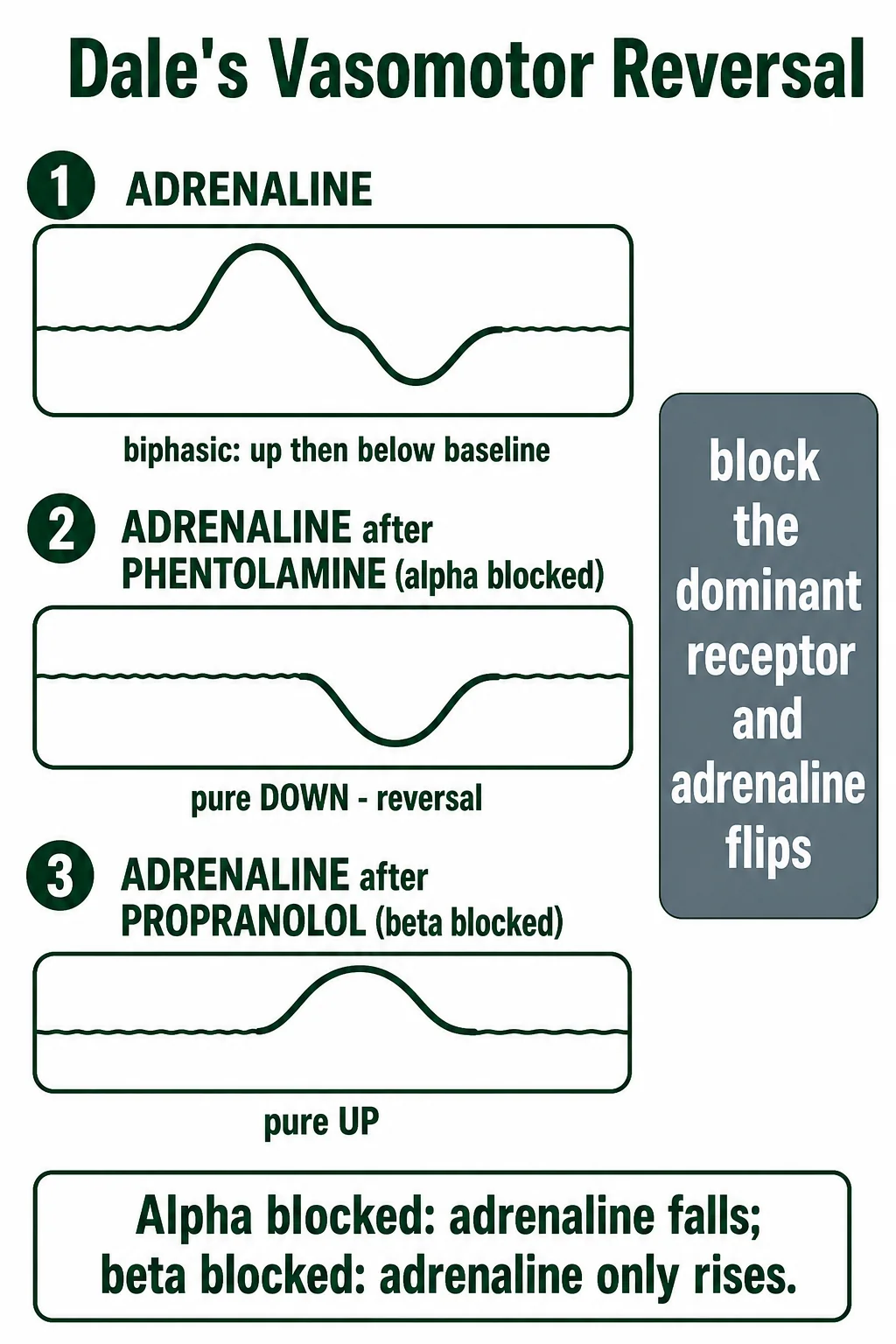
Three blood-pressure tracings of adrenaline — biphasic at baseline, purely depressor after phentolamine (Dale's vasomotor reversal), and purely pressor after propranolol.
Figure 2 — Reading dose-response shifts
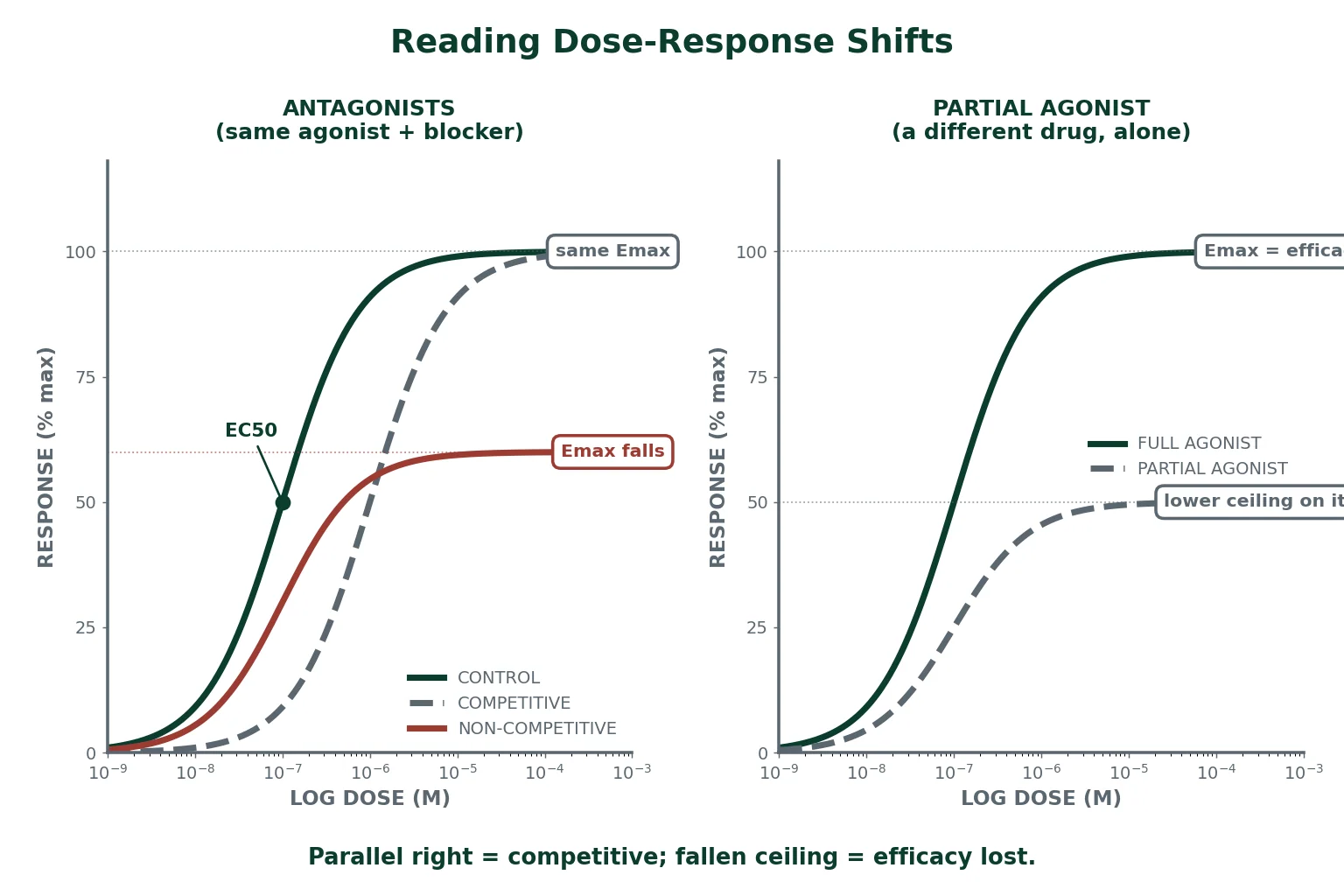
Two-panel dose-response diagram — antagonists (competitive antagonist shifts right with the same Emax; non-competitive antagonist lowers the Emax to 60 percent) and a partial agonist alone with a 50 percent ceiling versus a full agonist, with EC50 and Emax definitions.
Figure 3 — Three-point (2+1) bioassay
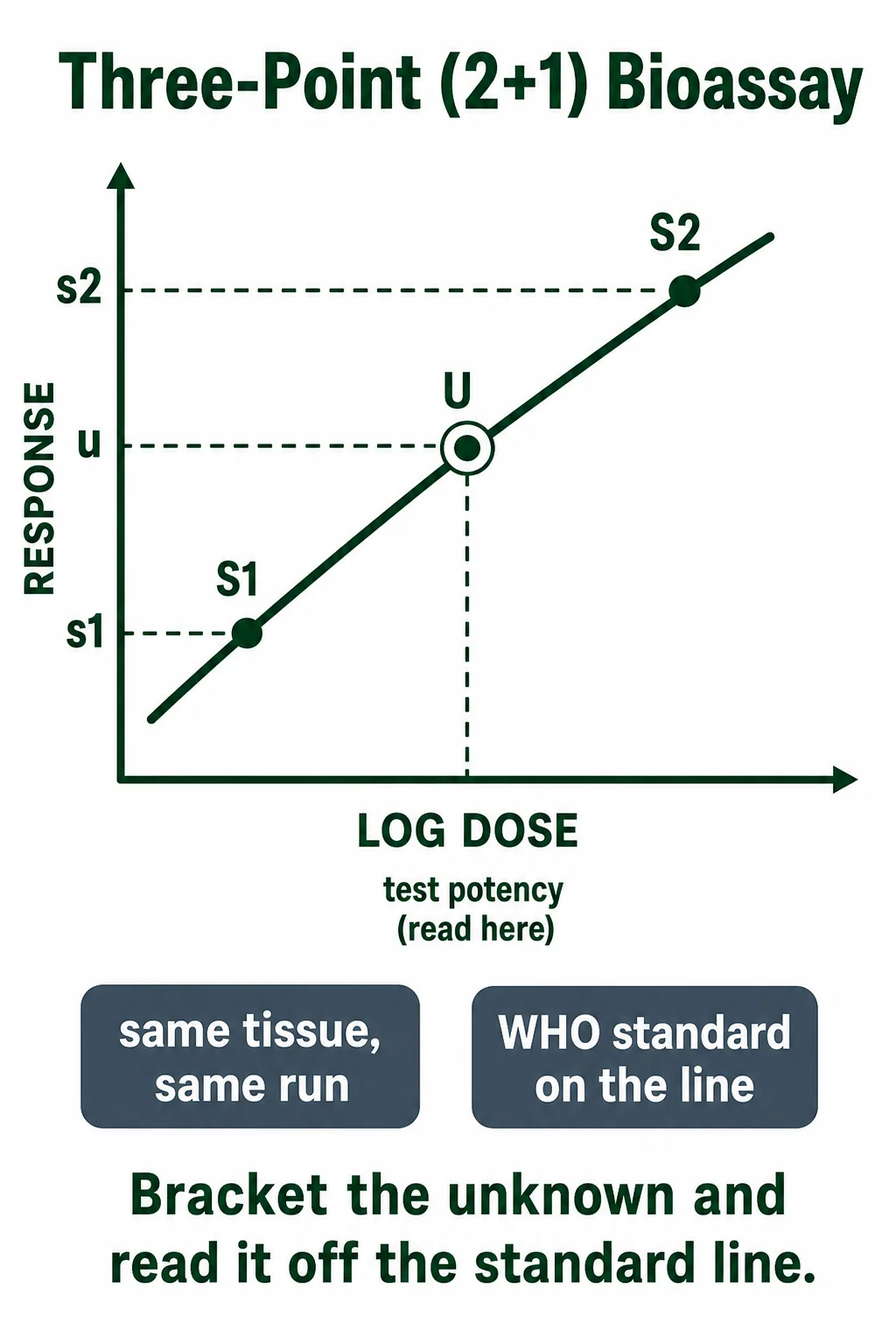
Three-point bioassay diagram with two standard doses bracketing the unknown response on a log-dose response line, reading the test potency by interpolation.
Clinical Correlation
Station 1 — Identify the unknown tracing series
Four unlabelled tracings from the simulated BP experiment are given: drug X produces a sharp rise then a fall below baseline; after phentolamine, the same dose of X produces only a fall; after propranolol, only a rise. The student reads: biphasic drug with alpha and beta2 components — adrenaline; the phentolamine tracing is Dale's vasomotor reversal; the propranolol tracing is the clipped pure-pressor form. Conclusion written in file format: "Unknown X is a mixed alpha and beta agonist with direct action (adrenaline), since responses persist after store depletion."
Reasoning: The four-step method — direction, heart rate, blocker, receptor — turns any tracing series into a logic problem. Biphasic plus reversal-after-phentolamine is pathognomonic of adrenaline; isoprenaline would never show a pressor phase, and noradrenaline would never reverse with phentolamine alone (it is simply abolished).
Station 2 — Tyramine and reserpine
Tracing A: an unknown pressor that is abolished after reserpine pretreatment, while adrenaline given in the same animal still raises pressure. The student concludes: the unknown is indirectly acting (tyramine-like) — it depends on intact noradrenaline stores, which reserpine depletes; adrenaline acts directly on receptors and survives.
Reasoning: This is the direct-versus-indirect sympathomimetic test. Its clinical echo deserves one line in the viva: the cheese reaction — tyramine in aged foods reaches the circulation when MAO is inhibited, displacing massive noradrenaline — the same displacement pharmacology, made dangerous in patients.
Station 3 — The atropine-ileum DRC station
Simulated ileum data: six acetylcholine doses give contraction heights; with atropine 10 nM present, the same doses give a shifted curve of the same height. The student plots both semilog curves, reads EC50 doubling (dose ratio 2), computes pA2, and writes: "Atropine produced a parallel rightward shift with unchanged Emax — competitive muscarinic antagonism; pA2 consistent with M3 blockade."
Reasoning: The shape of the conclusion IS the mark scheme: parallel + same Emax + right shift = competitive, quantified as pA2. If the ceiling had fallen, the answer would be non-competitive — the two-line discrimination every examiner probes.
Station 4 — Insulin unknown by the 2+1 assay
A rabbit blood-glucose bioassay: standard doses S1 (1 unit) and S2 (2 units) produce falls of 28 and 52 mg/dL; the unknown produces a fall of 40 mg/dL. The student interpolates on the log-dose line between S1 and S2: the unknown's potency lies between 1 and 2 units per dose, read as approximately 1.5 units by interpolation — and states two assumptions (linearity between S1 and S2; test parallel to standard) and the next design if precision mattered (2+2).
Reasoning: The 2+1 assay is arithmetic plus honesty: bracket, interpolate, and declare the assumptions. The upgrade path — four-point with a parallelism test — is the expected viva follow-up.
Practical Linkage
The DOAP Station Itself (PH4.2)
Tracing-Interpretation Station (six unknowns)
Given six simulated BP tracings (adrenaline, noradrenaline, isoprenaline, acetylcholine, histamine, tyramine — one with its blocker), name each using the four-step method spoken aloud: direction, heart rate, blocker effect, receptor conclusion. Marking: 1 mark per drug, 1 for the method, 2 for Dale's reversal if it appears.
DRC Plotting Worksheet
Data: acetylcholine 10 nanomolar to 100 micromolar (six doses) versus contraction height, with and without atropine 10 nM. Tasks: compute percent-maximal response; plot both semilog curves (labelled axes, units); read EC50 of each; compute dose ratio; compute pA2 (minus log of the atropine concentration if DR = 2, else from the Schild equation log(DR-1) versus minus log[B]); classify antagonism in one sentence.
Bioassay Calculation Worksheet
2+1 dataset (S1, S2, U with responses): compute the test potency by interpolation; state two assumptions of the three-point design; name one situation demanding a 2+2 assay (precision required; curvature suspected).
File Write-Up Self-Check (marking scheme)
Aim (1) — Setting/apparatus (2) — Procedure (3) — Observation table with units (3) — Graph with labelled axes, calibration and caption (4) — Result (2) — Inference following from the observation (3). Verify each item against your own write-up before submission.
MCQ Bank
25 questions · tagged by topic, exam pattern & difficulty · full explanations
The guiding ethical framework that replaced most live-animal teaching with computer simulations is summarised as the 3Rs. What are they?
Rapid Revision
- 3Rs — Replacement (simulate), Reduction (fewest animals), Refinement (least distress).
- NMC rule — frog, dog and cat experiments only by computer simulation.
- CPCSEA governs; IAEC approves; humane endpoints mandatory.
- Kymograph — the smoked-drum ancestor of the transducer and CAL software.
- Adrenaline on BP — biphasic: alpha pressor then beta2 depressor overshoot.
- Noradrenaline — pure pressor with reflex bradycardia; phenylephrine identical (pure alpha1).
- Isoprenaline — pure depressor with tachycardia (beta1 + beta2).
- Dopamine — low dose depressor (D1), high dose pressor (alpha1).
- Dale's vasomotor reversal — after phentolamine, adrenaline is purely DEPRESSOR.
- After propranolol — adrenaline is purely PRESSOR.
- Acetylcholine — depressor + bradycardia; abolished by atropine.
- Histamine — depressor; abolished by mepyramine (H1).
- Tyramine — indirect pressor; abolished by reserpine; adrenaline survives.
- Carotid occlusion — pressor (baroreceptor unloading); vagal stimulation — depressor.
- Interpretation method — direction, heart rate, blocker, receptor.
- Graded DRC — one tissue, magnitude; quantal DRC — population, per cent responding.
- EC50 — potency; Emax — efficacy; potency is NOT efficacy.
- pD2 — minus log EC50 (agonist affinity); pA2 — Schild antagonist affinity (DR = 2).
- Competitive antagonist — parallel right shift, same Emax.
- Non-competitive/irreversible — Emax falls; spare receptors delay the fall.
- Partial agonist — lower ceiling; antagonises a full agonist.
- Therapeutic index — LD50/ED50; margin of safety — LD1/ED99.
- Bioassay — unknown potency versus standard, same run, same tissue.
- Bracketing — S1 and S2 around U; interpolate; quick and approximate.
- Three-point (2+1) — assumes linear segment; parallelism untestable.
- Four-point (2+2) — cancels curvature; tests parallelism; the precise design.
- Insulin assay — mouse convulsion (quantal) or rabbit glucose (graded).
- Oxytocin assay — isolated rat uterus versus WHO standard.
- Tubocurarine assay — rabbit head-drop; heparin — sheep plasma clotting.
- Digitalis assay — guinea-pig/cat cardiac-arrest end-point.
- Frog heart — Ca2+ excess: systolic arrest; K+ excess: diastolic arrest.
- Digoxin on frog heart — positive inotropy, then arrhythmia in toxicity.
- Curare on nerve-diaphragm — junctional block; reversed by neostigmine.
- Practical file — aim, apparatus, procedure, observation, graph, result, inference.
Viva Questions
- Why have simulations replaced animal experiments in the undergraduate laboratory? — The 3Rs (replacement, reduction, refinement), CPCSEA and IAEC governance, and the NMC directive that frog, dog and cat work run only as computer-assisted experiments; the pharmacological logic (drug-receptor-blocker) is preserved.
- Describe adrenaline's blood-pressure tracing and its two classic reversals. — Biphasic (alpha1 pressor, beta2 depressor overshoot) with tachycardia; after phentolamine it becomes purely depressor (Dale's vasomotor reversal); after propranolol purely pressor — together they prove the dual receptor action.
- How do you prove a sympathomimetic acts indirectly? — Abolish its pressor effect by reserpine pretreatment (depleted stores) while a direct agonist like adrenaline still works; the clinical echo is the tyramine (cheese) reaction with MAO inhibitors.
- Interpret an unknown tracing in four steps. — Direction (pressor or depressor, biphasic), heart rate (tachycardia versus reflex bradycardia), effect of the blocker given, and the receptor conclusion; say the steps aloud — the method itself carries marks.
- What do EC50 and Emax measure and which is "better"? — EC50 measures potency (dose position), Emax measures efficacy (ceiling); neither alone is "better" — a potent partial agonist is clinically inferior to a less potent full agonist.
- How is competitive antagonism quantified? — By the dose ratio at each antagonist concentration and reported as pA2 from the Schild plot (minus log antagonist concentration at dose ratio 2); a slope of 1 confirms pure competition.
- What distinguishes non-competitive from competitive antagonism on the DRC? — The ceiling: competitive keeps Emax (parallel right shift), non-competitive lowers Emax; with spare receptors, irreversible antagonists mimic competition until the reserve is spent.
- Define bioassay and its inescapable rule. — Estimating an unknown's potency by comparing its biological effect with a standard preparation; the standard and unknown must be tested in the same run on the same preparation, because biological sensitivity varies between runs.
- Give the 2+1 design and its assumptions. — Two standard doses bracketing one unknown dose on the linear part of the log dose-response line; assumptions: linearity between S1 and S2 and parallel behaviour of test and standard (untestable with a single test dose — hence the 2+2).
- Which preparation assays oxytocin, and which assays heparin? — Oxytocin: rhythmic contraction of the isolated rat uterus against the WHO standard; heparin: sheep plasma clotting time against the international standard (now anti-Xa assays).
- What happens to the frog heart with calcium excess and potassium excess? — Calcium: force rises then the heart arrests in systole; potassium: the heart stops flaccid in diastole — keep the pair apart.
- How does the nerve-diaphragm experiment localise a neuromuscular block? — Tubocurarine abolishes nerve-elicited twitches while direct muscle stimulation still contracts (junctional block), and neostigmine restores the twitch by inhibiting cholinesterase — the same logic used clinically at the reversal of anaesthesia.
References
- Tripathi KD. Essentials of Medical Pharmacology. 9th ed. New Delhi: Jaypee Brothers Medical Publishers; 2024. Practical and dose-response/bioassay sections.
- Kulkarni SK, Reddy KV. Handbook of Experimental Pharmacology. 4th ed. New Delhi: Vallabh Prakashan; 2015.
- Ghosh MN. Fundamentals of Experimental Pharmacology. 7th ed. Kolkata: Hilton and Company; 2019.
- Katzung BG, Vanderah TW. Basic & Clinical Pharmacology. 16th ed. New York: McGraw Hill; 2024. Chapters 1–2 (drug-receptor interactions and dose-response).
- Committee for the Purpose of Control and Supervision of Experiments on Animals (CPCSEA). Guidelines for Laboratory Animal Facility. New Delhi: Ministry of Environment, Forest and Climate Change.
- National Medical Commission. Guidelines for competency-based postgraduate and undergraduate training in Pharmacology (computer-assisted simulation directive for amphibian/dog/cat experiments).
- Badyal DK, Modgill V, Kaur J. Computer simulation models are implementable as replacements for animal experiments. Altern Lab Anim. 2009;37:191–195.
- Schild HO. pA2 and the competitive antagonism of drugs. Br J Pharmacol Chemother. 1949;4(3):277–280.
- World Health Organization. WHO Expert Committee on Biological Standardization — annual reports (international reference preparations).
- Dale HH. The action of certain amines and related substances on the blood pressure (vasomotor reversal). J Physiol. 1906;34(3):163–206.
Downloads
All deliverables & printable revision sheets for PR06
Printable Chapter Handout & Study Notes
Generate a clean, high-yield PDF or print directly without sidebars and navigation menus.