
Antitussives, Expectorants, Nasal Decongestants
Learning Objectives
At the end of this chapter, the Phase II MBBS student will be able to:
- Describe the cough reflex arc — receptors, vagal afferents, medullary cough centre, effector phases — and map antitussive blockade points. (PH1.33 — Knows)
- Compare centrally acting antitussives (codeine, pholcodine, noscapine, dextromethorphan) for efficacy, dependence and safety. (PH1.33 — Knows)
- Explain the role of peripherally acting antitussives and demulcents (benzonatate, levodropropizine, honey). (PH1.33 — Knows)
- Differentiate expectorants (guaifenesin) from mucolytics (N-acetylcysteine, ambroxol, carbocisteine, dornase alfa) by mechanism and indication. (PH1.33 — Knows)
- Describe the dual role of N-acetylcysteine as mucolytic and paracetamol antidote, with its adverse effects. (PH1.33 — Knows-how)
- Compare topical and oral nasal decongestants, and diagnose and manage rhinitis medicamentosa. (PH1.33 — Knows-how)
- Select decongestant therapy rationally in special groups — children, pregnancy, hypertension, glaucoma and benign prostatic hyperplasia. (PH1.33 — Knows-how)
- Audit a cough-cold prescription or OTC label for irrational combinations and contraindicated ingredients. (PH1.33 — Knows-how)
Must-Know Summary
Cough is a protective reflex; suppressing it is only rational for a dry, exhausting cough — never for a productive one. Antitussives act centrally or peripherally. Codeine, the opioid antitussive (mu receptor agonist, 10–20 mg), is effective but causes constipation, sedation and dependence, and is contraindicated in children under 12 (and in breastfeeding mothers — ultrarapid CYP2D6 metabolisers). Dextromethorphan, the standard OTC antitussive, acts through dextrorphan (sigma-1 and NMDA receptors), has no analgesia and low dependence, but causes serotonin syndrome with MAOIs and is abused in mega-doses. Benzonatate anaesthetises pulmonary stretch receptors — the peripheral option. Among mucolytics, N-acetylcysteine cleaves disulfide bonds of mucus glycoproteins and, in a completely second role, is the antidote for paracetamol poisoning (replenishes glutathione); inhalation may bronchospasm asthmatics. Dornase alfa (DNase) is specific to cystic fibrosis. Topical decongestants (oxymetazoline, xylometazoline — alpha-1 agonists) open the nose within minutes but must stop by day 5: beyond this, tachyphylaxis and rebound vasodilation create rhinitis medicamentosa — the drop becomes the disease. Oral pseudoephedrine works but is diversion-controlled (amphetamine precursor); oral phenylephrine was judged ineffective by the FDA (2023 panel), which has now proposed its removal from the OTC monograph (Nov 2024, finalisation pending). Children: no OTC cough-cold under 4 years; honey (only over 1 year) beats dextromethorphan at bedtime.
- Codeine — mu agonist antitussive; constipation, sedation, dependence; never under 12 years
- Dextromethorphan — sigma-1/NMDA (dextrorphan); serotonin syndrome with MAOIs; the OTC standard
- Benzonatate — peripheral local anaesthetic on pulmonary stretch receptors
- Honey — better than dextromethorphan for paediatric night cough; forbidden under 1 year (infant botulism)
- N-acetylcysteine — mucolytic (disulfide cleavage) AND paracetamol antidote (glutathione repletion)
- Dornase alfa — recombinant DNase, cystic fibrosis specific
- Oxymetazoline — alpha-1 topical decongestant; 3–5 days maximum
- Rhinitis medicamentosa — rebound congestion from prolonged topical use; exit by stopping the drop
- Pseudoephedrine — effective orally but restricted (illicit amphetamine precursor)
- Oral phenylephrine — FDA 2023 panel: no better than placebo (first-pass metabolism); FDA proposed order (Nov 2024) to remove it from the OTC monograph — finalisation pending, still marketed meanwhile
- No OTC cough-cold preparations in children under 4 years (FDA)
Classification
BOX 1 — ANTITUSSIVES
Centrally Acting — Opioid
- Codeine, pholcodine, ethylmorphine
Centrally Acting — Non-Opioid
- Dextromethorphan, noscapine
Peripherally Acting
- Benzonatate, levodropropizine
Demulcents and Adjuncts
- Honey, glycerol linctuses, steam inhalation
BOX 2 — EXPECTORANTS, MUCOLYTICS AND NASAL DECONGESTANTS
Expectorants
- Guaifenesin, potassium iodide, saline hydration
Mucolytics
- N-acetylcysteine, carbocisteine, erdosteine, ambroxol, bromhexine
- Dornase alfa (recombinant DNase — cystic fibrosis)
- Hypertonic saline nebulisation
Topical Nasal Decongestants
- Oxymetazoline, xylometazoline, naphazoline, phenylephrine (nasal)
Oral Nasal Decongestants
- Pseudoephedrine, phenylephrine (oral — ineffective; FDA proposed removal from the OTC monograph, Nov 2024)
Adjuncts in Rhinitis
- Intranasal corticosteroids, ipratropium nasal spray, saline irrigation
Core Concepts
1. Physiology of cough
Cough is a violent protective reflex that clears the airway of secretions, foreign bodies and irritants. Each cough runs three phases: an inspiratory phase (deep inspiration against a closed glottis loads the thoracic pump), a compressive phase (glottic closure with rising intrathoracic pressure — up to 200 mmHg), and an expiratory phase (sudden glottic opening with expiratory flows approaching 800 km/h that shear mucus off the walls).
The arc: irritant receptors (rapidly adapting receptors) and C-fibres in the larynx, trachea and bronchial epithelium detect mechanical and chemical stimuli; afferents travel in the vagus (and superior laryngeal nerve) to the cough centre — a distributed pattern generator in the medulla overlapping the respiratory centres; efferents drive the diaphragm, abdominal and laryngeal muscles. Higher centres can initiate or suppress cough voluntarily, which is why antitussive action at the central level is feasible.
The therapeutic distinction is dry versus productive cough: a productive cough is doing useful work and should be helped to succeed (hydration, mucolytics, treat the cause); a dry, sleep-destroying cough may justify suppression. Chronic cough (over 3 weeks) has four dominant causes to exclude before any syrup is prescribed — ACE inhibitor cough (bradykinin and prostaglandin sensitisation of C-fibres; swap the drug, don't suppress), gastro-oesophageal reflux, post-nasal drip, and post-viral airway hyperresponsiveness; in a smoker or with haemoptysis or weight loss, investigate for malignancy or tuberculosis.
2. Antitussives: centrally and peripherally acting
Centrally acting — opioid. Codeine (methylmorphine; 10–20 mg every 6–8 hours) is the reference antitussive: a mu receptor agonist that raises the threshold of the cough centre. Adverse effects: constipation, sedation, nausea, respiratory depression in overdose, and dependence with repeated use. It is contraindicated in children under 12 and in breastfeeding women (ultrarapid CYP2D6 metabolisers convert codeine to morphine excessively — infant deaths led to the FDA restriction), and it must not be used to suppress a productive or contagious cough (it halts clearance and masks illness). Pholcodine is a longer-acting opioid derivative with less analgesia and dependence; popular in linctuses. Ethylmorphine survives in some older formulations. Noscapine, a benzylisoquinoline opium alkaloid, suppresses cough with minimal analgesia and negligible dependence liability — the classic "opioid antitussive that is not an analgesic".
Centrally acting — non-opioid. Dextromethorphan is the dextrorotary enantiomer of a codeine analogue with no analgesic or sedative profile at antitussive doses (15–30 mg every 6–8 hours). It is metabolised by CYP2D6 to dextrorphan, which acts at sigma-1 receptors and NMDA receptors to raise the cough threshold. Dependence is low but real: mega-dose abuse ("robo-tripping") produces dissociation, and the combination with MAO inhibitors causes serotonin syndrome (agitation, diaphoresis, clonus, hyperthermia) — a classic exam stem. It is the standard OTC antitussive for adults and the default before considering codeine.
Peripherally acting. Benzonatate (100–200 mg three times daily) is a local-anaesthetic-type ester that anaesthetises pulmonary stretch receptors in the airways, reducing afferent traffic — useful when central drugs are unsuitable; caution if the capsule is chewed (oropharyngeal anaesthesia and, rarely, anaphylaxis). Levodropropizine acts peripherally on C-fibre endings with comparable efficacy to dextromethorphan and less somnolence. Demulcents — honey, linctuses, glycerol syrups — coat the pharynx and blunt irritated supraglottic receptors: honey 2.5 mL at bedtime outperformed dextromethorphan in paediatric trials for night cough, but is absolutely avoided under 1 year of age because of infant botulism. Steam and humidification accomplish the same demulcent expectoration cheaply.
The safety frame: the FDA recommends no OTC cough-cold products in children under 4 years, no codeine under 12, and no antihistamines as sedatives for cough in children. Most adult acute coughs need explanation and patience, not a bottle.
3. Expectorants and mucolytics
Expectorants are meant to increase the volume and reduce the viscosity of respiratory secretions so cilia and cough can clear them. Guaifenesin is the prototype — evidence is modest but safety is good; it is the only expectorant recognised as effective in OTC labelling. Potassium iodide is the old strong expectorant (reflexly increases bronchial secretion) but causes iodism (metallic taste, salivary swelling, skin rash) and inhibits fetal thyroid function — contraindicated in pregnancy. The honest baseline for sputum mobilisation remains hydration, saline and humidified air.
Mucolytics break down established mucus. N-acetylcysteine (NAC) is the prototype: its free sulfhydryl group cleaves the disulfide bonds of mucus glycoproteins, liquefying tenacious sputum — by nebulisation (10–20% solution) or orally (600 mg daily). Adverse effects: nausea, hoarseness, and bronchospasm in asthmatics — premedicate with an inhaled bronchodilator. Its second life: NAC is the specific antidote for paracetamol poisoning — it replenishes glutathione, enabling detoxification of the accumulated NAPQI metabolite; given orally (72-hour protocol) or intravenously (21-hour three-bag or shorter two-bag regimens), it is most effective within 8–10 hours of overdose. The same molecule also sees high-dose oral use as an antioxidant in COPD and in contrast-nephropathy prevention (evidence evolving). One molecule, three hats — the exam loves the duality.
Ambroxol (a bromhexine metabolite) and bromhexine stimulate serous cell secretion and surfactant production, improving ciliary transport — widely used in Indian practice for tenacious sputum. Carbocisteine and erdosteine also cleave mucus bonds (the latter additionally has antioxidant action). Dornase alfa (recombinant human DNase) hydrolyses the extracellular DNA from degenerated neutrophils that makes cystic-fibrosis sputum viscous — it is specific to CF (and some bronchiectasis) and useless in ordinary bronchitis. Hypertonic saline (3–7%) nebulisation osmotically draws water into mucus, improving clearance in CF and bronchiectasis; it causes bronchospasm in some, so a bronchodilator or pretreatment test is advised.
4. Nasal decongestants and rhinitis medicamentosa
Nasal congestion is blood filling the capacitance venous sinuses of the turbinates. Decongestants constrict these vessels.
Topical imidazolines — oxymetazoline 0.05% and xylometazoline 0.05–0.1% are alpha-1 (and alpha-2) agonists: onset under 10 minutes, duration 10–12 hours, minimal systemic effects at adult doses — the most effective decongestants that exist. The catch: use for 3–5 days maximum. Beyond a week, receptor tachyphylaxis and rebound vasodilation (worse than the original swelling, often with hyperaemia and anxiety about the blocked nose) produce rhinitis medicamentosa — physical dependence on the drop. Management: stop the drop (nostril-by-nostril weaning helps), saline irrigation plus an intranasal corticosteroid as a bridge, a short oral steroid in severe cases, and treatment of the underlying rhinitis.
Paediatric topical toxicity: imidazolines are clonidine-like central alpha-2 agonists in children — absorption of adult-strength drops causes CNS depression, bradycardia, hypotension, miosis, apnoea and coma. Use paediatric strengths (0.025–0.05%), exact drop counts, and never repurpose adult sprays in infants.
Oral decongestants. Pseudoephedrine (30–60 mg) is effective: it constricts nasal vessels but also raises heart rate and blood pressure and causes insomnia and urinary retention in prostate disease. Its real notoriety is diversion to illicit amphetamine synthesis — sale is recorded and restricted behind pharmacy counters in most countries. Phenylephrine orally (10 mg) was judged no better than placebo by the FDA's 2023 advisory panel — extensive intestinal and hepatic first-pass metabolism leaves plasma levels far below the vasoconstrictive threshold; in November 2024 the FDA went further and proposed an order removing oral phenylephrine from the OTC monograph altogether (finalisation pending — products remain on shelves during the transition, so label-reading still matters). Topical phenylephrine remains effective. Phenylpropanolamine was withdrawn (haemorrhagic stroke risk).
Cautions for the class: hypertension, ischaemic heart disease, hyperthyroidism, diabetes (worsened control), closed-angle glaucoma, benign prostatic hyperplasia; with MAOIs — hypertensive crisis (an exam classic). In pregnancy, avoid pseudoephedrine in the first trimester (gastroschisis concern); saline or short-course oxymetazoline are the safer options.
Long-term control of congestion is not a decongestant job: intranasal corticosteroids are the true maintenance answer for rhinitis and nasal polyposis; ipratropium nasal spray specifically dries rhinorrhoea; saline irrigation and allergen avoidance complete the plan.
5. Rational use of cough preparations
Most acute coughs are viral and self-limiting — the genuine prescription is explanation, hydration and safety-netting. The most dangerous thing in the pharmacy is not a single drug but the multi-ingredient combination bottle: antihistamine + decongestant + antitussive + expectorant + paracetamol in one cap. Problems: duplicated paracetamol with separate fever tablets (hepatotoxicity), incompatible goals (suppressing cough while promoting expectoration), fixed doses that fit no one, and ingredient-specific contraindications hidden from the buyer. Rule: single ingredient, specific indication, shortest duration.
Children: honey 2.5 mL at night (over 1 year only), saline drops, upright positioning and humidified air; no OTC cough-cold under 4 years, no codeine under 12, no sedating antihistamines as cough suppressants.
Pregnancy: saline irrigation first; oxymetazoline for 3 days if essential; avoid pseudoephedrine (first trimester), potassium iodide, and codeine.
When the cough is the disease: suppress only dry, exhausting cough; investigate red flags — haemoptysis, weight loss, night sweats, over 3 weeks' duration, smoker, immunosuppression — before reaching for any bottle. The best antitussive is frequently a changed prescription (stop the ACE inhibitor), an antireflux measure, or treatment of the post-nasal drip.
Tables
Table 1 — Codeine vs dextromethorphan vs benzonatate
| Parameter | Codeine | Dextromethorphan | Benzonatate |
|---|---|---|---|
| Class | Central opioid | Central non-opioid | Peripheral |
| Mechanism | Mu receptor agonism at cough centre | Dextrorphan at sigma-1 and NMDA receptors | Local anaesthetic on stretch receptors |
| Dose | 10–20 mg every 6–8 h | 15–30 mg every 6–8 h | 100–200 mg three times daily |
| Dependence | Yes | Low (abuse exists) | None |
| Key adverse effect | Constipation, sedation, respiratory depression | Serotonin syndrome with MAOIs | Oropharyngeal anaesthesia if chewed |
| Cautions | Under 12 years, breastfeeding, productive cough | MAOI therapy, abuse history | Do not chew capsule |
| Role | Short-term dry cough in adults | Standard OTC antitussive | When central drugs unsuitable |
Table 2 — Expectorants and mucolytics
| Agent | Mechanism | Route and dose | Indication | Key adverse effect |
|---|---|---|---|---|
| Guaifenesin | Increases secretion volume, lowers viscosity | Oral 200–400 mg | Productive dry-sticky cough | Minimal |
| Potassium iodide | Reflex bronchial secretion increase | Oral (saturated solution) | Tenacious sputum (rare use) | Iodism; fetal thyroid — avoid in pregnancy |
| N-acetylcysteine | Cleaves disulfide bonds of mucus glycoproteins | Nebulised 10–20% or oral 600 mg | Thick sputum, CF, bronchiectasis | Bronchospasm in asthma; hoarseness, nausea |
| N-acetylcysteine (antidote role) | Replenishes glutathione for NAPQI detoxification | IV (21-h three-bag or 12-h two-bag) or oral 72-hour protocol | Paracetamol poisoning | Anaphylactoid reactions (IV, rare) |
| Ambroxol / Bromhexine | Stimulate serous secretion and surfactant; ciliary boost | Oral | Tenacious sputum | Mild GI upset |
| Carbocisteine / Erdosteine | Mucus bond cleavage; erdosteine antioxidant | Oral | COPD exacerbation adjuncts | GI upset |
| Dornase alfa | Hydrolyses neutrophil extracellular DNA | Nebulised daily | Cystic fibrosis (some bronchiectasis) | Voice change, chest irritation |
| Hypertonic saline 3–7% | Osmotic water draw into mucus | Nebulised | CF, bronchiectasis | Bronchospasm (test first dose) |
Table 3 — Nasal decongestants: topical vs oral
| Parameter | Oxymetazoline / Xylometazoline (topical) | Phenylephrine (topical) | Pseudoephedrine (oral) | Phenylephrine (oral) |
|---|---|---|---|---|
| Mechanism | Alpha-1 (and alpha-2) agonist | Alpha-1 agonist | Indirect and direct sympathomimetic | Alpha-1 agonist |
| Onset / duration | Under 10 min / 10–12 h | Minutes / 2–4 h | 30 min / 4–6 h | — |
| Efficacy | Excellent | Good | Good | Ineffective (FDA 2023 panel; Nov 2024 proposed removal from OTC monograph — first-pass metabolism) |
| Max duration | 3–5 days | 3–5 days | Short courses | — |
| Signature risk | Rhinitis medicamentosa; paediatric CNS depression | Rebound | BP rise, insomnia; diversion to amphetamine synthesis | None (no effect) |
| Special caution | Child-strength drops only | — | Hypertension, glaucoma, BPH, MAOI | — |
Table 4 — Rational-use audit grid by age
| Group | Safe options | Avoid |
|---|---|---|
| Under 1 year | Saline drops, bulb suction, humidified air — honey is FORBIDDEN | All cough-cold drugs; honey |
| 1–4 years | Honey 2.5 mL at night, saline, humidification | All OTC cough-cold preparations |
| 4–12 years | Dextromethorphan (if needed), saline, honey | Codeine; sedating antihistamines for cough |
| Adults | Dextromethorphan or short codeine for dry cough; guaifenesin or NAC for sticky sputum; topical decongestant 3–5 days | Combination bottles; chronic topical decongestants |
| Pregnancy | Saline irrigation; oxymetazoline 3 days if essential | Pseudoephedrine (first trimester), potassium iodide, codeine |
Figures
Figure 1 — Cough reflex arc and antitussive blockade points
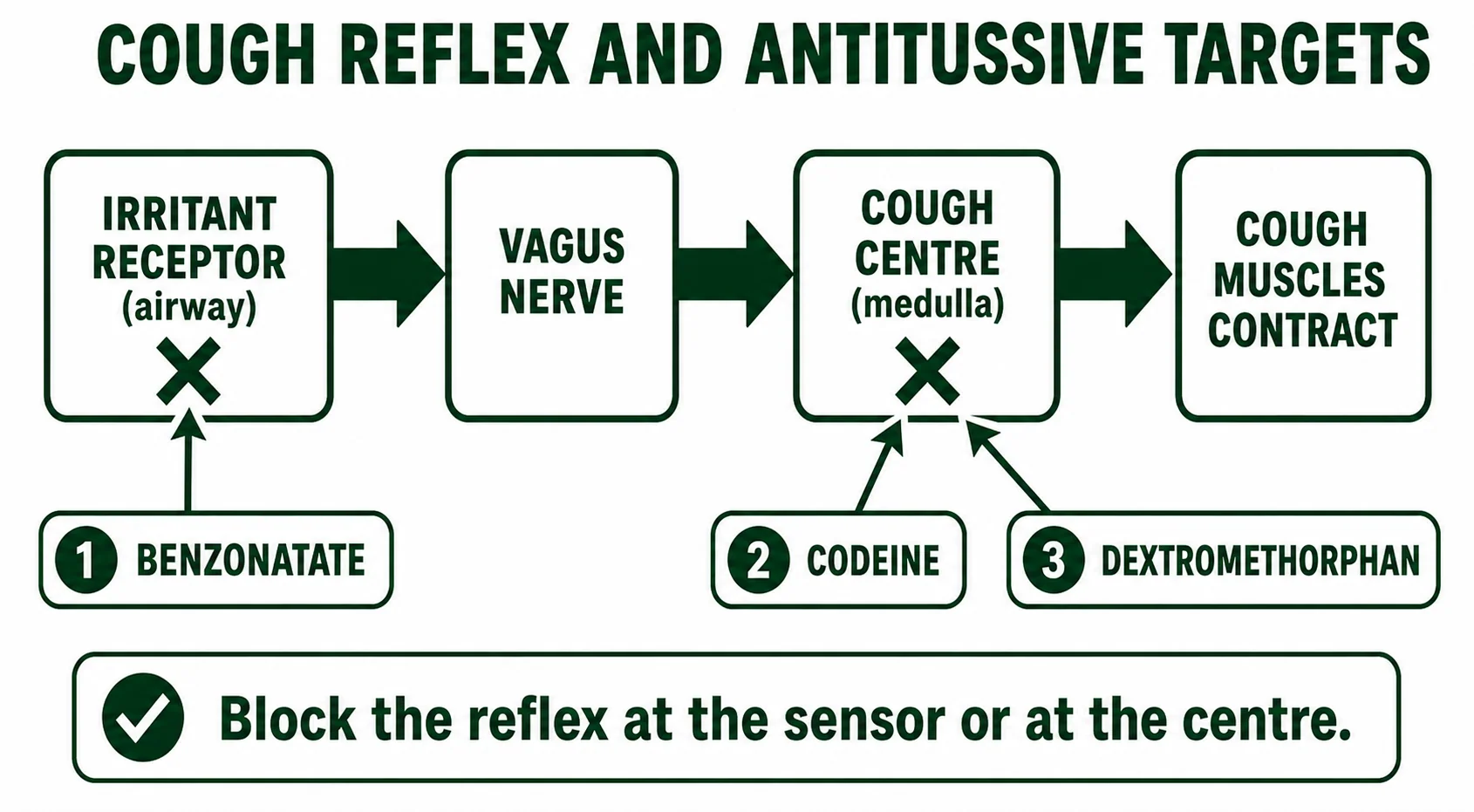
Simplified cough reflex arc from airway receptor through the vagus to the medullary cough centre and muscles, with benzonatate blocking the receptor and codeine and dextromethorphan blocking the centre.
Figure 2 — Nasal decongestants and the rebound cycle
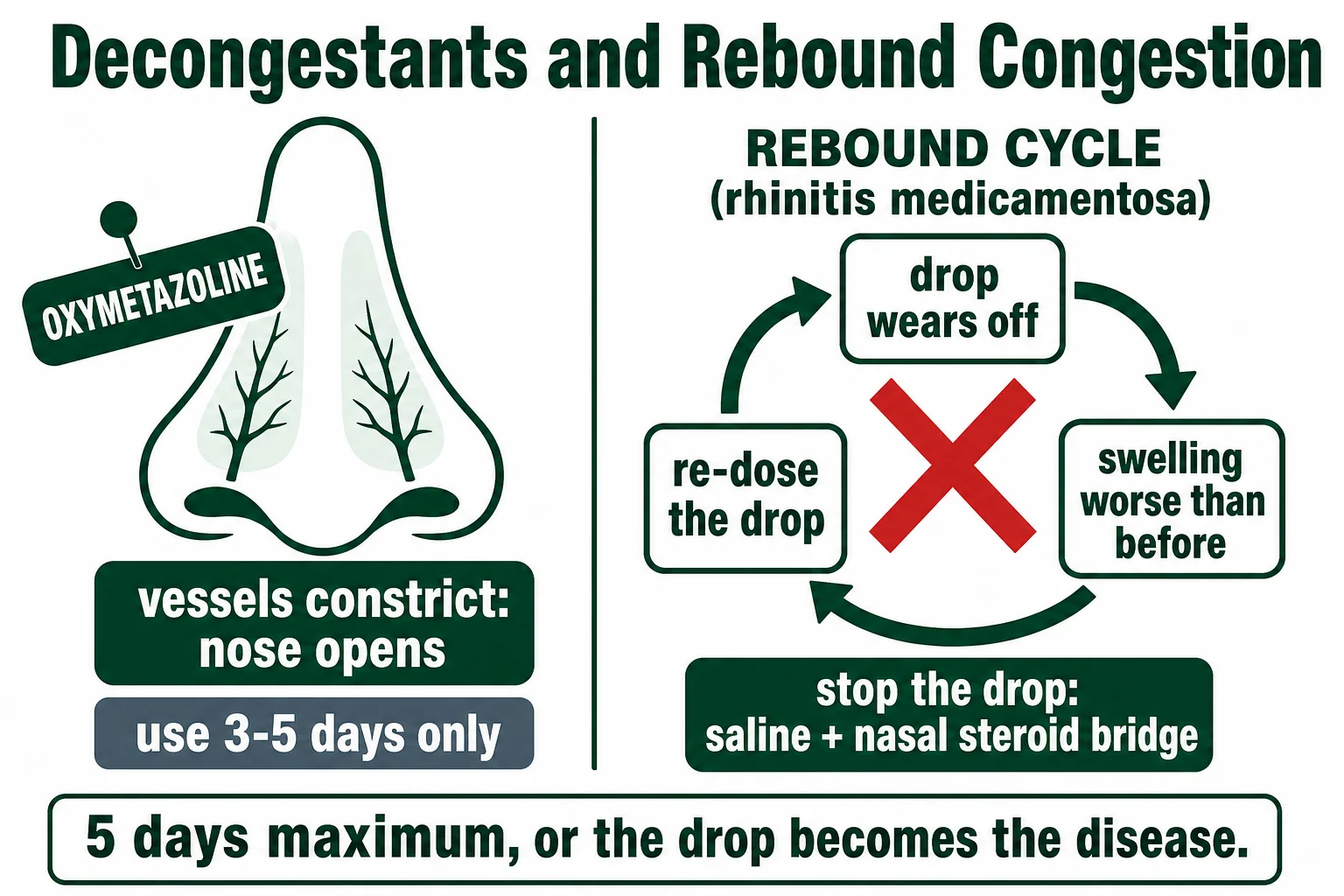
Two-panel simplified diagram showing oxymetazoline constricting nasal vessels on the left and the three-step rebound cycle of rhinitis medicamentosa with its exit strategy on the right.
Clinical Correlation
Vignette 1 — Rhinitis medicamentosa
A 26-year-old student started oxymetazoline drops for a viral cold 3 months ago and now uses them six times daily; his nose is permanently blocked the moment a dose wears off, with mild anxiety and disturbed sleep. Examination shows beefy, hyperaemic turbinates. Diagnosis: rhinitis medicamentosa. Plan: explain the rebound cycle; stop the drop on the right nostril first, then the left (nostril-by-nostril weaning); start saline irrigation 3–4 times daily plus an intranasal corticosteroid (e.g., fluticasone) as a bridge for 2–4 weeks; a short oral steroid course is reserved for severe cases; treat any underlying allergic rhinitis.
Reasoning: Prolonged alpha-1 stimulation produces tachyphylaxis and a rebound vasodilation mediated by denervation supersensitivity — the nasal mucosa now needs the drug to feel normal. The exit strategy is withdrawal with an intranasal steroid bridge, which down-regulates the hyperaemia over weeks. Prevention is the counselling message: topical decongestants for 3–5 days only.
Vignette 2 — Dextromethorphan–MAOI interaction
A 45-year-old on tranylcypromine (an MAO inhibitor) for depression takes an over-the-counter "night cough syrup" containing dextromethorphan. Two hours later he is agitated, diaphoretic, hypertensive (BP 172/98) with inducible clonus, tremor and temperature 38.8°C — serotonin syndrome. Management: stop both drugs, active cooling, benzodiazepines for agitation and clonus, cyproheptadine as the specific serotonin antagonist, and intensive monitoring.
Reasoning: Dextromethorphan and its metabolite dextrorphan increase serotonergic tone (and inhibit reuptake modestly); MAOIs prevent serotonin degradation — the combination crosses the toxicity threshold. Every patient on an MAOI must be warned that OTC cough and cold products are not automatically safe. The same alert applies to meperidine and tramadol.
Vignette 3 — N-acetylcysteine in paracetamol poisoning
A 19-year-old woman presents 6 hours after ingesting about 15 g of paracetamol in an impulsive overdose. Serum paracetamol level at 4 hours plots above the treatment line on the nomogram. N-acetylcysteine is started immediately by the IV protocol (21-hour three-bag or 12-hour two-bag regimen, or the oral 72-hour route where IV is unavailable): it replenishes glutathione, restoring detoxification of the reactive NAPQI metabolite before it binds to hepatocytes. She recovers with fully normal liver function.
Reasoning: After glutathione is depleted, NAPQI covalently injures hepatocytes; NAC restores the detoxification pathway and is most effective when given within 8–10 hours — a genuine time-critical antidote. The pharmacology class meets the same drug again as a mucolytic: one molecule with two entirely different indications — the highest-yield association of this chapter.
Vignette 4 — The child with night cough (rational use)
A couple brings their 3-year-old with a viral upper respiratory cough disturbing sleep; they ask for "a strong cough syrup like last time." Counselling: the cough is self-limiting; OTC cough-cold products are not recommended under 4 years; honey 2.5 mL at bedtime (she is over 1 year) beats dextromethorphan in trials; saline nasal drops before feeds, upright position and humidified air help; explain red flags — fast breathing, chest indrawing, fever over 3 days, lethargy — that would mandate review. No prescription bottle is dispensed.
Reasoning: Paediatric cough syrups combine negligible efficacy with real risk: dose errors, ingredient toxicity (antihistamine sedation, decongestant arrhythmia) and masked deterioration. The FDA's under-4 rule and the honey evidence give the doctor a positive, safe answer instead of a refusal.
Practical Linkage
OTC Label Audit Station and Counselling Scripts (PH1.33)
Label Audit Worksheet
Given three commercial cough-cold labels:
- List each active ingredient with its class.
- Flag duplicated paracetamol sources.
- Identify ingredients contraindicated in the listed patient (a 3-year-old; a pregnant woman; a man on tranylcypromine).
- Rewrite the prescription as single-agent therapy for a specific indication.
Decongestant Counselling Script
Demonstrate: correct paediatric drop strength; exact dose count; hard stop at day 5; recognition of early rebound; the exit plan (saline plus intranasal steroid bridge).
N-acetylcysteine Worksheet
State the mechanism in mucus (disulfide bond cleavage) versus in paracetamol poisoning (glutathione repletion enabling NAPQI detoxification); routes (nebulised, oral 600 mg; antidote oral 72-hour or IV 21-h/12-h protocols); adverse effects (hoarseness, nausea, bronchospasm in asthma — premedicate with a bronchodilator).
MCQ Bank
30 questions · tagged by topic, exam pattern & difficulty · full explanations
A physiology demonstration maps the afferent limb of the cough reflex. Which receptors in the larynx and tracheobronchial tree initiate the reflex that travels to the medulla via the vagus nerve?
Rapid Revision
- Cough afferents — irritant receptors and C-fibres travel in the vagus to the medullary cough centre.
- Cough phases — inspiratory, compressive (closed glottis), expiratory (high-velocity airflow).
- ACE inhibitor cough — bradykinin/prostaglandin C-fibre sensitisation; swap the drug, never suppress.
- Codeine — mu agonist antitussive, 10–20 mg; constipation, sedation, dependence.
- Codeine in children — contraindicated under 12 (ultrarapid CYP2D6 — excess morphine, infant deaths).
- Dextromethorphan — non-opioid; dextrorphan at sigma-1 and NMDA receptors; the OTC standard.
- Dextromethorphan hazard — serotonin syndrome with MAO inhibitors; mega-dose abuse exists.
- Noscapine — benzylisoquinoline antitussive; negligible dependence, no analgesia.
- Benzonatate — peripheral local anaesthetic on pulmonary stretch receptors; never chew the capsule.
- Honey — beats dextromethorphan for paediatric night cough; never under 1 year (infant botulism).
- Guaifenesin — expectorant: more secretion, thinner sputum; modest evidence, good safety.
- N-acetylcysteine mucolysis — free sulfhydryl cleaves mucus disulfide bonds.
- N-acetylcysteine antidote — replenishes glutathione for NAPQI detoxification in paracetamol poisoning.
- Inhaled NAC caution — bronchospasm in asthmatics; premedicate with a bronchodilator.
- Dornase alfa — recombinant DNase for cystic fibrosis sputum (neutrophil DNA).
- Hypertonic saline — osmotic rehydration of airway mucus in CF and bronchiectasis.
- Potassium iodide — iodism and fetal thyroid block; avoid in pregnancy.
- Oxymetazoline — alpha-1 agonist, onset under 10 minutes, duration 10–12 hours; 3–5 days maximum.
- Rhinitis medicamentosa — tachyphylaxis plus rebound vasodilation; the drop becomes the disease.
- Exit from rhinitis medicamentosa — stop the drop (nostril-by-nostril), saline plus intranasal steroid bridge.
- Paediatric imidazoline toxicity — clonidine-like: CNS depression, bradycardia, miosis, apnoea.
- Pseudoephedrine — effective but diversion-controlled (amphetamine precursor); BP rise, insomnia.
- Oral phenylephrine — FDA 2023: ineffective orally (first-pass); Nov 2024 proposed order to remove it from the OTC monograph (finalisation pending); topical form works.
- Children under 4 — no OTC cough-cold products at all (FDA).
Viva Questions
- How will you choose between suppressing and aiding a cough? — Dry, exhausting, non-productive cough justifies suppression; productive cough performs clearance and gets hydration, mucolytics and cause-directed treatment instead.
- Compare codeine and dextromethorphan. — Codeine: mu agonist, analgesic, dependence, constipation, contraindicated under 12; dextromethorphan: non-opioid, sigma-1/NMDA via dextrorphan, no analgesia, low dependence, the OTC standard, serotonin syndrome with MAOIs.
- Why is codeine banned in children? — Ultrarapid CYP2D6 metabolisers (including through breast milk) produce lethal morphine levels with respiratory depression; FDA restricts use below 12 years.
- What is benzonatate and its precaution? — A peripheral antitussive anaesthetising pulmonary stretch receptors; the capsule must be swallowed whole — chewing causes oropharyngeal anaesthesia and rarely anaphylaxis.
- Explain the dual role of N-acetylcysteine. — As a mucolytic it cleaves disulfide bonds of mucus glycoproteins; as an antidote it replenishes glutathione to detoxify NAPQI in paracetamol poisoning; inhalation risks bronchospasm in asthma.
- Which mucolytic for cystic fibrosis and why? — Dornase alfa, recombinant DNase, hydrolysing the neutrophil extracellular DNA unique to CF sputum; hypertonic saline is an osmotic adjunct.
- What is rhinitis medicamentosa and how do you manage it? — Rebound congestion from topical decongestants used beyond about 5 days (tachyphylaxis plus reflex vasodilation); managed by withdrawal — weaning nostril-by-nostril with saline and an intranasal steroid bridge.
- Why did oral phenylephrine fail FDA review? — Intestinal and hepatic first-pass metabolism yields subtherapeutic plasma levels; controlled trials showed no benefit over placebo by mouth (2023 panel), and the FDA proposed removing it from the OTC monograph in November 2024 (final order pending), though the nasal spray remains active.
- Why is pseudoephedrine sold behind the counter? — It is a precursor for illicit amphetamine synthesis, so quantities are restricted and purchases recorded; it also raises blood pressure and pulse.
- What decongestant advice in pregnancy? — Saline irrigation first; oxymetazoline for up to 3 days if essential; avoid pseudoephedrine (first trimester) and iodide-containing products.
- What will you tell parents of a 3-year-old with night cough? — No OTC cough-cold under 4 years; honey 2.5 mL at bedtime (over 1 year of age), saline drops, humidified air, and red-flag warnings (fast breathing, chest indrawing, persistent fever).
- Why are combination cough-cold bottles irrational? — They mix contradictory actions (suppress with expectorate), duplicate paracetamol with separate tablets, fix doses for no one, and bury contraindicated ingredients behind a single brand name.
References
- Tripathi KD. Essentials of Medical Pharmacology. 9th ed. New Delhi: Jaypee Brothers Medical Publishers; 2024. Chapter 16 (drugs for cough, expectorants, mucolytics and nasal decongestants).
- Katzung BG, Vanderah TW. Basic & Clinical Pharmacology. 16th ed. New York: McGraw Hill; 2024. Chapter 9 (sympathomimetics and decongestants) and Chapter 20 (drugs used in asthma and COPD).
- Brunton LL, Knollmann BC (eds). Goodman & Gilman's Pharmacological Basis of Therapeutics. 14th ed. New York: McGraw Hill; 2023. Autonomic and respiratory drug sections.
- Ritter JM, Flower R, Henderson G, et al. Rang & Dale's Pharmacology. 10th ed. Edinburgh: Elsevier; 2024. Respiratory system section.
- Irwin RS, Baumann MH, Bolser DC, et al. Diagnosis and management of cough: ACCP evidence-based clinical practice guidelines. Chest. 2006;129(1 Suppl):1S–292S.
- US Food and Drug Administration. Oral phenylephrine effectiveness — Nonprescription Drugs Advisory Committee (Sept 2023) and proposed order to remove oral phenylephrine from OTC Monograph M012 (Nov 2024, finalisation pending); Drug Safety Communication on codeine and tramadol in children (2017); OTC paediatric cough-cold recommendations (not under 4 years).
- American College of Clinical Pharmacy. Statement in support of the FDA proposed order on oral phenylephrine. May 2025.
- Paul IM, Beiler J, McMonagle A, Shaffer ML, Duda L, Berlin CM Jr. Effect of honey, dextromethorphan, and no treatment on nocturnal cough and sleep quality for coughing children and their parents. Arch Pediatr Adolesc Med. 2007;161(12):1140–1146.
- Rumack BH, Bateman DN. Acetaminophen and acetylcysteine dose and duration: past, present and future. Clin Toxicol (Phila). 2012;50(2):91–98.
- National Medical Commission (NMC). Competency Based Undergraduate Curriculum: Pharmacology. Competency PH1.33; 2019.
Downloads
All deliverables & printable revision sheets for CH34
Printable Chapter Handout & Study Notes
Generate a clean, high-yield PDF or print directly without sidebars and navigation menus.