
Antiplatelets, Anticoagulants, Fibrinolytics & Haematinics
Learning Objectives
At the end of this chapter, the Phase II MBBS student will be able to:
- Describe platelet activation and coagulation, mapping antithrombotic drugs to molecular targets. (PH1.25 — Knows)
- Compare UFH, LMWH and fondaparinux in mechanism, kinetics, monitoring, renal handling and reversal. (PH1.25 — Knows-how)
- Apply a 4Ts-based approach to suspected immune HIT and state immediate management. (PH1.25 — Knows-how)
- Explain warfarin's VKORC1 mechanism, delayed effect, indication-specific overlap, INR monitoring, interactions and reversal. (PH1.25 — Knows-how)
- Describe direct oral anticoagulants and the roles of idarucizumab, andexanet alfa and PCC. (PH1.25 — Knows)
- Classify aspirin, P2Y₁₂ blockers, GPIIb/IIIa blockers and PDE inhibitors and relate them to ACS/stroke therapy. (PH1.25 — Knows)
- Differentiate fibrin-specific thrombolytics from streptokinase and explain tranexamic acid. (PH1.25 — Knows)
- Plan oral/IV iron replacement, calculate an iron deficit and recognise acute iron toxicity and chelation. (PH1.35 — Knows-how)
- Differentiate B12 and folate deficiency and explain why folate must not substitute for B12 replacement. (PH1.35 — Knows-how)
- Describe ESAs, G-CSF and thrombopoietin-receptor agonists with major safety limits. (PH1.35 — Knows)
Must-Know Summary
Anticoagulants limit fibrin generation, antiplatelet drugs limit the platelet plug, thrombolytics dissolve existing fibrin, antifibrinolytics preserve clot, and haematinics/growth factors correct deficits in blood-cell production.
- UFH — antithrombin-dependent inhibition of IIa and Xa; monitor with a locally calibrated aPTT or anti-Xa strategy; protamine reverses.
- LMWH — antithrombin-dependent Xa > IIa inhibition; predictable SC effect, renal accumulation, partial protamine reversal and preferred use in most pregnancy-associated VTE.
- Fondaparinux — synthetic pentasaccharide causing antithrombin-dependent selective Xa inhibition; HIT risk is very low, not literally impossible.
- Immune HIT — platelet fall >50%, typical timing and/or new thrombosis; calculate 4Ts, stop all heparin and start a non-heparin anticoagulant when probability warrants.
- Warfarin — inhibits VKORC1, reducing functional II, VII, IX, X and proteins C/S; PT/INR monitored; 4F-PCC plus IV vitamin K for major/life-threatening bleeding.
- Warfarin overlap — required when treating acute VTE with warfarin (minimum five days and until INR therapeutic for the required period), not automatically for uncomplicated AF initiation.
- DOAC reversal — idarucizumab for dabigatran; andexanet alfa for life-threatening/uncontrolled apixaban or rivaroxaban bleeding; PCC when appropriate/specific antidote unavailable.
- Aspirin — irreversible platelet COX-1 inhibition; P2Y₁₂ blockers prevent ADP signalling; GPIIb/IIIa blockers inhibit final fibrinogen bridging.
- DAPT — default after ACS is often 12 months when bleeding risk is not high, but shorter/de-escalated strategies are guideline-based and individualised.
- Tenecteplase/alteplase — reperfusion drugs used only after strict eligibility screening; 2026 stroke guidance accepts either for eligible disabling AIS within 4.5 hours.
- Tranexamic acid — lysine analogue; give early for appropriate trauma/postpartum bleeding protocols.
- Oral iron — once daily at most; alternate-day dosing may improve tolerability. Use IV iron when oral therapy fails or absorption is unlikely.
- B12 deficiency — MMA and homocysteine rise; folate can improve anaemia while untreated neurological disease continues.
- ESA in CKD — correct reversible causes first and use the lowest effective dose; maintain Hb below 11.5 g/dL.
Classification
Box 1 — Antithrombotic and fibrinolytic drugs
- Anticoagulants
- UFH; LMWH (enoxaparin, dalteparin); fondaparinux
- Parenteral direct thrombin inhibitors: argatroban, bivalirudin
- Vitamin-K antagonists: warfarin, acenocoumarol
- DOACs: dabigatran (IIa); apixaban, rivaroxaban, edoxaban (Xa)
- Antiplatelet drugs
- Aspirin (COX-1)
- P2Y₁₂ blockers: clopidogrel, prasugrel, ticagrelor, IV cangrelor
- GPIIb/IIIa blockers: abciximab, eptifibatide, tirofiban
- PDE/adenosine-pathway: dipyridamole, cilostazol
- PAR-1 antagonist: vorapaxar
- Fibrinolytics
- Alteplase, tenecteplase, reteplase
- Streptokinase
- Antifibrinolytics
- Tranexamic acid, epsilon-aminocaproic acid
Box 2 — Haematinics and growth factors
- Iron: oral ferrous salts; IV iron sucrose, ferric carboxymaltose and ferric derisomaltose
- Chelators: deferoxamine; oral deferasirox/deferiprone
- Maturation factors: vitamin B12 preparations; folic acid; folinic acid
- Erythroid: epoetin alfa, darbepoetin alfa, methoxy-PEG-epoetin beta
- Myeloid: filgrastim, pegfilgrastim; sargramostim
- TPO-receptor agonists: eltrombopag, romiplostim, avatrombopag
Core Concepts
1. Haemostasis and drug targets
Primary haemostasis: exposed collagen and vWF recruit platelets through GPIb. Activation releases ADP and generates TXA₂, producing inside-out activation of GPIIb/IIIa. Fibrinogen bridges activated GPIIb/IIIa receptors on adjacent platelets.
Secondary haemostasis: tissue factor–VIIa initiates Xa generation and activates IX. The IXa–VIIIa tenase complex amplifies Xa formation. Xa–Va (prothrombinase) converts Factor II prothrombin to IIa thrombin. Thrombin converts Factor I fibrinogen to fibrin and activates XIII for crosslinking.
Endogenous brakes include antithrombin (IIa, Xa and other serine proteases), activated protein C with protein S (Va/VIIIa), and tissue-factor pathway inhibitor.
2. UFH, LMWH, fondaparinux and immune HIT
All heparin-class drugs contain/use a pentasaccharide sequence that accelerates antithrombin inhibition.
- UFH: chains long enough to bridge antithrombin to thrombin; anti-Xa:anti-IIa activity is roughly 1:1. IV effect is immediate. Monitor therapeutic infusions with a locally calibrated aPTT or anti-Xa protocol because a universal seconds/ratio target is unreliable. Protamine neutralises UFH; excess protamine itself can anticoagulate and cause hypotension/anaphylactoid reactions.
- LMWH: shorter chains favour Xa over IIa inhibition, with better SC bioavailability and longer half-life. Routine monitoring is unnecessary; consider anti-Xa in selected severe renal dysfunction, extreme body size or other specialised circumstances. Renal accumulation and incomplete protamine reversal matter. LMWH is preferred for most VTE in pregnancy.
- Fondaparinux: synthetic pentasaccharide producing antithrombin-dependent selective Xa inhibition. It is renally cleared and not reversed by protamine. HIT risk is extremely low rather than impossible; it is a commonly used off-label non-heparin option in stable HIT where appropriate.
Immune HIT
PF4–heparin complexes trigger IgG that activates platelets through FcγRIIa, producing intense thrombin generation. A >50% platelet fall, typical day 5–10 timing, thrombosis and lack of another cause drive the 4Ts score; rapid onset can occur with recent heparin exposure.
For intermediate/high probability, stop every heparin source and start a non-heparin anticoagulant while obtaining appropriate immunoassay/functional testing. Choices include argatroban, bivalirudin, danaparoid where available, fondaparinux and selected DOAC use. Choose by clinical stability, kidney/liver function, procedure need and bleeding risk. Do not routinely transfuse platelets. Do not initiate warfarin before platelet recovery; if already started, give vitamin K.
3. Warfarin
Warfarin inhibits VKORC1, reducing regenerated vitamin-K hydroquinone needed for γ-carboxylation of II, VII, IX, X and proteins C/S. It does not inactivate factors already circulating, so effect is delayed.
Factor VII and protein C fall early; II falls slowly. This explains early INR change and the rare protein-C-associated skin-necrosis risk. When warfarin treats acute VTE, overlap a rapidly active anticoagulant for at least five days and until INR has been therapeutic for the protocol-defined period. Routine heparin bridging is not automatically required merely to initiate warfarin for AF.
PT/INR targets are indication-specific: commonly 2.0–3.0 for AF/VTE; mechanical-valve targets depend on valve type and position (mechanical mitral commonly target INR 3.0, range 2.5–3.5). Warfarin is generally avoided in pregnancy, though specialist mechanical-valve management is a complex exception.
Interactions are numerous: amiodarone, azoles, metronidazole and TMP-SMX often raise INR; rifampicin and enzyme-inducing antiseizure drugs lower it; antibiotics, diet change, illness and alcohol alter response. Manage through closer INR testing and individual dose adjustment—not a universal pre-set percentage.
- No bleeding, INR 4.5–10: usually hold/adjust warfarin without routine vitamin K.
- INR >10, no bleeding: hold warfarin and give oral vitamin K according to protocol.
- Major/life-threatening bleeding: 4F-PCC plus IV vitamin K; use plasma if PCC unavailable.
4. Direct oral anticoagulants and reversal
- Dabigatran etexilate: prodrug, direct IIa inhibitor, predominantly renal elimination; idarucizumab 5 g IV is specific reversal for emergency/life-threatening circumstances.
- Apixaban, rivaroxaban, edoxaban: direct Xa inhibitors with differing renal/hepatic clearance and dosing rules. Do not select a drug solely from a renal-clearance percentage; use Cockcroft–Gault CrCl, indication, age/weight, interactions and the local product label.
DOACs have rapid onset and generally do not require routine coagulation monitoring, but adherence, renal/liver function and interactions matter. They are not substitutes for warfarin in mechanical heart valves and are generally avoided in pregnancy; warfarin remains preferred in high-risk triple-positive antiphospholipid syndrome.
Reversal: idarucizumab for dabigatran; andexanet alfa is labelled for life-threatening/uncontrolled apixaban or rivaroxaban bleeding. 4F-PCC/aPCC is used when the specific agent is unavailable or appropriate under protocol. Reversal carries thrombotic risk; make a restart plan after haemostasis.
5. Antiplatelet drugs
- Aspirin: irreversible platelet COX-1 acetylation → TXA₂ suppression for the platelet lifespan. Main risks: GI/intracranial bleeding, ulceration and hypersensitivity/bronchospasm.
- Clopidogrel: irreversible thienopyridine P2Y₁₂ blocker requiring CYP2C19 activation. Loss-of-function alleles reduce effect; avoid omeprazole/esomeprazole where possible because they reduce active metabolite/platelet inhibition.
- Prasugrel: rapid potent thienopyridine; contraindicated with previous stroke/TIA and used cautiously with older age/low weight.
- Ticagrelor: direct reversible P2Y₁₂ blocker; dyspnoea and urate elevation occur. The precise dyspnoea mechanism is not fully settled, though adenosine handling is implicated.
- GPIIb/IIIa blockers: abciximab, eptifibatide, tirofiban; IV, now reserved for selected/bailout PCI rather than routine ACS use.
- Dipyridamole/cilostazol: raise platelet cAMP; cilostazol improves claudication but is contraindicated in heart failure.
The 2025 ACS guideline uses 12-month DAPT as a default when bleeding risk is not high, while allowing evidence-based shorter or P2Y₁₂-monotherapy strategies. Duration and P2Y₁₂ choice are individualised; “all stents need 6–12 months” is obsolete.
6. Fibrinolytics and antifibrinolytics
Alteplase, tenecteplase and reteplase activate fibrin-bound plasminogen more selectively than streptokinase, but all can cause systemic bleeding and intracranial haemorrhage. Tenecteplase has longer half-life and bolus dosing.
- STEMI: use fibrinolysis when eligible within 12 hours and timely primary PCI cannot be achieved, followed by transfer for a pharmaco-invasive strategy.
- Acute ischaemic stroke: after imaging excludes haemorrhage and strict criteria are met, 2026 AHA/ASA guidance endorses either tenecteplase or alteplase within 4.5 hours for eligible disabling deficits; thrombectomy eligibility must also be assessed.
- High-risk PE: systemic thrombolysis may be used for haemodynamic instability after risk assessment.
Streptokinase is antigenic and non-fibrin-selective; prior exposure/recent streptococcal infection can neutralise it or provoke allergy, so repeat administration is generally avoided rather than relying on a simple 12-month reset.
Tranexamic acid and aminocaproic acid block plasminogen lysine-binding sites. TXA improves outcomes when given early in appropriate trauma and postpartum-haemorrhage protocols; delayed trauma administration beyond three hours is not beneficial and may be harmful.
7. Iron, folate and vitamin B12
Hepcidin degrades ferroportin and limits iron export. Oral ferrous salts are first-line for many patients, but modern guidance recommends once daily at most; alternate-day dosing may improve tolerability with similar absorption. Tea/calcium reduce absorption; vitamin C enhances chemical absorption but routine supplementation is not mandatory for every patient.
Use IV iron when oral treatment is not tolerated, ferritin/Hb fails to improve, absorption is unlikely or rapid replacement is required. Prefer products that replace the deficit in one or two visits when appropriate. Dose limits are product/country specific. Monitor infusion reactions and hypophosphataemia, particularly after ferric carboxymaltose.
Acute iron poisoning causes corrosive GI injury, shock, acidosis and hepatic failure. Deferoxamine is the parenteral chelator; vin-rosé urine may occur but is neither required nor a reliable endpoint. Deferasirox/deferiprone treat selected chronic overload, with renal/hepatic or agranulocytosis monitoring respectively.
B12 is required for methionine synthase and methylmalonyl-CoA mutase. B12 deficiency elevates MMA and homocysteine; folate deficiency elevates homocysteine with normal MMA. In B12 deficiency folate is functionally trapped as 5-methyl-THF. Folic acid can improve megaloblastosis and mask the diagnosis while untreated neurological injury progresses; it does not “accelerate” demyelination directly. Replace B12 promptly. Pernicious anaemia can be treated with parenteral or adequately high-dose oral B12 depending on context/adherence.
8. Haematopoietic growth factors
ESAs stimulate erythroid progenitors in selected CKD and chemotherapy-associated anaemia after correcting iron deficiency and other reversible causes. The 2026 KDIGO guideline recommends the lowest effective dose and an adult maintenance Hb target below 11.5 g/dL, individualised for symptoms and risk. Hypertension, stroke, thrombosis and tumour-related concerns limit use.
Filgrastim/pegfilgrastim stimulate neutrophil progenitors and reduce febrile-neutropenia risk in eligible chemotherapy regimens. Bone pain is common; splenic rupture is rare.
Eltrombopag, romiplostim and avatrombopag activate the thrombopoietin receptor in selected thrombocytopenic disorders. They raise platelets but do not correct the immune cause of ITP; thrombosis, hepatotoxicity and agent-specific food/drug interactions require monitoring.
Tables
Table 1 — UFH, LMWH, fondaparinux and warfarin
| Feature | UFH | LMWH | Fondaparinux | Warfarin |
|---|---|---|---|---|
| Target | AT-mediated IIa + Xa | AT-mediated Xa > IIa | AT-mediated selective Xa | VKORC1 → II, VII, IX, X, C/S |
| Route | IV/SC | SC | SC | Oral |
| Monitoring | Calibrated aPTT or anti-Xa for therapeutic infusion | Usually none; anti-Xa selected cases | Usually none | PT/INR |
| Clearance | Saturable cellular + renal | Predominantly renal | Renal | Hepatic metabolism |
| Reversal | Protamine | Partial protamine | No protamine; supportive/PCC protocol | 4F-PCC + vitamin K for major bleed |
| HIT | Highest among these | Lower | Very low/rare | None; avoid starting in acute HIT |
| Pregnancy | Does not cross placenta | Preferred for most VTE | Limited alternative data | Generally avoided; specialist exceptions |
Table 2 — DOACs and reversal
| Drug | Target | Key clearance issue | Specific reversal | Major exclusion/caution |
|---|---|---|---|---|
| Dabigatran | IIa | Predominantly renal | Idarucizumab | Renal accumulation; dyspepsia |
| Apixaban | Xa | Mixed renal/hepatic | Andexanet alfa for labelled critical bleeding | Dose/indication-specific criteria |
| Rivaroxaban | Xa | Mixed renal/hepatic; food requirement at some doses | Andexanet alfa | CYP3A/P-gp interactions |
| Edoxaban | Xa | Important renal component | No universally labelled andexanet indication; PCC protocol | Indication-specific renal rules |
| Warfarin | VKORC1 | CYP and diet/illness variability | 4F-PCC + IV vitamin K | INR monitoring; pregnancy/interaction burden |
Table 3 — Antiplatelet drugs
| Drug/class | Target | Reversibility | High-yield point |
|---|---|---|---|
| Aspirin | COX-1/TXA₂ | Irreversible | Platelet-lifespan effect; GI bleeding/asthma |
| Clopidogrel | P2Y₁₂ | Irreversible prodrug | CYP2C19 loss-of-function and omeprazole interaction |
| Prasugrel | P2Y₁₂ | Irreversible prodrug | Contraindicated prior stroke/TIA |
| Ticagrelor | P2Y₁₂ | Reversible direct | Dyspnoea, urate elevation |
| Cangrelor | P2Y₁₂ | Reversible IV | Very rapid on/off during selected PCI |
| Abciximab/eptifibatide/tirofiban | GPIIb/IIIa | Agent-dependent | Selected/bailout PCI; bleeding/thrombocytopenia |
| Cilostazol | PDE3 | Reversible | Claudication; contraindicated in HF |
Table 4 — Fibrinolysis and antifibrinolysis
| Agent | Fibrin selectivity | Administration | Main association | Key danger |
|---|---|---|---|---|
| Tenecteplase | High | Single weight-based IV bolus | STEMI; eligible AIS under current stroke protocol | Intracranial/systemic bleeding |
| Alteplase | Relatively fibrin selective | Bolus + infusion regimen | Eligible AIS, high-risk PE, STEMI | Intracranial/systemic bleeding |
| Streptokinase | Low | IV infusion | Resource-limited STEMI use | Allergy, hypotension, systemic lysis; avoid repeat |
| Tranexamic acid | Antifibrinolytic | IV/oral by indication | Early trauma/PPH, surgery, menorrhagia | Thrombotic caution; timing matters |
Table 5 — Iron therapy and chelation
| Therapy | When used | Practical point | Important toxicity |
|---|---|---|---|
| Oral ferrous salt | Most uncomplicated IDA | Once daily at most; alternate-day if better tolerated | GI upset, constipation, dark stool |
| IV iron sucrose | CKD/need for divided replacement | Multiple smaller doses | Infusion reaction |
| Ferric carboxymaltose/derisomaltose | Large deficit, one/two-visit replacement | Product-specific maximum dose | Hypophosphataemia especially FCM |
| Deferoxamine | Severe acute toxicity/selected overload | Parenteral; vin-rosé urine may occur | Hypotension, lung/ocular/aural toxicity with prolonged use |
| Deferasirox/deferiprone | Chronic transfusional overload | Oral | Renal/hepatic injury; agranulocytosis for deferiprone |
Table 6 — B12 versus folate deficiency
| Feature | B12 deficiency | Folate deficiency |
|---|---|---|
| Stores | Years | Months |
| Absorption | Intrinsic factor–terminal ileum | Proximal small bowel |
| Neurology | Neuropathy/subacute combined degeneration possible | Not characteristic |
| MMA | ↑ | Normal |
| Homocysteine | ↑ | ↑ |
| Treatment trap | Folate can mask anaemia while neurology progresses | Folic acid treats after B12 exclusion/replacement |
Table 7 — Growth factors
| Agent | Target | Use | Safety principle |
|---|---|---|---|
| Epoetin/darbepoetin | EPO receptor on erythroid progenitors | Selected CKD/chemotherapy anaemia | Correct iron first; lowest dose; CKD Hb target <11.5 |
| Filgrastim/pegfilgrastim | G-CSF receptor | Eligible chemotherapy neutropenia prophylaxis/recovery | Bone pain; rare splenic rupture |
| Eltrombopag | MPL/TPO receptor, oral | Selected ITP/aplastic anaemia | Hepatic monitoring, chelation interaction, thrombosis |
| Romiplostim | MPL/TPO receptor, SC | Chronic ITP | Thrombosis, marrow reticulin monitoring |
Figures
Figure 1 — Coagulation cascade and anticoagulant drug targets
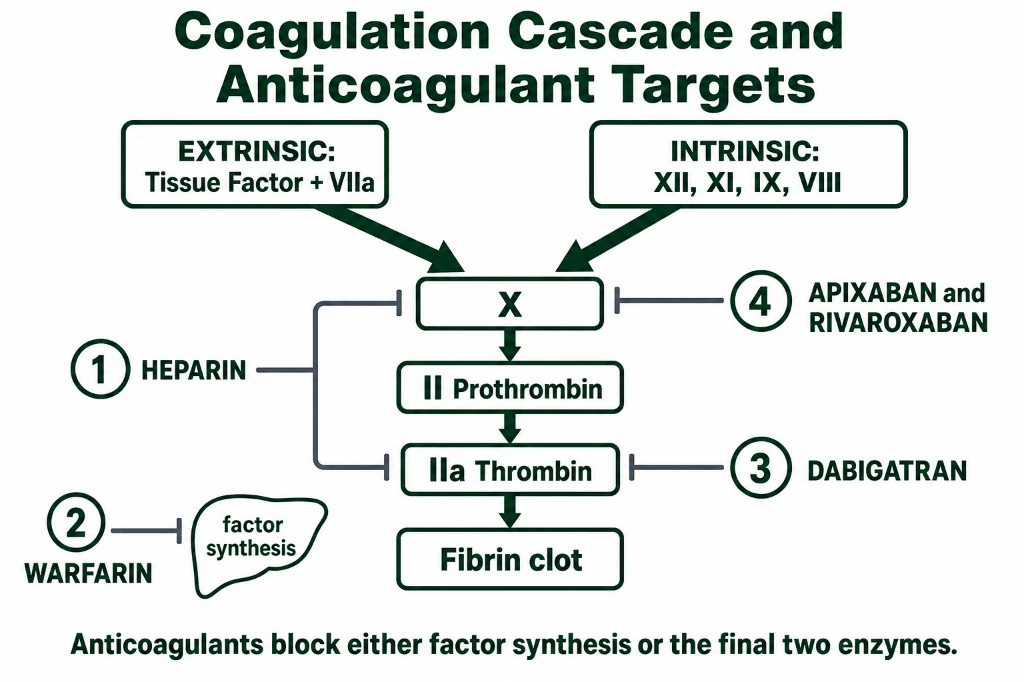
Flowchart of the intrinsic, extrinsic, and common coagulation pathways showing the molecular targets of Heparin, LMWH, Fondaparinux, Warfarin, Dabigatran, and direct Factor Xa inhibitors.
Figure 2 — Platelet activation pathways and antiplatelet drug targets
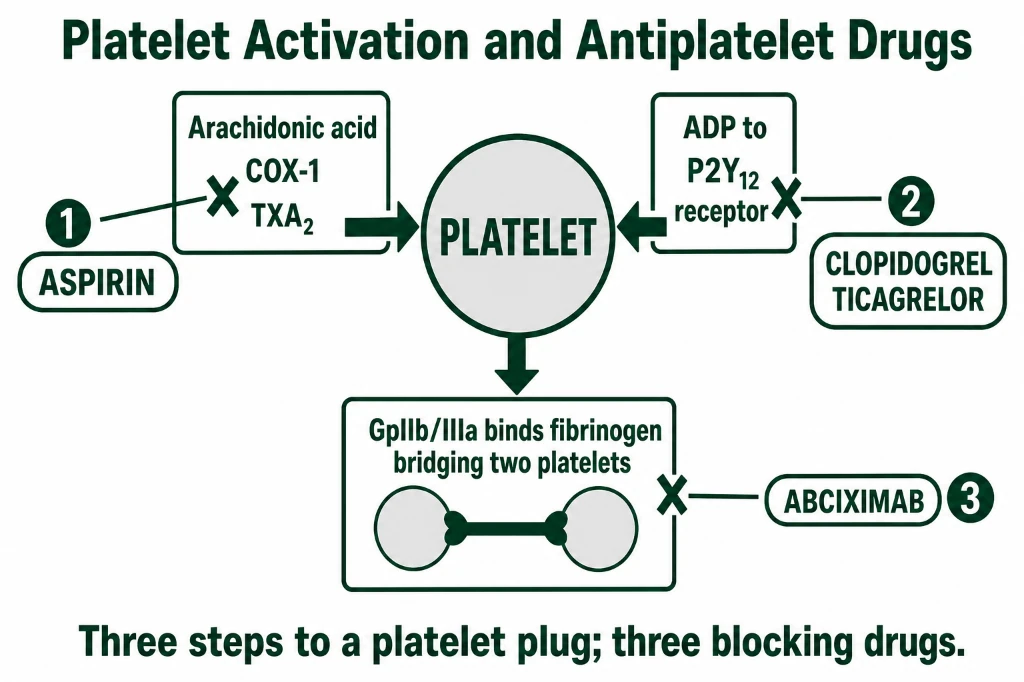
Illustration of platelet activation pathways showing mechanism of action of Aspirin on COX-1, Clopidogrel and Ticagrelor on P2Y12 ADP receptors, and Abciximab on GpIIb/IIIa receptors.
Figure 3 — Heparin-Induced Thrombocytopenia (Type II HIT) pathogenesis and management
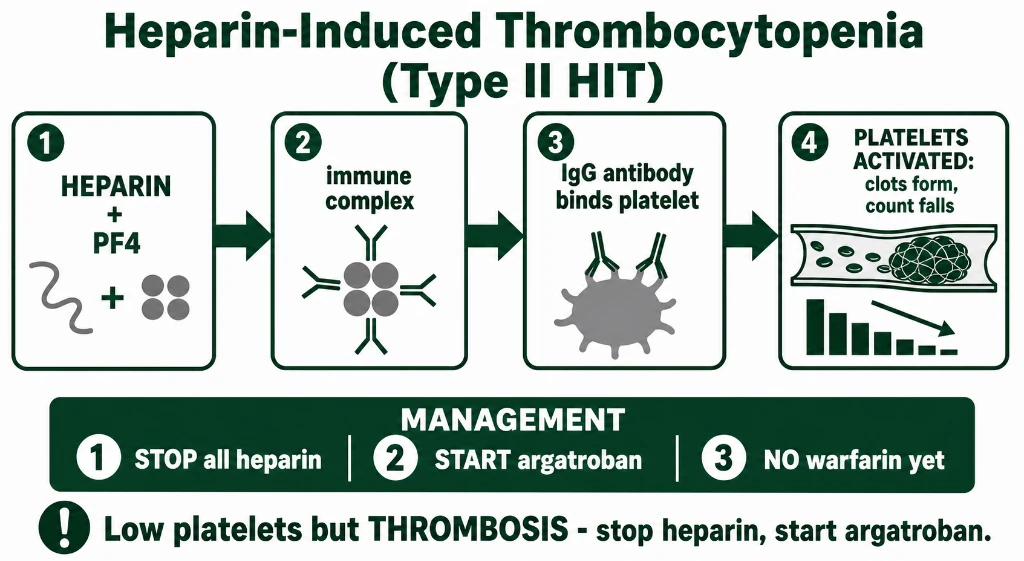
Pathway diagram of Type II HIT showing PF4-heparin-IgG complex binding platelet Fc receptors, causing platelet activation and thrombosis, with immediate management algorithm.
Figure 4 — Warfarin mechanism (VKORC1) and the Vitamin K cycle
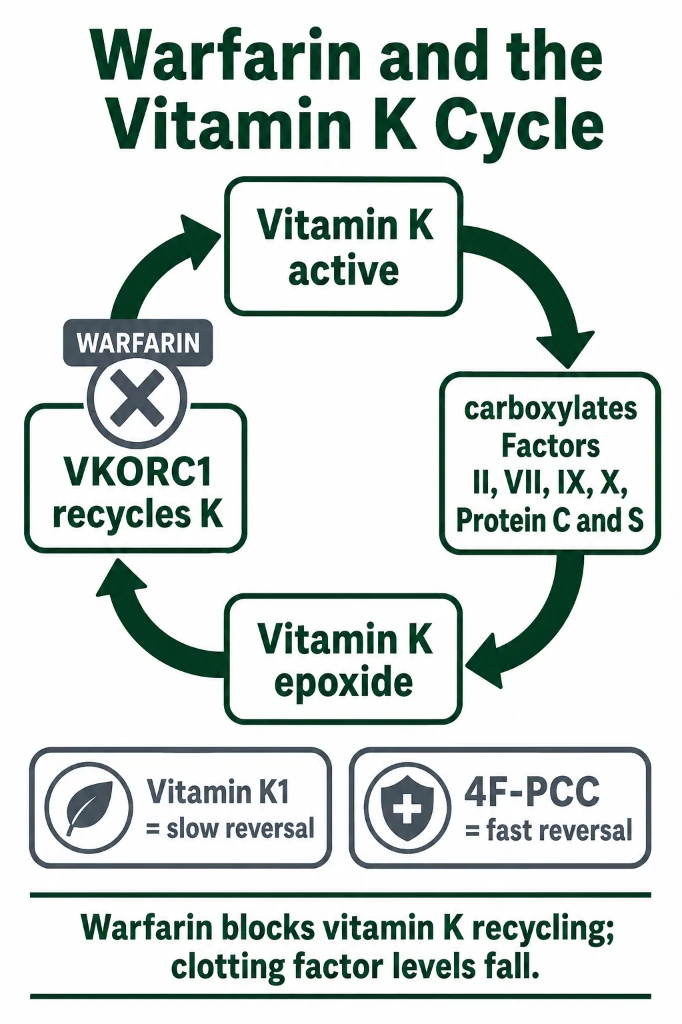
Biochemical cycle of Vitamin K epoxide reduction showing Warfarin inhibiting VKORC1, blocking gamma-carboxylation of Factors II, VII, IX, X, Protein C, and S, and reversal pathways.
Figure 5 — The Folate Trap and Vitamin B12 / Folate metabolic pathways
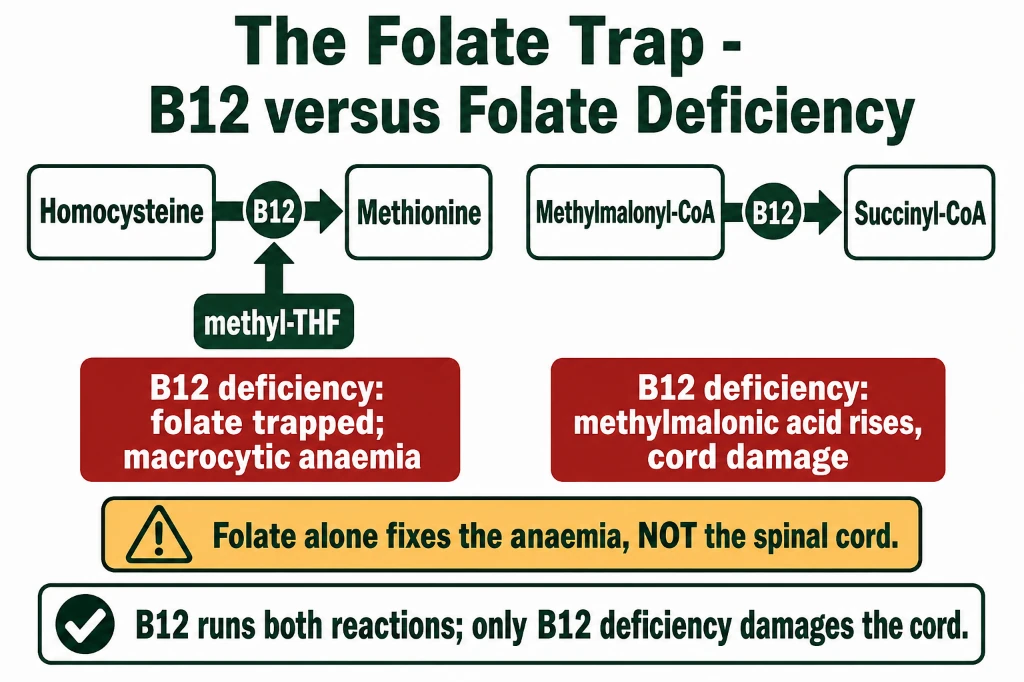
Metabolic diagram illustrating the Folate Trap where Vitamin B12 deficiency traps N5-methyl THF and causes methylmalonic acid accumulation leading to subacute combined degeneration.
Clinical Correlation
Vignette 1 — Suspected immune HIT with thrombosis
On day 6 of UFH exposure, a postoperative patient develops a new DVT and a platelet fall from 290 to 72 ×10⁹/L.
Reasoning: Calculate the 4Ts score and send an immunoassay when probability is intermediate/high. Stop UFH, LMWH, flushes and heparin-coated exposure; start an appropriate non-heparin anticoagulant at intensity determined by thrombosis and bleeding risk. Do not routinely transfuse platelets unless active bleeding/high-risk procedure requires it. Avoid starting warfarin before platelet recovery; reverse it with vitamin K if already given.
Vignette 2 — Warfarin-associated intracranial haemorrhage
A patient taking warfarin has intracerebral haemorrhage and INR 6.8.
Reasoning: Stop warfarin and provide urgent 4F-PCC plus IV vitamin K according to protocol. PCC restores functional II, VII, IX and X rapidly; vitamin K sustains factor synthesis after PCC factors decay. Plasma is a fallback when PCC is unavailable, not the preferred equal alternative.
Vignette 3 — Emergency dabigatran reversal
A patient who recently took dabigatran requires emergency surgery for life-threatening bleeding.
Reasoning: Idarucizumab binds dabigatran and its metabolites with high affinity. Assess dose timing, renal function and relevant coagulation tests without delaying reversal in critical bleeding. Rebound anticoagulant levels can occur, so repeat clinical/laboratory assessment is required.
Vignette 4 — B12 deficiency masked by folate
A vegan patient with macrocytosis, proprioceptive loss and high MMA has taken folic acid alone; haemoglobin improved but gait dysfunction progressed.
Reasoning: Folate can restore DNA synthesis and mask megaloblastic anaemia, but it does not restore B12-dependent methylmalonyl-CoA mutase or methionine synthase. Replace B12 promptly and investigate cause; neurological recovery may be incomplete if treatment is delayed.
Vignette 5 — Major iron deficiency with poor oral response
A patient with inflammatory bowel disease and confirmed iron-deficiency anaemia cannot tolerate oral iron and has ongoing inflammation.
Reasoning: Treat the bleeding/inflammatory cause and use IV iron when absorption is compromised or oral therapy fails. Dose by product label and calculated deficit; monitor hypersensitivity and phosphate, particularly with repeated ferric carboxymaltose. Do not assume anaemia is iron deficiency without ferritin/transferrin-saturation context.
Practical Linkage
Acute VTE transition to warfarin
- Start therapeutic parenteral anticoagulation and warfarin when warfarin is the selected long-term agent.
- Continue the parenteral drug for at least 5 days and until INR is therapeutic (commonly ≥2.0 for at least 24 hours; follow local indication-specific protocol).
- Do not apply this overlap automatically to every new AF patient; bridging decisions depend on indication and thrombotic/bleeding risk.
Suspected HIT OSPE
- Calculate 4Ts before indiscriminate PF4 testing.
- Intermediate/high probability: stop all heparin and start a non-heparin anticoagulant while testing, adjusted for bleeding risk and organ function.
- Low probability: avoid unnecessary HIT testing/empiric alternative anticoagulation.
- Avoid routine platelet transfusion; avoid warfarin before platelet recovery.
Ganzoni iron-deficit calculation
Total iron deficit (mg) = weight (kg) × [target Hb − actual Hb] (g/dL) × 2.4 + iron stores
The target Hb and store allowance must be individualised; product maximum single doses vary. Modern IV products may replace the deficit in one or two infusions, but ferric carboxymaltose can cause clinically important hypophosphataemia.
High-risk interactions
- Warfarin + amiodarone/azole/metronidazole/TMP-SMX: INR may rise; increase monitoring and adjust dose rather than applying an automatic percentage reduction.
- Warfarin + rifampicin/carbamazepine: INR may fall through induction.
- Clopidogrel + omeprazole/esomeprazole: reduced CYP2C19 activation; use an alternative acid suppressant when appropriate.
- DOAC + strong P-gp/CYP3A inducer: reduced anticoagulant exposure and treatment failure.
- Anticoagulant + NSAID/antiplatelet: additive bleeding risk.
MCQ Bank
40 questions · tagged by topic, exam pattern & difficulty · full explanations
A 65-year-old male with acute deep vein thrombosis is started on unfractionated heparin infusion. The therapeutic anticoagulant effect of unfractionated heparin is best monitored using which of the following laboratory parameters?
Rapid Revision
- Fibrinogen — Factor I; prothrombin — Factor II
- UFH — antithrombin-dependent IIa and Xa inhibition
- LMWH — antithrombin-dependent Xa > IIa inhibition
- Fondaparinux — antithrombin-dependent selective Xa; HIT risk very low, not zero
- UFH monitoring — locally calibrated aPTT or anti-Xa strategy
- Protamine — reverses UFH; only partial LMWH reversal
- HIT probability — calculate 4Ts before indiscriminate testing
- Immune HIT — stop every heparin exposure and start a non-heparin anticoagulant
- HIT platelet transfusion — avoid routine use; reserve for bleeding/procedure need
- Warfarin target — VKORC1; II, VII, IX, X and proteins C/S
- Acute VTE warfarin overlap — ≥5 days and INR therapeutic for required period
- Warfarin bridge in AF — not automatically required
- Major warfarin bleed — 4F-PCC + IV vitamin K
- INR >10 without bleeding — hold warfarin + oral vitamin K by protocol
- Dabigatran reversal — idarucizumab
- Apixaban/rivaroxaban reversal — andexanet alfa for labelled life-threatening/uncontrolled bleeding
- Aspirin — irreversible platelet COX-1 inhibition
- Clopidogrel — CYP2C19-activated irreversible P2Y₁₂ blocker
- Prasugrel — contraindicated prior stroke/TIA
- Ticagrelor — reversible P2Y₁₂ blocker; dyspnoea/urate elevation
- GPIIb/IIIa blockers — final fibrinogen-bridging pathway; selected PCI use
- DAPT after ACS — default often 12 months if bleeding risk low; individualise/shorten when indicated
- Tenecteplase — single bolus; eligible STEMI and current-protocol AIS
- 2026 AIS thrombolysis — eligible tenecteplase or alteplase within 4.5 h
- Streptokinase — antigenic; avoid repeat exposure
- Tranexamic acid — blocks plasminogen lysine sites; give early in trauma/PPH protocols
- Oral iron — once daily at most; alternate-day can improve tolerance
- IV iron danger — infusion reactions and hypophosphataemia, especially ferric carboxymaltose
- Acute iron toxicity — deferoxamine; vin-rosé urine may occur but is not required
- B12 deficiency — MMA ↑ and homocysteine ↑
- Folate deficiency — homocysteine ↑, MMA normal
- Folate-alone hazard — anaemia can improve while untreated B12 neurological disease progresses
- ESA in CKD — correct causes/iron first; maintenance Hb below 11.5 g/dL
- Filgrastim — G-CSF; bone pain and rare splenic rupture
Viva Questions
-
What factors are fibrinogen and prothrombin?
Fibrinogen is Factor I; prothrombin is Factor II. -
Why does UFH inhibit thrombin better than LMWH?
UFH contains enough long chains to bridge antithrombin to thrombin; LMWH mainly induces antithrombin's conformational Xa inhibition. -
How is therapeutic UFH monitored?
With a locally calibrated aPTT or anti-Xa protocol rather than one universal seconds range. -
What is the first step in suspected HIT?
Calculate 4Ts; at intermediate/high probability stop all heparin and begin an appropriate non-heparin anticoagulant while testing. -
Why avoid warfarin in acute HIT?
Early protein-C depletion can worsen microvascular thrombosis and limb gangrene before HIT has resolved. -
When is heparin overlap required with warfarin?
When warfarin is selected for acute VTE and other high-risk indications—not automatically for every AF initiation. -
How is life-threatening warfarin bleeding reversed?
4F-PCC for immediate factor replacement plus IV vitamin K for sustained synthesis. -
What reverses dabigatran and apixaban/rivaroxaban?
Idarucizumab reverses dabigatran; andexanet alfa is the specific labelled agent for apixaban/rivaroxaban critical bleeding. -
Why does CYP2C19 matter for clopidogrel?
It creates the active metabolite; loss-of-function alleles or omeprazole/esomeprazole reduce platelet inhibition. -
What is the current principle for DAPT duration after ACS?
Twelve months is a common default without high bleeding risk, but shorter or P2Y₁₂-monotherapy strategies are evidence-based for selected patients. -
Which thrombolytics are accepted in eligible acute ischaemic stroke in 2026 guidance?
Tenecteplase or alteplase within the 4.5-hour window after protocol eligibility and imaging. -
How does tranexamic acid work?
It blocks plasminogen lysine-binding sites and prevents binding/activation on fibrin. -
How should oral iron generally be dosed now?
Once daily at most; alternate-day dosing may improve tolerance and absorption in some patients. -
What distinguishes B12 from folate deficiency?
B12 deficiency raises MMA and homocysteine and can cause neurological disease; folate deficiency leaves MMA normal. -
Does folate accelerate B12 demyelination?
It can correct/mask anaemia while untreated B12 neurological injury continues; it does not replace B12. -
What is the CKD ESA maintenance ceiling?
Target Hb below 11.5 g/dL, individualised, using the lowest effective dose after correctable causes are treated.
References
- Tripathi KD. Essentials of Medical Pharmacology. 9th ed. Jaypee Brothers; Chapters 43–44.
- Katzung BG, Vanderah TW. Basic & Clinical Pharmacology. 16th ed. McGraw Hill; drugs used in coagulation disorders.
- Brunton LL, Knollmann BC, editors. Goodman & Gilman's The Pharmacological Basis of Therapeutics. 14th ed. McGraw Hill; anticoagulant, fibrinolytic and antiplatelet drugs.
- National Medical Commission. Competency Based Undergraduate Curriculum, Pharmacology PH1.25 and PH1.35.
- Cuker A, Arepally GM, Chong BH, et al. ASH guideline for management of heparin-induced thrombocytopenia. Blood Adv. 2018;2:3360–3392; see current ASH pocket guide.
- Tomaselli GF, Mahaffey KW, Cuker A, et al. 2020 ACC Expert Consensus Decision Pathway on anticoagulant-related bleeding. J Am Coll Cardiol. 2020;76:594–622.
- Rao SV, O'Donoghue ML, Ruel M, et al. 2025 ACC/AHA/ACEP/NAEMSP/SCAI Guideline for Acute Coronary Syndromes. Circulation. 2025.
- American Heart Association/American Stroke Association. 2026 Guideline for Early Management of Acute Ischaemic Stroke. 2026.
- DeLoughery TG, Jackson CS, Ko CW, Rockey DC. AGA Clinical Practice Update on Management of Iron Deficiency Anaemia. Clin Gastroenterol Hepatol. 2024.
- KDIGO. 2026 Clinical Practice Guideline for Anaemia in CKD. Adult ESA maintenance target below 11.5 g/dL.
- CRASH-2 Trial Collaborators. Effects of tranexamic acid in bleeding trauma patients. Lancet. 2010;376:23–32.
- WOMAN Trial Collaborators. Early tranexamic acid in postpartum haemorrhage. Lancet. 2017;389:2105–2116.
- U.S. FDA/NCBI. Clopidogrel therapy and CYP2C19 genotype: avoid omeprazole/esomeprazole and consider genotype in ACS/PCI.
- Pitt B, Zannad F, Remme WJ, et al. RALES. N Engl J Med. 1999;341:709–717.
Antithrombotic selection, interruption, reversal, thrombolysis, pregnancy treatment, IV iron and growth-factor dosing require indication-specific current protocols and specialist oversight.
Downloads
All deliverables & printable revision sheets for CH31
Printable Chapter Handout & Study Notes
Generate a clean, high-yield PDF or print directly without sidebars and navigation menus.