
Diuretics & Antidiuretics
Learning Objectives
At the end of this chapter, the Phase II MBBS student will be able to:
- Describe nephron transport mechanisms and the tubular targets of major diuretic classes. (PH1.24 — Knows)
- Classify diuretics by site of action and ceiling efficacy. (PH1.24 — Knows)
- Differentiate loop and thiazide diuretics, particularly their effects on calcium, the medullary gradient and blood pressure. (PH1.24 — Knows-how)
- Compare mineralocorticoid-receptor antagonists with direct ENaC blockers. (PH1.24 — Knows)
- Explain acetazolamide in altitude illness and mannitol/hypertonic therapy in raised intracranial pressure. (PH1.24 — Knows)
- Predict major electrolyte and acid-base disturbances produced by each class. (PH1.24 — Knows-how)
- Construct a monitored strategy for diuretic resistance using sequential nephron blockade. (PH1.24 — Shows-how)
- Differentiate desmopressin and vasopressin antagonists in central DI, selected hyponatraemia and SIADH. (PH1.24 — Knows-how)
- Recognise hazardous interactions: loop plus aminoglycoside, thiazide plus lithium, and potassium-sparing therapy plus RAAS blockade/K⁺ supplementation. (PH1.24 — Knows)
Must-Know Summary
Diuretics act from the tubular lumen or collecting-duct receptor system, so efficacy depends on delivery to the nephron, kidney function, dietary sodium, compensatory distal reabsorption and the patient's haemodynamic state.
- Loop diuretics — inhibit NKCC2 in the thick ascending limb; high ceiling; increase urinary Ca²⁺/Mg²⁺ and commonly cause hypokalaemic contraction alkalosis.
- Thiazide/thiazide-like drugs — inhibit NCC in the distal convoluted tubule; lower urinary calcium and are major antihypertensives.
- Chlorthalidone — long acting and effective for 24-hour BP control; CLICK showed efficacy even in stage-4 CKD, with close electrolyte/creatinine monitoring.
- IV furosemide — useful when acute pulmonary oedema includes congestion/volume overload; an early venodilator effect may precede natriuresis, but airway support and vasodilators may be equally urgent.
- Spironolactone — cornerstone aldosterone-antagonist therapy for cirrhotic ascites and a mortality-reducing MRA in appropriate HFrEF.
- Amiloride — directly blocks ENaC; important in lithium-induced nephrogenic DI and Liddle syndrome.
- Acetazolamide — bicarbonaturic CA inhibitor; causes alkaline urine and hyperchloraemic metabolic acidosis; facilitates acclimatisation in altitude illness.
- Mannitol — IV osmotic agent that can reduce ICP/IOP but initially expands intravascular volume; avoid in pulmonary oedema and decompensated heart failure.
- Sequential nephron blockade — loop plus a distal diuretic can overcome resistance but may cause abrupt hypovolaemia, hyponatraemia, hypokalaemia and kidney injury.
- Desmopressin — V₂ agonist for central DI and selected haemostatic/enuresis indications; water intoxication is the danger.
- Tolvaptan — oral V₂ antagonist producing aquaresis in selected monitored hyponatraemia; severe symptomatic hyponatraemia requires hypertonic saline, not routine vaptan therapy.
- Safe sodium correction — generally ≤10 mmol/L in the first 24 hours and ≤8 mmol/L on later days; do not exceed 8 mmol/L/24 h in high-risk patients.
Classification
Box 1 — Diuretics by nephron site and efficacy
- High-ceiling — thick ascending limb (NKCC2)
- Furosemide, torsemide, bumetanide
- Ethacrynic acid (non-sulfonamide loop)
- Moderate efficacy — distal convoluted tubule (NCC)
- Thiazides: hydrochlorothiazide, chlorothiazide
- Thiazide-like: chlorthalidone, indapamide, metolazone
- Weak/adjunctive
- Proximal carbonic anhydrase inhibitors: acetazolamide; topical dorzolamide/brinzolamide
- Potassium-sparing, collecting duct:
- MR antagonists: spironolactone, eplerenone; finerenone is a non-steroidal cardiorenal MRA with little diuretic effect
- ENaC blockers: amiloride, triamterene
- Osmotic: mannitol IV (freely filtered, poorly reabsorbed)
Box 2 — Antidiuretics and aquaretics
- Vasopressin-system agonists / analogues
- Desmopressin: V₂-predominant
- Vasopressin: V₁a/V₁b/V₂
- Terlipressin: V₁-predominant clinical effects
- Drugs that reduce polyuria in nephrogenic DI
- Thiazide, amiloride (especially lithium-induced), selected NSAID use under specialist supervision
- Vasopressin antagonists (vaptans)
- Tolvaptan: oral V₂-selective
- Conivaptan: IV V₁a/V₂ antagonist
Older agents such as chlorpropamide and carbamazepine are not routine antidiuretic choices because safer, more predictable therapy is available.
Core Concepts
1. Nephron physiology and target sites
- Proximal tubule (~65% filtered Na⁺): NHE3 and luminal/cytosolic carbonic anhydrase reclaim NaHCO₃. Organic-anion transporters secrete highly protein-bound loop and thiazide drugs into tubular fluid. Acetazolamide inhibits CA; mannitol acts osmotically wherever water-permeable segments cannot reabsorb it.
- Thick ascending limb (~20–25%): NKCC2 reabsorbs Na⁺/K⁺/2Cl⁻. ROMK recycles K⁺ and creates a lumen-positive voltage supporting paracellular Ca²⁺/Mg²⁺ uptake. This water-impermeable segment builds the medullary gradient. Loop diuretics act here.
- Distal convoluted tubule (~5%): NCC reabsorbs NaCl. Ca²⁺ enters through TRPV5 and exits basolaterally through NCX1/Ca²⁺-ATPase. Thiazides act here.
- Collecting duct (~1–3% Na⁺ but decisive): principal-cell ENaC reabsorbs Na⁺ and promotes K⁺ secretion; aldosterone increases ENaC and Na⁺/K⁺-ATPase expression/activity. Intercalated cells regulate H⁺/HCO₃⁻. MR antagonists and ENaC blockers act here.
- Collecting-duct water permeability: V₂–Gs–cAMP–PKA signalling inserts AQP2 in the apical membrane. Desmopressin stimulates and vaptans inhibit this pathway.
2. Loop diuretics
Furosemide, torsemide, bumetanide and ethacrynic acid reach the lumen through proximal organic-anion secretion and inhibit NKCC2 at the chloride-binding site.
Consequences:
- Powerful natriuresis and loss of the medullary concentration gradient.
- Reduced lumen-positive voltage → increased urinary Ca²⁺ and Mg²⁺.
- Increased distal Na⁺ delivery plus RAAS activation → K⁺/H⁺ loss and contraction alkalosis.
- Increased urate through transport competition and volume contraction.
IV furosemide may produce early prostaglandin-associated venodilation before diuresis, but clinical benefit in acute pulmonary oedema also depends on decongestion and the emergency haemodynamic/respiratory bundle. NSAIDs blunt renal prostaglandins and diuretic response.
Torsemide has more predictable oral bioavailability and a longer half-life than furosemide. Approximate potency is often taught as furosemide 40 mg ≈ torsemide 20 mg ≈ bumetanide 1 mg, but individual response varies. Ethacrynic acid lacks a sulfonamide group and is an alternative after a severe reaction to a sulfonamide non-antibiotic diuretic; it is notably ototoxic.
Major toxicity: hypovolaemia, hyponatraemia, hypokalaemic hypochloraemic metabolic alkalosis, hypomagnesaemia, hyperuricaemia and dose/infusion-related ototoxicity—enhanced by aminoglycosides. Serum calcium is often maintained despite hypercalciuria, so “loop = hypocalcaemia” is a tendency, not an inevitable finding.
3. Thiazide and thiazide-like diuretics
Hydrochlorothiazide, chlorthalidone, indapamide and metolazone inhibit NCC in the early DCT. Their natriuretic ceiling is lower than loops, but their long-term antihypertensive effect includes reduced peripheral resistance.
Calcium sparing: NCC inhibition lowers intracellular Na⁺, favouring basolateral NCX1-mediated Ca²⁺ extrusion and apical TRPV5 entry; mild volume contraction also increases proximal Ca²⁺ reabsorption. Urinary calcium falls, which can help selected patients with recurrent calcium stones after dietary evaluation.
Chlorthalidone is longer acting and generally more potent milligram-for-milligram than hydrochlorothiazide. ALLHAT established outcome benefit for a chlorthalidone-based strategy but did not directly compare chlorthalidone with HCTZ. CLICK demonstrated BP reduction with chlorthalidone in stage-4 CKD, overturning the absolute rule that all thiazides are ineffective below eGFR 30; electrolyte and creatinine monitoring is essential. Metolazone remains a common partner for loop-resistant oedema but is not uniquely active at low GFR.
Thiazides reduce polyuria in nephrogenic DI by mild ECF contraction, increasing proximal Na⁺/water reabsorption and reducing distal delivery. Adverse effects include hyponatraemia (often severe in older adults), hypokalaemic alkalosis, hypomagnesaemia, hyperuricaemia, dysglycaemia and reduced urinary calcium; persistent hypercalcaemia should prompt assessment for another cause.
4. Potassium-sparing diuretics
Mineralocorticoid-receptor antagonists
- Spironolactone: slow genomic MR blockade; endocrine adverse effects include gynaecomastia, breast tenderness, sexual dysfunction and menstrual disturbance.
- Eplerenone: more selective, with fewer—not zero—sex-hormone adverse effects.
- Finerenone: non-steroidal MRA used for cardiorenal protection in selected CKD with type 2 diabetes; it is not used for substantial natriuresis.
Spironolactone-based therapy is central to cirrhotic ascites. A first episode of moderate ascites may respond to spironolactone alone; recurrent ascites often uses combination therapy, commonly maintaining spironolactone:furosemide near 100:40 to balance potassium. MRAs also improve outcomes in indicated HFrEF but require K⁺ and kidney-function monitoring.
Direct ENaC blockers
- Amiloride: blocks principal-cell ENaC independent of aldosterone. It reduces lithium entry in lithium-induced nephrogenic DI and treats Liddle syndrome.
- Triamterene: ENaC blocker associated with crystalluria and stones.
All potassium-sparing drugs can cause hyperkalaemia and hyperchloraemic metabolic acidosis, especially with CKD, ACE inhibitors/ARBs, potassium supplements or NSAIDs.
5. Carbonic-anhydrase inhibitors and osmotic therapy
Acetazolamide
Acetazolamide inhibits luminal CA IV and cytosolic CA II, causing NaHCO₃ loss, alkaline urine, hypokalaemia and hyperchloraemic metabolic acidosis. Its diuresis wanes as plasma bicarbonate falls.
Uses include prophylaxis/facilitation of acclimatisation in moderate/high-risk ascent, selected treatment of altitude illness, glaucoma (systemic or topical CA inhibitors) and correction of metabolic alkalosis in appropriate patients. Descent and oxygen remain essential for worsening high-altitude illness.
Avoid/caution in advanced liver disease because reduced renal NH₄⁺ trapping may worsen hyperammonaemia, and in marked metabolic acidosis or severe electrolyte depletion. Alkaline urine favours calcium-phosphate stones.
Toxicology trap: acetazolamide is not appropriate for salicylate poisoning. Although it alkalinises urine, it lowers serum pH and may increase tissue/CNS salicylate entry. Use IV sodium bicarbonate to alkalinise serum and urine; dialyse when indicated.
Mannitol and hypertonic saline
Mannitol is IV, freely filtered and poorly reabsorbed. It raises tubular osmolality and can reduce intraocular pressure and cerebral oedema/ICP. It initially expands intravascular volume, so avoid it in pulmonary oedema or decompensated HF; monitor volume, kidney function and osmolar burden. In TBI, neurocritical-care guidance often prefers hypertonic saline initially, with mannitol an effective alternative when selected by patient factors and local protocol.
6. Electrolyte patterns and diuretic resistance
- Loop: K⁺↓, Mg²⁺↓, urate↑, urinary Ca²⁺↑, contraction alkalosis.
- Thiazide: Na⁺↓, K⁺↓, Mg²⁺↓, urate↑, urinary Ca²⁺↓, alkalosis; dysglycaemia may occur.
- K⁺-sparing: K⁺↑ and metabolic acidosis.
- Acetazolamide: HCO₃⁻↓, K⁺↓, hyperchloraemic acidosis and alkaline urine.
Apparent resistance may reflect non-adherence, excess sodium, poor oral absorption from gut oedema, reduced renal perfusion/GFR, impaired organic-anion secretion, NSAIDs, post-diuretic Na⁺ retention, RAAS/sympathetic activation and distal nephron hypertrophy.
Management is individualised: confirm congestion; remove interfering drugs; optimise loop dose/route; then consider a thiazide/thiazide-like add-on for sequential blockade. Combination therapy can cause rapid volume/electrolyte loss and kidney injury, so monitor closely rather than using a fixed “loop + metolazone + spironolactone” recipe.
7. Desmopressin, vasopressin and vaptans
V₁a receptors (Gq) cause vasoconstriction; V₁b promotes ACTH release; V₂ receptors (Gs) insert AQP2 and increase endothelial vWF/factor VIII release.
Desmopressin is V₂-predominant and treats central DI; it is also used in selected nocturnal enuresis and type-1 von Willebrand disease/mild haemophilia A after confirming responsiveness. Restrict excess fluid because water intoxication and hyponatraemic seizures can occur.
Tolvaptan (oral V₂ antagonist) and conivaptan (IV V₁a/V₂ antagonist) produce aquaresis. Treat the cause and use fluid restriction where appropriate for chronic SIADH. Severe symptomatic hyponatraemia requires hypertonic saline. Tolvaptan is reserved for selected monitored euvolaemic/hypervolaemic hyponatraemia; initiate/re-initiate in hospital under the U.S. label, monitor sodium and volume, and respect CYP3A/liver warnings and the 30-day U.S. duration limit.
For chronic hyponatraemia, European guidance limits correction to 10 mmol/L on day 1 and 8 mmol/L/day thereafter. In high-risk patients—very low sodium, alcoholism, malnutrition, hypokalaemia or advanced liver disease—do not exceed 8 mmol/L in any 24 hours; many clinicians use this conservative ceiling broadly.
Tables
Table 1 — Nephron transport and targets
| Segment | Main transport | Approx. Na⁺ reclaimed | Drug targets | Key feature |
|---|---|---|---|---|
| Proximal tubule | NHE3 + CA II/IV | ~65% | Acetazolamide; osmotic effect | HCO₃⁻ reclamation and organic-anion secretion |
| Thick ascending limb | NKCC2 + ROMK | 20–25% | Loop diuretics | Medullary gradient; paracellular Ca²⁺/Mg²⁺ |
| Distal convoluted tubule | NCC | ~5% | Thiazide/thiazide-like | TRPV5/NCX1 calcium reabsorption |
| Collecting duct | ENaC + MR | 1–3% | Amiloride/triamterene; spironolactone/eplerenone | Controls K⁺/H⁺ secretion |
| Collecting-duct water pathway | V₂–cAMP–AQP2 | Variable water | Desmopressin vs vaptans | Water handling, not a fixed Na⁺ fraction |
Table 2 — Electrolyte and acid-base signatures
| Feature | Loop | Thiazide | K⁺-sparing | Acetazolamide | Mannitol |
|---|---|---|---|---|---|
| Natriuresis | High | Moderate | Mild | Mild/self-limited | Osmotic, variable solute loss |
| Serum K⁺ | ↓ | ↓ | ↑ | ↓ | Variable |
| Urinary Ca²⁺ | ↑ | ↓ | Little direct effect | May ↑ stone risk | Variable |
| Serum urate | ↑ | ↑ | Little direct effect | Variable | No primary predictable effect |
| Acid-base | Metabolic alkalosis | Metabolic alkalosis | Metabolic acidosis | Hyperchloraemic metabolic acidosis | No primary fixed pattern |
| Signature danger | Ototoxicity/volume loss | Hyponatraemia | Hyperkalaemia | Acidosis/alkaline urine | Initial volume expansion |
Table 3 — Loop versus thiazide
| Feature | Loop | Thiazide/thiazide-like |
|---|---|---|
| Target | NKCC2, thick ascending limb | NCC, DCT |
| Ceiling | High | Moderate |
| Calcium | Urinary Ca²⁺ ↑ | Urinary Ca²⁺ ↓ |
| Medullary gradient | Reduced/abolished | Preserved |
| Low GFR | Often requires higher dose; commonly used for volume | Chlorthalidone can lower BP in stage-4 CKD; metolazone useful with loops |
| Main use pattern | Congestion/oedema | Hypertension; selected hypercalciuria/NDI |
| Distinctive risk | Ototoxicity, Mg²⁺ loss | Severe hyponatraemia, metabolic effects |
Table 4 — Potassium-sparing comparison
| Drug | Target | Aldosterone-dependent? | Key use | Distinctive problem |
|---|---|---|---|---|
| Spironolactone | MR | Yes | Ascites, HFrEF/hyperaldosteronism | Gynaecomastia/endocrine effects |
| Eplerenone | MR | Yes | Indicated HF/post-MI, MRA alternative | Hyperkalaemia; fewer endocrine effects |
| Amiloride | ENaC | No | Lithium NDI, Liddle syndrome | Hyperkalaemia |
| Triamterene | ENaC | No | Combination antihypertensive products | Crystalluria/stones |
| Finerenone | Non-steroidal MR | Yes | Cardiorenal protection in selected T2D CKD | Hyperkalaemia; weak diuresis |
Table 5 — Selected clinical associations
| Scenario | Association | Safety qualification |
|---|---|---|
| Congested acute HF | IV loop diuretic | Treat oxygenation/haemodynamics concurrently |
| Cirrhotic ascites | Spironolactone ± furosemide | First episode may use MRA alone; recurrent often combination |
| Altitude prophylaxis | Acetazolamide | Gradual ascent remains foundational |
| Recurrent hypercalciuric stones | Thiazide/thiazide-like | Pair with dietary sodium reduction and monitoring |
| Lithium NDI / Liddle | Amiloride | Monitor K⁺/kidney function |
| Raised ICP | Hypertonic saline or mannitol | Select by pathology, volume and protocol |
| Severe symptomatic SIADH | Hypertonic saline | Tolvaptan is not emergency rescue therapy |
| Salicylate poisoning | IV sodium bicarbonate | Avoid acetazolamide-induced systemic acidosis |
Table 6 — Desmopressin versus vaptans
| Feature | Desmopressin | Tolvaptan | Conivaptan |
|---|---|---|---|
| Receptor | V₂ agonist | V₂ antagonist | V₁a/V₂ antagonist |
| Route | Oral/intranasal/sublingual/parenteral by product | Oral | IV |
| Urine | Volume ↓, osmolality ↑ | Aquaresis ↑ | Aquaresis ↑ |
| Main association | Central DI; selected enuresis/vWD/haemophilia A | Selected monitored eu-/hypervolaemic hyponatraemia | Selected hospital hyponatraemia |
| Danger | Water intoxication/hyponatraemia | Overcorrection, thirst, dehydration, liver/CYP3A restrictions | Infusion-site reactions, CYP3A interactions, overcorrection |
Table 7 — Diuretic-resistance approach
| Step | Rationale | Action |
|---|---|---|
| Verify | Not all weight/oedema is congestion | Clinical reassessment, weights, intake/output |
| Remove brakes | Sodium and NSAIDs oppose natriuresis | Individualised sodium plan; stop NSAID if possible |
| Improve delivery | Gut oedema/low renal secretion reduces luminal drug | Optimise dose and route; consider IV or reliable oral loop |
| Block distal compensation | DCT hypertrophy after chronic loop | Add thiazide/thiazide-like drug with close monitoring |
| Monitor toxicity | Combination response can be abrupt | BP, volume, Na⁺/K⁺/Mg²⁺, creatinine and symptoms |
| Escalate | Refractory congestion may need specialist therapy | Haemodynamic review, ultrafiltration only in selected cases |
Figures
Figure 1 — Segmental nephron map of diuretic action and solute transporters
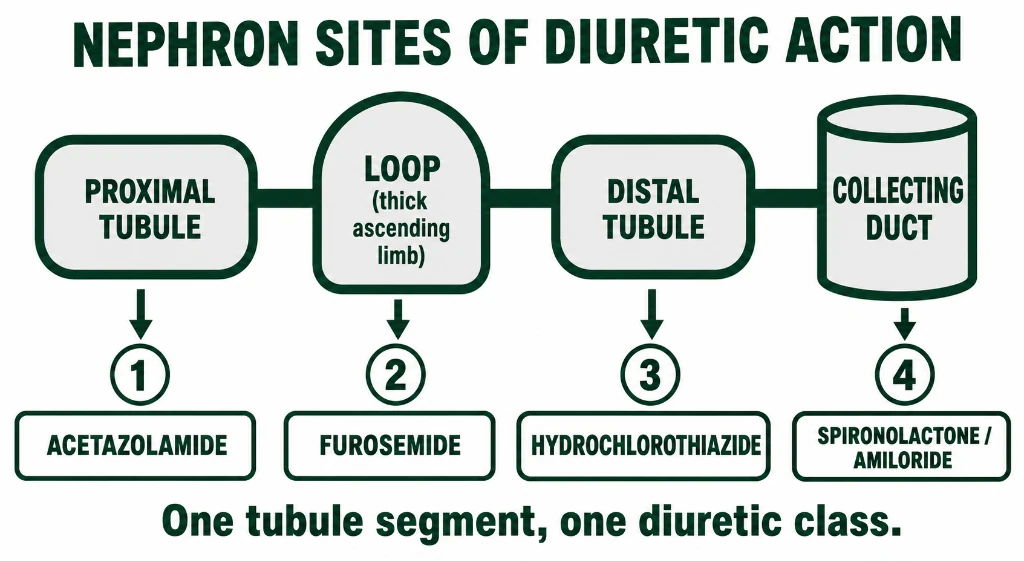
Detailed diagram of a nephron mapping the five sites of diuretic action: Site 1 PCT (Acetazolamide on Carbonic Anhydrase), Site 2 TAL (Loop diuretics on NKCC2 and paracellular Ca2+/Mg2+), Site 3 DCT (Thiazides on NCCT and Ca2+ reabsorption), Site 4 CCD (Amiloride on ENaC, Spironolactone on MR), and Site 5 MCD (Tolvaptan on V2/Aquaporin-2).
Figure 2 — Differential calcium handling: Loop vs Thiazide mechanisms
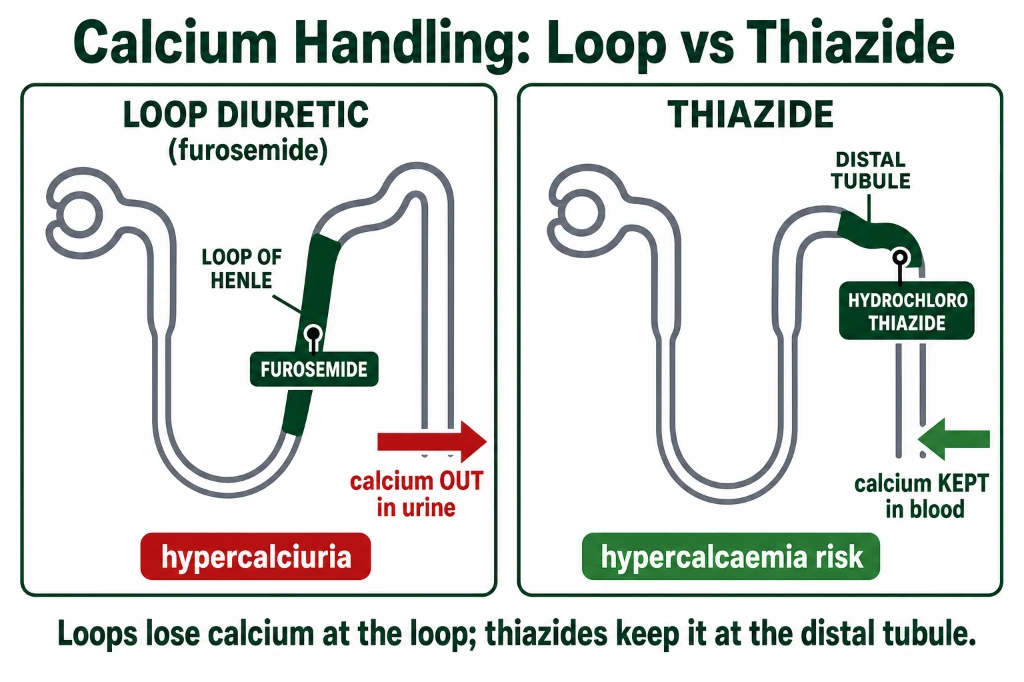
Side-by-side cellular diagrams comparing the calcium-wasting effect of Loop diuretics in the TAL (loss of lumen-positive potential abolishes paracellular Ca2+ drive) with the calcium-sparing effect of Thiazides in the DCT (NCCT blockade stimulates basolateral NCX1 and apical TRPV5 calcium entry).
Figure 3 — Comparative diuretic electrolyte and metabolic profiles
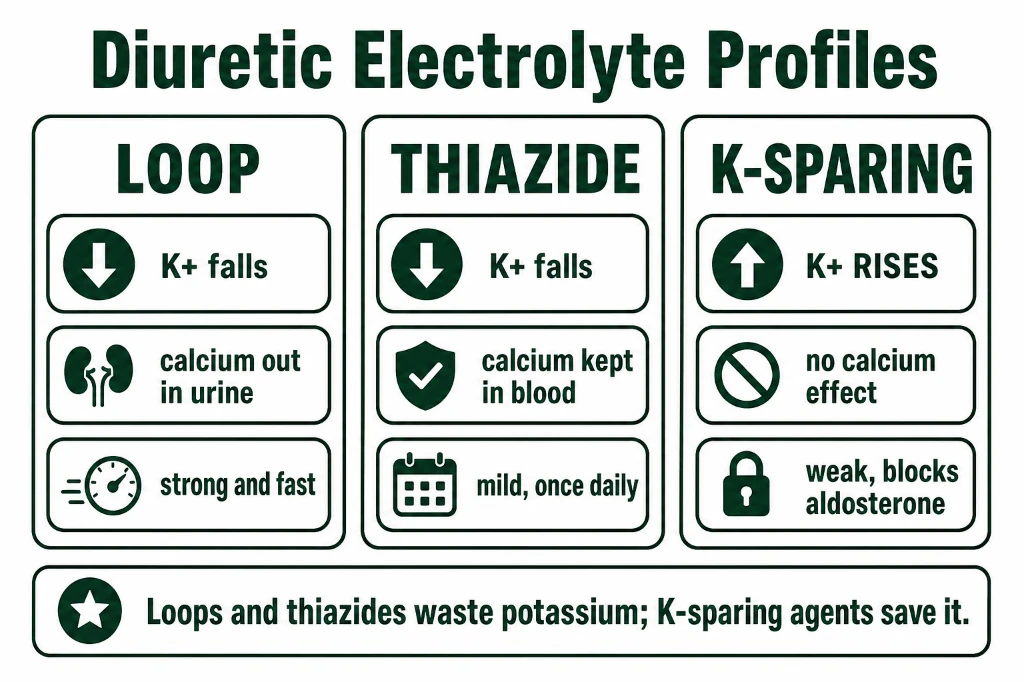
Summary chart displaying the serum electrolyte and acid-base signatures of major diuretic classes, highlighting hypokalemic alkalosis with loop/thiazides, hyperkalemic acidosis with K+-sparers, hypercalcemia with thiazides, and hypocalcemia with loop diuretics.
Figure 4 — Vasopressin V2 signaling and aquaretic action
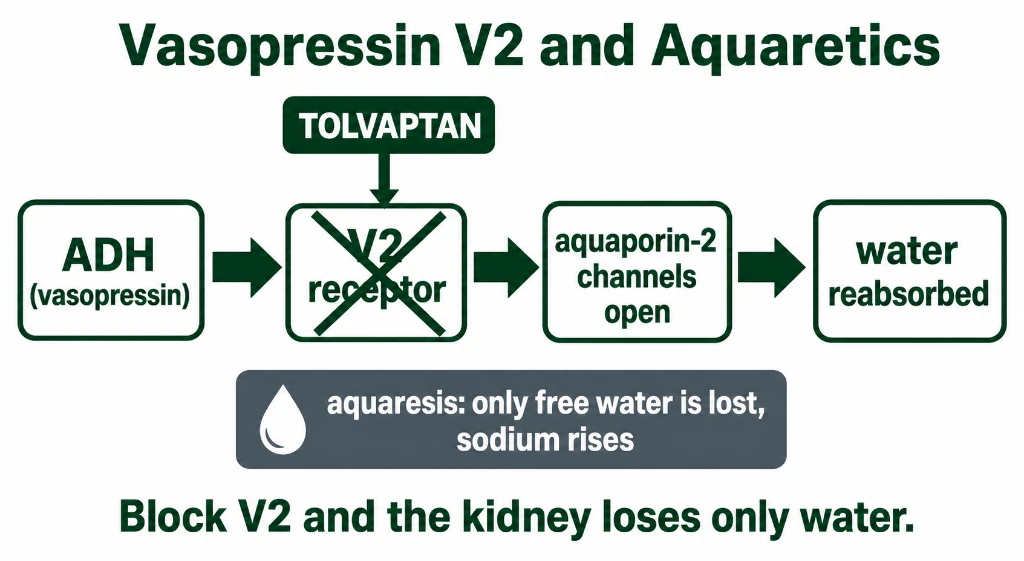
Cellular signaling diagram of collecting duct principal cell showing vasopressin V2 receptor activation stimulating the Gs-cAMP-PKA pathway to insert Aquaporin-2 channels apically, and Tolvaptan blocking the V2 receptor to promote free-water excretion (aquaresis).
Clinical Correlation
Vignette 1 — Acute cardiogenic pulmonary oedema
A patient with ischaemic cardiomyopathy presents with severe dyspnoea, hypertension, crackles and clinical congestion. Non-invasive ventilatory support and vasodilator therapy are initiated; IV furosemide is given because volume overload is present.
Reasoning: IV loop diuretic reaches luminal NKCC2 by proximal organic-anion secretion. An early prostaglandin-associated venodilator effect may reduce preload before urine output, while subsequent natriuresis relieves congestion. Diuretic treatment must not delay airway/oxygenation support or indicated vasodilators. NSAIDs can blunt natriuresis and renal prostaglandin effects.
Vignette 2 — Thiazide-associated severe hyponatraemia
An older adult develops confusion ten days after starting chlorthalidone; Na⁺ is 116 mmol/L, K⁺ 3.1 mmol/L and urine remains concentrated.
Reasoning: NCC blockade impairs cortical dilution while the medullary gradient and ADH-mediated water reabsorption remain intact. Stop the thiazide. Severe symptoms require protocol-driven hypertonic saline with frequent sodium and urine-output checks. Limit total correction—especially in chronic/high-risk hyponatraemia—to prevent osmotic demyelination; use desmopressin/D5W if overcorrection develops according to specialist protocol.
Vignette 3 — Lithium-induced nephrogenic diabetes insipidus
A patient taking lithium has polyuria and persistently dilute urine despite desmopressin.
Reasoning: Lithium enters principal cells through ENaC and disrupts AQP2 expression/trafficking. Amiloride reduces lithium entry by directly blocking ENaC. Also review whether lithium can be reduced or stopped, correct volume/electrolyte losses and monitor potassium and kidney function.
Vignette 4 — Persistent chronic SIADH
A clinically stable patient with chronic euvolaemic hyponatraemia from SIADH remains low in sodium despite treating the cause and appropriate fluid restriction. Specialist-supervised tolvaptan is considered in hospital.
Reasoning: Tolvaptan blocks V₂-mediated AQP2 insertion and causes brisk aquaresis. It is not the initial treatment for severe symptomatic hyponatraemia, which requires hypertonic saline. Sodium must be monitored closely; patients need access to water, and liver/label restrictions must be observed.
Vignette 5 — Severe hypercalcaemia
A patient with malignancy-associated hypercalcaemia is dehydrated.
Reasoning: Replete volume with isotonic fluid as tolerated and use cause-directed therapy such as calcitonin plus an antiresorptive agent. Do not routinely prescribe furosemide simply to force calcium excretion; use a loop only if needed to manage fluid overload after repletion. Thiazides should be stopped because they reduce urinary calcium.
Practical Linkage
OSPE: choose the site, benefit and danger
| Scenario | Pharmacological option | Critical monitoring / caveat |
|---|---|---|
| Congested acute heart failure/pulmonary oedema | IV loop diuretic as part of an emergency bundle | BP, oxygenation, urine output, Na⁺/K⁺/Mg²⁺, creatinine; not a substitute for ventilatory/vasodilator support |
| First episode moderate cirrhotic ascites | Spironolactone-based therapy | Weight, Na⁺/K⁺, creatinine; recurrent ascites often uses spironolactone + furosemide, commonly maintaining a 100:40 ratio |
| Recurrent calcium stone with hypercalciuria | Thiazide/thiazide-like therapy after diet evaluation | 24-h urinary calcium, Na⁺/K⁺, glucose and urate |
| Lithium-induced nephrogenic DI | Amiloride | K⁺, creatinine, lithium plan and urine volume |
| Moderate/high-risk ascent | Acetazolamide prophylaxis plus gradual ascent | Paraesthesia, acid-base status; descent/oxygen for worsening illness |
| Raised ICP | Hypertonic saline or mannitol selected by pathology/protocol | Volume, sodium/osmolality, kidney function and ICP response; avoid mannitol in pulmonary oedema |
| Severe symptomatic hyponatraemia | Hypertonic saline protocol | Frequent Na⁺ checks; prevent overcorrection; vaptans are not rescue therapy |
Hazardous combinations
- Loop + aminoglycoside: additive ototoxicity.
- Thiazide + lithium: reduced lithium clearance and toxicity risk.
- MRA/ENaC blocker + ACE inhibitor/ARB + K⁺ supplement: dangerous hyperkalaemia, especially in CKD.
- Loop/thiazide + NSAID: blunted diuresis and increased kidney-injury risk.
- Tolvaptan + strong CYP3A inhibitor: excessive exposure; follow label contraindications.
Diuretic-resistance checklist
- Confirm congestion and exclude poor adherence or excessive sodium intake.
- Review NSAIDs and other nephrotoxic/interacting drugs.
- Ensure adequate loop dose, route and luminal delivery; consider IV therapy or a better-absorbed oral loop when appropriate.
- Add a thiazide/thiazide-like drug for monitored sequential blockade when loop response remains inadequate.
- Reassess BP, weight, urine output, Na⁺/K⁺/Mg²⁺ and creatinine frequently; stop escalation if hypovolaemia or kidney/electrolyte injury develops.
- Use MRA therapy for its indication, not as an automatic third diuretic in every resistant patient.
MCQ Bank
35 questions · tagged by topic, exam pattern & difficulty · full explanations
A 64-year-old male with ischemic cardiomyopathy presents with severe acute dyspnea, orthopnea, and bilateral lung crackles. Intravenous furosemide (80 mg) is administered. Within 10 minutes, his dyspnea improves substantially, prior to any significant urine output. Which of the following mechanisms accounts for this rapid initial therapeutic benefit?
Rapid Revision
- Loop target — luminal NKCC2 in the thick ascending limb
- Thiazide target — luminal NCC in the distal convoluted tubule
- MR antagonists — spironolactone, eplerenone; finerenone is weakly diuretic
- Direct ENaC blockers — amiloride, triamterene
- CA inhibitor — acetazolamide at proximal CA II/IV
- Loop calcium effect — urinary Ca²⁺/Mg²⁺ increase because lumen-positive voltage is lost
- Thiazide calcium effect — urinary Ca²⁺ falls through NCX1/TRPV5 and volume effects
- Loop acid-base — hypokalaemic hypochloraemic metabolic alkalosis
- Thiazide signature danger — severe hyponatraemia
- K⁺-sparing danger — hyperkalaemia and metabolic acidosis
- Acetazolamide — alkaline urine with hyperchloraemic metabolic acidosis
- Furosemide + aminoglycoside — additive ototoxicity
- Thiazide + lithium — lithium toxicity risk
- MRA/amiloride + ACEI/ARB/K⁺ — hyperkalaemia risk
- Ethacrynic acid — non-sulfonamide loop; high ototoxicity
- Chlorthalidone — long acting; ALLHAT was not a direct HCTZ comparison
- Advanced CKD — chlorthalidone can still lower BP (CLICK); monitor closely
- Cirrhotic ascites — spironolactone-based; recurrent ascites often combines furosemide near 100:40
- Lithium-induced NDI — amiloride reduces lithium entry via ENaC
- Liddle syndrome — amiloride; spironolactone fails because aldosterone is suppressed
- Gitelman syndrome — NCC loss: hypokalaemia, alkalosis, hypomagnesaemia, hypocalciuria
- Bartter syndrome — loop-segment defect, often hypercalciuria
- Altitude prophylaxis — acetazolamide facilitates acclimatisation; gradual ascent remains essential
- Mannitol — IV osmotic agent; avoid in pulmonary oedema/decompensated HF
- TBI cerebral oedema — hypertonic saline often preferred initially; mannitol is an alternative
- Salicylate toxicity — IV sodium bicarbonate; avoid acetazolamide
- Severe hypercalcaemia — fluids as tolerated + antiresorptive/calcitonin; loop only for volume overload
- Desmopressin — V₂ agonist; central DI; danger is water intoxication
- Tolvaptan — oral V₂ antagonist; selected monitored hyponatraemia, not emergency rescue
- Safe Na⁺ correction — ≤10 mmol/L first day and ≤8 thereafter; ≤8/24 h for high risk
- Sequential blockade — loop plus distal diuretic with intensive electrolyte/kidney monitoring
Viva Questions
-
What defines a high-ceiling diuretic?
A loop diuretic can inhibit reabsorption of a large filtered Na⁺ fraction by blocking NKCC2 in the thick ascending limb. -
Why do loops increase urinary calcium while thiazides lower it?
Loops abolish TAL lumen-positive voltage and paracellular Ca²⁺ uptake; thiazides favour DCT NCX1/TRPV5-mediated transcellular reabsorption. -
How can IV furosemide improve pulmonary oedema before marked diuresis?
An early prostaglandin-associated venodilator effect may reduce preload, followed by decongestive natriuresis. -
What is the key long-acting feature of chlorthalidone?
Tissue/RBC binding and slow elimination produce a roughly 40–60-hour half-life and sustained BP action. -
Did ALLHAT prove chlorthalidone superior to HCTZ?
No. ALLHAT demonstrated outcomes with a chlorthalidone-based strategy but was not a direct head-to-head HCTZ trial. -
Do all thiazides fail below eGFR 30?
No. CLICK showed chlorthalidone lowers BP in stage-4 CKD; metolazone is also useful with loops, but toxicity monitoring is crucial. -
Why is spironolactone useful in cirrhotic ascites?
It blocks the secondary hyperaldosteronism driving collecting-duct Na⁺ retention. -
Why does amiloride work in lithium NDI?
It blocks ENaC and reduces lithium entry into principal cells. -
Why does spironolactone fail in Liddle syndrome?
ENaC is constitutively active while aldosterone is already suppressed; direct ENaC blockade is required. -
How does acetazolamide facilitate altitude acclimatisation?
Bicarbonate loss produces metabolic acidosis that sustains ventilation; it complements, not replaces, gradual ascent/descent decisions. -
Why is acetazolamide avoided in salicylate poisoning?
It may alkalinise urine but lowers serum pH, increasing non-ionised salicylate entry into tissues and brain. -
Why is mannitol dangerous in pulmonary oedema?
Initial movement of water into the intravascular compartment increases preload before osmotic diuresis. -
What is sequential nephron blockade?
Adding a distal thiazide/thiazide-like drug to an optimised loop to block compensatory Na⁺ reabsorption, with close monitoring. -
What is desmopressin's main renal mechanism?
V₂–Gs–cAMP–PKA activation inserts AQP2 into the apical collecting-duct membrane. -
When is tolvaptan inappropriate as initial therapy?
In severe symptomatic hyponatraemia, where protocol-driven hypertonic saline is required. -
What is Gitelman's calcium pattern?
Hypocalciuria; hypercalciuria suggests a loop-segment/Bartter pattern instead.
References
- Tripathi KD. Essentials of Medical Pharmacology. 9th ed. Jaypee Brothers; Chapters 41–42.
- Katzung BG, Vanderah TW. Basic & Clinical Pharmacology. 16th ed. McGraw Hill; chapter on diuretic agents.
- Brunton LL, Knollmann BC, editors. Goodman & Gilman's The Pharmacological Basis of Therapeutics. 14th ed. McGraw Hill; chapter on renal transport and diuretics.
- Ritter JM, Flower RJ, Henderson G, et al. Rang & Dale's Pharmacology. 10th ed. Elsevier; renal pharmacology chapter.
- National Medical Commission. Competency Based Undergraduate Curriculum for the Indian Medical Graduate, Pharmacology competency PH1.24.
- Biggins SW, Angeli P, Garcia-Tsao G, et al. AASLD Practice Guidance on ascites, spontaneous bacterial peritonitis and hepatorenal syndrome. Hepatology. 2021;74:1014–1048.
- Agarwal R, Sinha AD, Cramer AE, et al. Chlorthalidone for hypertension in advanced chronic kidney disease (CLICK). N Engl J Med. 2021;385:2507–2519.
- Cook AM, Morgan Jones G, Hawryluk GWJ, et al. Guidelines for acute treatment of cerebral edema in neurocritical care patients. Neurocrit Care. 2020;32:647–666.
- Luks AM, Auerbach PS, Freer L, et al. Wilderness Medical Society Clinical Practice Guidelines for altitude illness: 2024 update. Wilderness Environ Med. 2024.
- Sterns RH, Rondon-Berrios H. Treatment guidelines for hyponatremia: stay the course. Clin J Am Soc Nephrol. 2024;19:129–135.
- U.S. Food and Drug Administration. SAMSCA (tolvaptan) prescribing information: hospital initiation/monitoring, liver warning and U.S. 30-day limit.
- Pitt B, Zannad F, Remme WJ, et al. The effect of spironolactone on morbidity and mortality in severe heart failure (RALES). N Engl J Med. 1999;341:709–717.
- ALLHAT Officers and Coordinators. Major outcomes in high-risk hypertensive patients randomized to antihypertensive regimens. JAMA. 2002;288:2981–2997.
- Merck Manual Professional. Aspirin and other salicylate poisoning: IV sodium bicarbonate alkalinisation; avoid acetazolamide.
Doses, sodium-correction plans, hyperosmolar therapy and emergency diuresis must follow current institutional protocols and specialist monitoring.
Downloads
All deliverables & printable revision sheets for CH30
Printable Chapter Handout & Study Notes
Generate a clean, high-yield PDF or print directly without sidebars and navigation menus.