
Antiarrhythmic Drugs
Learning Objectives
At the end of this chapter, the Phase II MBBS student will be able to:
- Describe fast- and slow-response cardiac action potentials, their phases and major antiarrhythmic targets. (PH1.30 — Knows)
- Classify antiarrhythmic drugs by the Vaughan-Williams system (Classes I–IV) and identify important unclassified agents. (PH1.30 — Knows)
- Differentiate Class IA, IB and IC drugs by sodium-channel block, action-potential effect, uses and major toxicity. (PH1.30 — Knows)
- Describe amiodarone's mixed electrophysiological actions, pharmacokinetics, interactions and multi-organ toxicity. (PH1.30 — Knows)
- Explain how adenosine terminates AV-node-dependent supraventricular tachycardia and state its adverse effects and cautions. (PH1.30 — Knows)
- Recognise acquired QT prolongation and outline immediate management of torsades de pointes. (PH1.30 — Knows-how)
- Describe the role and toxicity of lidocaine in selected ventricular arrhythmias. (PH1.30 — Knows)
- Select an appropriate pharmacological or electrical intervention after considering rhythm, QRS width and haemodynamic stability. (PH1.30 — Shows-how)
- Explain the CAST-trial caution against Class IC drugs in ischaemic or structural heart disease. (PH1.30 — Knows)
Must-Know Summary
Antiarrhythmic treatment is rhythm- and stability-specific: an unstable tachyarrhythmia needs prompt electrical therapy, while drugs are selected by the tissue and ionic current sustaining the rhythm.
- Class I — fast sodium-channel blockers: IA, IB and IC.
- Class II — beta-blockers; reduce automaticity and slow AV-nodal conduction.
- Class III — potassium-channel blockers; prolong repolarisation and refractoriness.
- Class IV — non-dihydropyridine calcium-channel blockers; slow calcium-dependent AV-nodal conduction.
- Adenosine — first-line drug after vagal manoeuvres for a stable, regular, AV-node-dependent SVT; give as a rapid IV bolus.
- Amiodarone — broad-spectrum Class III drug with Class I, II and IV effects; pulmonary toxicity and thyroid dysfunction are classic.
- Lidocaine — Class IB drug used intravenously for selected ventricular arrhythmias, especially in ischaemic myocardium.
- Torsades de pointes — stop QT-prolonging drugs, correct potassium/magnesium and give IV magnesium; shock if unstable or pulseless.
- Class IC drugs — avoid in prior MI or significant structural/ischaemic heart disease because of proarrhythmic mortality demonstrated by CAST.
- Phase 0 is not identical in all cardiac cells: fast sodium current drives myocardial/Purkinje phase 0, whereas L-type calcium current drives nodal phase 0.
Classification
Box 1 — Vaughan-Williams classification
- Class I — fast Na⁺-channel blockers
- IA: quinidine, procainamide, disopyramide
- IB: lidocaine, mexiletine
- IC: flecainide, propafenone
- Class II — beta-blockers: propranolol, metoprolol, esmolol
- Class III — predominantly K⁺-channel blockers: amiodarone, sotalol, dofetilide, ibutilide; dronedarone has mixed actions
- Class IV — non-dihydropyridine Ca²⁺-channel blockers: verapamil, diltiazem
- Important unclassified agents: adenosine, digoxin, magnesium and atropine
Box 2 — High-yield emergency associations
- Stable regular narrow-complex AVNRT/orthodromic AVRT: vagal manoeuvres → adenosine
- Haemodynamically unstable tachycardia with a pulse: synchronized cardioversion
- Pulseless ventricular tachycardia/ventricular fibrillation: defibrillation plus cardiac-arrest protocol
- Selected stable ventricular arrhythmias: procainamide, amiodarone, sotalol or lidocaine according to rhythm and substrate
- Torsades de pointes: IV magnesium; correct electrolytes and remove the cause
- Symptomatic bradycardia: atropine; pace/escalate if ineffective
Safety exception: avoid AV-nodal blockers such as adenosine, verapamil/diltiazem, beta-blockers and digoxin in pre-excited atrial fibrillation, where preferential accessory-pathway conduction may precipitate ventricular fibrillation.
Core Concepts
1. Electrophysiological basis
Antiarrhythmic drugs alter automaticity, conduction velocity, refractoriness or triggered activity. Their effects depend on the cell type and the state of the channel; most Class I drugs show use dependence, producing greater block at faster rates because they preferentially bind open or inactivated channels.
Fast-response cells: atrial/ventricular myocytes and Purkinje fibres
- Phase 0: rapid fast Na⁺ influx; determines upstroke and conduction velocity. Class I drugs reduce this upstroke.
- Phase 1: brief early repolarisation, largely transient outward K⁺ current.
- Phase 2: plateau from inward L-type Ca²⁺ current balanced by outward K⁺ currents.
- Phase 3: K⁺-mediated repolarisation. Class III drugs prolong repolarisation, action-potential duration (APD) and effective refractory period (ERP).
- Phase 4: stable resting potential near −90 mV, maintained mainly by inward-rectifier K⁺ current.
Slow-response cells: SA and AV nodes
- Phase 4: spontaneous pacemaker depolarisation involving the funny current (Iƒ), Ca²⁺ currents and declining K⁺ efflux. Beta stimulation steepens this slope; Class II drugs flatten it.
- Phase 0: L-type Ca²⁺ influx—not fast Na⁺ influx—creates the nodal upstroke. Class IV drugs slow AV-nodal conduction.
- Phase 3: K⁺ efflux repolarises the cell.
This distinction prevents a common error: the antiarrhythmic action of verapamil and diltiazem is primarily through calcium-dependent nodal phase 0, not merely the ventricular phase-2 plateau.
2. Vaughan-Williams Classes I–IV
Class I — fast Na⁺-channel blockers
- IA: quinidine, procainamide, disopyramide — moderate Na⁺ block plus some K⁺ block; slow conduction and prolong APD/QT. Major associations: quinidine—cinchonism/torsades; procainamide—drug-induced lupus; disopyramide—antimuscarinic effects and negative inotropy.
- IB: lidocaine, mexiletine — relatively weak Na⁺ block with preference for inactivated channels in depolarised/ischaemic ventricular tissue; shorten APD. Lidocaine is IV and may cause neurological toxicity (paraesthesia, tremor, seizures).
- IC: flecainide, propafenone — marked slowing of conduction with minimal APD change. Avoid in prior MI or important structural/ischaemic heart disease because CAST demonstrated proarrhythmic mortality.
Class II — beta-blockers
Beta-blockers decrease cAMP, reduce SA-node automaticity, slow AV-nodal conduction and prolong AV-nodal refractoriness. They are used for rate control and catecholamine-driven arrhythmias. Esmolol is rapidly hydrolysed and useful when short titratable IV action is desired. Watch for bradycardia, AV block, hypotension, bronchospasm and worsening acute decompensated heart failure.
Class III — repolarisation-prolonging drugs
Amiodarone, sotalol, dofetilide and ibutilide inhibit repolarising K⁺ currents, increasing APD/ERP and often QT. Sotalol also beta-blocks. Dofetilide, ibutilide and sotalol can cause torsades; many pure K⁺ blockers show reverse-use dependence. Amiodarone prolongs QT but causes torsades less often than expected because of its mixed channel effects.
Class IV — non-dihydropyridine Ca²⁺-channel blockers
Verapamil and diltiazem slow calcium-dependent AV-nodal conduction and prolong AV-nodal refractoriness. They help control selected supraventricular rhythms and AF ventricular rate. Avoid IV use in moderate/severe LV systolic dysfunction and avoid AV-nodal blockade in pre-excited AF.
3. Amiodarone
Amiodarone is conventionally Class III but also blocks Na⁺ channels, beta receptors and Ca²⁺ channels. It has a very large volume of distribution and a terminal half-life measured in weeks, so effects and toxicity may persist after withdrawal.
High-yield adverse effects:
- Pulmonary pneumonitis/fibrosis — potentially fatal.
- Hypothyroidism or hyperthyroidism — iodine load plus direct thyroid effects.
- Corneal microdeposits; rare optic neuropathy.
- Hepatotoxicity and transaminase elevation.
- Photosensitivity and blue-grey skin pigmentation.
- Bradycardia, AV block and QT prolongation.
- Tremor, ataxia and peripheral neuropathy.
Important interactions include increased exposure/effect of warfarin (CYP inhibition) and digoxin (including P-glycoprotein inhibition); monitor and reduce interacting doses as clinically appropriate.
4. Adenosine and AV-node-dependent SVT
Adenosine activates A₁ receptors (Gi-coupled), reducing adenylyl cyclase/cAMP, decreasing Ca²⁺ current and opening K⁺ channels. AV-nodal hyperpolarisation produces a transient conduction block. Its plasma half-life is only seconds because of rapid uptake and metabolism.
Use adenosine for a stable, regular narrow-complex tachycardia when vagal manoeuvres fail and AVNRT/orthodromic AVRT is likely. Give it as a rapid IV push with continuous ECG monitoring. Flushing, chest pressure, dyspnoea, a sense of impending doom and transient bradycardia are brief; bronchospasm may occur. Methylxanthines (caffeine/theophylline) antagonise and blunt its action, while dipyridamole can enhance it.
Do not treat unstable tachycardia with adenosine instead of cardioversion. Avoid it in severe active bronchospasm and in irregular/pre-excited AF; use caution with high-grade AV block or sick-sinus syndrome without pacing.
5. QT prolongation and torsades de pointes
Drug-induced IKr block prolongs repolarisation and promotes early afterdepolarisations. Risk rises with female sex, bradycardia, congenital long-QT syndrome, structural heart disease, renal/hepatic accumulation, high drug concentrations, combinations of QT-prolonging medicines, hypokalaemia and hypomagnesaemia.
Culprits include sotalol, dofetilide, ibutilide, Class IA drugs and selected macrolides, fluoroquinolones, antipsychotics, antidepressants and antiemetics. Treat acquired torsades by stopping culprits, giving IV magnesium, correcting K⁺/Mg²⁺ and treating instability/pulselessness with immediate shock. Recurrent pause-dependent torsades may require overdrive pacing or isoproterenol under expert direction.
6. Selecting treatment safely
- Unstable tachycardia with a pulse: synchronized cardioversion.
- Pulseless VT/VF: defibrillation and cardiac-arrest protocol.
- Stable regular narrow-complex SVT: vagal manoeuvres, then adenosine.
- AF rate control: beta-blocker or diltiazem/verapamil when appropriate; digoxin is useful in selected patients, particularly with heart-failure symptoms or when first-line agents are unsuitable. Avoid non-dihydropyridine CCBs in LVEF <40%.
- Stable wide-complex tachycardia: diagnose carefully and follow current protocol/expert guidance; antiarrhythmic options depend on QT, ventricular function and substrate.
- Symptomatic bradycardia: atropine may be tried; pacing or vasoactive support is required if ineffective.
No antiarrhythmic is intrinsically “safe”: slowing one pathway can create another re-entry circuit, and prolonging refractoriness can provoke triggered activity. Always correct hypoxia, ischaemia, electrolyte disturbance and offending medicines.
Tables
Table 1 — Action potentials and drug targets
| Cell / phase | Dominant ionic event | Functional consequence | Principal drug relationship |
|---|---|---|---|
| Fast cell phase 0 | Fast Na⁺ influx | Rapid upstroke and conduction | Class I slows upstroke/conduction |
| Fast cell phase 2 | L-type Ca²⁺ influx balanced by K⁺ efflux | Plateau and contraction | Ca²⁺ blockers shorten plateau, but antiarrhythmic Class IV action is mainly nodal |
| Fast cell phase 3 | K⁺ efflux | Repolarisation | Class III prolongs APD/ERP and often QT |
| Nodal phase 4 | Iƒ, Ca²⁺ entry, declining K⁺ efflux | Pacemaker slope | Class II reduces cAMP and slope |
| Nodal phase 0 | L-type Ca²⁺ influx | AV-nodal conduction | Class IV slows conduction |
Table 2 — Vaughan-Williams overview
| Class | Main action | Prototypes | High-yield use/toxicity |
|---|---|---|---|
| I | Fast Na⁺-channel block | Quinidine, lidocaine, flecainide | Subclass-dependent; conduction slowing and proarrhythmia |
| II | Beta blockade | Metoprolol, propranolol, esmolol | Rate control; bradycardia/AV block |
| III | K⁺-current block / prolonged repolarisation | Amiodarone, sotalol, dofetilide, ibutilide | QT prolongation; torsades risk varies |
| IV | Non-DHP Ca²⁺-channel block | Verapamil, diltiazem | AV-nodal rate control; avoid in HFrEF and pre-excited AF |
Table 3 — Class I subclasses
| Subclass | Na⁺ block / APD | Examples | Key associations |
|---|---|---|---|
| IA | Moderate; APD/QT prolonged | Quinidine, procainamide, disopyramide | Torsades; cinchonism, lupus, antimuscarinic effects |
| IB | Weak; APD shortened | Lidocaine, mexiletine | Ventricular/ischaemic tissue; neurological toxicity |
| IC | Marked conduction slowing; minimal APD change | Flecainide, propafenone | Avoid prior MI/significant structural heart disease (CAST) |
Table 4 — Amiodarone profile
| Domain | Key point |
|---|---|
| Electrophysiology | Class III with additional I, II and IV effects |
| Kinetics | Large distribution volume; terminal half-life of weeks |
| Pulmonary | Pneumonitis/fibrosis — potentially fatal |
| Thyroid | Hypo- or hyperthyroidism; iodine-rich drug |
| Eye/skin | Corneal microdeposits, photosensitivity, blue-grey pigmentation |
| Liver/nerves | Hepatotoxicity, tremor/ataxia/peripheral neuropathy |
| Interactions | Increases warfarin effect and digoxin exposure |
Table 5 — Acquired QT prolongation and torsades
| Component | Examples / action |
|---|---|
| Antiarrhythmic culprits | Class IA, sotalol, dofetilide, ibutilide |
| Non-cardiac culprits | Selected macrolides, fluoroquinolones, antipsychotics, antidepressants and antiemetics |
| Amplifiers | Bradycardia, hypokalaemia, hypomagnesaemia, drug accumulation and multiple QT drugs |
| Immediate management | Stop culprits, IV magnesium, correct electrolytes; shock if unstable/pulseless |
| Recurrent pause-dependent episodes | Consider overdrive pacing/rate acceleration under expert care |
Table 6 — Rhythm-based selection
| Clinical rhythm | First safety decision | Typical association |
|---|---|---|
| Stable regular narrow SVT | Try vagal manoeuvres | Adenosine if persistent |
| Unstable tachycardia with pulse | Do not delay electrical treatment | Synchronized cardioversion |
| Pulseless VT/VF | Cardiac arrest | Defibrillation + resuscitation protocol |
| AF ventricular rate control | Consider EF, BP, pre-excitation and comorbidity | Beta-blocker or diltiazem/verapamil; selected use of digoxin |
| Acquired torsades | QT/electrolytes and stability | IV magnesium + correction/withdrawal |
| Symptomatic bradycardia | Assess reversible cause and response | Atropine; pace/escalate if ineffective |
Figures
Figure 1 — Fast- and slow-response cardiac action potentials
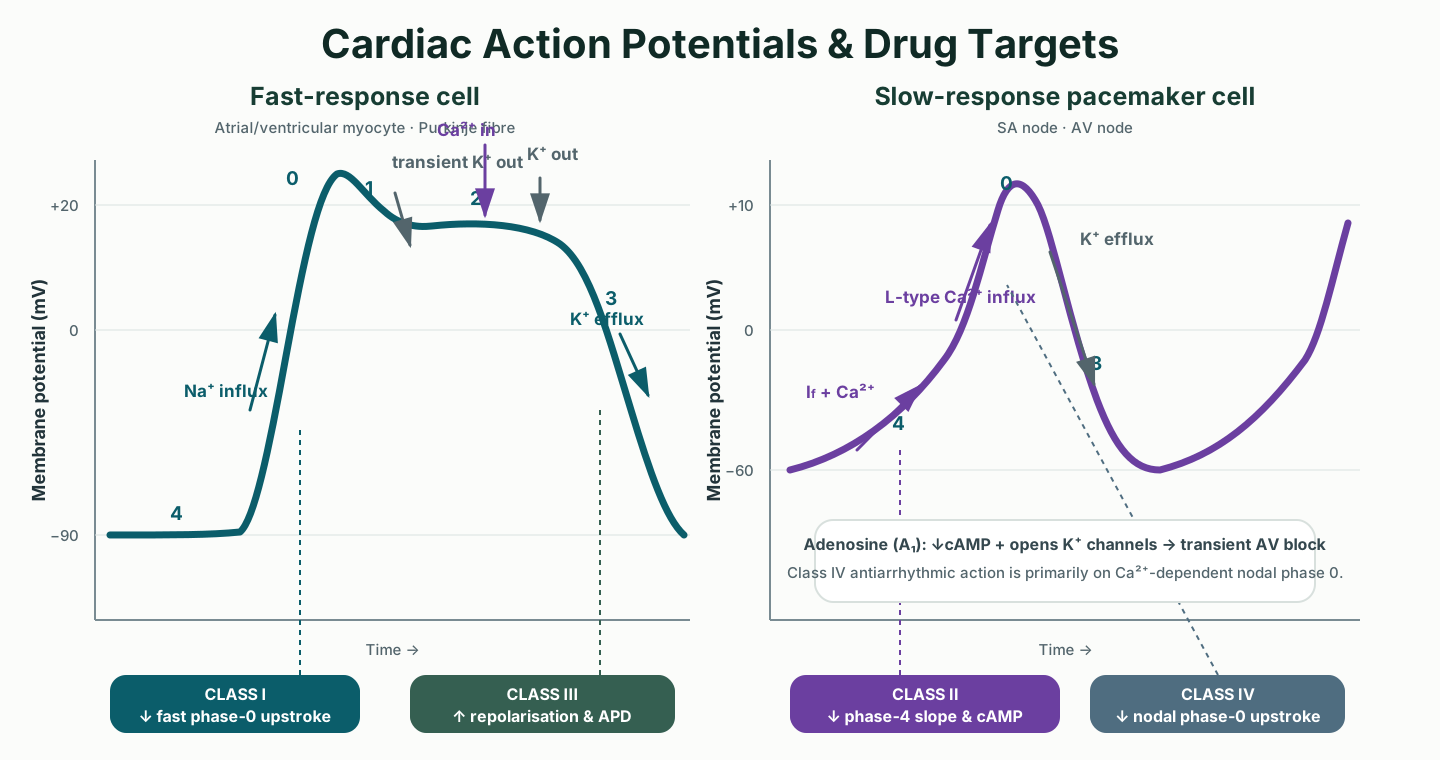
Fast myocardial/Purkinje phase 0 is Na⁺-dependent and targeted by Class I drugs; phase 3 is predominantly K⁺-dependent and targeted by Class III drugs. Nodal phase 0 is Ca²⁺-dependent and slowed by Class IV drugs, while Class II drugs reduce the phase-4 pacemaker slope. The supplied source image was replaced because it combined ventricular and pacemaker phase-4 concepts and contained a non-monotonic voltage axis.
Figure 2 — Vaughan-Williams classification
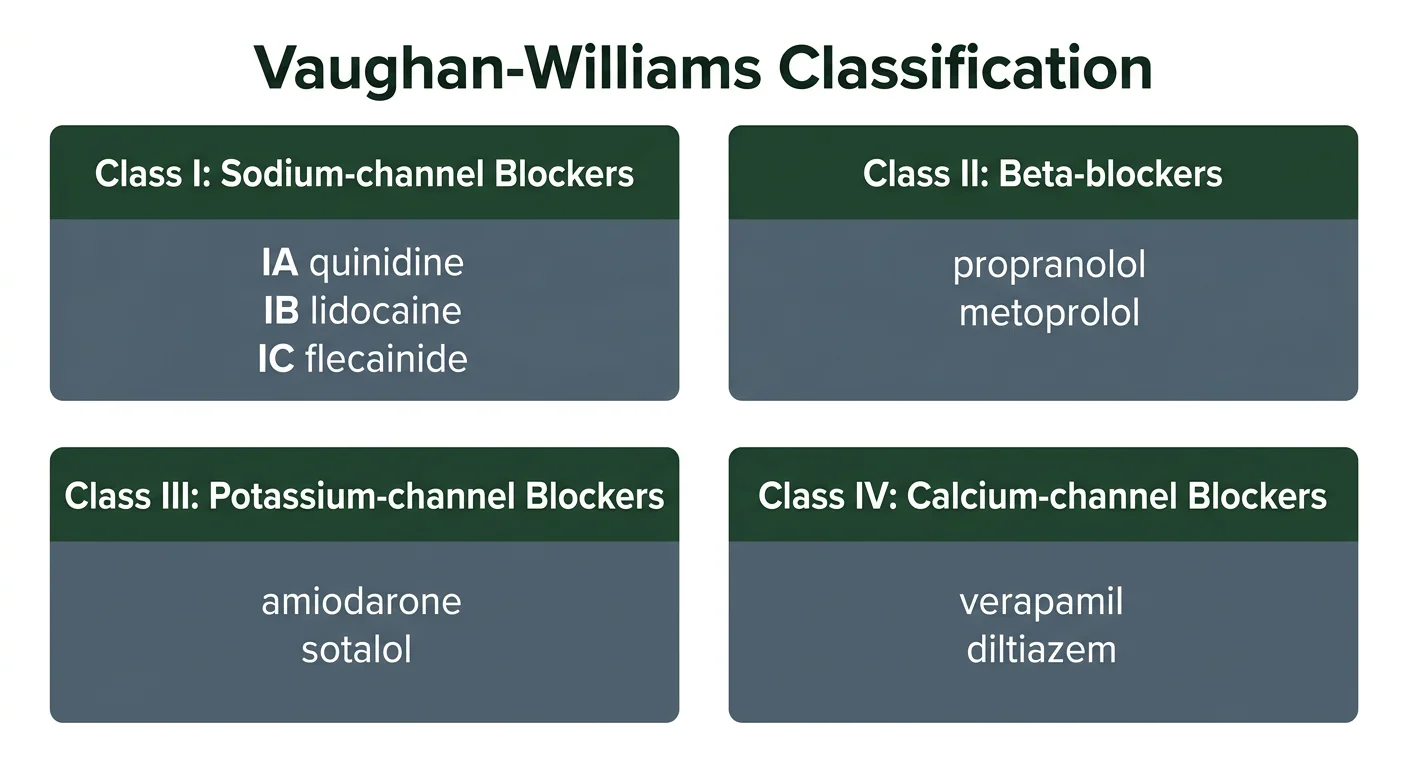
The four traditional classes: Class I sodium-channel blockers, Class II beta-blockers, Class III potassium-channel blockers and Class IV non-dihydropyridine calcium-channel blockers. Adenosine, digoxin, magnesium and atropine sit outside the four-class framework.
Figure 3 — Amiodarone multi-organ toxicity
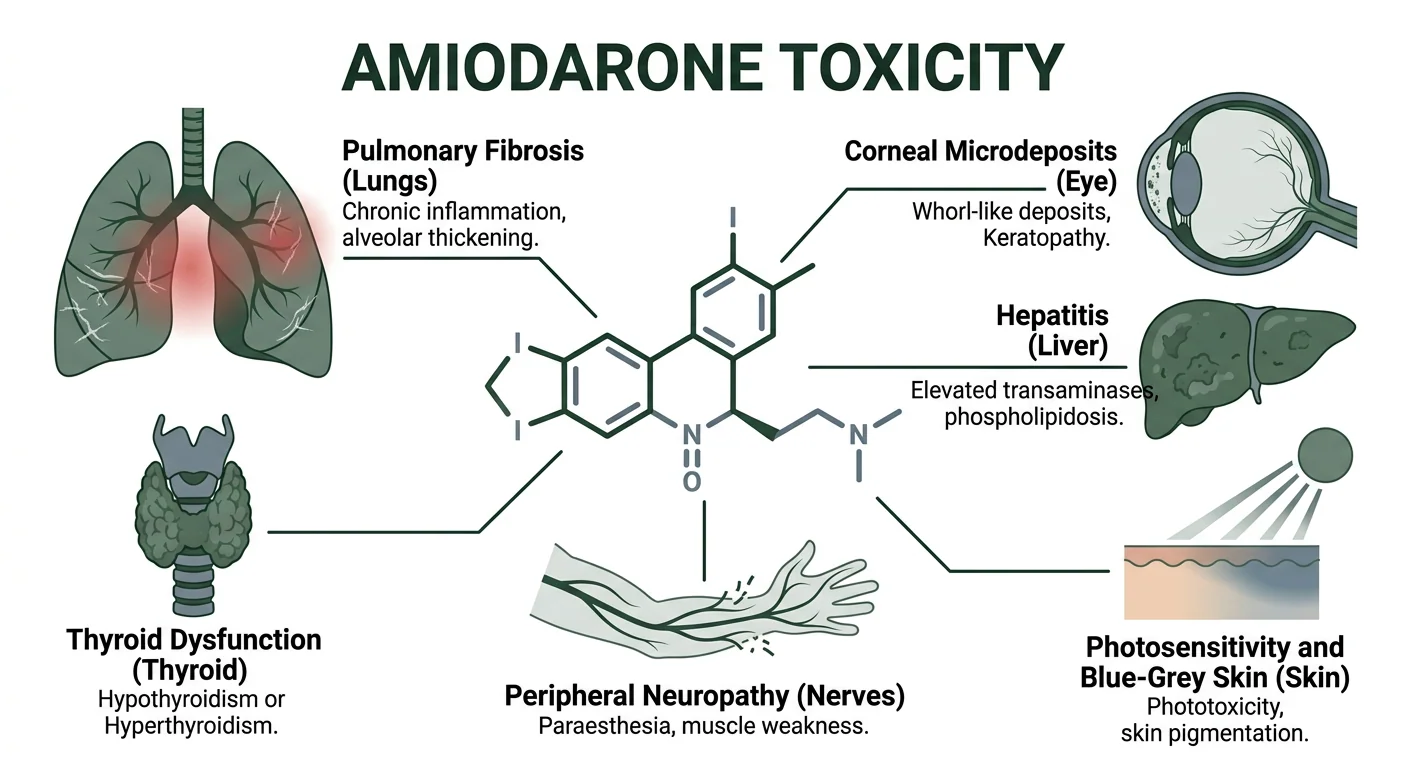
Important chronic amiodarone toxicities include pulmonary pneumonitis/fibrosis, hypo- or hyperthyroidism, corneal microdeposits, hepatotoxicity, photosensitivity/blue-grey skin and peripheral neuropathy.
Figure 4 — Adenosine in AV-node-dependent SVT
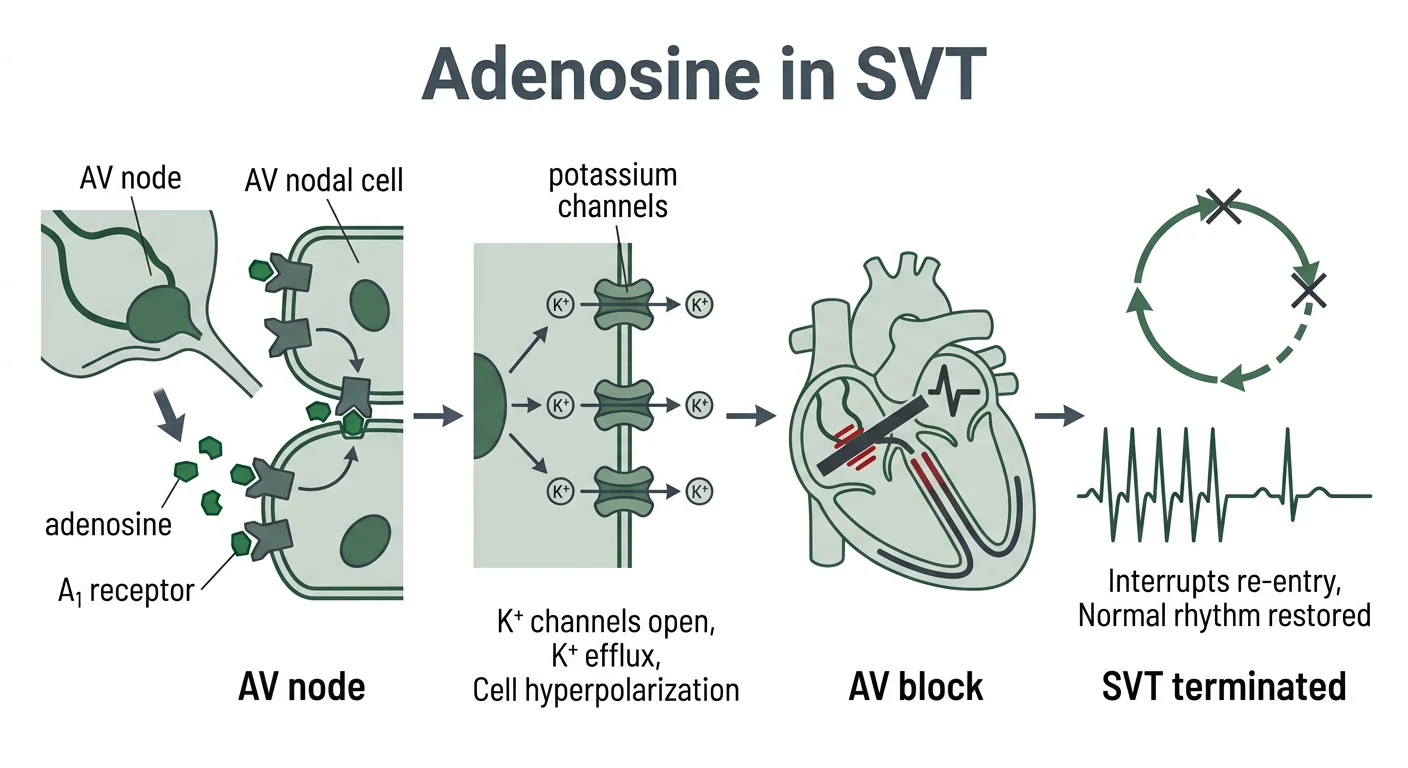
Adenosine activates A₁ receptors, lowers cAMP, opens K⁺ channels and suppresses Ca²⁺-dependent AV-nodal conduction. The resulting transient AV block can terminate AVNRT or orthodromic AVRT.
Clinical Correlation
Vignette 1 — Stable paroxysmal SVT
A young adult has a regular narrow-complex tachycardia, normal blood pressure and no ischaemic chest pain. A modified Valsalva manoeuvre fails; a rapid IV adenosine bolus terminates the rhythm, with transient flushing and chest pressure.
Reasoning: This is a stable, regular, AV-node-dependent re-entrant SVT. Vagal manoeuvres precede adenosine. Adenosine produces brief AV block through A₁-receptor activation, K⁺ efflux and reduced cAMP/Ca²⁺ current. If the patient were unstable, synchronized cardioversion—not delayed drug treatment—would be required.
Vignette 2 — Amiodarone pulmonary toxicity
A patient taking long-term amiodarone develops progressive dyspnoea, dry cough and new interstitial infiltrates.
Reasoning: Suspect amiodarone pneumonitis/pulmonary fibrosis after excluding competing causes. Stop amiodarone and obtain specialist assessment; corticosteroids may be used in clinically significant pneumonitis. Monitoring also includes thyroid and liver function, clinical pulmonary assessment and ECG review.
Vignette 3 — Acquired torsades de pointes
A patient taking sotalol develops syncope and polymorphic ventricular tachycardia with a prolonged QT interval in the setting of hypokalaemia.
Reasoning: Stop QT-prolonging drugs, give IV magnesium and correct potassium and magnesium. Defibrillate if the rhythm is pulseless or causes instability. Recurrent pause-dependent torsades may require overdrive pacing or heart-rate acceleration under expert care.
Vignette 4 — Ventricular tachycardia after myocardial ischaemia
A patient develops a regular wide-complex tachycardia after acute myocardial ischaemia.
Reasoning: First determine whether a pulse is present and whether the patient is stable. Unstable VT with a pulse requires synchronized cardioversion; pulseless VT requires defibrillation and resuscitation. Antiarrhythmic infusion is reserved for appropriate stable or refractory scenarios. Lidocaine is a Class IB option with preferential action in depolarised/ischaemic ventricular tissue; amiodarone and procainamide are alternatives in selected settings.
Vignette 5 — Pre-excited atrial fibrillation
An irregular wide-complex tachycardia occurs in a patient with ventricular pre-excitation.
Reasoning: Do not give isolated AV-nodal blockers (adenosine, beta-blocker, verapamil/diltiazem or digoxin), because accessory-pathway conduction can accelerate and degenerate into ventricular fibrillation. Urgent cardioversion or an appropriate pathway-active drug under specialist guidance is required.
Practical Linkage
Rhythm-to-intervention exercise
| Presentation | Immediate principle | Drug association |
|---|---|---|
| Stable, regular narrow-complex SVT | Vagal manoeuvres, then rapid IV adenosine | Adenosine |
| Unstable tachycardia with a pulse | Synchronized cardioversion | Do not delay shock for a drug |
| Pulseless VT/VF | Defibrillation and cardiac-arrest protocol | Amiodarone/lidocaine only within protocol |
| AF requiring rate control | Choose by EF and comorbidity | Beta-blocker or diltiazem/verapamil if appropriate; digoxin in selected patients |
| Acquired torsades | Remove cause, IV magnesium, correct K⁺/Mg²⁺ | Magnesium |
| Symptomatic bradycardia | Atropine; pace/escalate if ineffective | Atropine |
Practical station prompts
- Interpret before treating: regular or irregular, narrow or wide QRS, pulse present or absent, stable or unstable.
- Adenosine administration: continuous ECG monitoring, rapid IV push through a proximal line followed immediately by a saline flush; warn the patient about brief flushing/chest discomfort.
- Amiodarone monitoring: baseline and periodic thyroid/liver testing; assess pulmonary symptoms, ECG/QT and clinically indicated ocular/neurological effects; check interacting warfarin and digoxin therapy.
- QT audit: list QT-prolonging medicines, check K⁺/Mg²⁺, renal function, heart rate and baseline QTc.
- CAST discussion: Class IC suppression of ventricular ectopy did not translate into benefit; it increased mortality after MI, illustrating why a surrogate endpoint cannot replace patient outcomes.
Drug doses and shock energy should follow the institution's current resuscitation protocol; the key undergraduate skill is safe rhythm/stability classification and correct drug-class selection.
MCQ Bank
35 questions · tagged by topic, exam pattern & difficulty · full explanations
The Vaughan-Williams Class I antiarrhythmics act by blocking:
Rapid Revision
- Class I — fast sodium-channel blockers (IA, IB, IC)
- Class II — beta-blockers
- Class III — predominantly potassium-channel blockers
- Class IV — verapamil and diltiazem
- Fast-cell phase 0 — Na⁺ influx; Class I target
- Nodal phase 0 — L-type Ca²⁺ influx; Class IV target
- Nodal phase 4 — pacemaker depolarisation; flattened by Class II
- Phase 3 — K⁺ efflux; Class III target
- Class IA — prolongs APD/QT; quinidine, procainamide, disopyramide
- Class IB — shortens APD; lidocaine, mexiletine
- Class IC — marked conduction slowing with minimal APD change; flecainide, propafenone
- CAST lesson — Class IC drugs increased post-MI mortality; avoid in significant ischaemic/structural disease
- Procainamide — drug-induced lupus
- Quinidine — cinchonism and torsades
- Lidocaine — selected ventricular/ischaemic arrhythmias; neurological toxicity
- Esmolol — ultra-short-acting beta-blocker
- Sotalol — Class III plus beta-blockade; torsades risk
- Amiodarone — Class III with I, II and IV effects
- Amiodarone lung toxicity — pneumonitis/fibrosis
- Amiodarone thyroid toxicity — hypo- or hyperthyroidism
- Amiodarone interactions — increases warfarin effect and digoxin exposure
- Adenosine — stable regular AV-node-dependent SVT after vagal manoeuvres
- Adenosine mechanism — A₁ activation, ↓cAMP, K⁺ channel opening and transient AV block
- Adenosine adverse effects — flushing, chest pressure, dyspnoea; possible bronchospasm
- Methylxanthines — caffeine/theophylline antagonise adenosine
- Unstable tachycardia with pulse — synchronized cardioversion
- Pulseless VT/VF — defibrillation and resuscitation
- Acquired torsades — IV magnesium, stop culprits, correct K⁺/Mg²⁺; shock if unstable
- Pre-excited AF — avoid isolated AV-nodal blockers
- Symptomatic bradycardia — atropine, then pacing/escalation if ineffective
- Digoxin in AF — selected/adjunctive rate control; digoxin immune Fab is the toxicity antidote
Viva Questions
-
What are the four Vaughan-Williams classes?
I—Na⁺-channel blockers; II—beta-blockers; III—repolarisation/K⁺-channel blockers; IV—non-DHP Ca²⁺-channel blockers. -
How do Class IA, IB and IC differ?
IA moderately blocks Na⁺ and prolongs APD/QT; IB weakly blocks Na⁺ and shortens APD; IC markedly slows conduction with minimal APD change. -
Why is nodal phase 0 different from ventricular phase 0?
SA/AV nodal phase 0 depends on L-type Ca²⁺ influx, whereas fast myocardial/Purkinje phase 0 depends on fast Na⁺ influx. -
Which class is amiodarone?
Predominantly Class III, with clinically important Class I, II and IV effects. -
What is amiodarone's most serious chronic toxicity?
Pulmonary pneumonitis/fibrosis. -
Why does amiodarone cause thyroid dysfunction?
It is iodine-rich and also alters thyroid hormone metabolism and has direct thyroid effects. -
When is adenosine appropriate?
For a stable, regular narrow-complex AV-node-dependent SVT that persists after vagal manoeuvres. -
How does adenosine work?
A₁ (Gi) activation lowers cAMP, decreases Ca²⁺ current and opens K⁺ channels, causing transient AV block. -
What blunts adenosine?
Caffeine and theophylline, which antagonise adenosine receptors. -
What treats acquired torsades de pointes?
IV magnesium, withdrawal of culprits and correction of K⁺/Mg²⁺; immediate shock if unstable or pulseless. -
What is lidocaine used for?
Selected ventricular arrhythmias, particularly in depolarised/ischaemic ventricular tissue. -
What is the CAST-trial lesson?
Class IC suppression of ectopy increased mortality after MI; avoid these drugs in important ischaemic/structural heart disease. -
What treats symptomatic bradycardia?
Atropine may be tried; pacing or vasoactive support is required when ineffective. -
What is procainamide's classic toxicity?
Drug-induced lupus, particularly with prolonged exposure and slow acetylation. -
Why are AV-nodal blockers dangerous in pre-excited AF?
They may favour rapid accessory-pathway conduction and precipitate ventricular fibrillation. -
Is magnesium the antidote for digoxin toxicity?
No. Correct magnesium if deficient, but digoxin-specific immune Fab is the specific antidote for severe toxicity.
References
- Tripathi KD. Essentials of Medical Pharmacology. 9th ed. New Delhi: Jaypee Brothers; Chapter 38, Antiarrhythmic Drugs.
- Katzung BG, Vanderah TW, editors. Basic & Clinical Pharmacology. 16th ed. New York: McGraw Hill; Chapter 14, Agents Used in Cardiac Arrhythmias.
- Brunton LL, Knollmann BC, editors. Goodman & Gilman's The Pharmacological Basis of Therapeutics. 14th ed. New York: McGraw Hill; therapy of cardiac arrhythmias.
- Ritter JM, Flower RJ, Henderson G, Loke YK, MacEwan D, Robinson E. Rang & Dale's Pharmacology. 10th ed. Elsevier; chapter on the heart.
- National Medical Commission. Competency Based Undergraduate Curriculum for the Indian Medical Graduate, Volume II — Pharmacology; competency PH1.30.
- Echt DS, Liebson PR, Mitchell LB, et al. Mortality and morbidity in patients receiving encainide, flecainide, or placebo: the Cardiac Arrhythmia Suppression Trial. N Engl J Med. 1991;324:781–788.
- Brugada J, Katritsis DG, Arbelo E, et al. 2019 ESC Guidelines for the management of patients with supraventricular tachycardia. Eur Heart J. 2020;41:655–720.
- Zeppenfeld K, Tfelt-Hansen J, de Riva M, et al. 2022 ESC Guidelines for ventricular arrhythmias and prevention of sudden cardiac death. Eur Heart J. 2022;43:3997–4126.
- Joglar JA, Chung MK, Armbruster AL, et al. 2023 ACC/AHA/ACCP/HRS Guideline for the Diagnosis and Management of Atrial Fibrillation. Circulation. 2024;149:e1–e156.
- American Heart Association. 2025 Adult Tachycardia With a Pulse Algorithm. Accessed 24 August 2026.
Clinical algorithms change over time. Use the institution's current resuscitation protocol for patient care; this chapter is an undergraduate pharmacology learning resource.
Downloads
All deliverables & printable revision sheets for CH29
Printable Chapter Handout & Study Notes
Generate a clean, high-yield PDF or print directly without sidebars and navigation menus.