
Drugs for Heart Failure
Learning Objectives
At the end of this chapter, the Phase II MBBS student will be able to:
- Describe the neurohumoral basis of heart failure and the mortality-versus-symptom distinction. (PH1.29 — Knows)
- Explain digoxin's mechanism (Na+/K+-ATPase inhibition), kinetics and uses. (PH1.29 — Knows)
- Describe digoxin toxicity, its precipitants and its management with antibody fragments. (PH1.29 — Knows-how)
- List the drugs that reduce mortality in heart failure with reduced ejection fraction. (PH1.29 — Knows)
- Describe the role of ACE inhibitors, ARBs and sacubitril-valsartan (ARNI) in heart failure. (PH1.29 — Knows)
- Describe the beta-blockers and mineralocorticoid antagonists used in heart failure. (PH1.29 — Knows)
- Explain the role of SGLT2 inhibitors in heart failure. (PH1.29 — Knows)
- Manage acute pulmonary oedema. (PH1.29 — Shows-how)
- State why hypokalaemia precipitates digoxin toxicity. (PH1.29 — Knows)
- Explain why digoxin does not reduce mortality in heart failure. (PH1.29 — Knows)
Must-Know Summary
Heart failure activates the sympathetic and renin-angiotensin systems, and the modern therapy blocks these: the four mortality-reducing pillars are an ACE inhibitor/ARB/ARNI, a beta-blocker, a mineralocorticoid antagonist and an SGLT2 inhibitor. Digoxin, the cardiac glycoside, improves symptoms (positive inotropy) but does not reduce mortality, and its narrow therapeutic index makes hypokalaemia-precipitated toxicity the classic exam scenario — treated with digoxin antibody fragments.
In one line each:
- Digoxin — inhibits the Na+/K+-ATPase, increasing cardiac calcium
- Digoxin — positive inotropy with vagal slowing
- Digoxin toxicity — precipitated by hypokalaemia
- Digoxin toxicity — anorexia, xanthopsia, arrhythmias
- Digoxin antidote — antibody fragments (Digibind)
- The four pillars — ACEI/ARB/ARNI, beta-blocker, MRA, SGLT2 inhibitor
- Sacubitril-valsartan — an ARNI (neprilysin inhibition + ARB)
- SGLT2 inhibitors — reduce mortality even in non-diabetics
- Digoxin and diuretics — relieve symptoms, do not reduce mortality
- Pulmonary oedema — furosemide, nitrates, morphine, oxygen
Classification
BOX 1 — DRUGS FOR HEART FAILURE
Mortality-reducing (the four pillars)
- ACE inhibitors / ARBs / ARNI (sacubitril-valsartan)
- Beta-blockers — carvedilol, bisoprolol, metoprolol
- Mineralocorticoid antagonists — spironolactone, eplerenone
- SGLT2 inhibitors — dapagliflozin, empagliflozin
Symptomatic
- Digoxin (inotrope), loop diuretics (furosemide), ivabradine
BOX 2 — DIGOXIN (THE CARDIAC GLYCOSIDE)
- Mechanism — Na+/K+-ATPase inhibition → increased intracellular calcium
- Effects — positive inotropy, vagal slowing (negative chronotropy/dromotropy)
- Uses — symptomatic HFrEF, atrial-fibrillation rate control
- Toxicity — hypokalaemia-precipitated; antibody fragments (Digibind)
Core Concepts
1. Pathophysiology and neurohumoral basis of heart failure
Heart failure is the inability of the heart to pump adequately, and the failing heart triggers compensatory neurohumoral activation — the sympathetic nervous system and the renin-angiotensin-aldosterone system (RAAS) — which, chronically, worsens the remodelling and the disease. This gives the therapeutic principle: the drugs that block these systems reduce mortality, whereas the older positive inotropes and diuretics relieve symptoms but do not improve survival. The mortality-reducing classes are the ACE inhibitors/ARBs/ARNI, beta-blockers, mineralocorticoid antagonists and SGLT2 inhibitors — the "four pillars" of heart failure with reduced ejection fraction (HFrEF).
2. Digoxin — mechanism, kinetics and toxicity
Digoxin is a cardiac glycoside (from Digitalis). Its mechanism is the inhibition of the myocardial Na+/K+-ATPase: intracellular sodium rises, which reduces calcium extrusion through the Na+/Ca2+ exchanger, increasing intracellular calcium and producing a positive inotropic effect. It also has vagal effects, slowing the sinus rate and AV conduction (negative chronotropy and dromotropy).
Uses — symptomatic HFrEF (when other therapy is insufficient) and rate control in atrial fibrillation.
Kinetics — a narrow therapeutic index (therapeutic level ~0.5–2 ng/mL), renal excretion, a large volume of distribution (CH02), and a long half-life.
Toxicity is precipitated by hypokalaemia, hypomagnesaemia, hypercalcaemia, renal failure, and drugs that raise its level (amiodarone, verapamil, quinidine — CH06). Its features are anorexia and nausea, visual disturbances (xanthopsia — yellow/green vision), and arrhythmias — the classic digoxin-toxic rhythms being paroxysmal atrial tachycardia with block, bidirectional ventricular tachycardia and ventricular premature beats. Severe toxicity is treated with digoxin-specific antibody fragments (Digibind), which bind and inactivate the drug.
3. ACE inhibitors, ARBs and ARNI in heart failure
ACE inhibitors (enalapril, ramipril, lisinopril) and ARBs (valsartan, candesartan, losartan) reduce mortality in HFrEF by blocking the RAAS (CH26). The ARNI — sacubitril-valsartan — combines an ARB with sacubitril (a neprilysin inhibitor), which raises natriuretic peptides (vasodilation, natriuresis); it is superior to enalapril in HFrEF (PARADIGM-HF) and is now preferred where available.
4. Beta blockers and mineralocorticoid antagonists
Beta-blockers — carvedilol, bisoprolol, metoprolol succinate — reduce mortality in HFrEF (by blocking the sympathetic drive and reverse remodelling), given in stable, compensated patients at low, titrated doses (CH13).
Mineralocorticoid antagonists — spironolactone and eplerenone — block aldosterone, reducing fibrosis and sodium retention, and reduce mortality; they cause hyperkalaemia (and spironolactone gynaecomastia — eplerenone is more selective).
5. SGLT2 inhibitors in heart failure
The SGLT2 inhibitors — dapagliflozin and empagliflozin — are the newest mortality-reducing class in HFrEF, reducing death and heart-failure hospitalisation even in non-diabetic patients (through diuretic, metabolic and cardiorenal effects). They are now part of the four-pillar foundation.
6. Diuretics and acute pulmonary oedema
Loop diuretics (furosemide) relieve the congestion (symptoms) of heart failure but do not reduce mortality. Acute pulmonary oedema is managed with furosemide (IV), nitrates (venodilation), morphine (anxiolysis and venodilation — CH24) and oxygen, with the underlying cause addressed. (The loop-diuretic pharmacology is developed in CH30.)
Tables
Table 1 — Neurohumoral basis of heart failure
| System | Effect | Drug |
|---|---|---|
| Sympathetic | Tachycardia, vasoconstriction | Beta-blockers |
| RAAS | Vasoconstriction, sodium retention | ACEI/ARB/ARNI, MRA |
| Aldosterone | Fibrosis, sodium retention | Spironolactone, eplerenone |
Table 2 — Mortality-reducing drugs in HFrEF
| Class | Examples |
|---|---|
| ACEI/ARB/ARNI | Enalapril, valsartan, sacubitril-valsartan |
| Beta-blockers | Carvedilol, bisoprolol, metoprolol |
| MRAs | Spironolactone, eplerenone |
| SGLT2 inhibitors | Dapagliflozin, empagliflozin |
Table 3 — Digoxin
| Aspect | Detail |
|---|---|
| Mechanism | Na+/K+-ATPase inhibition |
| Effect | Positive inotropy, vagal slowing |
| Uses | Symptomatic HFrEF, AF rate control |
| Therapeutic range | 0.5–2 ng/mL |
Table 4 — Digoxin toxicity
| Precipitants | Features |
|---|---|
| Hypokalaemia, hypomagnesaemia | Anorexia, nausea |
| Hypercalcaemia, renal failure | Xanthopsia |
| Amiodarone, verapamil, quinidine | Arrhythmias (PAT with block) |
| — | Antidote: Digibind |
Table 5 — Sacubitril-valsartan (ARNI)
| Feature | Detail |
|---|---|
| Components | Sacubitril (neprilysin inhibitor) + valsartan (ARB) |
| Effect | Raises natriuretic peptides |
| Evidence | Superior to enalapril (PARADIGM-HF) |
Table 6 — SGLT2 inhibitors
| Feature | Detail |
|---|---|
| Examples | Dapagliflozin, empagliflozin |
| Effect | Mortality and hospitalisation reduction |
| Note | Effective even in non-diabetics |
Table 7 — Acute pulmonary oedema
| Intervention | Role |
|---|---|
| Furosemide (IV) | Diuresis |
| Nitrates | Venodilation (preload) |
| Morphine | Anxiolysis, venodilation |
| Oxygen | Hypoxaemia |
Figures
Figure 1 — Neurohumoral basis of heart failure and drug targets
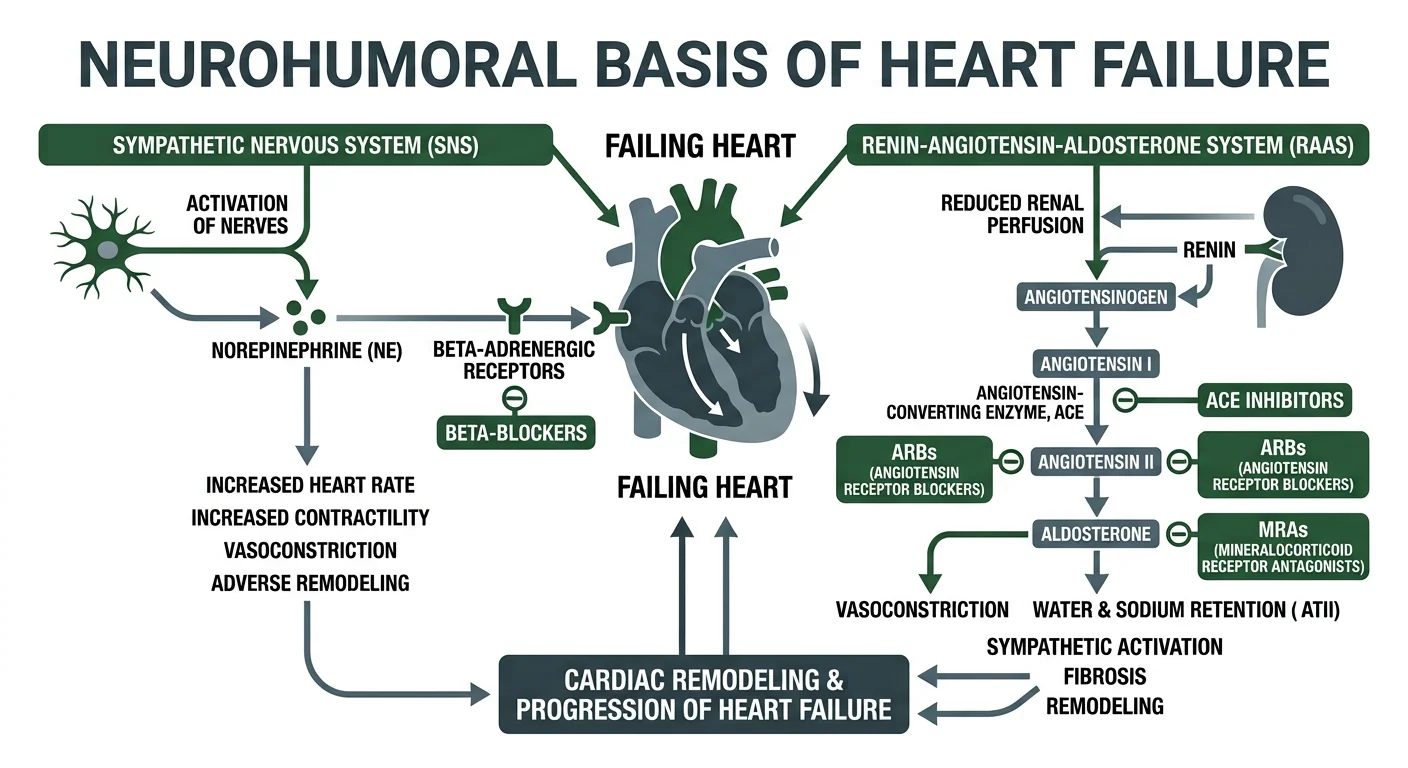
Diagram of the neurohumoral activation in heart failure — the sympathetic and renin-angiotensin systems — with the drug classes that block each.
Figure 2 — Digoxin mechanism
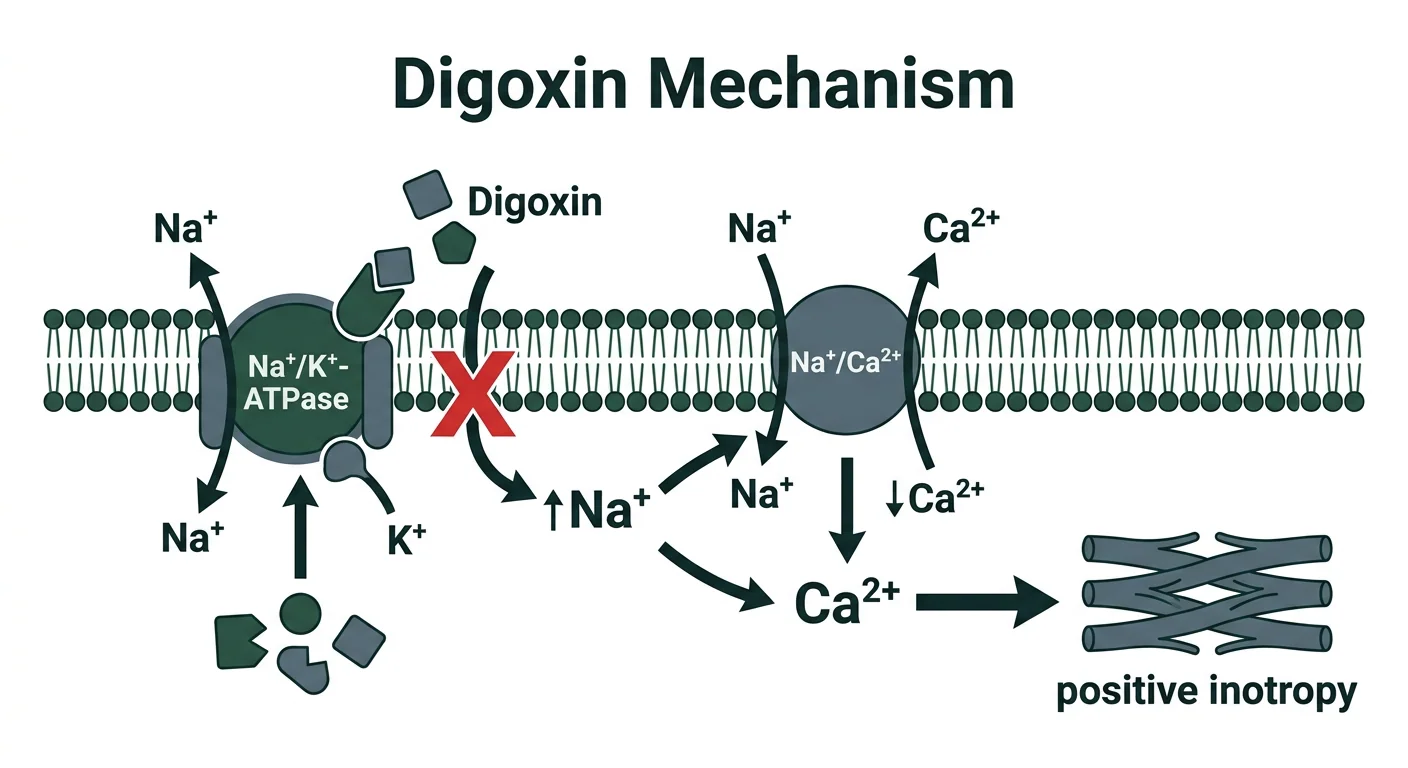
Diagram of digoxin's mechanism showing inhibition of the sodium-potassium ATPase, a rise in intracellular sodium and calcium through the sodium-calcium exchanger, producing positive inotropy.
Figure 3 — Digoxin toxicity
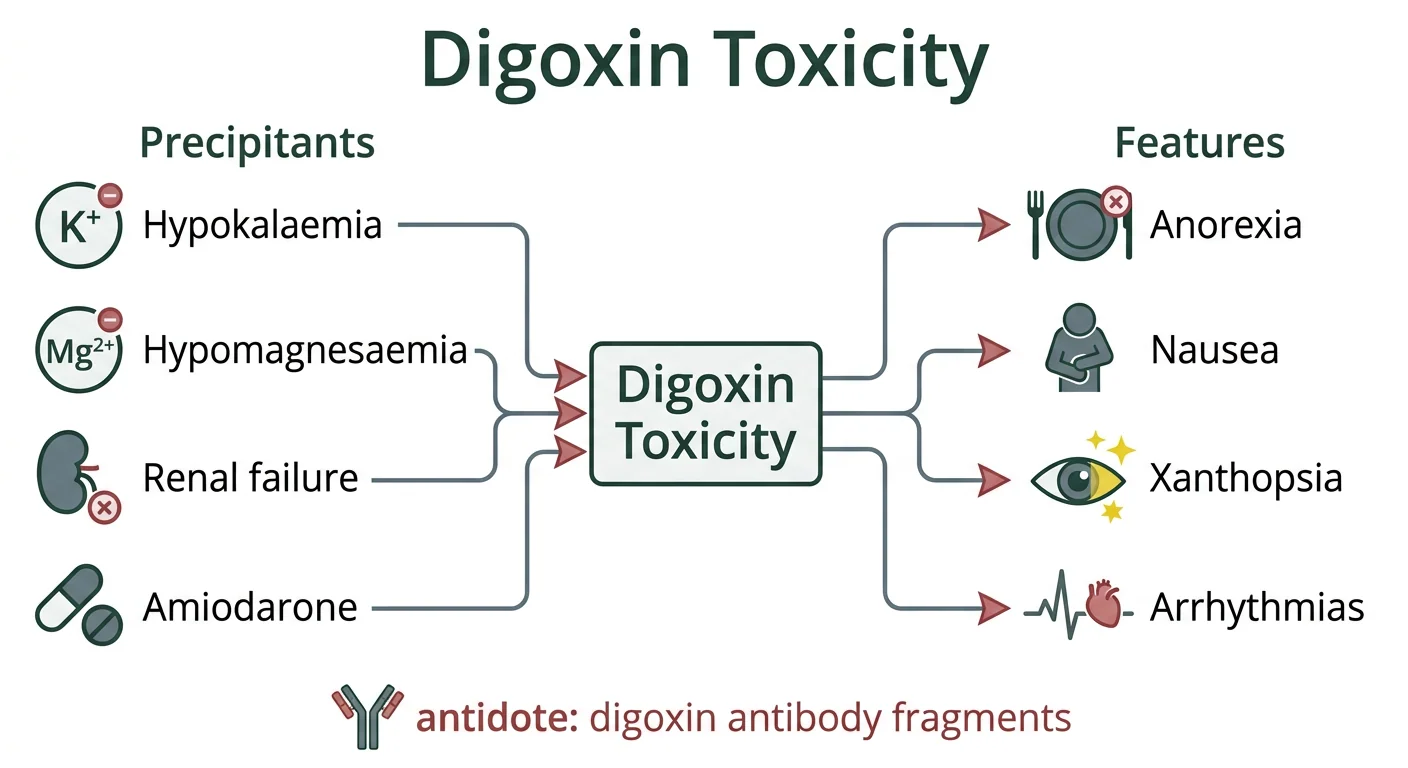
Diagram of digoxin toxicity showing its precipitants and features, with digoxin antibody fragments as the antidote.
Figure 4 — The four mortality-reducing pillars
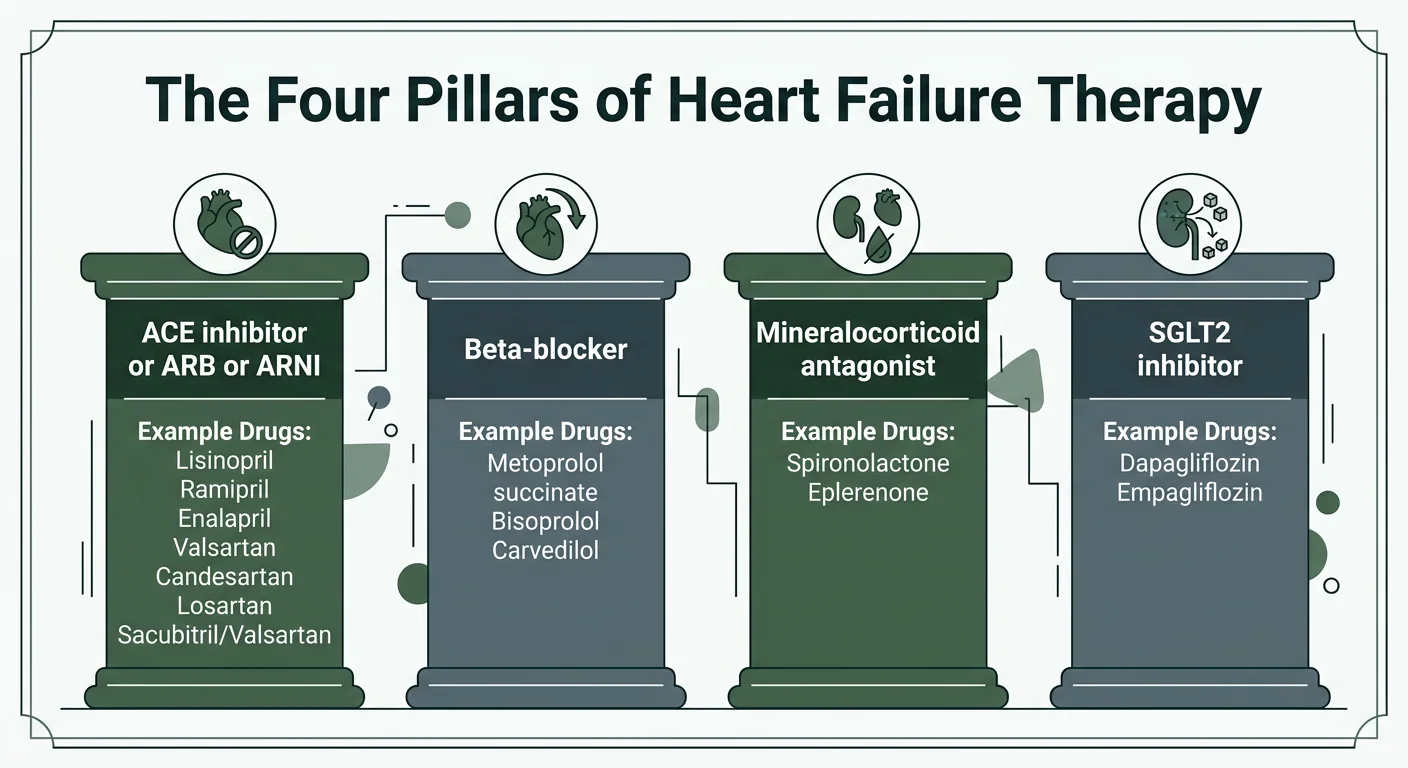
Diagram of the four mortality-reducing drug classes in heart failure — ACE inhibitors, beta-blockers, mineralocorticoid antagonists and SGLT2 inhibitors — with example drugs.
Clinical Correlation
Vignette 1 — Digoxin toxicity from hypokalaemia
A patient on digoxin and furosemide develops anorexia, nausea, yellow-tinted vision and an irregular pulse.
Reasoning: Furosemide-induced hypokalaemia sensitises the myocardium to digoxin (they compete for the Na+/K+-ATPase), precipitating digoxin toxicity — anorexia, nausea, xanthopsia (yellow vision) and arrhythmias. Management is to stop the digoxin, correct the potassium and magnesium, and use antibody fragments if severe. This is the classic digoxin-toxicity scenario (CH06).
Vignette 2 — Digoxin overdose
A patient who ingested a large amount of digoxin presents with life-threatening ventricular arrhythmias.
Reasoning: Severe digoxin toxicity is treated with digoxin-specific antibody fragments (Digibind), which bind and inactivate the drug, rapidly reversing the toxicity. Supportive care (electrolyte correction, arrhythmia management) accompanies it. This is the specific antidote of digoxin.
Vignette 3 — HFrEF therapy
A patient with heart failure and a reduced ejection fraction is started on the four-pillar combination: an ARNI, a beta-blocker, a mineralocorticoid antagonist and an SGLT2 inhibitor.
Reasoning: The four mortality-reducing pillars — ACEI/ARB/ARNI + beta-blocker + MRA + SGLT2 inhibitor — are the modern foundation of HFrEF therapy, each reducing death and hospitalisation. The ARNI (sacubitril-valsartan) is preferred over enalapril where available. This is the current evidence-based approach.
Vignette 4 — Acute pulmonary oedema
A patient with acute pulmonary oedema is given intravenous furosemide, nitrates, morphine and oxygen.
Reasoning: Acute pulmonary oedema is managed with furosemide (diuresis), nitrates (venodilation reducing preload), morphine (anxiolysis and venodilation) and oxygen, while the precipitant is treated. These provide symptom relief; the long-term mortality benefit comes from the four pillars.
Practical Linkage
| Scenario | Choice |
|---|---|
| HFrEF, newly diagnosed | Four pillars: ARNI/ACEI, beta-blocker, MRA, SGLT2 |
| Digoxin toxicity (hypokalaemia) | Stop digoxin, correct K+/Mg2+, antibody if severe |
| Atrial fibrillation, rate control | Digoxin (or beta-blocker/CCB) |
| Acute pulmonary oedema | Furosemide, nitrates, morphine, oxygen |
| Symptomatic HFrEF despite pillars | Add digoxin (symptomatic) |
Exercise (PH1.29 — select the heart-failure therapy)
Discussion point. Why does digoxin improve symptoms but not mortality?
Expected: digoxin is a positive inotrope that improves contractility and symptoms, but it does not reverse the neurohumoral remodelling that drives mortality — unlike the ACEI/ARB/beta-blocker/MRA/SGLT2 classes.
MCQ Bank
40 questions · tagged by topic, exam pattern & difficulty · full explanations
Digoxin's positive inotropic effect results from inhibition of:
Rapid Revision
- Digoxin — inhibits the Na+/K+-ATPase
- Digoxin — increases intracellular calcium, positive inotropy
- Digoxin — vagal slowing of the SA node and AV conduction
- Digoxin therapeutic range — 0.5 to 2 ng/mL
- Digoxin toxicity — hypokalaemia, hypomagnesaemia, renal failure
- Digoxin toxicity features — anorexia, xanthopsia, arrhythmias
- Digoxin-toxic arrhythmia — PAT with block, bidirectional VT
- Digoxin antidote — antibody fragments (Digibind)
- Digoxin and diuretics — symptom relief, no mortality reduction
- The four pillars — ACEI/ARB/ARNI, beta-blocker, MRA, SGLT2 inhibitor
- Sacubitril-valsartan — neprilysin inhibitor plus ARB
- Sacubitril-valsartan — superior to enalapril
- SGLT2 inhibitors — reduce mortality even in non-diabetics
- Heart-failure beta-blockers — carvedilol, bisoprolol, metoprolol
- MRAs — spironolactone, eplerenone
- Spironolactone — hyperkalaemia and gynaecomastia
- Eplerenone — less gynaecomastia
- Pulmonary oedema — furosemide, nitrates, morphine, oxygen
- Digoxin in atrial fibrillation — rate control
- Digoxin excretion — renal
- Neurohumoral blockade — reduces heart-failure mortality
- Loop diuretics — congestion relief, no mortality reduction
- Ivabradine in heart failure — reduces the high resting heart rate
- Natriuretic peptides — raised by sacubitril
- Digoxin does not reduce mortality — no remodelling reversal
- Beta-blockers in heart failure — start low, titrate slowly
Viva Questions
- What is digoxin's mechanism — Inhibition of the Na+/K+-ATPase, increasing intracellular calcium
- What are digoxin's effects — Positive inotropy with vagal slowing (negative chronotropy and dromotropy)
- What precipitates digoxin toxicity — Hypokalaemia, hypomagnesaemia, renal failure and amiodarone
- What are digoxin toxicity features — Anorexia, nausea, xanthopsia and arrhythmias
- What is digoxin's antidote — Digoxin-specific antibody fragments
- What is digoxin's therapeutic range — 0.5 to 2 ng/mL
- Does digoxin reduce mortality — No, it improves symptoms only
- What are the four mortality-reducing pillars — ACEI/ARB/ARNI, beta-blocker, MRA and SGLT2 inhibitor
- What is sacubitril-valsartan — An ARNI combining a neprilysin inhibitor and an ARB
- Do SGLT2 inhibitors help non-diabetics — Yes, they reduce heart-failure mortality in non-diabetics too
- Which beta-blockers reduce heart-failure mortality — Carvedilol, bisoprolol and metoprolol succinate
- What is spironolactone's adverse effect — Hyperkalaemia and gynaecomastia
- How is acute pulmonary oedema managed — Furosemide, nitrates, morphine and oxygen
- Why is digoxin used in atrial fibrillation — For rate control by slowing AV conduction
- Why does hypokalaemia precipitate digoxin toxicity — Digoxin and potassium compete for the Na+/K+-ATPase
References
- Tripathi KD. Essentials of Medical Pharmacology. 9th ed. New Delhi: Jaypee Brothers Medical Publishers; Chapter 37 (Drugs Used in Congestive Heart Failure).
- Katzung BG, Vanderah TW (eds). Basic & Clinical Pharmacology. 16th ed. New York: McGraw Hill; Chapter 13 (Drugs Used in Heart Failure).
- Brunton LL, Knollmann BC (eds). Goodman & Gilman's The Pharmacological Basis of Therapeutics. 14th ed. New York: McGraw Hill; Chapter 28 (Treatment of Heart Failure).
- Ritter JM, Flower RJ, Henderson G, et al. Rang & Dale's Pharmacology. 10th ed. Edinburgh: Elsevier; Chapter 21 (The Heart).
- National Medical Commission. Competency Based Undergraduate Curriculum for the Indian Medical Graduate, Volume II — Pharmacology (Code: PH), competency PH1.29.
- McMurray JJV, Packer M, Desai AS, et al. Angiotensin-neprilysin inhibition versus enalapril in heart failure (PARADIGM-HF). N Engl J Med. 2014;371(11):993–1004.
- McMurray JJV, Solomon SD, Inzucchi SE, et al. Dapagliflozin in patients with heart failure and reduced ejection fraction (DAPA-HF). N Engl J Med. 2019;381(21):1995–2008.
- Ponikowski P, Voors AA, Anker SD, et al. 2016 ESC Guidelines for the diagnosis and treatment of acute and chronic heart failure. Eur Heart J. 2016;37(27):2129–2200.
Downloads
All deliverables & printable revision sheets for CH28
Printable Chapter Handout & Study Notes
Generate a clean, high-yield PDF or print directly without sidebars and navigation menus.