
Antianginal & Drugs for Peripheral Vascular Disease
Learning Objectives
At the end of this chapter, the Phase II MBBS student will be able to:
- Describe the pathophysiology of angina as an imbalance of myocardial oxygen supply and demand. (PH1.28 — Knows)
- Explain the mechanism of organic nitrates (nitric oxide and cGMP). (PH1.28 — Knows)
- Explain nitrate tolerance and the nitrate-free interval. (PH1.28 — Knows)
- Describe the role of beta-blockers and calcium-channel blockers in angina, including the vasospastic-angina caution. (PH1.28 — Knows)
- Describe the newer antianginals — ivabradine, ranolazine and nicorandil. (PH1.28 — Knows)
- Explain the sildenafil-nitrate interaction. (PH1.28 — Knows)
- Describe the management of acute coronary syndrome (MONA). (PH1.28 — Knows-how)
- Describe the drugs for peripheral vascular disease (cilostazol, pentoxifylline). (PH1.28 — Knows)
- Select an appropriate antianginal for a given patient (exertional, vasospastic, bradycardic). (PH1.28 — Shows-how)
Must-Know Summary
Angina is the pain of myocardial ischaemia — an imbalance between oxygen supply and demand — and the antianginal drugs either reduce demand (beta-blockers, ivabradine) or improve supply (nitrates, calcium-channel blockers). The organic nitrates work by releasing nitric oxide, which relaxes vascular smooth muscle; their two clinical lessons are nitrate tolerance (prevented by a nitrate-free interval) and the sildenafil interaction (a profound hypotension, an absolute contraindication). The drug choice follows the angina type: beta-blockers for exertional angina, calcium-channel blockers for vasospastic (Prinzmetal) angina.
In one line each:
- Nitrates — release nitric oxide, activating guanylyl cyclase
- Nitrate tolerance — prevented by a nitrate-free interval
- Sildenafil plus a nitrate — profound hypotension, contraindicated
- Beta-blockers — reduce heart rate and contractility
- Prinzmetal angina — a calcium-channel blocker, not a beta-blocker
- Ivabradine — a funny-channel inhibitor, reduces heart rate
- Ranolazine — a late sodium-channel inhibitor
- Nicorandil — a potassium-channel opener plus nitrate
- MONA — morphine, oxygen, nitrates, aspirin
- Cilostazol — a PDE3 inhibitor for claudication
Classification
Box 1 — Antianginal drugs
- Nitrates — glyceryl trinitrate, isosorbide dinitrate, isosorbide mononitrate
- Beta-blockers — metoprolol, atenolol, bisoprolol
- Calcium-channel blockers — amlodipine, nifedipine; verapamil, diltiazem
- Newer agents — ivabradine, ranolazine, nicorandil
Box 2 — Drugs for peripheral vascular disease
- Cilostazol — PDE3 inhibitor (claudication)
- Pentoxifylline — viscosity reduction
Core Concepts
1. Pathophysiology of angina and myocardial oxygen demand
Angina pectoris is the pain of myocardial ischaemia, caused by an imbalance between myocardial oxygen supply (coronary blood flow) and demand (heart rate, contractility, wall tension). The therapeutic strategy is to reduce demand (beta-blockers, ivabradine), improve supply (nitrates, calcium-channel blockers), or both. The three clinical types — stable angina (exertional), unstable angina (at rest, part of the acute coronary syndromes) and vasospastic (Prinzmetal) angina (coronary spasm) — guide the drug choice.
2. Organic nitrates and nitrate tolerance
Organic nitrates — glyceryl trinitrate (GTN), isosorbide dinitrate, isosorbide mononitrate — are metabolised to release nitric oxide (NO), which activates guanylyl cyclase → cGMP, relaxing vascular smooth muscle. They are venodilators more than arteriolar dilators, reducing preload (and afterload) and dilating the coronary arteries — relieving angina by reducing myocardial work and improving supply.
Nitrate tolerance develops with continuous exposure (the vascular smooth muscle becomes refractory to the nitrates), and is prevented by a nitrate-free interval of 8–12 hours each day. GTN is used sublingually for acute attacks (rapid, bypassing first-pass — CH01); the long-acting nitrates (isosorbide mononitrate) are for prophylaxis.
3. Beta blockers and calcium channel blockers in angina
Beta-blockers (metoprolol, atenolol, bisoprolol — CH13) reduce heart rate and contractility, lowering myocardial oxygen demand — the mainstay of exertional (stable) angina and post-MI. They are avoided in vasospastic (Prinzmetal) angina, where they can worsen the coronary spasm.
Calcium-channel blockers (CH26): the dihydropyridines (amlodipine, nifedipine) dilate coronary arteries, and the non-dihydropyridines (verapamil, diltiazem) also reduce heart rate. CCBs are the drug of choice for vasospastic angina (they relieve the spasm) and are alternatives in stable angina.
4. Newer antianginals
- Ivabradine — a funny-channel (If) inhibitor that reduces the heart rate without affecting contractility or blood pressure — useful in angina when beta-blockers are contraindicated or insufficient.
- Ranolazine — a late sodium-channel inhibitor that improves myocardial metabolic efficiency, reducing ischaemia without significant haemodynamic effects.
- Nicorandil — a potassium-channel opener with a nitrate moiety (dual mechanism: vasodilation + preload reduction).
5. Management of stable angina, unstable angina and MI
Stable angina — sublingual GTN for the attack, with prophylaxis (beta-blocker, CCB, or a long-acting nitrate).
Acute coronary syndrome (unstable angina / MI) — the immediate measures are remembered by MONA: Morphine (analgesia), Oxygen, Nitrates (GTN), Aspirin (antiplatelet) — to which the modern bundle adds antiplatelets and anticoagulants (CH31), with reperfusion where indicated.
6. Drugs for peripheral vascular disease
Peripheral arterial disease (intermittent claudication) is treated symptomatically with:
- Cilostazol — a phosphodiesterase-3 (PDE3) inhibitor that inhibits platelet aggregation and dilates vessels, improving walking distance (contraindicated in heart failure).
- Pentoxifylline — reduces blood viscosity and improves red-cell flexibility.
Vasodilators and the CCBs are also used in Raynaud phenomenon.
Tables
Table 1 — Myocardial oxygen demand and supply
| Determinant | Drug |
|---|---|
| Heart rate | Beta-blockers, ivabradine |
| Contractility | Beta-blockers |
| Preload | Nitrates |
| Coronary dilation | Nitrates, CCBs |
Table 2 — Nitrates
| Aspect | Detail |
|---|---|
| Mechanism | NO → cGMP → vasodilation |
| Dominant effect | Venodilation (preload) |
| Tolerance | Nitrate-free interval (8–12 h) |
| Acute use | Sublingual GTN |
Table 3 — Beta-blockers versus CCBs in angina
| Feature | Beta-blockers | CCBs |
|---|---|---|
| Demand reduction | Heart rate, contractility | Heart rate (non-DHP) |
| Vasospastic angina | Worsen | Treat |
| Use | Exertional angina | Vasospastic, stable |
Table 4 — Newer antianginals
| Drug | Mechanism |
|---|---|
| Ivabradine | If-channel inhibition (heart rate) |
| Ranolazine | Late sodium-channel inhibition |
| Nicorandil | K+-channel opener + nitrate |
Table 5 — MONA in acute coronary syndrome
| Component | Drug |
|---|---|
| M | Morphine |
| O | Oxygen |
| N | Nitrates |
| A | Aspirin |
Table 6 — Peripheral vascular disease drugs
| Drug | Mechanism | Use |
|---|---|---|
| Cilostazol | PDE3 inhibition | Claudication |
| Pentoxifylline | Viscosity reduction | Claudication |
Figures
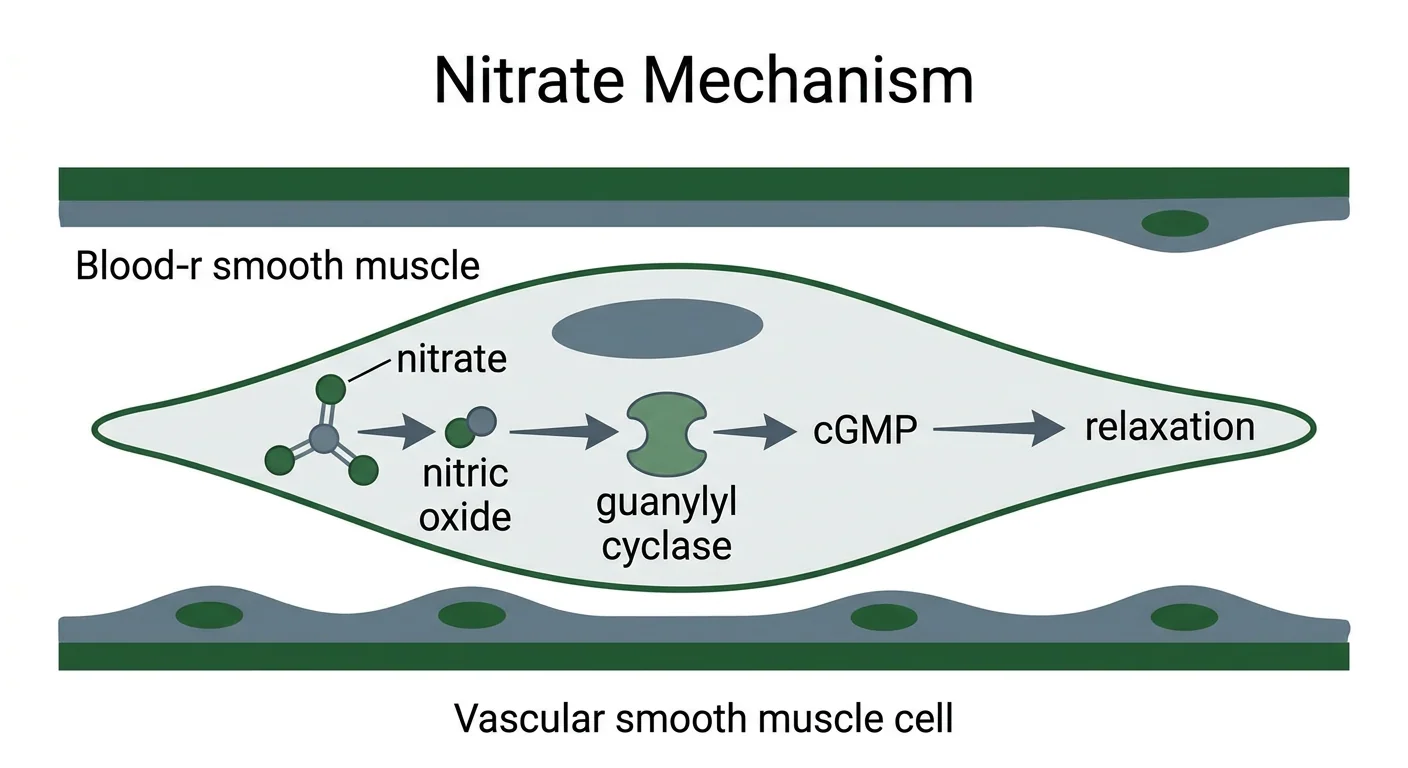
Figure 1 — Nitrate mechanism. Diagram of the nitrate mechanism showing nitrate releasing nitric oxide, activating guanylyl cyclase and producing cGMP, leading to vascular smooth muscle relaxation.
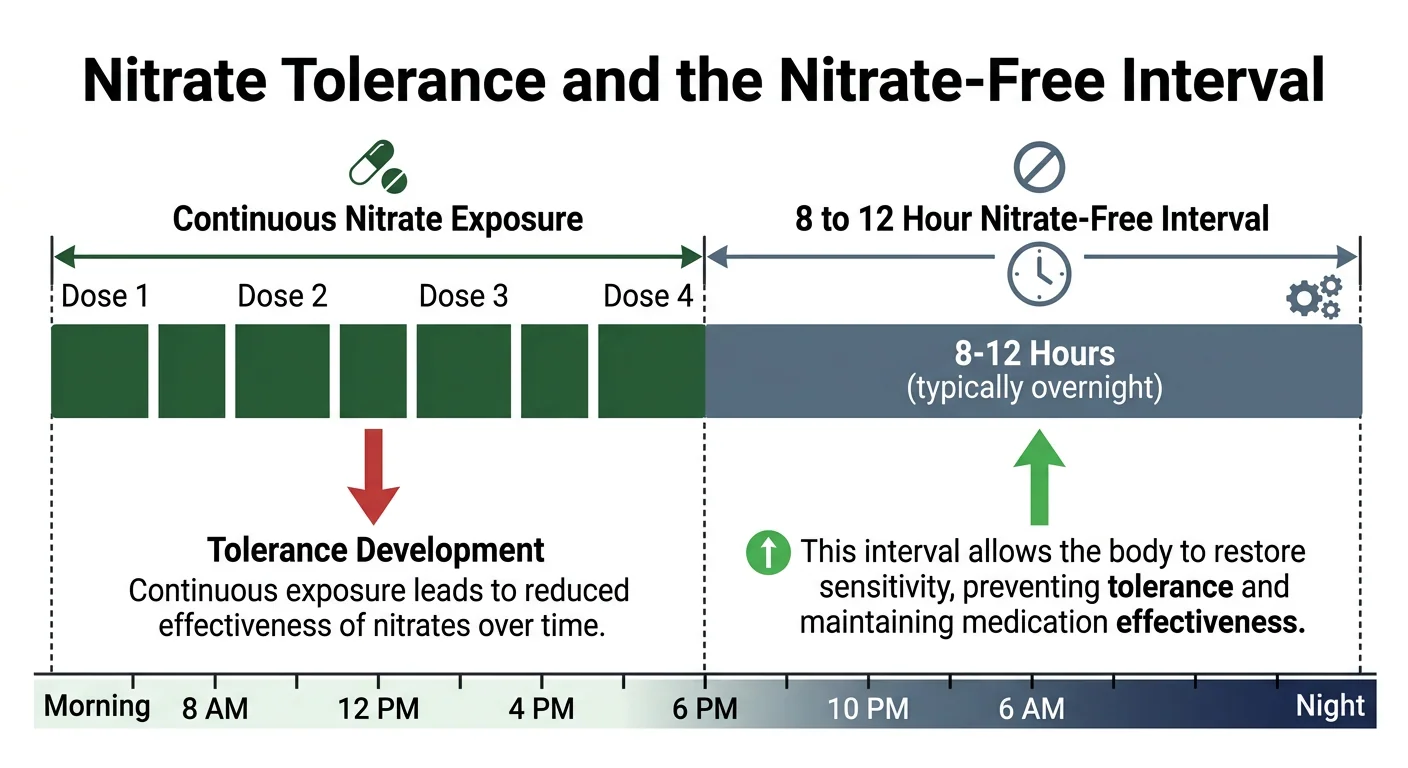
Figure 2 — Nitrate tolerance and the nitrate-free interval. Timeline diagram showing the nitrate-free interval of 8 to 12 hours each day that prevents the development of nitrate tolerance.
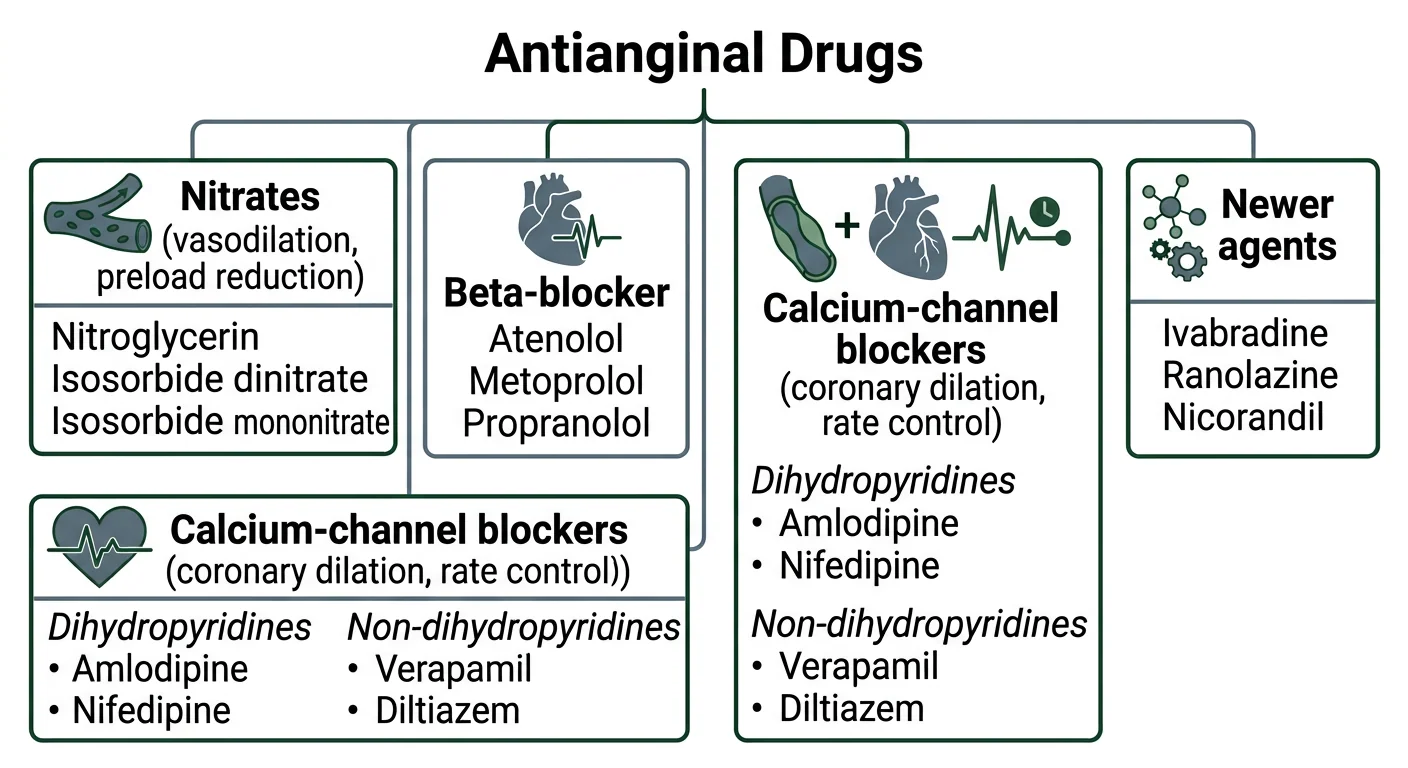
Figure 3 — Antianginal drug classes and targets. Classification of antianginal drugs into nitrates, beta-blockers, calcium-channel blockers and newer agents, with their mechanisms and example drugs.
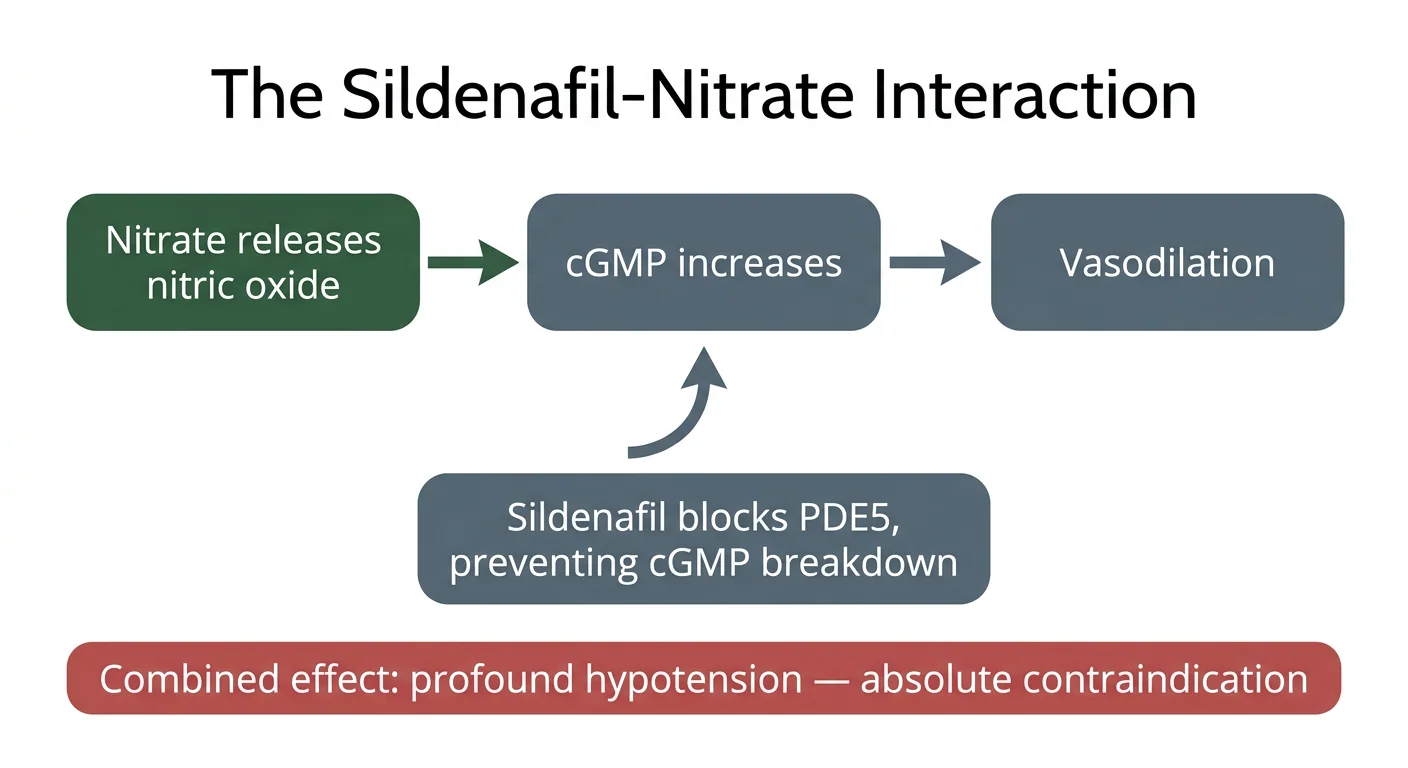
Figure 4 — The sildenafil-nitrate interaction. Diagram of the sildenafil-nitrate interaction showing both drugs raising cGMP, producing profound hypotension, marked as an absolute contraindication.
Clinical Correlation
Vignette 1 — Sildenafil and a sublingual nitrate
A patient who took sildenafil earlier uses sublingual glyceryl trinitrate for chest pain and develops profound, refractory hypotension.
Reasoning: Sildenafil inhibits phosphodiesterase-5, preventing cGMP breakdown, while the nitrate produces cGMP — the combination causes a massive, refractory hypotension. This is an absolute contraindication: nitrates must not be given within 24–48 hours of a PDE5 inhibitor (CH06). The patient must always be asked about sildenafil use before giving a nitrate.
Vignette 2 — Nitrate tolerance
A patient on a continuous nitrate patch finds that its antianginal effect fades after a few days.
Reasoning: This is nitrate tolerance — the vascular smooth muscle becomes refractory with continuous nitrate exposure. It is prevented by a nitrate-free interval (8–12 hours) each day, so the patch is removed overnight. This is the standard management of long-term nitrate therapy.
Vignette 3 — Vasospastic (Prinzmetal) angina
A young patient with chest pain at rest (with ST elevation) is treated with a calcium-channel blocker rather than a beta-blocker.
Reasoning: Prinzmetal (vasospastic) angina is caused by coronary spasm; a calcium-channel blocker (or nitrate) relieves the spasm, whereas a beta-blocker can worsen it. This is the classic "wrong drug for the wrong angina type" distinction.
Vignette 4 — Acute coronary syndrome
A patient with acute chest pain is given the MONA bundle: morphine, oxygen, nitrates and aspirin.
Reasoning: The immediate management of acute coronary syndrome is MONA — Morphine (analgesia and venodilation), Oxygen, Nitrates (GTN) and Aspirin (antiplatelet) — followed by the modern escalation of antiplatelets/anticoagulants (CH31) and reperfusion. MONA is the classic mnemonic for the acute measures.
Practical Linkage
Selecting the antianginal
| Patient | Choice | Rationale |
|---|---|---|
| Acute anginal attack | Sublingual GTN | Rapid, bypasses first-pass |
| Exertional angina | Beta-blocker (or CCB) | Reduce demand |
| Vasospastic angina | CCB (amlodipine) or nitrate | Relieve spasm |
| Bradycardic patient | Ivabradine or a CCB | Avoid beta-blocker |
| Claudication | Cilostazol | PDE3 inhibition |
Exercise (PH1.28 — select the antianginal)
Discussion point
Why must a nitrate-free interval be maintained?
Expected: continuous nitrate exposure causes tolerance, so an 8–12 hour nitrate-free interval each day preserves the antianginal effect.
MCQ Bank
35 questions · tagged by topic, exam pattern & difficulty · full explanations
With regard to their mechanism of action, organic nitrates relieve angina by:
Rapid Revision
- Nitrates — release nitric oxide, activate guanylyl cyclase
- Nitrate second messenger — cGMP
- Nitrates — venodilation more than arteriolar
- Nitrate tolerance — prevented by a nitrate-free interval
- Nitrate-free interval — 8 to 12 hours daily
- Sublingual GTN — bypasses first-pass, for acute attacks
- Sildenafil plus nitrate — profound hypotension, contraindicated
- Beta-blockers — reduce heart rate and contractility
- Prinzmetal angina — a calcium-channel blocker, not a beta-blocker
- Prinzmetal angina — coronary spasm
- Ivabradine — a funny-channel inhibitor, reduces heart rate
- Ranolazine — a late sodium-channel inhibitor
- Nicorandil — potassium-channel opener plus nitrate
- MONA — morphine, oxygen, nitrates, aspirin
- Cilostazol — a PDE3 inhibitor for claudication
- Cilostazol — contraindicated in heart failure
- Pentoxifylline — reduces blood viscosity
- GTN adverse effects — headache and hypotension
- Nitrate contraindications — hypotension, recent sildenafil
- Long-acting nitrate — isosorbide mononitrate
- Beta-blocker plus GTN — blunts reflex tachycardia
- Diltiazem and verapamil — rate control and angina
- Ranolazine advantage — no haemodynamic effects
- Ivabradine contraindication — severe bradycardia
- Morphine in ACS — analgesia and venodilation
- Aspirin in MONA — inhibits platelet aggregation
Viva Questions
- What is the nitrate mechanism — Release of nitric oxide, activating guanylyl cyclase and producing cGMP.
- What is the dominant haemodynamic effect of nitrates — Venodilation, reducing preload.
- What is nitrate tolerance and how is it prevented — A loss of effect with continuous exposure, prevented by a nitrate-free interval.
- What is the nitrate-free interval — 8 to 12 hours each day.
- Why are sildenafil and nitrates contraindicated together — Both raise cGMP, causing profound hypotension.
- How do beta-blockers help angina — They reduce heart rate and contractility, lowering oxygen demand.
- What is the treatment of Prinzmetal angina — A calcium-channel blocker or nitrate; beta-blockers are avoided.
- What is ivabradine's mechanism — Inhibition of the funny-channel, reducing heart rate.
- What is ranolazine — A late sodium-channel inhibitor.
- What is nicorandil — A potassium-channel opener with a nitrate moiety.
- What is MONA — Morphine, oxygen, nitrates and aspirin.
- What is cilostazol — A PDE3 inhibitor for claudication, contraindicated in heart failure.
- What is pentoxifylline — It reduces blood viscosity and improves red-cell flexibility.
- Why is sublingual GTN used acutely — It bypasses first-pass metabolism and acts rapidly.
- What are GTN's adverse effects — Headache and hypotension.
References
- Tripathi KD. Essentials of Medical Pharmacology. 9th ed. New Delhi: Jaypee Brothers Medical Publishers; Chapter 39 (Drugs Used in Angina Pectoris and Peripheral Vascular Disease).
- Katzung BG, Vanderah TW (eds). Basic & Clinical Pharmacology. 16th ed. New York: McGraw Hill; Chapter 12 (Vasodilators and the Treatment of Angina Pectoris).
- Brunton LL, Knollmann BC (eds). Goodman & Gilman's The Pharmacological Basis of Therapeutics. 14th ed. New York: McGraw Hill; Chapter 27 (Treatment of Ischemic Heart Disease).
- Ritter JM, Flower RJ, Henderson G, et al. Rang & Dale's Pharmacology. 10th ed. Edinburgh: Elsevier; Chapter 21 (The Heart).
- National Medical Commission. Competency Based Undergraduate Curriculum for the Indian Medical Graduate, Volume II — Pharmacology (Code: PH), competency PH1.28.
- Parker JD, Parker JO. Nitrate therapy for stable angina pectoris. New England Journal of Medicine. 1998;338(8):520–531.
- Beltrame JF, Crea F, Kaski JC, et al. The who, what, why, when, how and where of vasospastic angina. Circulation Journal. 2016;80(2):289–298.
- Boden WE, O'Rourke RA, Teo KK, et al. Optimal medical therapy with or without PCI for stable coronary disease. New England Journal of Medicine. 2007;356(15):1503–1516.
Downloads
All deliverables & printable revision sheets for CH27
Printable Chapter Handout & Study Notes
Generate a clean, high-yield PDF or print directly without sidebars and navigation menus.