
Antihypertensives (RAAS blockers, CCBs, Diuretics)
Learning Objectives
At the end of this chapter, the Phase II MBBS student will be able to:
- Describe the renin-angiotensin-aldosterone system and its role in blood-pressure regulation. (PH1.26 — Knows)
- Describe the mechanism, effects and adverse effects of the ACE inhibitors and ARBs. (PH1.26 — Knows)
- Explain the difference between ACE inhibitors and ARBs, especially the cough. (PH1.26 — Knows)
- Describe the calcium-channel blockers and differentiate the dihydropyridines from the non-dihydropyridines. (PH1.27 — Knows)
- Describe the role of diuretics, centrally-acting agents and vasodilators in hypertension. (PH1.27 — Knows)
- Select the appropriate antihypertensive for a given comorbidity (diabetes, pregnancy, heart failure, elderly). (PH1.27 — Shows-how)
- Manage a hypertensive emergency with intravenous agents. (PH1.27 — Knows-how)
- State why methyldopa is used in hypertension of pregnancy. (PH1.27 — Knows)
- Explain the adverse effects of nitroprusside, including cyanide toxicity. (PH1.27 — Knows)
- Describe the metabolic adverse effects of thiazide diuretics. (PH1.27 — Knows)
Must-Know Summary
The antihypertensives lower blood pressure by five mechanisms — blocking the renin-angiotensin system, the calcium channels, the beta receptors (CH13), the sympathetic outflow or the renal sodium handling — and the choice of drug follows the patient's comorbidities. The most examined facts are the ACE-inhibitor cough (bradykinin) with the ARB as the cough-free alternative, the dihydropyridine-vs-non-dihydropyridine CCB distinction, and the special-population choices (methyldopa in pregnancy, ACEI/ARB in diabetic proteinuria).
In one line each:
- ACE inhibitors — block angiotensin-II formation, cause a dry cough
- ARBs — block the AT1 receptor, no cough
- The ACE-inhibitor cough — bradykinin accumulation
- ACE inhibitors and ARBs — hyperkalaemia and teratogenicity
- Dihydropyridines — vasodilation, ankle oedema
- Non-dihydropyridines — rate control, AV block, constipation
- Methyldopa — the hypertension-in-pregnancy drug
- Nitroprusside — hypertensive emergency, cyanide toxicity
- Diabetic proteinuria — ACE inhibitor or ARB
- Elderly hypertension — a CCB or thiazide
Classification
Box 1 — Antihypertensive classes
- RAAS blockers — ACE inhibitors (captopril, enalapril, ramipril); ARBs (losartan, valsartan, telmisartan); aliskiren (renin inhibitor); sacubitril-valsartan (ARNI)
- Calcium-channel blockers — dihydropyridines (amlodipine, nifedipine); non-dihydropyridines (verapamil, diltiazem)
- Beta-blockers — metoprolol, atenolol, bisoprolol (CH13)
- Diuretics — thiazides (hydrochlorothiazide, chlorthalidone)
- Centrally acting — clonidine, alpha-methyldopa
- Vasodilators — hydralazine, minoxidil, sodium nitroprusside
Box 2 — The RAAS cascade and drug targets
- Renin (juxtaglomerular cells) → angiotensinogen → angiotensin I → angiotensin II (ACE) → vasoconstriction + aldosterone
- Targets: renin (aliskiren), ACE (ACE inhibitors), AT1 receptor (ARBs)
Core Concepts
1. Regulation of blood pressure and RAAS physiology
Blood pressure is determined by cardiac output and systemic vascular resistance, regulated by the sympathetic nervous system, the renin-angiotensin-aldosterone system (RAAS), and renal sodium handling. The RAAS cascade is the central target of the modern antihypertensives:
Renin (released from the juxtaglomerular cells in response to low renal perfusion, sympathetic stimulation, or low sodium) converts angiotensinogen (from the liver) to angiotensin I, which angiotensin-converting enzyme (ACE) — largely in the lungs — converts to angiotensin II. Angiotensin II causes vasoconstriction, stimulates aldosterone (sodium and water retention, potassium loss), and facilitates sympathetic activity. The drug targets follow directly: ACE inhibitors (block the enzyme), ARBs (block the AT1 receptor), and renin inhibitors (block renin).
2. ACE inhibitors and angiotensin receptor blockers
ACE inhibitors — captopril, enalapril, lisinopril, ramipril, perindopril — block the conversion of angiotensin I to angiotensin II, producing vasodilation, reduced aldosterone (less sodium/water retention, potassium retention), and — because ACE also degrades bradykinin — bradykinin accumulation.
Adverse effects (the most examined):
- Dry cough — the hallmark, from bradykinin accumulation in the airways.
- Angioedema — bradykinin-mediated, potentially life-threatening.
- Hyperkalaemia (reduced aldosterone).
- First-dose hypotension (especially with diuretics).
- Renal impairment — in bilateral renal-artery stenosis (the efferent-arteriolar protection is lost).
- Teratogenicity (renal dysgenesis — CH05); contraindicated in pregnancy.
ARBs — losartan, valsartan, telmisartan, candesartan, irbesartan — block the AT1 receptor directly, giving the same antihypertensive and renoprotective benefits without the cough (they do not affect bradykinin). They share the hyperkalaemia and teratogenicity. The "ARB for the ACE-inhibitor-cough patient" switch is the classic exam point.
3. Direct renin inhibitors and ARNI
Aliskiren is a direct renin inhibitor (blocks the first, rate-limiting step), with a limited role. The ARNI (angiotensin-receptor-neprilysin inhibitor) — sacubitril-valsartan — combines an ARB with a neprilysin inhibitor (raising natriuretic peptides) and is used in heart failure (CH28).
4. Calcium channel blockers
Calcium-channel blockers (CCBs) block L-type calcium channels, reducing vascular and/or cardiac contractility. They divide into two groups with distinct profiles:
- Dihydropyridines — amlodipine, nifedipine, felodipine — vascular-selective: they dilate arterioles, producing ankle oedema, flushing, headache and reflex tachycardia. They are excellent antihypertensives (amlodipine is first-line in many patients).
- Non-dihydropyridines — verapamil, diltiazem — cardiac-selective: they reduce heart rate and conduction (AV block), with negative inotropy; they are used for rate control and angina, but are avoided with beta-blockers (additive cardiac depression), and verapamil causes constipation.
5. Diuretics in hypertension
Thiazide diuretics (hydrochlorothiazide, chlorthalidone) are first-line antihypertensives, reducing blood pressure by sodium excretion (and later by reduced peripheral resistance). Their metabolic adverse effects are the examinable point: hypokalaemia, hyperglycaemia, hyperuricaemia (gout) and dyslipidaemia. (Their full pharmacology is CH30.)
6. Centrally acting and vasodilator antihypertensives
- Clonidine and alpha-methyldopa — central alpha-2 agonists that reduce sympathetic outflow. Methyldopa is the drug of choice for hypertension in pregnancy (safe in the fetus); its adverse effects include a positive Coombs test (haemolytic anaemia) and hepatitis.
- Hydralazine — a direct arteriolar vasodilator (used with a beta-blocker and diuretic to counter reflex tachycardia and fluid retention); labetalol and hydralazine are used in pre-eclampsia emergencies.
- Minoxidil — a potent vasodilator (also used topically for hair growth).
- Sodium nitroprusside — an intravenous arteriolar and venous dilator (releases nitric oxide) for hypertensive emergencies; its toxicity is cyanide (and thiocyanate) accumulation, especially with prolonged or high-dose infusion.
7. Stepped care, hypertensive emergency and special populations
Drug choice by comorbidity (the compelling indications):
- Diabetes with proteinuria — an ACE inhibitor or ARB (renoprotection — reduces proteinuria and slows nephropathy).
- Heart failure — an ACE inhibitor/ARB + beta-blocker + diuretic (CH28).
- Angina — a beta-blocker or CCB.
- Elderly — a CCB or thiazide (the preferred first-line).
- Pregnancy — methyldopa, labetalol or nifedipine (ACE inhibitors and ARBs are contraindicated).
Hypertensive emergency (severe hypertension with end-organ damage) is treated with intravenous labetalol, nitroprusside or nicardipine, with gradual, controlled reduction (avoiding rapid over-correction, which can cause cerebral or myocardial ischaemia).
Tables
Table 1 — The RAAS cascade and drug targets
| Step | Enzyme/hormone | Drug |
|---|---|---|
| Renin release | Juxtaglomerular cells | Aliskiren |
| Angiotensin I → II | ACE | ACE inhibitors |
| AT1 receptor | — | ARBs |
Table 2 — ACE inhibitors versus ARBs
| Feature | ACE inhibitors | ARBs |
|---|---|---|
| Mechanism | Block ACE | Block AT1 receptor |
| Cough | Yes (bradykinin) | No |
| Angioedema | Yes | Less |
| Hyperkalaemia | Yes | Yes |
| Teratogenicity | Yes | Yes |
Table 3 — Dihydropyridine versus non-dihydropyridine CCBs
| Feature | Dihydropyridines | Non-dihydropyridines |
|---|---|---|
| Selectivity | Vascular | Cardiac |
| Effects | Vasodilation, ankle oedema, reflex tachycardia | Rate control, AV block, negative inotropy |
| Examples | Amlodipine, nifedipine | Verapamil, diltiazem |
| Caution | — | Avoid with beta-blockers; constipation |
Table 4 — Antihypertensive classes
| Class | Mechanism | Key adverse effect |
|---|---|---|
| ACE inhibitors | Block ACE | Cough, angioedema, hyperkalaemia |
| ARBs | Block AT1 | Hyperkalaemia |
| DHP CCBs | Vasodilation | Ankle oedema |
| Non-DHP CCBs | Cardiac blockade | AV block, constipation |
| Thiazides | Natriuresis | Hypokalaemia, hyperglycaemia |
| Methyldopa | Central alpha-2 | Positive Coombs, hepatitis |
Table 5 — Compelling indications
| Comorbidity | Drug of choice |
|---|---|
| Diabetes + proteinuria | ACEI/ARB |
| Heart failure | ACEI + beta-blocker + diuretic |
| Angina | Beta-blocker, CCB |
| Elderly | CCB, thiazide |
| Pregnancy | Methyldopa, labetalol, nifedipine |
Table 6 — Hypertensive emergency
| Drug | Feature |
|---|---|
| Labetalol | IV, alpha + beta blockade |
| Nitroprusside | IV, cyanide toxicity |
| Nicardipine | IV CCB |
Table 7 — Pregnancy and diabetes
| Population | Preferred | Avoid |
|---|---|---|
| Pregnancy | Methyldopa, labetalol, nifedipine | ACEI, ARB |
| Diabetes + proteinuria | ACEI, ARB | — |
Figures
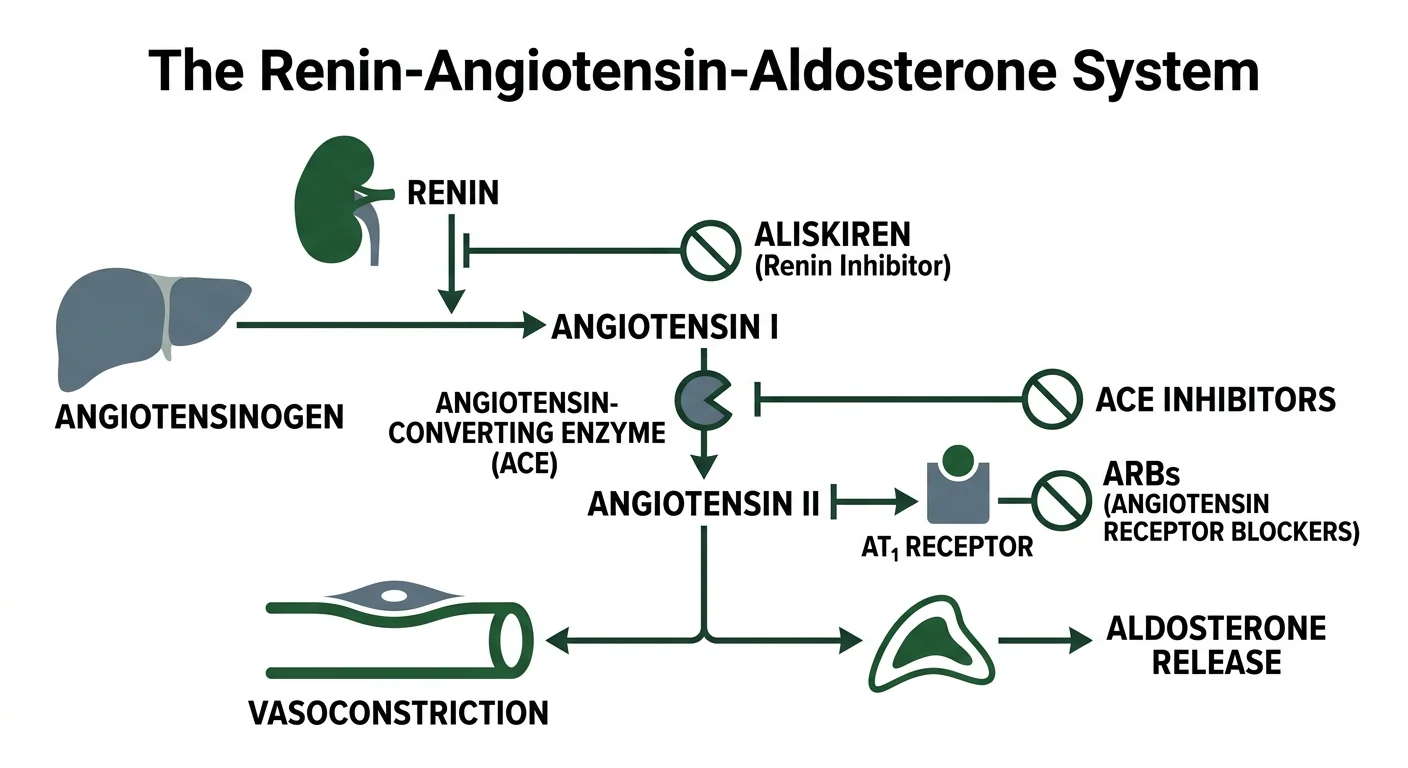
Figure 1 — The renin-angiotensin-aldosterone system and drug targets. Diagram of the renin-angiotensin-aldosterone cascade from renin through angiotensin I and II to vasoconstriction and aldosterone, with aliskiren, ACE inhibitors and ARBs at their targets.
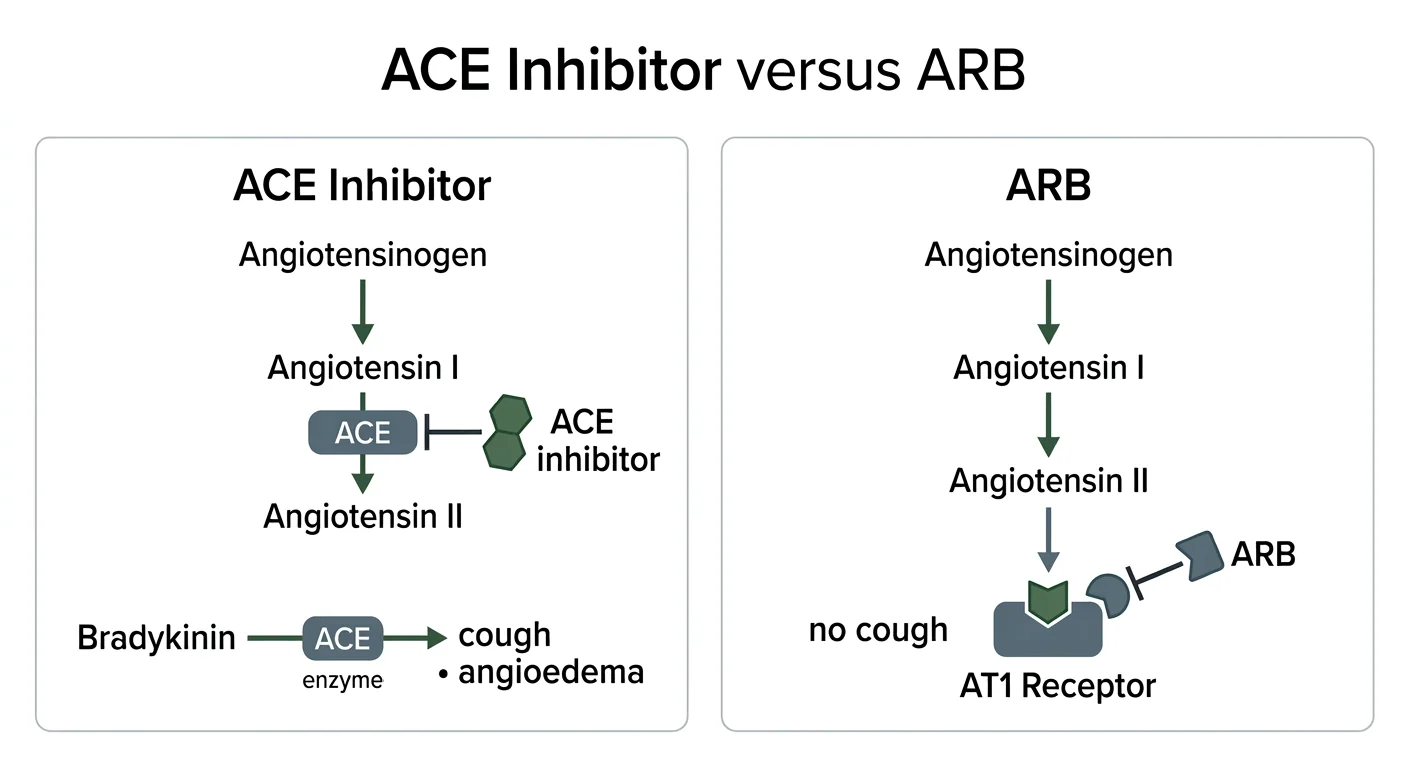
Figure 2 — ACE inhibitor versus ARB. Comparison of ACE inhibitors, which block ACE and cause bradykinin-mediated cough and angioedema, with ARBs, which block the AT1 receptor without affecting bradykinin and therefore cause no cough.
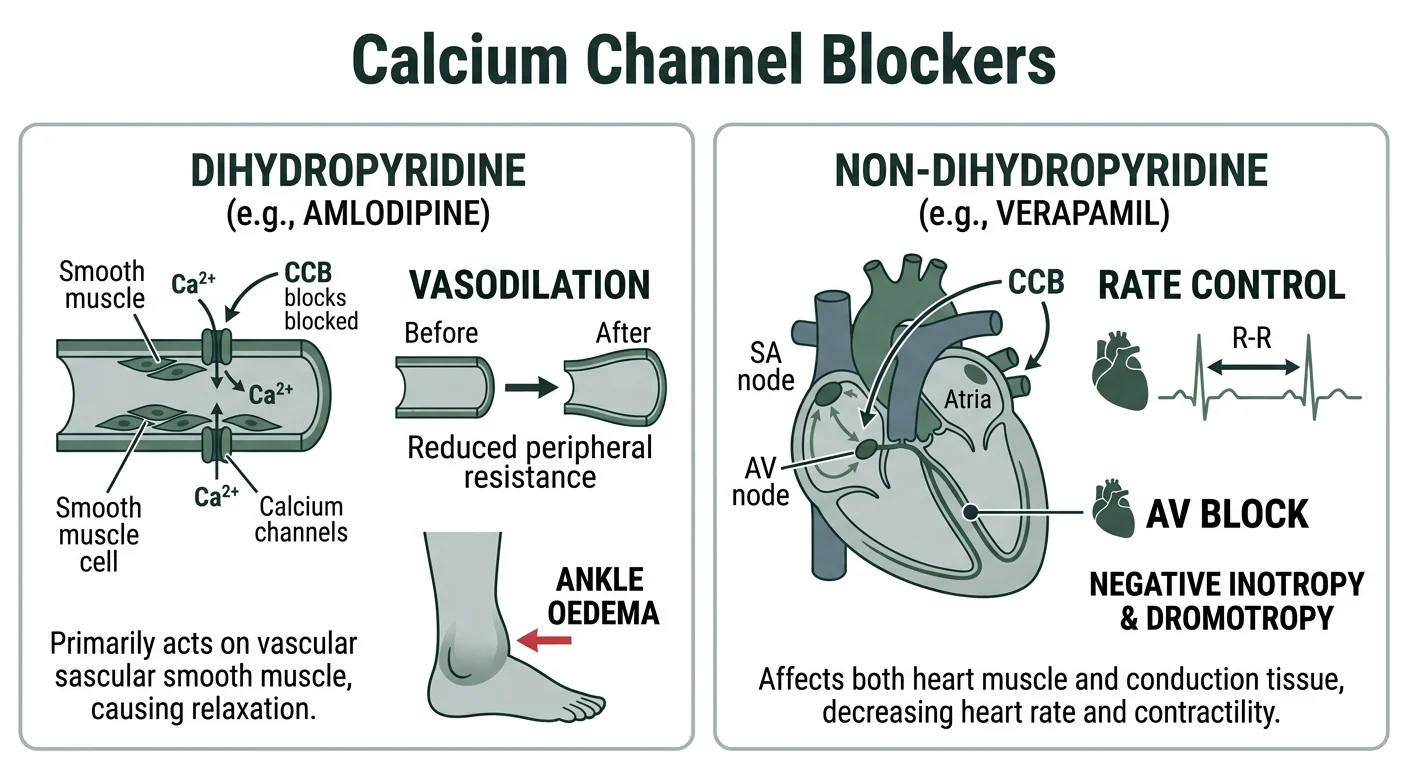
Figure 3 — Dihydropyridine versus non-dihydropyridine CCBs. Comparison of dihydropyridine calcium channel blockers, which dilate blood vessels causing ankle oedema, with non-dihydropyridines, which act on the heart causing rate control and AV block.
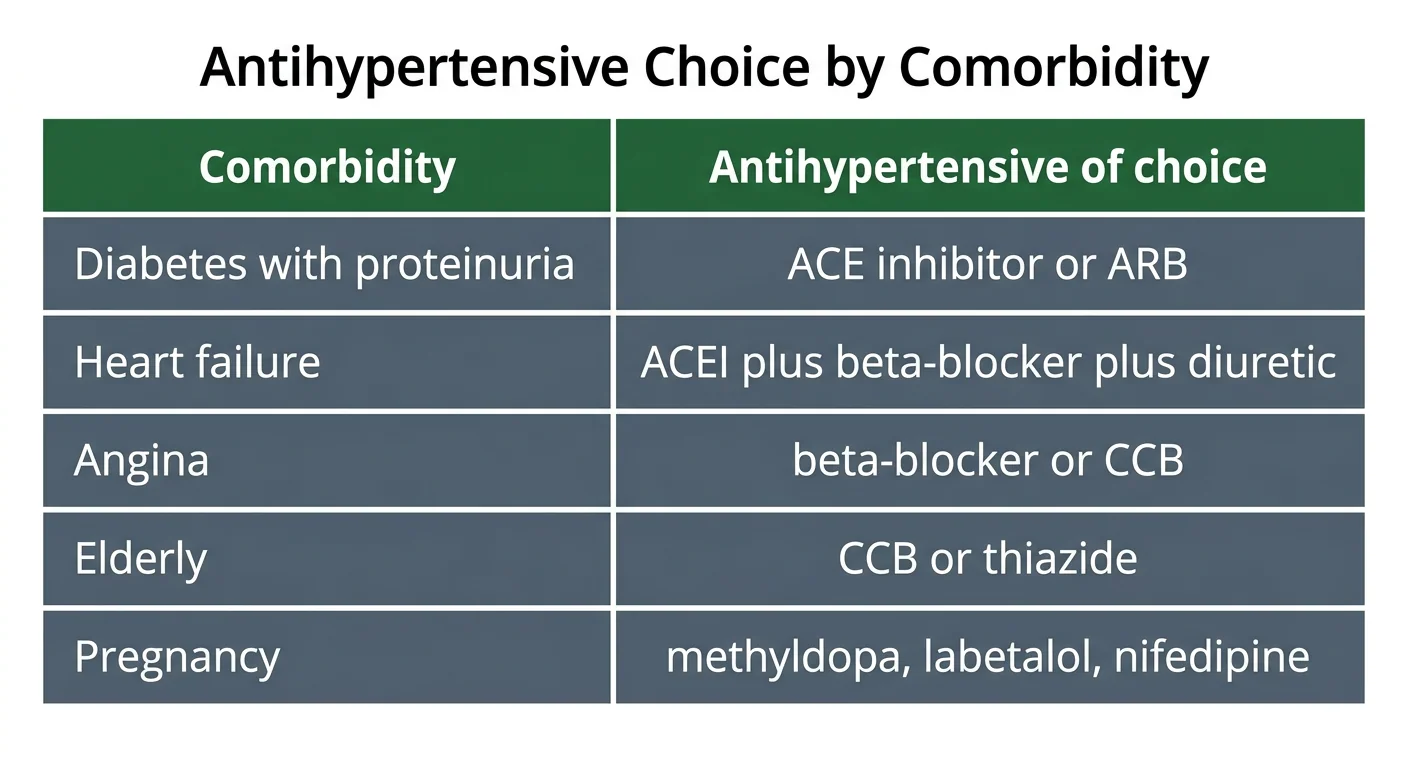
Figure 4 — Compelling indications. Diagram of the compelling indications pairing comorbidities with their antihypertensive of choice, including diabetes with ACE inhibitors, pregnancy with methyldopa, and the elderly with calcium channel blockers.
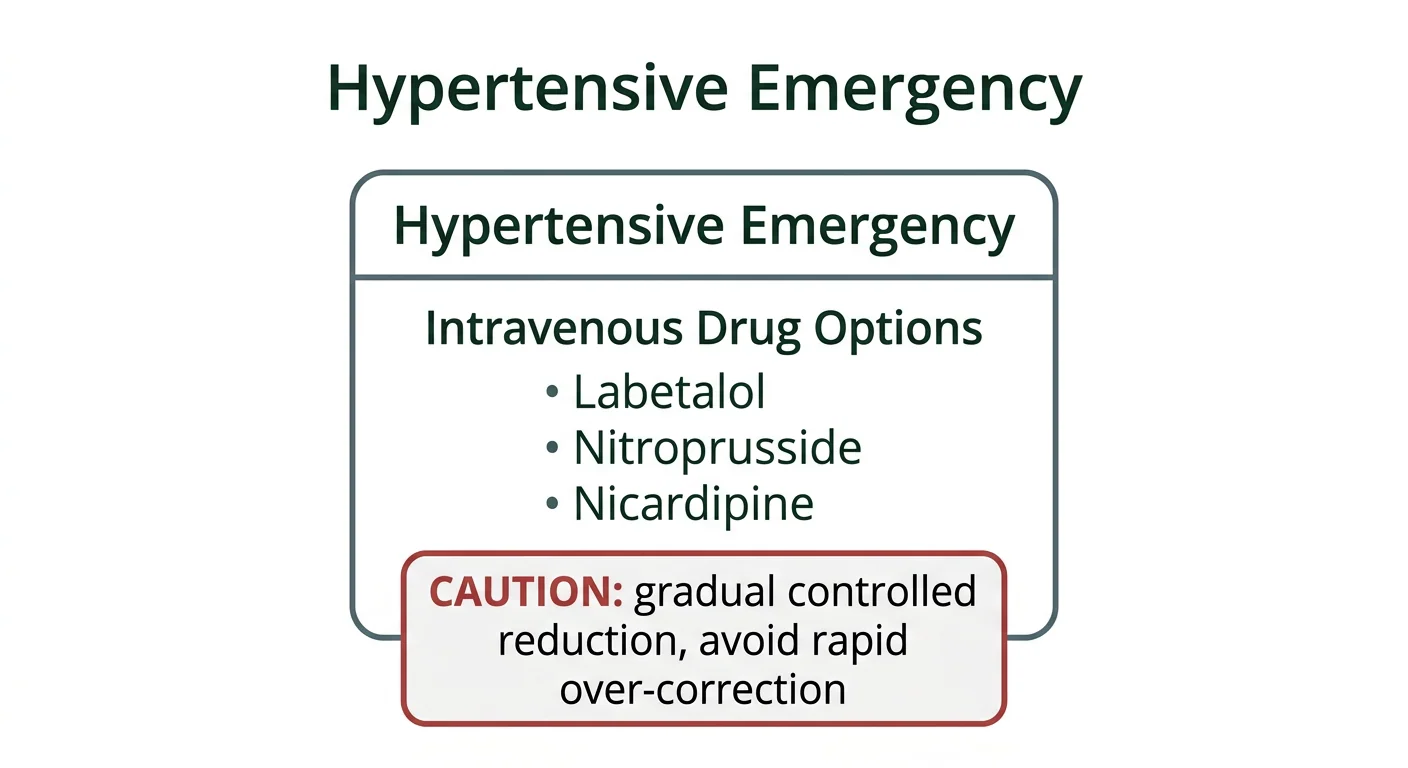
Figure 5 — Hypertensive emergency management. Diagram of hypertensive emergency management with intravenous labetalol, nitroprusside and nicardipine, and the caution to reduce blood pressure gradually.
Clinical Correlation
Vignette 1 — ACE-inhibitor cough
A patient started on enalapril develops a persistent dry cough, and the clinician switches to losartan, which relieves it.
Reasoning: The ACE-inhibitor cough is caused by bradykinin accumulation (ACE normally degrades bradykinin). Switching to an ARB (losartan) — which blocks the AT1 receptor without affecting bradykinin — relieves the cough while preserving the antihypertensive and renoprotective effect. This is the classic ACEI-vs-ARB switch.
Vignette 2 — Angioedema with an ACE inhibitor
A patient on ramipril develops swelling of the lips and tongue with breathing difficulty.
Reasoning: This is angioedema — a bradykinin-mediated, potentially life-threatening reaction to an ACE inhibitor. The drug must be stopped, the airway secured, and the patient managed acutely; an ARB may be used subsequently (with caution, as angioedema can rarely recur). This is the most serious ACE-inhibitor adverse effect.
Vignette 3 — Hypertension in a diabetic with proteinuria
A diabetic patient with hypertension and proteinuria is started on an ACE inhibitor.
Reasoning: In diabetes with proteinuria, an ACE inhibitor (or ARB) is the drug of choice because it reduces intraglomerular pressure and proteinuria, providing renoprotection beyond its blood-pressure effect. This is the defining compelling indication for RAAS blockade.
Vignette 4 — Hypertensive emergency
A patient with a blood pressure of 220/130 mmHg and papilloedema is treated with intravenous labetalol.
Reasoning: This is a hypertensive emergency (severe hypertension with end-organ damage). It is treated with an intravenous agent — labetalol, nitroprusside or nicardipine — with gradual, controlled reduction to avoid rapid over-correction (which can cause cerebral or myocardial ischaemia). Nitroprusside's use is limited by its cyanide toxicity.
Practical Linkage
Selecting the antihypertensive
| Patient | Choice | Rationale |
|---|---|---|
| Young patient, no comorbidity | ACEI/ARB or CCB | First-line |
| Elderly | Amlodipine or thiazide | Preferred first-line |
| Diabetic + proteinuria | ACEI/ARB | Renoprotection |
| Pregnant | Methyldopa, labetalol | Safe; avoid ACEI/ARB |
| Heart failure | ACEI + beta-blocker + diuretic | Mortality benefit |
Exercise (PH1.27 — select the antihypertensive)
Discussion point
Why is methyldopa used in hypertension of pregnancy?
Expected: it is effective and safe for the fetus, whereas ACE inhibitors and ARBs are teratogenic and contraindicated.
MCQ Bank
40 questions · tagged by topic, exam pattern & difficulty · full explanations
The enzyme that converts angiotensin I to angiotensin II is:
Rapid Revision
- Renin — released from juxtaglomerular cells
- ACE — converts angiotensin I to angiotensin II
- Angiotensin II — vasoconstriction and aldosterone release
- ACE inhibitors — block ACE, causing a dry cough
- ACE-inhibitor cough — bradykinin accumulation
- ARBs — block the AT1 receptor, no cough
- ACEI and ARB shared effects — hyperkalaemia, teratogenicity
- ACEI in renal-artery stenosis — acute renal failure
- ACEI angioedema — bradykinin-mediated
- Dihydropyridines — vasodilation, ankle oedema, reflex tachycardia
- Non-dihydropyridines — rate control, AV block, constipation
- Verapamil and beta-blockers — avoid combining
- Methyldopa — hypertension in pregnancy
- Methyldopa adverse effects — positive Coombs, hepatitis
- Nitroprusside — hypertensive emergency, cyanide toxicity
- Nitroprusside — releases nitric oxide
- Thiazide adverse effects — hypokalaemia, hyperglycaemia, hyperuricaemia
- Diabetic proteinuria — ACE inhibitor or ARB
- Elderly hypertension — CCB or thiazide
- Hypertensive emergency — IV labetalol, nitroprusside, nicardipine
- Avoid rapid over-correction — cerebral and myocardial ischaemia
- Aliskiren — a direct renin inhibitor
- Sacubitril-valsartan — an ARNI for heart failure
- Clonidine and methyldopa — central alpha-2 agonists
- Hydralazine — direct arteriolar vasodilator
- Labetalol — alpha plus beta blockade
- Minoxidil — hypertrichosis
- Chlorthalidone — long-acting thiazide-like diuretic
- Thiazide hypokalaemia — torsades de pointes risk
- First-dose ACEI hypotension — in volume-depleted patients
Viva Questions
- What does ACE convert — Angiotensin I to angiotensin II.
- What are the effects of angiotensin II — Vasoconstriction and aldosterone release.
- Why do ACE inhibitors cause cough — Bradykinin accumulation.
- What is the alternative for an ACE-inhibitor cough — An ARB, which does not affect bradykinin.
- What adverse effects do ACE inhibitors and ARBs share — Hyperkalaemia and teratogenicity.
- Differentiate dihydropyridine and non-dihydropyridine CCBs — Dihydropyridines are vasodilators (ankle oedema); non-dihydropyridines are cardiac (rate control, AV block).
- Why avoid verapamil with beta-blockers — Additive cardiac depression and heart block.
- What is the drug of choice for hypertension in pregnancy — Methyldopa.
- What is nitroprusside's toxicity — Cyanide accumulation.
- What is the first-line antihypertensive in the elderly — A CCB or thiazide.
- What is the choice in diabetic proteinuria — An ACE inhibitor or ARB for renoprotection.
- How is a hypertensive emergency treated — With IV labetalol, nitroprusside or nicardipine.
- Why avoid rapid over-correction — Risk of cerebral and myocardial ischaemia.
- What is aliskiren — A direct renin inhibitor.
- What are thiazide metabolic adverse effects — Hypokalaemia, hyperglycaemia, hyperuricaemia and dyslipidaemia.
References
- Tripathi KD. Essentials of Medical Pharmacology. 9th ed. New Delhi: Jaypee Brothers Medical Publishers; Chapter 40 (Drugs Affecting the Renin-Angiotensin System and Antihypertensive Drugs).
- Katzung BG, Vanderah TW (eds). Basic & Clinical Pharmacology. 16th ed. New York: McGraw Hill; Chapter 11 (Antihypertensive Agents).
- Brunton LL, Knollmann BC (eds). Goodman & Gilman's The Pharmacological Basis of Therapeutics. 14th ed. New York: McGraw Hill; Chapter 28 (Treatment of Hypertension).
- Ritter JM, Flower RJ, Henderson G, et al. Rang & Dale's Pharmacology. 10th ed. Edinburgh: Elsevier; Chapter 22 (The Heart and Antihypertensive Drugs).
- National Medical Commission. Competency Based Undergraduate Curriculum for the Indian Medical Graduate, Volume II — Pharmacology (Code: PH), competencies PH1.26 and PH1.27.
- Whelton PK, Carey RM, Aronow WS, et al. 2017 ACC/AHA Guideline for the Prevention, Detection, Evaluation, and Management of High Blood Pressure in Adults. Journal of the American College of Cardiology. 2018;71(19):e127–e248.
- James PA, Oparil S, Carter BL, et al. 2014 evidence-based guideline for the management of high blood pressure in adults (JNC 8). JAMA. 2014;311(5):507–520.
- Magee LA, Pels A, Helewa M, et al. Diagnosis, evaluation, and management of the hypertensive disorders of pregnancy. Journal of Obstetrics and Gynaecology Canada. 2014;36(5):416–441.
Downloads
All deliverables & printable revision sheets for CH26
Printable Chapter Handout & Study Notes
Generate a clean, high-yield PDF or print directly without sidebars and navigation menus.