
CNS Stimulants, Cognition Enhancers, Drug Dependence & Abuse
Learning Objectives
At the end of this chapter, the Phase II MBBS student will be able to:
- Describe the CNS stimulants (amphetamines, cocaine, caffeine) and their mechanisms. (PH1.22 — Knows)
- Describe the acute and chronic effects of ethanol, including the disulfiram reaction. (PH1.20 — Knows)
- Explain methanol and ethylene glycol poisoning and manage them with fomepizole or ethanol. (PH1.21 — Knows-how)
- Describe the drugs of abuse by class, including psychedelics and the drugs used for criminal offences. (PH1.22 — Knows)
- Explain the process and mechanism of drug deaddiction for alcohol, opioids and nicotine. (PH1.23 — Knows)
- Recognise Wernicke encephalopathy and state the thiamine-before-glucose rule. (PH1.20 — Knows-how)
- Describe ethanol withdrawal and its management. (PH1.20 — Knows)
- State the mechanism of fomepizole. (PH1.21 — Knows)
- Select an appropriate deaddiction strategy for a given substance dependence. (PH1.23 — Shows-how)
- Explain why disulfiram produces its aversive reaction. (PH1.23 — Knows)
Must-Know Summary
Ethanol and the drugs of abuse share a common pharmacology of intoxication, dependence and withdrawal, and the chapter's exam weight sits in the toxicology. The key facts: methanol is metabolised to formic acid (acidosis and blindness) and is treated with fomepizole or ethanol to block alcohol dehydrogenase; the disulfiram reaction results from acetaldehyde accumulation; and Wernicke encephalopathy in alcoholics is treated with thiamine before glucose. Deaddiction is substance-specific — buprenorphine/methadone for opioids, disulfiram/naltrexone/acamprosate for alcohol, and replacement/bupropion/varenicline for nicotine.
In one line each:
- Methanol — metabolised to formic acid, causing acidosis and blindness
- Fomepizole — blocks alcohol dehydrogenase
- The disulfiram reaction — acetaldehyde accumulation
- Wernicke encephalopathy — thiamine before glucose
- Opioid deaddiction — buprenorphine or methadone substitution
- Alcohol deaddiction — disulfiram, naltrexone, acamprosate
- Nicotine deaddiction — replacement, bupropion, varenicline
- Cocaine — blocks catecholamine reuptake
- Amphetamines — release catecholamines
- Caffeine — an adenosine antagonist
Classification
Box 1 — Drugs of abuse
- Stimulants — cocaine, amphetamines, caffeine
- Depressants — ethanol, benzodiazepines, barbiturates
- Opioids — heroin, morphine
- Psychedelics — LSD, cannabis
- Inhalants — volatile solvents
Box 2 — Deaddiction agents
- Alcohol — disulfiram, naltrexone, acamprosate, benzodiazepines (withdrawal)
- Opioid — buprenorphine, methadone, naltrexone
- Nicotine — nicotine replacement, bupropion, varenicline
Core Concepts
1. CNS stimulants and cognition enhancers
The CNS stimulants increase alertness and arousal by different mechanisms:
- Amphetamines (dextroamphetamine, methamphetamine) — release catecholamines (noradrenaline, dopamine) from presynaptic stores and inhibit reuptake; used (restrictedly) for ADHD and narcolepsy, and abused for euphoria.
- Cocaine — blocks catecholamine reuptake (its vasoconstriction from noradrenaline-reuptake blockade is the CH19 point); a major drug of abuse.
- Caffeine — an adenosine-receptor antagonist; the most widely used stimulant.
- Methylphenidate (ADHD) and modafinil (narcolepsy) — named for completeness.
The cognition enhancers (donepezil, memantine for Alzheimer disease — CH21) are recalled rather than re-taught.
2. Acute and chronic effects of ethanol
Acute effects — ethanol is a CNS depressant (enhances GABA-A and inhibits NMDA), producing disinhibition, sedation and, at high doses, coma. It also causes vasodilation and diuresis (inhibiting ADH).
The disulfiram reaction — when ethanol is consumed by a patient on disulfiram (an aldehyde dehydrogenase inhibitor), acetaldehyde accumulates, causing flushing, throbbing headache, nausea, vomiting and hypotension. The same reaction occurs with metronidazole, cephalosporins and sulfonylureas (CH06) — the cross-reacting drugs.
Chronic effects — chronic ethanol causes enzyme induction (CH06), tolerance and physical dependence (a withdrawal syndrome), and organ damage: cirrhosis, pancreatitis, cardiomyopathy, and Wernicke-Korsakoff syndrome (from thiamine deficiency).
Ethanol withdrawal — tremor, agitation, delirium tremens and seizures — is treated with benzodiazepines (chlordiazepoxide/diazepam — CH17) and thiamine.
Wernicke encephalopathy — the triad of confusion, ataxia and ophthalmoplegia from thiamine deficiency in alcoholics — is treated with thiamine, given before glucose (glucose without thiamine precipitates/worsens it).
3. Methanol and ethylene glycol poisoning
Methanol (methylated spirit) is metabolised by alcohol dehydrogenase → formaldehyde → formic acid. Formic acid produces a severe metabolic acidosis and optic-nerve toxicity (visual disturbances → blindness). Ethylene glycol (antifreeze) is metabolised to oxalic acid, causing renal failure and calcium-oxalate crystals.
Management is the same for both: block alcohol dehydrogenase so the parent alcohol is excreted unchanged, using fomepizole (a specific alcohol-dehydrogenase inhibitor, without ethanol's intoxicating effects) or ethanol (which competes for the enzyme). Additional measures are sodium bicarbonate (for the acidosis), haemodialysis (removes the alcohol and its acids), and folinic acid (methanol).
4. Drug dependence, addiction and abuse
Dependence (physical — a withdrawal syndrome) and addiction (compulsive use despite harm — CH06) define the substance-use disorders. The drugs of abuse are classified as:
- Stimulants — cocaine, amphetamines.
- Depressants — ethanol, benzodiazepines, barbiturates.
- Opioids — heroin, morphine (CH24).
- Psychedelics/hallucinogens — LSD, cannabis, psilocybin.
- Inhalants — volatile solvents (glue, petrol).
5. Drugs used for criminal offences
Certain sedatives/hypnotics are misused to incapacitate victims — the "date-rape" drugs: flunitrazepam (a potent benzodiazepine — sedation and amnesia), GHB (gamma-hydroxybutyrate), ketamine (CH18), and scopolamine (antimuscarinic — "truth-serum" mythology and incapacitation). These are the PH1.22 forensic content.
6. Deaddiction — alcohol, opioid and nicotine
Alcohol deaddiction:
- Disulfiram — the aversive agent (aldehyde dehydrogenase inhibition → the disulfiram reaction on drinking).
- Naltrexone — reduces craving (opioid-receptor blockade).
- Acamprosate — reduces craving (glutamatergic/GABAergic modulation).
- Benzodiazepines for the withdrawal, with thiamine.
Opioid deaddiction:
- Substitution therapy with buprenorphine or methadone (CH24), tapered gradually.
- Naltrexone to prevent relapse after detoxification.
Nicotine deaddiction:
- Nicotine replacement therapy (gum, patch).
- Bupropion (CH23) and varenicline (a nicotinic partial agonist).
The principle throughout is to treat the withdrawal, reduce craving, and prevent relapse.
Tables
Table 1 — CNS stimulants
| Drug | Mechanism |
|---|---|
| Amphetamines | Release catecholamines |
| Cocaine | Block catecholamine reuptake |
| Caffeine | Adenosine antagonist |
| Methylphenidate | Catecholamine reuptake inhibition |
Table 2 — Acute versus chronic ethanol effects
| Acute | Chronic |
|---|---|
| CNS depression, vasodilation, diuresis | Enzyme induction, tolerance |
| Disulfiram reaction (with disulfiram) | Cirrhosis, pancreatitis, cardiomyopathy |
| — | Wernicke-Korsakoff (thiamine deficiency) |
Table 3 — Methanol and ethylene glycol poisoning
| Feature | Methanol | Ethylene glycol |
|---|---|---|
| Toxic metabolite | Formic acid | Oxalic acid |
| Effects | Acidosis, blindness | Renal failure, crystals |
| Antidote | Fomepizole/ethanol | Fomepizole/ethanol |
| Additional | Bicarbonate, haemodialysis, folinic acid | Bicarbonate, haemodialysis |
Table 4 — Drugs of abuse by class
| Class | Examples |
|---|---|
| Stimulants | Cocaine, amphetamines |
| Depressants | Ethanol, benzodiazepines, barbiturates |
| Opioids | Heroin, morphine |
| Psychedelics | LSD, cannabis |
| Inhalants | Solvents |
Table 5 — Deaddiction agents
| Substance | Agents |
|---|---|
| Alcohol | Disulfiram, naltrexone, acamprosate, benzodiazepines |
| Opioid | Buprenorphine, methadone, naltrexone |
| Nicotine | Nicotine replacement, bupropion, varenicline |
Table 6 — The disulfiram reaction
| Aspect | Detail |
|---|---|
| Mechanism | Aldehyde dehydrogenase inhibition |
| Result | Acetaldehyde accumulation |
| Features | Flushing, headache, nausea, hypotension |
| Cross-reacting drugs | Metronidazole, cephalosporins, sulfonylureas |
Figures
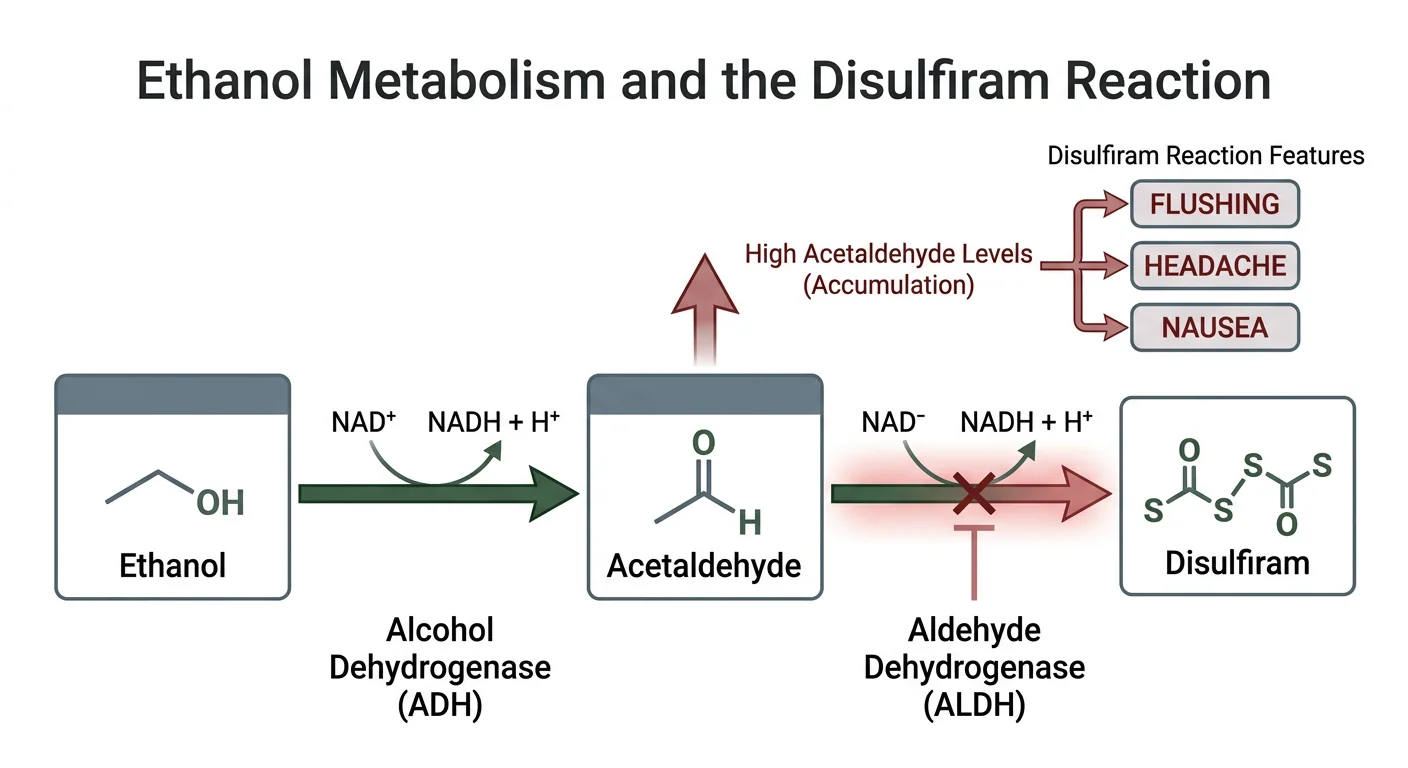
Figure 1 — Ethanol metabolism and the disulfiram reaction. Diagram of ethanol metabolism showing disulfiram blocking aldehyde dehydrogenase so acetaldehyde accumulates, producing the disulfiram reaction of flushing, headache and nausea.
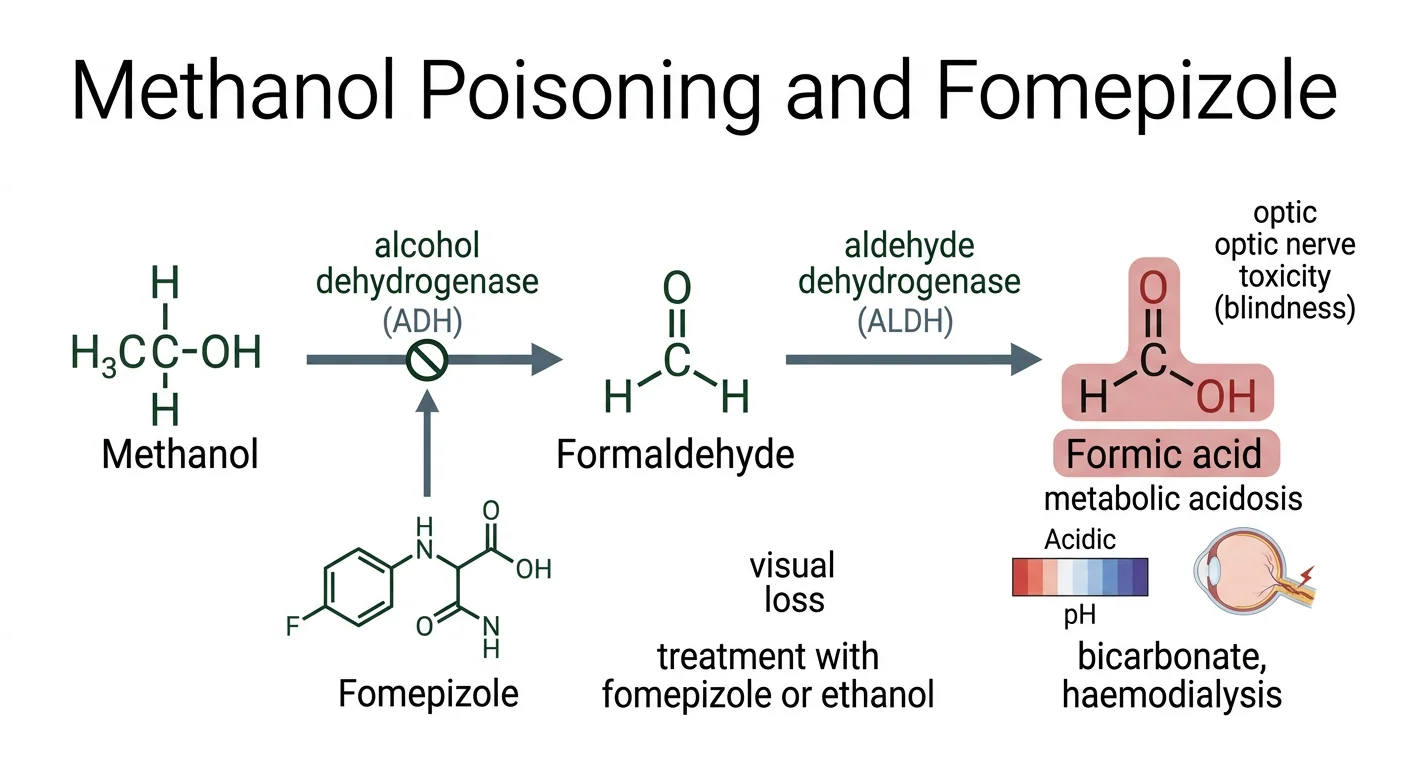
Figure 2 — Methanol poisoning and fomepizole. Diagram of methanol poisoning showing conversion to formic acid causing acidosis and blindness, with fomepizole blocking alcohol dehydrogenase as the antidote.
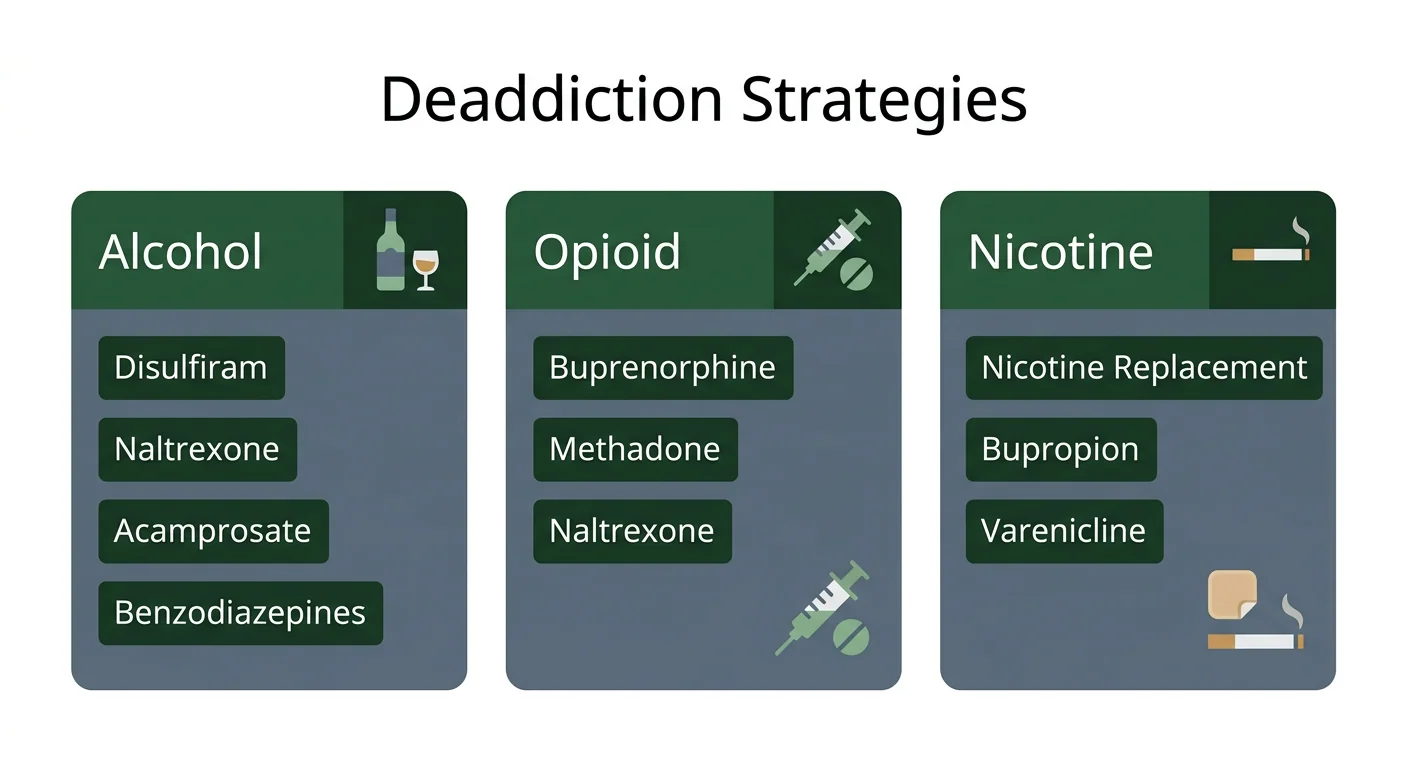
Figure 3 — Deaddiction strategies by substance. Diagram of deaddiction strategies for alcohol (disulfiram, naltrexone, acamprosate), opioids (buprenorphine, methadone) and nicotine (replacement, bupropion, varenicline).
Clinical Correlation
Vignette 1 — Methanol poisoning
A patient who drank methylated spirit presents with a high-anion-gap metabolic acidosis and blurred vision.
Reasoning: Methanol is metabolised to formic acid, producing the metabolic acidosis and optic-nerve toxicity (blindness). Management is to block alcohol dehydrogenase with fomepizole (or ethanol), give sodium bicarbonate for the acidosis, haemodialysis to remove the alcohol and its acids, and folinic acid. Early treatment is essential to prevent permanent blindness.
Vignette 2 — The disulfiram reaction
A patient on disulfiram drinks alcohol and develops facial flushing, throbbing headache, nausea and hypotension.
Reasoning: Disulfiram inhibits aldehyde dehydrogenase, so acetaldehyde accumulates and produces the aversive disulfiram reaction (flushing, headache, nausea, hypotension). The same reaction occurs with metronidazole, cephalosporins and sulfonylureas — the cross-reacting drugs. This aversive effect is the basis of disulfiram's use in alcohol deaddiction.
Vignette 3 — Wernicke encephalopathy
An alcoholic presents with confusion, ataxia and ophthalmoplegia, and is about to be given intravenous glucose.
Reasoning: This is Wernicke encephalopathy — thiamine deficiency in the alcoholic, with the triad of confusion, ataxia and ophthalmoplegia. The critical rule is thiamine before glucose: glucose without thiamine precipitates or worsens Wernicke. Thiamine is given immediately, followed by glucose and benzodiazepines for any withdrawal.
Vignette 4 — Opioid deaddiction
A patient with opioid dependence is started on buprenorphine, with a plan to taper it gradually.
Reasoning: Opioid deaddiction uses substitution therapy — replacing the illicit opioid with a long-acting or partial agonist (buprenorphine or methadone), which suppresses withdrawal and craving, then tapering it gradually. Naltrexone may be added after detoxification to prevent relapse. This is the standard opioid-deaddiction model.
Practical Linkage
Selecting the deaddiction strategy
| Substance | Strategy | Rationale |
|---|---|---|
| Alcohol | Disulfiram / naltrexone / acamprosate | Aversive / anti-craving |
| Opioid | Buprenorphine or methadone | Substitution, tapering |
| Nicotine | Replacement / bupropion / varenicline | Craving + withdrawal relief |
Exercise (PH1.23 — select the deaddiction strategy)
Discussion point
Why is thiamine given before glucose in a suspected Wernicke patient?
Expected: glucose metabolism consumes thiamine, so glucose without thiamine precipitates or worsens Wernicke encephalopathy.
MCQ Bank
35 questions · tagged by topic, exam pattern & difficulty · full explanations
The toxic metabolite responsible for the blindness of methanol poisoning is:
Rapid Revision
- Methanol — metabolised to formic acid, causing acidosis and blindness
- Ethylene glycol — metabolised to oxalic acid, causing renal failure
- Fomepizole — blocks alcohol dehydrogenase
- Ethanol as an antidote — competes for alcohol dehydrogenase
- Disulfiram reaction — acetaldehyde accumulation
- Disulfiram reaction features — flushing, headache, nausea, hypotension
- Cross-reacting drugs — metronidazole, cephalosporins, sulfonylureas
- Wernicke encephalopathy — thiamine deficiency, the triad
- Thiamine before glucose — to avoid precipitating Wernicke
- Ethanol withdrawal — benzodiazepines and thiamine
- Cocaine — blocks catecholamine reuptake
- Amphetamines — release catecholamines
- Caffeine — an adenosine antagonist
- Opioid deaddiction — buprenorphine or methadone substitution
- Alcohol deaddiction — disulfiram, naltrexone, acamprosate
- Nicotine deaddiction — replacement, bupropion, varenicline
- Varenicline — a nicotinic partial agonist
- Bupropion — depression and smoking cessation
- Naltrexone — prevents relapse, blocks opioid receptors
- Date-rape drugs — flunitrazepam, GHB, ketamine, scopolamine
- LSD and cannabis — psychedelics
- Inhalants — volatile solvents, depressants
- Ethanol acute effects — CNS depression, vasodilation, diuresis
- Ethanol chronic effects — enzyme induction, cirrhosis, Wernicke
- Ethanol diuresis — inhibition of ADH
- Methanol management — fomepizole, bicarbonate, dialysis, folinic acid
Viva Questions
- What is the toxic metabolite of methanol — Formic acid, causing acidosis and blindness.
- What is fomepizole — An alcohol dehydrogenase inhibitor, the antidote for methanol and ethylene glycol.
- What is the disulfiram reaction — Acetaldehyde accumulation causing flushing, headache and nausea.
- Which drugs cause a disulfiram-like reaction — Metronidazole, cephalosporins and sulfonylureas.
- What is Wernicke encephalopathy — Thiamine deficiency with confusion, ataxia and ophthalmoplegia.
- Why is thiamine given before glucose — Glucose metabolism consumes thiamine, precipitating Wernicke.
- How is ethanol withdrawal treated — With benzodiazepines and thiamine.
- What is cocaine's mechanism — Blockade of catecholamine reuptake.
- What is the opioid deaddiction strategy — Substitution with buprenorphine or methadone, then tapering.
- What are the alcohol deaddiction agents — Disulfiram, naltrexone and acamprosate.
- What is varenicline — A nicotinic partial agonist for nicotine deaddiction.
- Name the date-rape drugs — Flunitrazepam, GHB, ketamine and scopolamine.
- How does ethylene glycol differ from methanol — It produces oxalic acid and renal failure, not blindness.
- What is caffeine's mechanism — Adenosine-receptor antagonism.
- What is naltrexone used for — Relapse prevention in opioid and alcohol dependence.
References
- Tripathi KD. Essentials of Medical Pharmacology. 9th ed. New Delhi: Jaypee Brothers Medical Publishers; Chapters 35 and 36 (CNS Stimulants; Drugs of Abuse and Deaddiction).
- Katzung BG, Vanderah TW (eds). Basic & Clinical Pharmacology. 16th ed. New York: McGraw Hill; Chapter 23 (The Alcohols) and Chapter 32 (Drugs of Abuse).
- Brunton LL, Knollmann BC (eds). Goodman & Gilman's The Pharmacological Basis of Therapeutics. 14th ed. New York: McGraw Hill; Chapter 24 (The Pharmacological Basis of Therapeutics of Alcohol).
- Ritter JM, Flower RJ, Henderson G, et al. Rang & Dale's Pharmacology. 10th ed. Edinburgh: Elsevier; Chapter 50 (Drugs of Abuse).
- National Medical Commission. Competency Based Undergraduate Curriculum for the Indian Medical Graduate, Volume II — Pharmacology (Code: PH), competencies PH1.20, PH1.21, PH1.22 and PH1.23.
- Barceloux DG, Bond GR, Krenzelok EP, Cooper H, Vale JA. American Academy of Clinical Toxicology practice guidelines on the treatment of methanol poisoning. Journal of Toxicology: Clinical Toxicology. 2002;40(4):415–446.
- Seitz HK, Bataller R, Cortez-Pinto H, et al. Alcoholic liver disease. Nature Reviews Disease Primers. 2018;4(1):16.
- Mattick RP, Breen C, Kimber J, Davoli M. Buprenorphine maintenance versus placebo or methadone maintenance for opioid dependence. Cochrane Database of Systematic Reviews. 2014;(2):CD002207.
Downloads
All deliverables & printable revision sheets for CH25
Printable Chapter Handout & Study Notes
Generate a clean, high-yield PDF or print directly without sidebars and navigation menus.