
Opioid Analgesics & Antagonists
Learning Objectives
At the end of this chapter, the Phase II MBBS student will be able to:
- Describe the opioid receptors (mu, kappa, delta) and the endogenous opioid peptides. (PH1.19 — Knows)
- Describe morphine's pharmacology, uses and adverse effects, including its contraindications. (PH1.19 — Knows)
- Describe the individual opioids — codeine, pethidine, fentanyl, tramadol, methadone, buprenorphine and pentazocine. (PH1.19 — Knows)
- Explain the mechanism of naloxone and naltrexone. (PH1.19 — Knows)
- Recognise opioid poisoning (the triad) and manage it with naloxone. (PH1.19 — Shows-how)
- Explain the pethidine-MAOI interaction and tramadol's seizure risk. (PH1.19 — Knows)
- Describe tolerance, dependence and the WHO analgesic ladder. (PH1.19 — Knows)
- State which opioid effects do not develop tolerance. (PH1.19 — Knows)
- Explain buprenorphine's partial-agonist ceiling effect. (PH1.19 — Knows)
- Explain why naloxone may need repeated doses in opioid overdose. (PH1.19 — Knows)
Must-Know Summary
Opioids produce analgesia, euphoria and respiratory depression by acting on mu receptors, and their pharmacology is dominated by the prototype morphine and the antagonist naloxone. The opioid triad — miosis, respiratory depression and coma — is the diagnostic signature of poisoning, reversed by naloxone (whose short half-life mandates repeated doses). Three drug-specific points recur in the examinations: pethidine with an MAOI causes serotonin syndrome, tramadol lowers the seizure threshold, and buprenorphine's partial agonism gives a ceiling on respiratory depression.
In one line each:
- Mu receptor — analgesia, euphoria, respiratory depression, miosis
- Opioid triad — miosis, respiratory depression, coma
- Naloxone — the opioid antagonist, reversed by repeated doses (short half-life)
- Morphine — histamine release, avoid in asthma and head injury
- Pethidine plus MAOI — serotonin syndrome, hyperpyrexia
- Tramadol — lowers the seizure threshold
- Buprenorphine — a partial agonist with a ceiling effect
- Miosis and constipation — do not develop tolerance
- WHO ladder — non-opioid, then weak opioid, then strong opioid
- Naltrexone — long-acting oral antagonist for dependence
Classification
Box 1 — Opioids
- Strong agonists — morphine, pethidine, fentanyl, methadone
- Weak agonists — codeine, tramadol
- Partial agonist — buprenorphine
- Agonist-antagonist — pentazocine
- Antagonists — naloxone, naltrexone
Box 2 — The WHO analgesic ladder
- Step 1 — non-opioid (paracetamol, NSAID) ± adjuvant
- Step 2 — add a weak opioid (codeine, tramadol)
- Step 3 — strong opioid (morphine)
Core Concepts
1. Opioid receptors and endogenous peptides
Opioids act on three G-protein coupled receptor families, each with endogenous peptide ligands:
- Mu (μ) — mediates analgesia, euphoria, respiratory depression, miosis, sedation and physical dependence; the principal target of the analgesic opioids (morphine and most others). Its endogenous ligands are the endorphins.
- Kappa (κ) — analgesia (spinal), dysphoria; ligands are the dynorphins.
- Delta (δ) — analgesia, modulatory; ligands are the enkephalins.
The endogenous opioid system (endorphins, enkephalins, dynorphins) is the body's own pain-modulating network, and the opioid drugs exploit it.
2. Morphine — pharmacology, uses and adverse effects
Morphine is the prototype mu-agonist and the standard against which other opioids are judged.
Effects — analgesia (without loss of consciousness), euphoria, sedation, respiratory depression (the dose-limiting effect, by reducing the medullary response to CO2), miosis (pinpoint pupils), constipation (increased gut tone, reduced motility), nausea and vomiting (CTZ stimulation), histamine release (itching, flushing, hypotension, bronchospasm), urinary retention and biliary spasm.
Uses — severe acute and chronic (cancer) pain, myocardial infarction (analgesia + venodilation reduces preload), pulmonary oedema, and premedication.
Adverse effects and contraindications — the histamine-mediated bronchospasm makes morphine hazardous in asthma; in head injury it masks the pupillary signs and raises intracranial pressure (via CO2 retention) — so it is contraindicated in head injury and respiratory disease. Constipation, nausea and dependence are the other liabilities.
3. Other opioid agonists and partial agonists
- Codeine — a weak analgesic and antitussive; a prodrug activated by CYP2D6 to morphine (CH07 — poor metabolisers get no analgesia).
- Pethidine (meperidine) — a short-acting mu-agonist used in labour; it is serotonergic, so combining it with an MAOI causes serotonin syndrome/hyperpyrexia (the classic interaction), and its metabolite normeperidine causes seizures (with accumulation).
- Fentanyl — a potent, lipophilic opioid (transdermal patch); remifentanil (ultra-short, esterase-metabolised), alfentanil and sufentanil are the anaesthetic congeners.
- Tramadol — a weak mu-agonist that also inhibits serotonin and noradrenaline reuptake; it lowers the seizure threshold and interacts with SSRIs/MAOIs (serotonin syndrome).
- Methadone — a long-acting oral mu-agonist used in opioid substitution.
- Buprenorphine — a partial mu-agonist with a ceiling effect (its respiratory depression plateaus, making it safer in overdose); used for opioid substitution and analgesia.
- Pentazocine — a kappa-agonist/mu-antagonist (agonist-antagonist); causes dysphoria and has less abuse potential.
4. Opioid antagonists — naloxone and naltrexone
Naloxone is a pure opioid antagonist that competitively reverses all opioid effects. It is given intravenously in opioid overdose and to reverse neonatal respiratory depression from maternal opioids. Its short half-life (about 30–60 minutes) means re-sedation can occur as it wears off (especially with long-acting opioids like methadone), so repeated doses or an infusion are needed.
Naltrexone is a long-acting oral antagonist used to prevent relapse in opioid (and alcohol) dependence. Nalmefene (longer-acting parenteral) and naloxegol (peripherally-acting, for opioid constipation) are named for completeness.
5. Acute opioid poisoning and management
Opioid overdose presents with the triad of miosis (pinpoint pupils), respiratory depression and coma. Management is to secure the airway, ventilate, and give naloxone intravenously — titrated to reverse the respiratory depression (not to full arousal, which would precipitate withdrawal in a dependent patient), with repeated doses or an infusion because of naloxone's short half-life.
6. Tolerance, dependence and the WHO analgesic ladder
Tolerance develops to the analgesia, euphoria and respiratory depression, but NOT to miosis and constipation — a favourite discriminator. Physical dependence produces a withdrawal syndrome (lacrimation, rhinorrhoea, yawning, diarrhoea, piloerection — "cold turkey") on abrupt cessation.
The WHO analgesic ladder guides cancer-pain management: Step 1 — a non-opioid (paracetamol/NSAID) ± adjuvant; Step 2 — add a weak opioid (codeine, tramadol); Step 3 — substitute a strong opioid (morphine). The principles are "by the mouth, by the clock, by the ladder".
Tables
Table 1 — Opioid receptors
| Receptor | Effects | Endogenous ligand |
|---|---|---|
| Mu | Analgesia, euphoria, respiratory depression, miosis | Endorphins |
| Kappa | Analgesia, dysphoria | Dynorphins |
| Delta | Analgesia, modulation | Enkephalins |
Table 2 — Morphine's effects and adverse effects
| Effect | Type |
|---|---|
| Analgesia, euphoria | Therapeutic |
| Respiratory depression | Dose-limiting |
| Miosis, constipation | Persistent (no tolerance) |
| Nausea, vomiting | CTZ |
| Histamine release | Itch, hypotension, bronchospasm |
Table 3 — Individual opioids
| Drug | Key feature |
|---|---|
| Codeine | Prodrug (CYP2D6), antitussive |
| Pethidine | MAOI interaction, normeperidine seizures |
| Fentanyl | Potent, transdermal |
| Tramadol | Seizure threshold, SNRI-like |
| Buprenorphine | Partial agonist, ceiling effect |
| Methadone | Long-acting, substitution |
Table 4 — Opioid antagonists
| Drug | Duration | Use |
|---|---|---|
| Naloxone | Short (30–60 min) | Acute overdose reversal |
| Naltrexone | Long (oral) | Dependence relapse prevention |
Table 5 — Opioid poisoning
| Feature | Detail |
|---|---|
| Triad | Miosis, respiratory depression, coma |
| Management | Airway, ventilation, naloxone |
| Caution | Re-sedation (short naloxone half-life) |
Table 6 — Tolerance and dependence
| Develops tolerance | Does NOT develop tolerance |
|---|---|
| Analgesia | Miosis |
| Respiratory depression | Constipation |
| Euphoria | — |
Table 7 — The WHO analgesic ladder
| Step | Agent |
|---|---|
| 1 | Non-opioid ± adjuvant |
| 2 | Weak opioid (codeine, tramadol) |
| 3 | Strong opioid (morphine) |
Figures
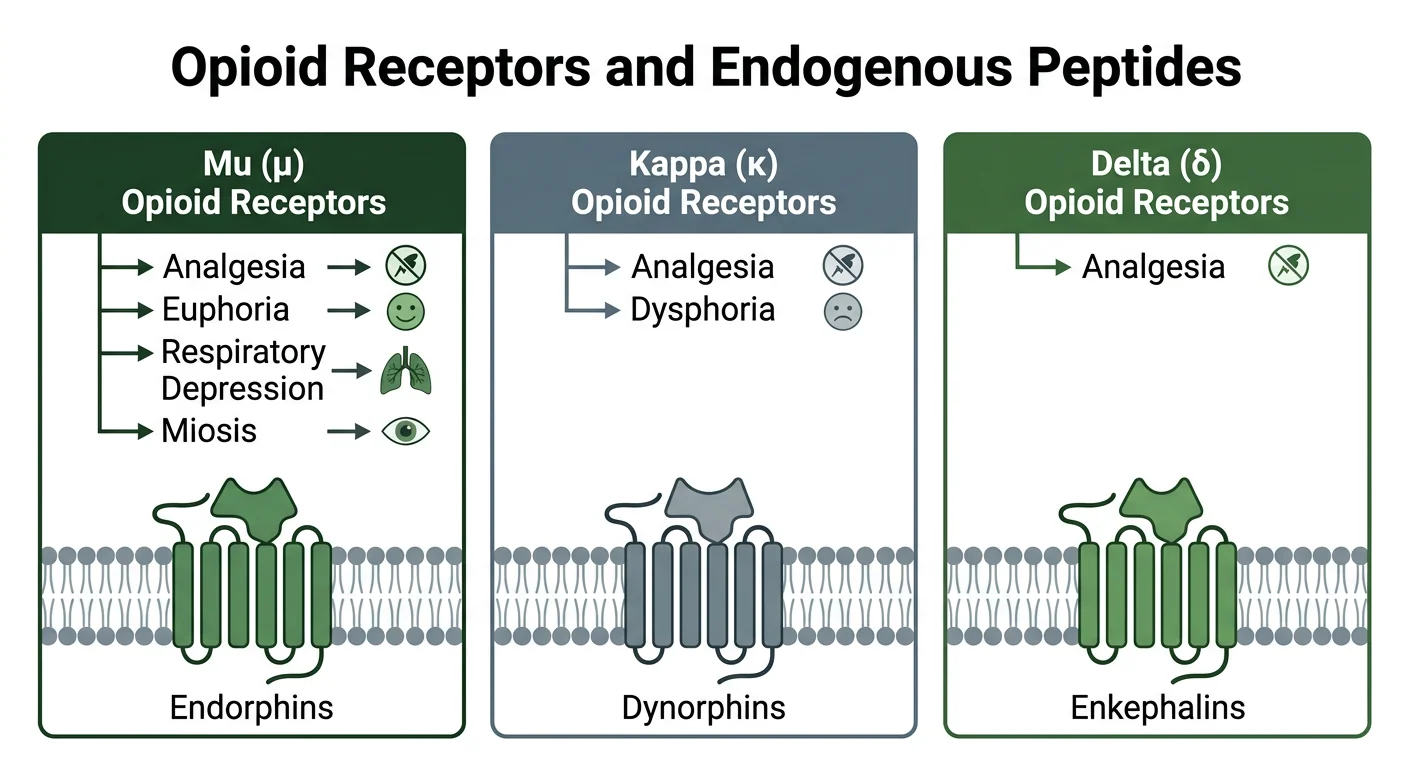
Figure 1 — Opioid receptors and endogenous peptides. Diagram of the three opioid receptors mu, kappa and delta with their effects and endogenous peptide ligands endorphins, dynorphins and enkephalins.
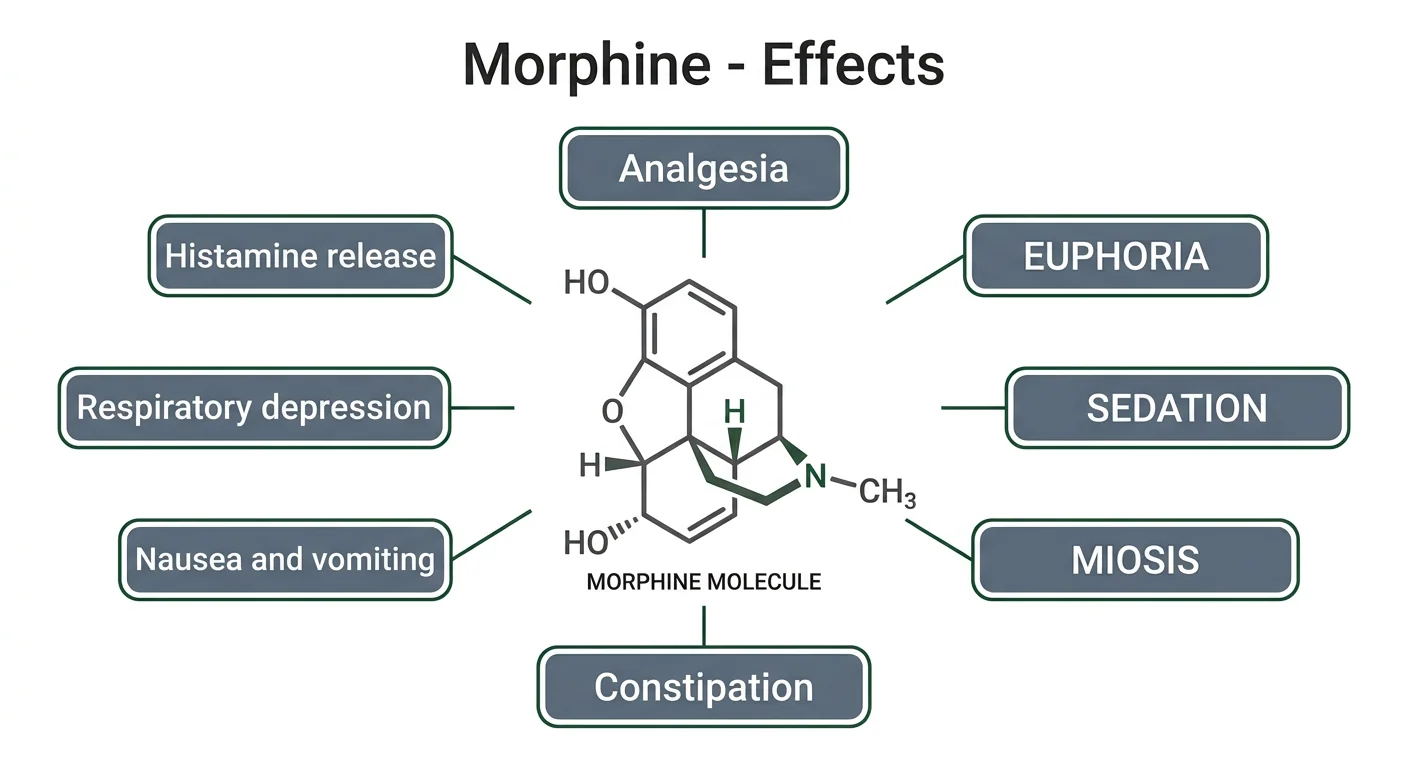
Figure 2 — Morphine's effects. Diagram of morphine's effects including analgesia, euphoria, respiratory depression, miosis, constipation, nausea, histamine release and urinary retention.
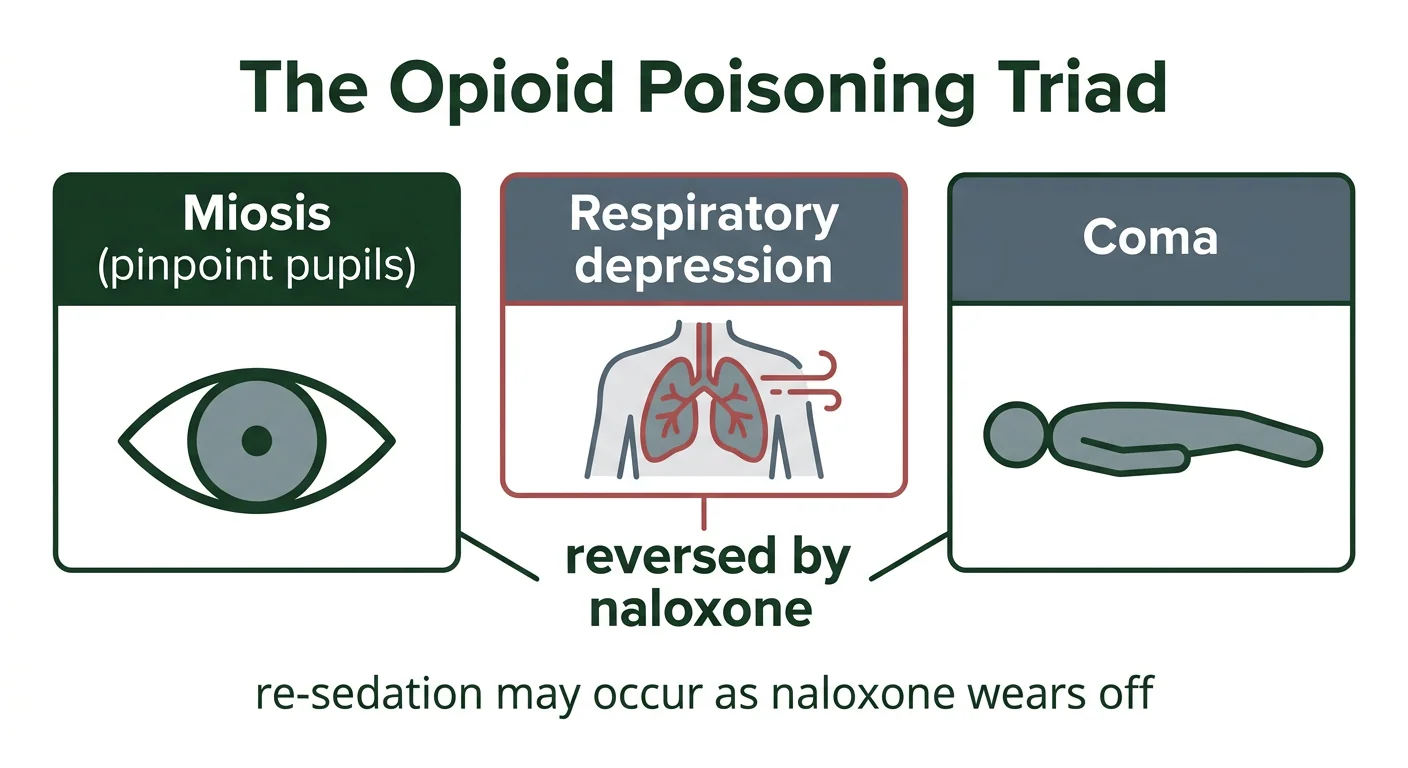
Figure 3 — The opioid poisoning triad. Diagram of the opioid poisoning triad of miosis, respiratory depression and coma, reversed by naloxone, with the caution that re-sedation may occur.
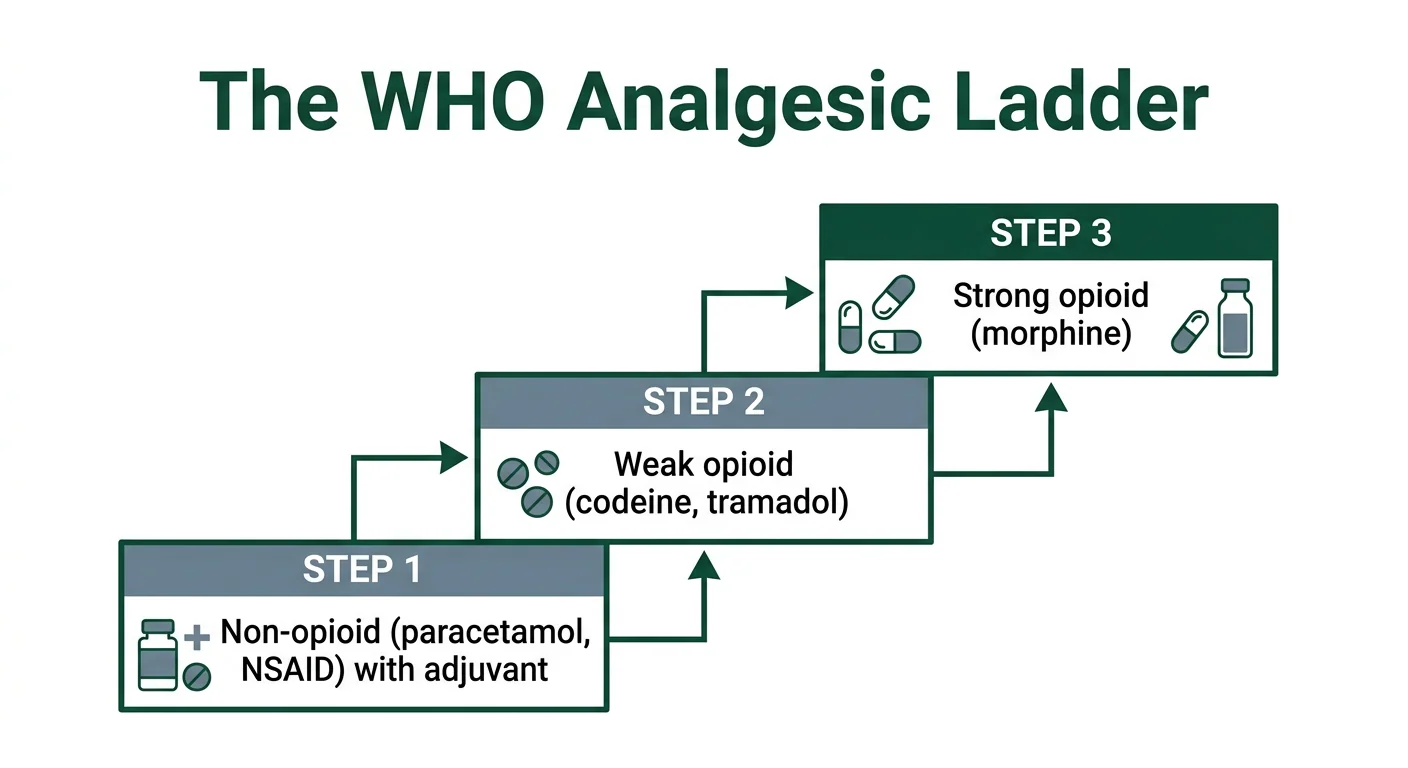
Figure 4 — The WHO analgesic ladder. The three-step WHO analgesic ladder from non-opioid analgesics through weak opioids to strong opioids for progressive pain management.
Clinical Correlation
Vignette 1 — Opioid overdose
A patient is found unresponsive with pinpoint pupils and slow, shallow breathing.
Reasoning: This is the opioid triad — miosis, respiratory depression and coma. Management is airway and ventilation support with naloxone titrated to reverse the respiratory depression. Because naloxone's half-life is short, re-sedation can occur (especially with long-acting opioids), so repeated doses or an infusion are required. This is the classic emergency of opioid pharmacology.
Vignette 2 — Pethidine in a patient on an MAOI
A patient on phenelzine is given pethidine for pain and develops agitation, hyperthermia and cardiovascular instability.
Reasoning: Pethidine is serotonergic, and combining it with an MAOI produces a severe serotoninergic reaction (hyperpyrexia, agitation, cardiovascular collapse) — one of the classic, avoidable drug interactions. Pethidine is therefore avoided in patients on MAOIs; this is the single most examined pethidine point (CH06/CH23).
Vignette 3 — Tramadol-induced seizure
A patient on an SSRI is given tramadol and develops a generalised seizure.
Reasoning: Tramadol lowers the seizure threshold (and inhibits serotonin reuptake), so it can precipitate seizures, especially with an SSRI (serotonin syndrome risk) or in patients with epilepsy. This is the modern opioid of note, and its seizure risk is the key examinable adverse effect.
Vignette 4 — Buprenorphine for opioid dependence
A patient with opioid dependence is treated with buprenorphine rather than methadone, with a lower overdose risk.
Reasoning: Buprenorphine is a partial mu-agonist, so its respiratory-depressant effect has a ceiling — beyond a certain dose there is little further depression, making it safer in overdose than the full agonists (methadone, morphine). It is used in opioid substitution for this safety margin.
Practical Linkage
The WHO analgesic ladder
| Pain severity | Step | Agent |
|---|---|---|
| Mild | 1 | Paracetamol/NSAID ± adjuvant |
| Moderate | 2 | Add codeine/tramadol |
| Severe | 3 | Morphine |
Exercise (PH1.19 — the WHO analgesic ladder)
Discussion point
Why does naloxone need to be repeated in opioid overdose?
Expected: naloxone has a short half-life, so as it wears off the long-acting opioid re-exerts its effect (re-sedation); repeated doses or an infusion are needed.
MCQ Bank
40 questions · tagged by topic, exam pattern & difficulty · full explanations
The opioid receptor mediating analgesia, euphoria and respiratory depression is:
Rapid Revision
- Mu receptor — analgesia, euphoria, respiratory depression, miosis
- Kappa receptor — dysphoria
- Endorphins — the mu receptor ligand
- Opioid triad — miosis, respiratory depression, coma
- Naloxone — the opioid antagonist, short half-life
- Naloxone — repeated doses for re-sedation
- Morphine — histamine release, avoid in asthma and head injury
- Morphine dose-limiting effect — respiratory depression
- Morphine in MI — analgesia plus venodilation
- Miosis and constipation — no tolerance develops
- Pethidine plus MAOI — serotonin syndrome, hyperpyrexia
- Pethidine metabolite — normeperidine causes seizures
- Tramadol — lowers the seizure threshold
- Codeine — a prodrug activated by CYP2D6
- Fentanyl — potent, lipophilic, transdermal
- Remifentanil — esterase-metabolised, ultra-short
- Buprenorphine — partial agonist, ceiling effect
- Methadone — long-acting, substitution therapy
- Pentazocine — agonist-antagonist, dysphoria
- Naltrexone — long-acting oral antagonist
- WHO ladder step 1 — non-opioid
- WHO ladder step 2 — weak opioid
- WHO ladder step 3 — strong opioid
- By the clock — regular scheduled dosing
- Opioid withdrawal — lacrimation, rhinorrhoea, piloerection
- Morphine constipation — no tolerance
- Buprenorphine in a dependent patient — precipitates withdrawal
- Opioid overdose death — respiratory depression
- Adjuvants — amitriptyline, gabapentin for neuropathic pain
Viva Questions
- What is the opioid triad — Miosis, respiratory depression and coma.
- Which receptor mediates opioid analgesia — The mu receptor.
- What is naloxone — A pure opioid antagonist used to reverse overdose.
- Why must naloxone be repeated — Its short half-life causes re-sedation.
- What are morphine's contraindications — Head injury and asthma (and respiratory disease).
- Why is morphine avoided in asthma — Histamine release causes bronchospasm.
- Which opioid effects do not develop tolerance — Miosis and constipation.
- What is the pethidine-MAOI interaction — Serotonin syndrome with hyperpyrexia.
- What causes tramadol's seizures — A lowered seizure threshold.
- What is buprenorphine — A partial mu agonist with a ceiling effect.
- What is codeine — A prodrug activated by CYP2D6.
- What is the WHO analgesic ladder — Non-opioid, then weak opioid, then strong opioid.
- What does "by the clock" mean — Regular scheduled analgesia.
- What is naltrexone used for — Prevention of opioid and alcohol relapse.
- Why is morphine used in myocardial infarction — Analgesia and venodilation reduce preload.
References
- Tripathi KD. Essentials of Medical Pharmacology. 9th ed. New Delhi: Jaypee Brothers Medical Publishers; Chapter 34 (Opioid Analgesics and Antagonists).
- Katzung BG, Vanderah TW (eds). Basic & Clinical Pharmacology. 16th ed. New York: McGraw Hill; Chapter 31 (Opioid Agonists and Antagonists).
- Brunton LL, Knollmann BC (eds). Goodman & Gilman's The Pharmacological Basis of Therapeutics. 14th ed. New York: McGraw Hill; Chapter 20 (Opioid Analgesics).
- Ritter JM, Flower RJ, Henderson G, et al. Rang & Dale's Pharmacology. 10th ed. Edinburgh: Elsevier; Chapter 41 (Analgesic Drugs).
- National Medical Commission. Competency Based Undergraduate Curriculum for the Indian Medical Graduate, Volume II — Pharmacology (Code: PH), competency PH1.19.
- World Health Organization. Cancer pain relief and palliative care. Geneva: WHO; 1996.
- Trescot AM, Datta S, Lee M, Hansen H. Opioid pharmacology. Pain Physician. 2008;11(2 Suppl):S133–S153.
- Boyer EW. Management of opioid analgesic overdose. New England Journal of Medicine. 2012;367(2):146–155.
Downloads
All deliverables & printable revision sheets for CH24
Printable Chapter Handout & Study Notes
Generate a clean, high-yield PDF or print directly without sidebars and navigation menus.