
Antidepressants & Antianxiety Drugs
Learning Objectives
At the end of this chapter, the Phase II MBBS student will be able to:
- Describe the monoamine hypothesis of depression and the delayed onset of antidepressant effect. (PH1.19 — Knows)
- Classify the antidepressants (SSRIs, SNRIs, TCAs, MAOIs, atypicals) by mechanism. (PH1.19 — Knows)
- Describe the adverse effects and interactions of the SSRIs. (PH1.19 — Knows)
- Describe TCA overdose (the 3 Cs) and its management with sodium bicarbonate. (PH1.19 — Knows-how)
- Explain the MAOI cheese reaction and the tyramine restriction and washout. (PH1.19 — Knows)
- Differentiate serotonin syndrome from the discontinuation syndrome. (PH1.19 — Knows)
- Describe the atypical antidepressants (mirtazapine, bupropion, trazodone). (PH1.19 — Knows)
- Describe buspirone's mechanism and its contrast with the benzodiazepines. (PH1.19 — Knows)
- Select an appropriate antidepressant for a given patient profile. (PH1.19 — Shows-how)
- Explain why the initial antidepressant period carries a suicide-risk concern. (PH1.19 — Knows)
Must-Know Summary
Antidepressants raise brain monoamines — serotonin, noradrenaline and dopamine — but their therapeutic effect is delayed by 2–4 weeks, reflecting adaptive receptor changes. The classes are distinguished by mechanism and toxicity: the SSRIs are first-line (with sexual dysfunction and hyponatraemia), the tricyclics carry the dangerous 3-C overdose (coma, convulsions, cardiac arrhythmias), and the MAOIs cause the cheese reaction. Two syndromes must not be confused: serotonin syndrome (from serotonergic excess, treated with cyproheptadine) and the discontinuation syndrome (from serotonergic withdrawal, treated by tapering).
In one line each:
- Antidepressants — raise monoamines, but the effect is delayed 2 to 4 weeks
- SSRIs — first-line, causing sexual dysfunction and hyponatraemia
- TCA overdose — the 3 Cs: coma, convulsions, cardiac arrhythmias
- TCA overdose treatment — sodium bicarbonate, supportive care
- MAOI cheese reaction — tyramine causing hypertensive crisis
- MAOI washout — two weeks before an SSRI
- Serotonin syndrome — hyperthermia, clonus — cyproheptadine
- Discontinuation syndrome — brain zaps, dizziness — taper
- Bupropion — no sexual dysfunction, risk of seizures
- Buspirone — a 5-HT1A partial agonist, no sedation or dependence
Classification
Box 1 — Antidepressants
- SSRIs — fluoxetine, sertraline, paroxetine, fluvoxamine, citalopram, escitalopram
- SNRIs — venlafaxine, duloxetine
- TCAs — amitriptyline, imipramine, nortriptyline, clomipramine
- MAOIs — phenelzine, tranylcypromine, moclobemide
- Atypicals — mirtazapine, bupropion, trazodone
Box 2 — Antianxiety drugs
- Buspirone — 5-HT1A partial agonist
- Benzodiazepines — rapid onset, dependence risk
- SSRIs/SNRIs — first-line for chronic anxiety
Core Concepts
1. Monoamine hypothesis of depression
The monoamine hypothesis holds that depression is associated with deficient monoamine neurotransmission — particularly serotonin, noradrenaline and dopamine — and that antidepressants act by increasing these transmitters in the synapse. Critically, although the synaptic monoamine levels rise within hours, the therapeutic (mood) effect is delayed by 2–4 weeks, reflecting slow adaptive changes (receptor down-regulation, neurogenesis). This delayed onset explains the clinical caution in the initial treatment period, when the activating effect may outpace the mood improvement and transiently increase suicide risk in some patients.
2. SSRIs, SNRIs and atypical antidepressants
SSRIs — fluoxetine, sertraline, paroxetine, fluvoxamine, citalopram, escitalopram — selectively block serotonin reuptake, and are first-line for depression and anxiety disorders. Their adverse effects include gastrointestinal upset, sexual dysfunction, insomnia/agitation, hyponatraemia (SIADH, especially in the elderly), and an increased bleeding tendency (platelet serotonin depletion). Paroxetine has antimuscarinic effects and the worst withdrawal profile; fluoxetine has the longest half-life (least withdrawal).
SNRIs — venlafaxine, duloxetine — block both serotonin and noradrenaline reuptake; they are also used for neuropathic pain; venlafaxine can raise blood pressure.
Atypical antidepressants:
- Mirtazapine — an alpha-2 antagonist that increases noradrenaline and serotonin release; sedating and causes weight gain (useful in depression with insomnia).
- Bupropion — a dopamine/noradrenaline reuptake inhibitor; no sexual dysfunction (an advantage), used for smoking cessation, but lowers the seizure threshold.
- Trazodone — sedating, used for insomnia; can cause priapism.
3. Tricyclic antidepressants and their toxicity
Tricyclic antidepressants (TCAs) — amitriptyline, imipramine, nortriptyline, clomipramine, desipramine — block the reuptake of noradrenaline and serotonin, but also block muscarinic, alpha-adrenergic, histamine and cardiac sodium channels. These additional actions produce the characteristic adverse effects: antimuscarinic (dry mouth, constipation, urinary retention, blurred vision), postural hypotension (alpha-blockade), sedation (antihistamine), and cardiotoxicity (sodium-channel blockade → conduction delay).
TCA overdose is the classic toxicity — the "3 Cs": Coma, Convulsions, and Cardiac arrhythmias (QRS widening, ventricular arrhythmias). Management is supportive (airway, ventilation, benzodiazepines for seizures) with sodium bicarbonate for the cardiac arrhythmias (alkalinisation reduces the cardiotoxic free fraction). Physostigmine is avoided (it can precipitate arrhythmias).
4. MAO inhibitors and dietary restrictions
Monoamine oxidase inhibitors (MAOIs) — phenelzine, tranylcypromine, moclobemide (reversible MAO-A), selegiline — inhibit the enzyme that metabolises the monoamines, increasing their levels.
The defining hazard is the cheese reaction: tyramine (in aged cheese, fermented meats, red wine, broad beans) is normally metabolised by intestinal and hepatic MAO; when MAO is inhibited, tyramine enters the circulation and displaces noradrenaline, producing a hypertensive crisis (CH06/CH22). Patients must observe a tyramine-restricted diet, and a two-week washout is required when switching between an MAOI and an SSRI (to avoid serotonin syndrome). Moclobemide (reversible MAO-A) and selegiline (MAO-B at low doses) carry a lower dietary risk.
5. Serotonin syndrome and discontinuation syndrome
Two syndromes must be distinguished:
- Serotonin syndrome — from excess serotonergic activity (SSRI + MAOI, tramadol, a triptan or linezolid). It presents with the triad of altered mental status, autonomic instability (hyperthermia, tachycardia) and neuromuscular hyperactivity (clonus). Treatment is to stop the serotonergic drugs, supportive care and cyproheptadine (a 5-HT2 antagonist) (CH06/CH14).
- Discontinuation (withdrawal) syndrome — from abrupt cessation of an SSRI/SNRI. It causes dizziness, flu-like symptoms, sensory disturbances ("brain zaps") and insomnia — worst with the short-half-life agents (paroxetine, venlafaxine). It is treated by tapering the drug. It is distinct from serotonin syndrome (which is an excess, not a withdrawal, phenomenon).
6. Antianxiety drugs — buspirone and others
Buspirone is a 5-HT1A partial agonist anxiolytic. Unlike the benzodiazepines (CH17), it causes no sedation, no dependence, no potentiation of alcohol, and does not impair psychomotor function — but its onset is delayed (1–2 weeks), so it is not used for acute anxiety. The benzodiazepines remain the rapid-onset anxiolytics but carry dependence and withdrawal liabilities; the SSRIs/SNRIs are the first-line agents for chronic anxiety disorders.
Tables
Table 1 — Antidepressant classes
| Class | Mechanism |
|---|---|
| SSRIs | Block serotonin reuptake |
| SNRIs | Block serotonin + noradrenaline reuptake |
| TCAs | Block NA + 5-HT reuptake + other receptors |
| MAOIs | Inhibit monoamine oxidase |
| Atypicals | Various (alpha-2, DA/NA reuptake) |
Table 2 — SSRIs versus TCAs
| Feature | SSRIs | TCAs |
|---|---|---|
| Selectivity | Serotonin | Non-selective |
| Antimuscarinic | Minimal (paroxetine some) | Marked |
| Cardiotoxicity | Low | High (overdose) |
| Overdose | Less dangerous | 3 Cs, fatal |
| First-line | Yes | No (except niche) |
Table 3 — TCA overdose
| Feature | Detail |
|---|---|
| The 3 Cs | Coma, convulsions, cardiac arrhythmias |
| Cardiac | QRS widening |
| Management | Supportive, sodium bicarbonate |
| Avoid | Physostigmine |
Table 4 — MAOIs and the cheese reaction
| Aspect | Detail |
|---|---|
| Trigger | Tyramine (cheese, wine) |
| Mechanism | Noradrenaline displacement |
| Result | Hypertensive crisis |
| Prevention | Tyramine-free diet, washout |
Table 5 — Serotonin versus discontinuation syndrome
| Feature | Serotonin syndrome | Discontinuation syndrome |
|---|---|---|
| Cause | Serotonergic excess | Abrupt withdrawal |
| Features | Hyperthermia, clonus | Dizziness, brain zaps |
| Treatment | Cyproheptadine | Taper |
Table 6 — Atypical antidepressants
| Drug | Mechanism | Distinctive effect |
|---|---|---|
| Mirtazapine | Alpha-2 antagonist | Sedation, weight gain |
| Bupropion | DA/NA reuptake inhibitor | No sexual dysfunction, seizures |
| Trazodone | 5-HT2 antagonist | Sedation, priapism |
Table 7 — Buspirone versus benzodiazepines
| Feature | Buspirone | Benzodiazepines |
|---|---|---|
| Mechanism | 5-HT1A partial agonist | GABA-A |
| Sedation | No | Yes |
| Dependence | No | Yes |
| Onset | Delayed (weeks) | Rapid |
Figures
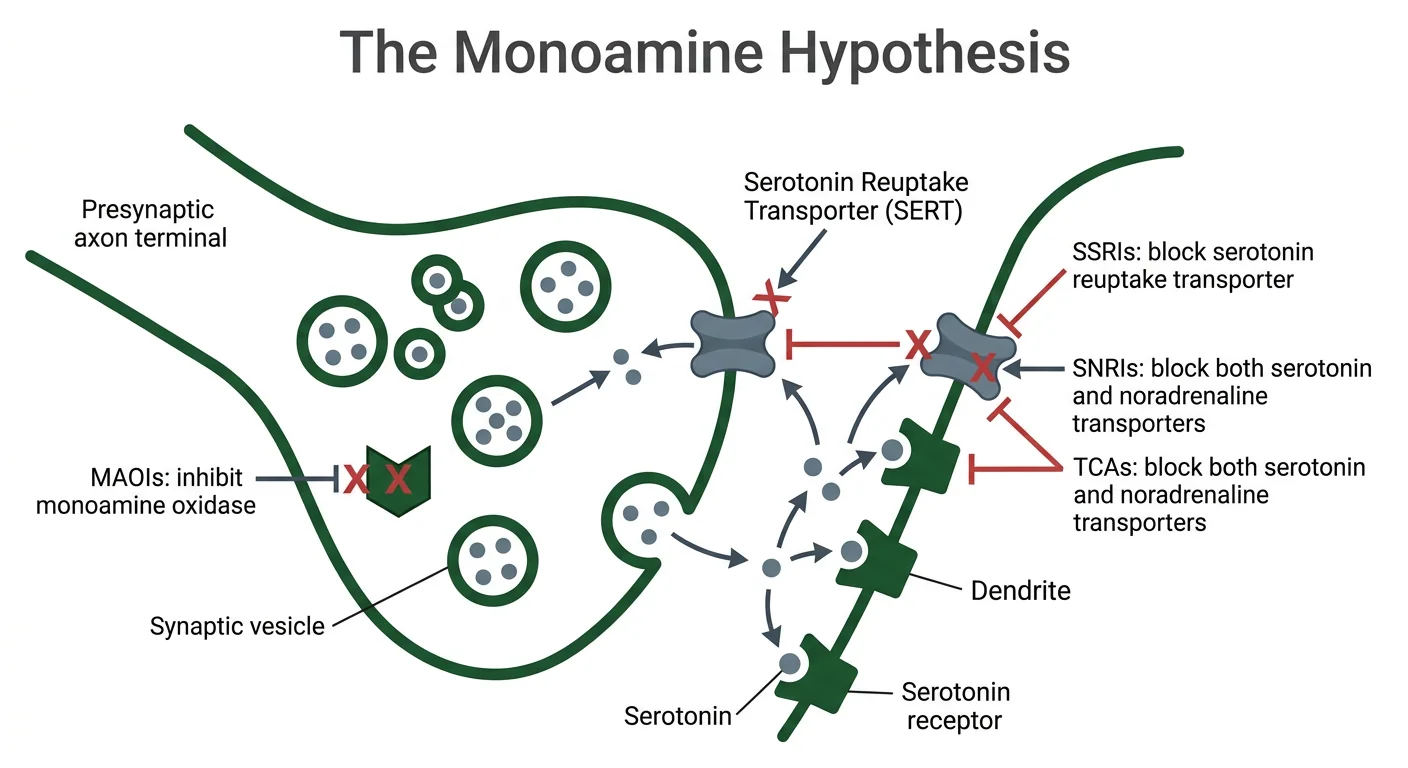
Figure 1 — The monoamine hypothesis and antidepressant targets. Diagram of the monoamine synapse showing SSRIs, SNRIs and TCAs blocking neurotransmitter reuptake and MAOIs inhibiting monoamine oxidase, illustrating the antidepressant mechanism of increasing synaptic monoamines.
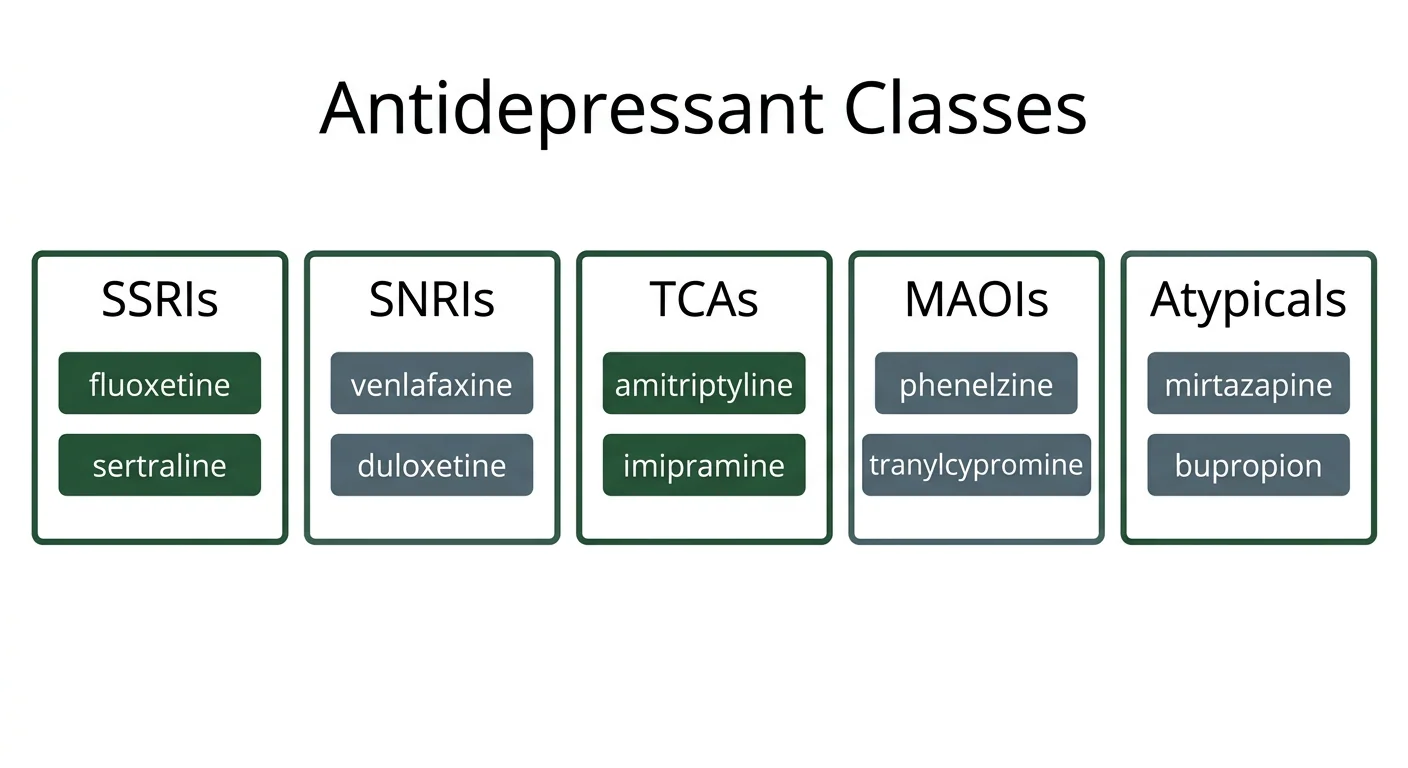
Figure 2 — Antidepressant classes by mechanism. Classification of antidepressants into SSRIs, SNRIs, TCAs, MAOIs and atypicals, with example drugs in each class.
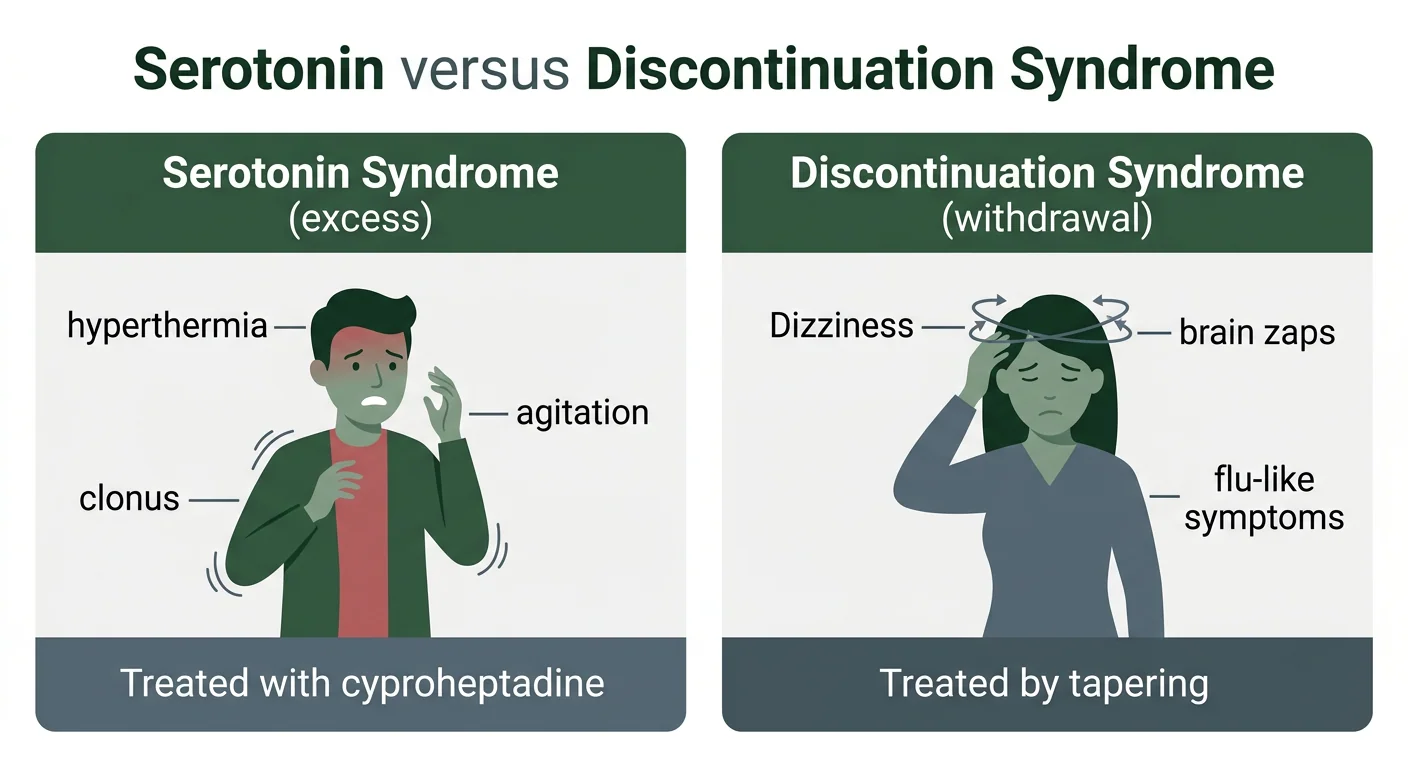
Figure 3 — Serotonin syndrome versus discontinuation syndrome. Comparison of serotonin syndrome, an excess state with hyperthermia and clonus treated with cyproheptadine, against the discontinuation syndrome, a withdrawal state with dizziness and brain zaps treated by tapering.
Clinical Correlation
Vignette 1 — TCA overdose
A patient ingests a large amount of amitriptyline and presents comatose, with convulsions and a widened QRS on the ECG.
Reasoning: This is TCA overdose — the "3 Cs" (coma, convulsions, cardiac arrhythmias). The cardiac toxicity reflects sodium-channel blockade (QRS widening). Management is supportive (airway, ventilation, benzodiazepines for seizures) with sodium bicarbonate to treat the arrhythmias; physostigmine is avoided (it can precipitate arrhythmias). This is the most dangerous antidepressant overdose.
Vignette 2 — Serotonin syndrome after SSRI + tramadol
A patient on fluoxetine is given tramadol for pain and develops agitation, sweating, hyperthermia and lower-limb clonus.
Reasoning: This is serotonin syndrome — excessive serotonergic activity from the SSRI plus tramadol (a serotonin-reuptake inhibitor). The triad is altered mental status, autonomic instability and clonus. Management is to stop the serotonergic drugs, give supportive care (cooling, benzodiazepines) and cyproheptadine (a 5-HT2 antagonist). This links to CH06/CH14.
Vignette 3 — The cheese reaction
A patient on phenelzine (an MAOI) eats aged cheese and develops a severe throbbing headache and a blood pressure of 220/130 mmHg.
Reasoning: This is the cheese reaction — tyramine from the cheese, normally metabolised by MAO, displaces noradrenaline and produces a hypertensive crisis when MAO is inhibited. Management is alpha-adrenergic blockade (phentolamine). Prevention requires a tyramine-restricted diet and the two-week washout when changing antidepressants (CH06/CH22).
Vignette 4 — Discontinuation syndrome
A patient who stops paroxetine abruptly develops dizziness, nausea and "electric-shock" sensations in the head ("brain zaps").
Reasoning: This is the discontinuation syndrome — a withdrawal phenomenon from abrupt SSRI cessation, worst with the short-half-life agent paroxetine. It is treated by tapering the dose, and it is distinct from serotonin syndrome (which is an excess, not a withdrawal). The distinction is a recurring examination point.
Practical Linkage
Selecting the antidepressant
| Patient | Choice | Rationale |
|---|---|---|
| Depression with insomnia, weight loss | Mirtazapine | Sedating, weight gain |
| Depression with sexual-dysfunction concern | Bupropion | No sexual dysfunction |
| Depression with neuropathic pain | Duloxetine (SNRI) | Pain relief |
| Elderly with depression | Sertraline (SSRI, low SIADH) | Better tolerated |
| Anxiety (chronic) | SSRI (or buspirone) | First-line |
Exercise (PH1.19 — select the antidepressant)
Discussion point
How do serotonin syndrome and the discontinuation syndrome differ, and how is each managed?
Expected: serotonin syndrome is serotonergic excess (hyperthermia, clonus — cyproheptadine); discontinuation syndrome is serotonergic withdrawal (dizziness, brain zaps — taper).
MCQ Bank
40 questions · tagged by topic, exam pattern & difficulty · full explanations
Antidepressants raise monoamine levels within hours, but the therapeutic effect is delayed by:
Rapid Revision
- Antidepressants — raise monoamines, delayed effect 2 to 4 weeks
- Monoamine hypothesis — serotonin, noradrenaline and dopamine deficiency
- SSRIs — block serotonin reuptake, first-line
- SSRI adverse effects — sexual dysfunction, hyponatraemia, bleeding
- Paroxetine — worst discontinuation syndrome
- Fluoxetine — longest half-life, least withdrawal
- SNRIs — venlafaxine, duloxetine, for neuropathic pain
- TCA overdose — the 3 Cs: coma, convulsions, cardiac arrhythmias
- TCA overdose treatment — sodium bicarbonate, supportive care
- Physostigmine — avoided in TCA overdose
- MAOI cheese reaction — tyramine causes hypertensive crisis
- MAOI washout — two weeks before an SSRI
- Moclobemide — reversible MAO-A inhibitor
- Serotonin syndrome — hyperthermia, clonus, cyproheptadine
- Discontinuation syndrome — brain zaps, dizziness, taper
- Bupropion — no sexual dysfunction, seizures, smoking cessation
- Mirtazapine — sedation, weight gain
- Trazodone — sedation, priapism
- Buspirone — 5-HT1A partial agonist
- Buspirone — no sedation, no dependence, delayed onset
- Benzodiazepines — rapid anxiolysis, dependence
- Chronic anxiety — SSRIs first-line
- Early antidepressant period — suicide-risk caution
- Venlafaxine — can raise blood pressure
- TCAs — antimuscarinic, alpha-blockade, cardiotoxic
- Amitriptyline — dry mouth, hypotension, sedation
- Mirtazapine mechanism — alpha-2 antagonism
- Serotonin syndrome cause — SSRI plus MAOI or tramadol
- Bupropion mechanism — dopamine and noradrenaline reuptake
Viva Questions
- What is the monoamine hypothesis — Depression involves deficient serotonin, noradrenaline and dopamine.
- Why is the antidepressant effect delayed — Adaptive receptor changes take 2 to 4 weeks.
- How do SSRIs work — They block serotonin reuptake.
- What are SSRI adverse effects — GI upset, sexual dysfunction, hyponatraemia and bleeding.
- What are the 3 Cs of TCA overdose — Coma, convulsions and cardiac arrhythmias.
- How is TCA overdose treated — Supportive care and sodium bicarbonate for the arrhythmias.
- What is the cheese reaction — A hypertensive crisis from tyramine displacing noradrenaline in a patient on an MAOI.
- What is the MAOI washout period — Two weeks.
- Differentiate serotonin syndrome from discontinuation syndrome — Serotonin syndrome is excess (hyperthermia, clonus); discontinuation is withdrawal (brain zaps, dizziness).
- What treats serotonin syndrome — Cyproheptadine.
- What is buspirone — A 5-HT1A partial agonist anxiolytic with no sedation or dependence.
- Why is buspirone not used for acute anxiety — Its onset is delayed 1 to 2 weeks.
- What is bupropion's advantage and risk — No sexual dysfunction, but a seizure risk.
- What is mirtazapine's mechanism — Alpha-2 antagonism, causing sedation and weight gain.
- Which SSRI has the worst withdrawal — Paroxetine.
References
- Tripathi KD. Essentials of Medical Pharmacology. 9th ed. New Delhi: Jaypee Brothers Medical Publishers; Chapter 33 (Antidepressant and Antianxiety Drugs).
- Katzung BG, Vanderah TW (eds). Basic & Clinical Pharmacology. 16th ed. New York: McGraw Hill; Chapter 30 (Antidepressant Agents).
- Brunton LL, Knollmann BC (eds). Goodman & Gilman's The Pharmacological Basis of Therapeutics. 14th ed. New York: McGraw Hill; Chapter 15 (Drug Therapy of Depression and Anxiety Disorders).
- Ritter JM, Flower RJ, Henderson G, et al. Rang & Dale's Pharmacology. 10th ed. Edinburgh: Elsevier; Chapter 46 (Antidepressant Drugs).
- National Medical Commission. Competency Based Undergraduate Curriculum for the Indian Medical Graduate, Volume II — Pharmacology (Code: PH), competency PH1.19.
- Boyer EW, Shannon M. The serotonin syndrome. New England Journal of Medicine. 2005;352(11):1112–1120.
- Cipriani A, Furukawa TA, Salanti G, et al. Comparative efficacy and acceptability of 21 antidepressant drugs. Lancet. 2018;391(10128):1357–1366.
- Kerr GW, McGuffie AC, Wilkie S. Tricyclic antidepressant overdose: a review. Emergency Medicine Journal. 2001;18(4):236–241.
Downloads
All deliverables & printable revision sheets for CH23
Printable Chapter Handout & Study Notes
Generate a clean, high-yield PDF or print directly without sidebars and navigation menus.