
Antipsychotics & Antimanic Drugs
Learning Objectives
At the end of this chapter, the Phase II MBBS student will be able to:
- Describe the four dopamine pathways and their relationship to the symptoms of schizophrenia. (PH1.19 — Knows)
- Differentiate typical from atypical antipsychotics by receptor profile and adverse-effect pattern. (PH1.19 — Knows)
- Describe the four types of extrapyramidal side effects with their time course and treatment. (PH1.19 — Knows)
- Recognise neuroleptic malignant syndrome and distinguish it from serotonin syndrome. (PH1.19 — Knows-how)
- Explain clozapine's efficacy, agranulocytosis risk and monitoring requirement. (PH1.19 — Knows)
- Describe lithium's pharmacology, therapeutic monitoring and toxicity. (PH1.19 — Knows)
- Describe the other mood stabilisers — valproate, carbamazepine and lamotrigine. (PH1.19 — Knows)
- State the mechanism of aripiprazole as a partial D2 agonist. (PH1.19 — Knows)
- Manage a patient with acute dystonia and a patient with lithium toxicity. (PH1.19 — Shows-how)
- Explain why lithium has a narrow therapeutic index and requires trough monitoring. (PH1.19 — Knows)
Must-Know Summary
The antipsychotics work by blocking dopamine D2 receptors — and the location of that blockade determines both the benefit and the harm: mesolimbic blockade relieves the positive symptoms, while nigrostriatal blockade causes the extrapyramidal side effects and tuberoinfundibular blockade causes hyperprolactinaemia. The atypical antipsychotics add 5-HT2A blockade, reducing EPS but causing metabolic syndrome. The two safety lessons that dominate the examinations are clozapine's agranulocytosis (weekly monitoring) and lithium's narrow therapeutic index (trough monitoring, NSAID/thiazide interactions).
In one line each:
- Mesolimbic D2 blockade — treats the positive symptoms
- Nigrostriatal D2 blockade — causes the extrapyramidal side effects
- Tuberoinfundibular D2 blockade — raises prolactin
- Acute dystonia — an anticholinergic (hours to days)
- Akathisia — a beta-blocker (days to weeks)
- Tardive dyskinesia — worsened by anticholinergics, no good treatment
- NMS — rigidity, hyperthermia, raised CK — dantrolene
- Clozapine — agranulocytosis, weekly blood counts
- Aripiprazole — a partial D2 agonist
- Lithium — narrow therapeutic index, trough monitoring
Classification
Box 1 — Antipsychotics
- Typical (first-generation, D2 antagonists)
- High-potency — haloperidol, fluphenazine, trifluoperazine
- Low-potency — chlorpromazine, thioridazine
- Atypical (second-generation, D2 + 5-HT2A)
- Clozapine, risperidone, olanzapine, quetiapine, aripiprazole, ziprasidone
Box 2 — Mood stabilisers (antimanic)
- Lithium (the classic mood stabiliser)
- Anticonvulsants — valproate, carbamazepine, lamotrigine
- Atypical antipsychotics — olanzapine, quetiapine, aripiprazole
Core Concepts
1. Dopamine pathways and the antipsychotic hypothesis
The antipsychotic hypothesis holds that schizophrenia arises from excess dopaminergic activity in the mesolimbic pathway, and antipsychotics act by blocking D2 receptors. The four dopamine pathways explain both the therapeutic and adverse effects:
- Mesolimbic — mediates the positive symptoms (hallucinations, delusions); its blockade is the therapeutic target.
- Mesocortical — its hypofunction underlies the negative/cognitive symptoms (apathy, social withdrawal).
- Nigrostriatal — its blockade produces the extrapyramidal side effects (movement disorders).
- Tuberoinfundibular — its blockade removes the dopamine inhibition of prolactin, causing hyperprolactinaemia (galactorrhoea, amenorrhoea).
This mapping — which pathway produces which effect — is the mechanistic backbone of the chapter.
2. Typical antipsychotics — classification and potency
Typical (first-generation) antipsychotics — chlorpromazine, haloperidol, fluphenazine, trifluoperazine, thioridazine — are potent D2 antagonists. They are divided into high-potency (haloperidol, fluphenazine — strong D2 blockade, more EPS, less sedation/antimuscarinic) and low-potency (chlorpromazine, thioridazine — weaker D2, more sedation, alpha-blockade (hypotension) and antimuscarinic effects). Their principal liabilities are the extrapyramidal side effects and hyperprolactinaemia, and they are less effective for the negative symptoms. Chlorpromazine, the prototype, also causes photosensitivity and hypotension.
3. Atypical antipsychotics and receptor profiles
Atypical (second-generation) antipsychotics — clozapine, risperidone, olanzapine, quetiapine, aripiprazole, ziprasidone — block D2 and 5-HT2A receptors (and others). The 5-HT2A blockade (in the striatum) reduces the EPS, and the atypicals are more effective for negative symptoms — but at the cost of metabolic syndrome (weight gain, dyslipidaemia, diabetes), especially olanzapine and clozapine. The individual agents differ:
- Clozapine — the most effective (treatment-resistant schizophrenia), minimal EPS, but agranulocytosis (Section 6).
- Risperidone — the most EPS-prone atypical at higher doses (high D2 occupancy).
- Olanzapine — effective, with prominent weight gain.
- Quetiapine — sedating, low EPS.
- Aripiprazole — a partial D2 agonist (unique mechanism), low metabolic risk, low EPS.
4. Extrapyramidal side effects and their management
The EPS are classified by their time of onset, which also determines the treatment — the single most examined table in the chapter:
- Acute dystonia (hours–days) — sustained muscle spasm: torticollis, tongue protrusion, oculogyric crisis. Treated with an anticholinergic (trihexyphenidyl, benztropine) or diphenhydramine.
- Akathisia (days–weeks) — subjective and motor restlessness (inability to sit still). Treated with a beta-blocker (propranolol) or a benzodiazepine (not anticholinergics).
- Parkinsonism (weeks–months) — tremor, rigidity, bradykinesia (the drug-induced parkinsonism of CH21). Treated with an anticholinergic.
- Tardive dyskinesia (months–years) — orofacial choreoathetoid movements, often irreversible; worsened by anticholinergics, with no reliable treatment (reduce/switch the antipsychotic).
5. Neuroleptic malignant syndrome
Neuroleptic malignant syndrome (NMS) is a rare, life-threatening reaction to D2 blockade (antipsychotics, especially the potent typicals). It presents with muscle rigidity, hyperthermia, autonomic instability (tachycardia, labile blood pressure), altered mental status and a markedly raised creatine kinase (CK). Management is to withdraw the antipsychotic, give supportive care (cooling, fluids), and dantrolene (for rigidity) and/or bromocriptine (a dopamine agonist). NMS is distinguished from serotonin syndrome (CH06/CH23) — which features clonus/hyperreflexia and a history of a serotonergic drug, and is treated with cyproheptadine.
6. Clozapine and agranulocytosis
Clozapine is the most effective antipsychotic, reserved for treatment-resistant schizophrenia (where two other antipsychotics have failed), and it causes minimal EPS. Its dose-limiting toxicity is agranulocytosis (neutrophil depletion → serious infection), which mandates regular (initially weekly) blood-count monitoring; other effects include seizures, weight gain, sedation and (rarely) myocarditis. The agranulocytosis-monitoring requirement is the defining feature of clozapine therapy.
7. Lithium and other mood stabilisers
Lithium is the classic mood stabiliser for bipolar disorder (mania and prophylaxis). It has a narrow therapeutic index — the target serum level is 0.6–1.2 mEq/L — and is excreted renally, so trough levels are monitored. Toxicity (levels >1.5) causes tremor, ataxia, polyuria (nephrogenic diabetes insipidus), hypothyroidism, and — at severe levels — confusion, seizures and arrhythmias, treated with supportive care and haemodialysis. Lithium levels are raised by NSAIDs, thiazide diuretics and dehydration — the key interactions (CH06).
Other mood stabilisers: valproate, carbamazepine and lamotrigine (from CH20) are used for mania and prophylaxis, and the atypical antipsychotics (olanzapine, quetiapine, aripiprazole) are first-line for acute mania.
Tables
Table 1 — The four dopamine pathways
| Pathway | Blockade effect |
|---|---|
| Mesolimbic | Treats positive symptoms |
| Mesocortical | Negative/cognitive symptoms |
| Nigrostriatal | Extrapyramidal side effects |
| Tuberoinfundibular | Hyperprolactinaemia |
Table 2 — Typical versus atypical antipsychotics
| Feature | Typical | Atypical |
|---|---|---|
| Receptor | D2 | D2 + 5-HT2A |
| EPS | More | Less |
| Negative symptoms | Less effective | More effective |
| Metabolic syndrome | Less | More (weight gain, diabetes) |
Table 3 — Extrapyramidal side effects
| Type | Onset | Treatment |
|---|---|---|
| Acute dystonia | Hours–days | Anticholinergic |
| Akathisia | Days–weeks | Propranolol, benzodiazepine |
| Parkinsonism | Weeks–months | Anticholinergic |
| Tardive dyskinesia | Months–years | No good treatment |
Table 4 — NMS versus serotonin syndrome
| Feature | NMS | Serotonin syndrome |
|---|---|---|
| Cause | D2 blockade | Serotonergic excess |
| Rigidity | Severe | Less |
| Clonus | Absent | Present |
| CK | Raised | Normal |
| Treatment | Dantrolene, bromocriptine | Cyproheptadine |
Table 5 — Individual atypical antipsychotics
| Drug | Key feature |
|---|---|
| Clozapine | Agranulocytosis, most effective |
| Risperidone | Most EPS-prone atypical |
| Olanzapine | Weight gain |
| Quetiapine | Sedating, low EPS |
| Aripiprazole | Partial D2 agonist |
Table 6 — Lithium
| Aspect | Detail |
|---|---|
| Therapeutic range | 0.6–1.2 mEq/L |
| Monitoring | Trough levels, renal/thyroid |
| Toxicity | Tremor, ataxia, DI, hypothyroidism |
| Severe toxicity | Confusion, seizures — haemodialysis |
| Interactions | NSAIDs, thiazides, dehydration raise levels |
Table 7 — Mood stabilisers
| Drug | Use |
|---|---|
| Lithium | Mania, prophylaxis |
| Valproate | Mania, rapid cycling |
| Carbamazepine | Mania |
| Lamotrigine | Depressive episodes |
| Atypical antipsychotics | Acute mania |
Figures
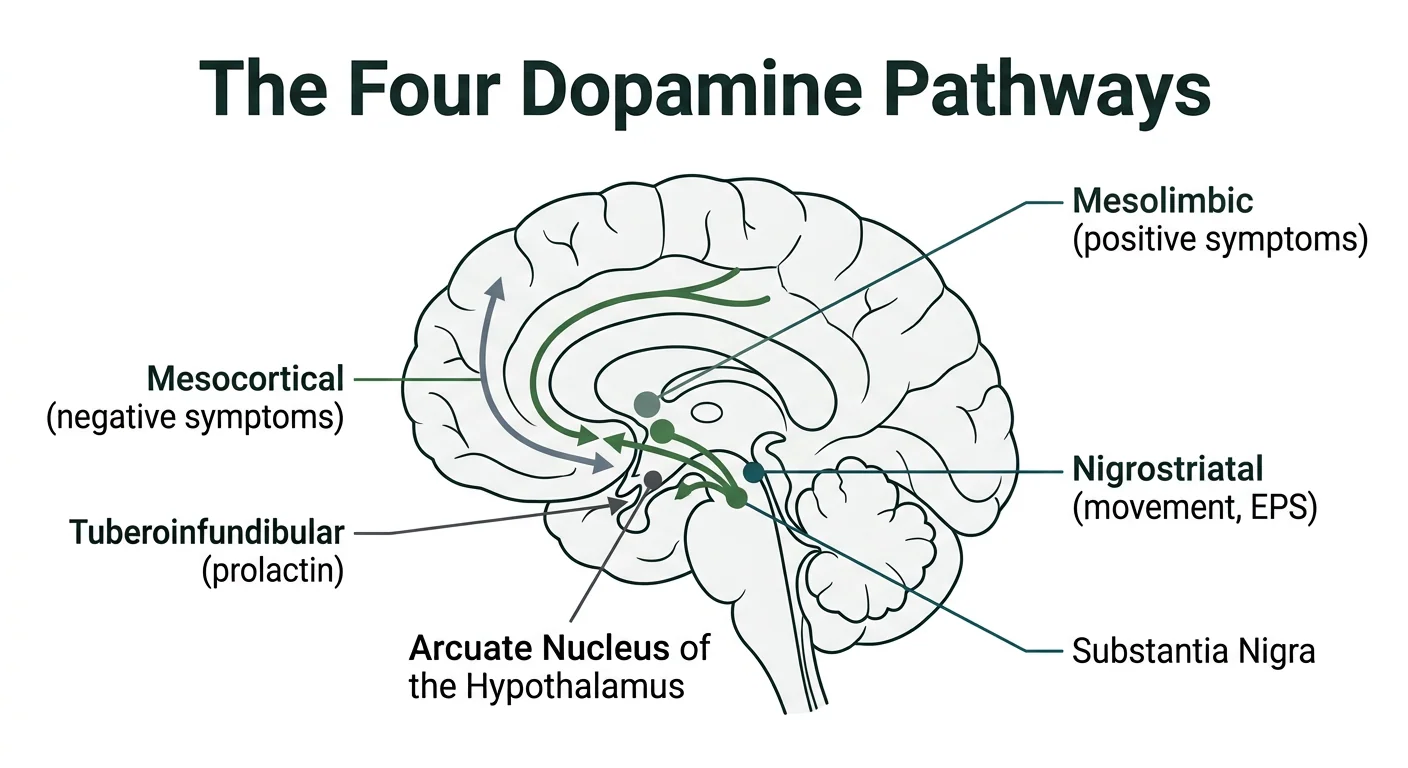
Figure 1 — The four dopamine pathways. Diagram of the four dopamine pathways — mesolimbic, mesocortical, nigrostriatal and tuberoinfundibular — with their associated functions and the symptoms of their blockade.
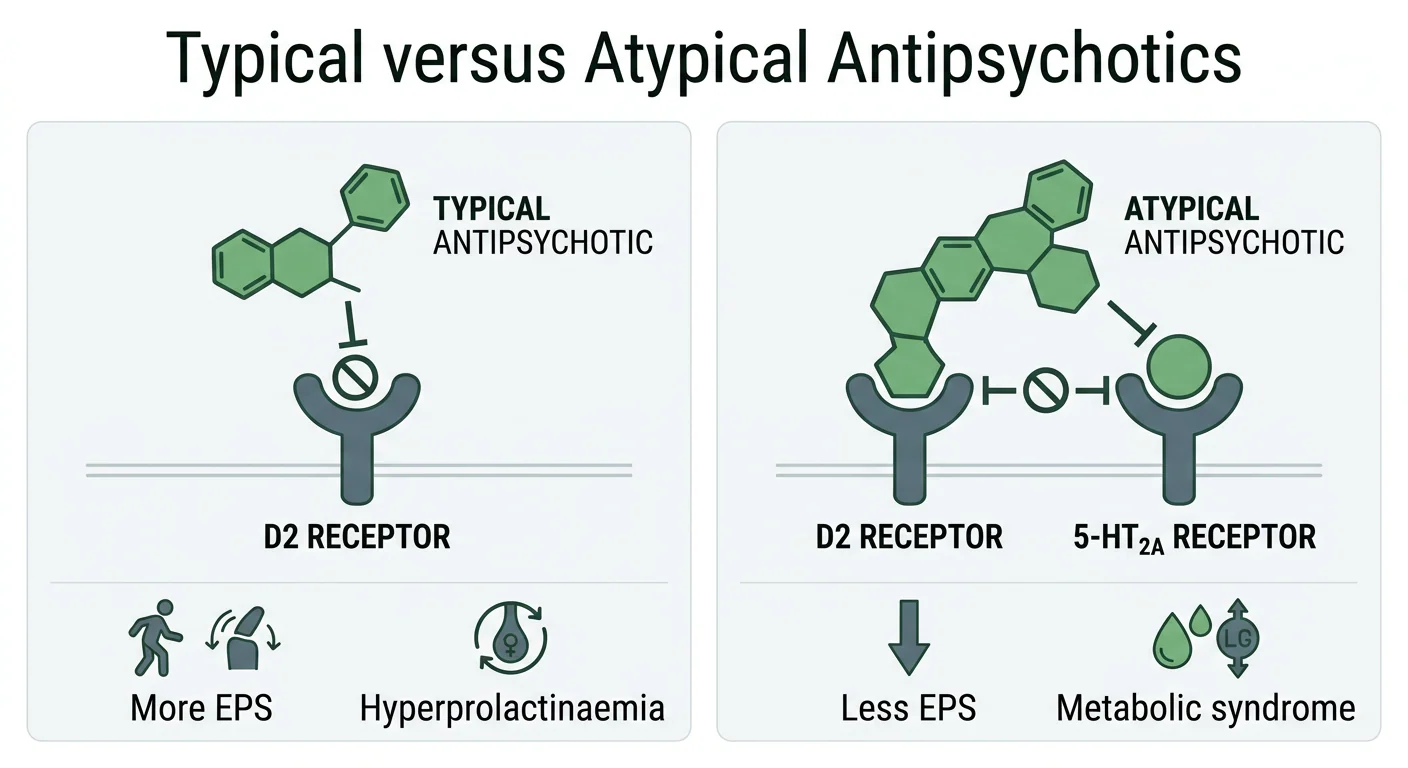
Figure 2 — Typical versus atypical antipsychotic receptor profiles. Comparison of typical antipsychotics, which block D2 receptors alone and cause more EPS, with atypical antipsychotics, which block D2 and 5-HT2A receptors and cause less EPS but metabolic syndrome.
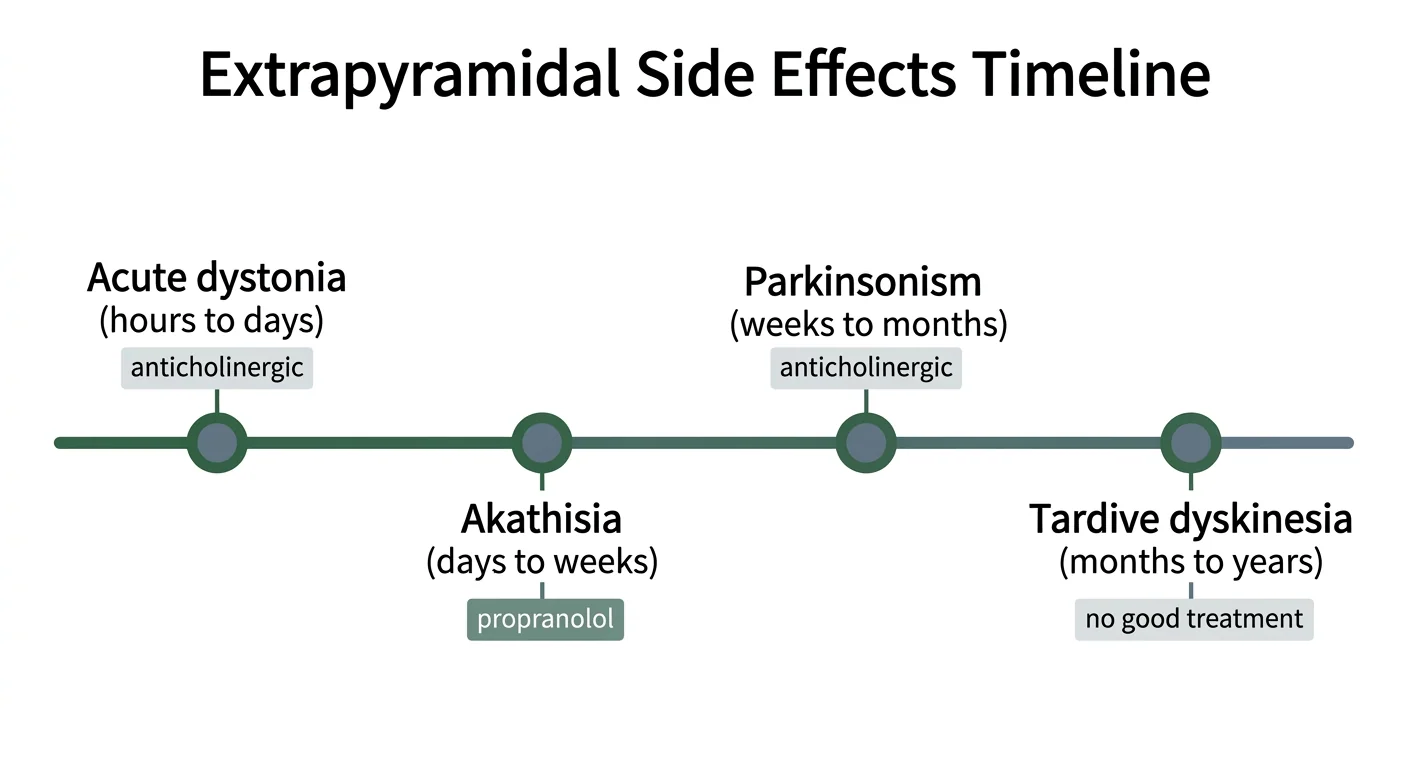
Figure 3 — Extrapyramidal side effects timeline. Timeline of the four extrapyramidal side effects — acute dystonia, akathisia, parkinsonism and tardive dyskinesia — in order of onset, with their respective treatments.
Clinical Correlation
Vignette 1 — Acute dystonia after an antipsychotic
A young man given haloperidol develops, within hours, painful neck spasm with his eyes deviated upward (oculogyric crisis).
Reasoning: This is acute dystonia, the earliest EPS, from D2 blockade. It is treated with an anticholinergic (trihexyphenidyl, benztropine) or diphenhydramine, which relieves the spasm within minutes. The vignette illustrates the time-course principle — dystonia appears within hours to days, and its specific treatment is anticholinergic.
Vignette 2 — Neuroleptic malignant syndrome
A patient on high-dose haloperidol develops severe rigidity, a temperature of 40°C, tachycardia and a markedly raised creatine kinase.
Reasoning: This is neuroleptic malignant syndrome — a life-threatening reaction to D2 blockade. Management is to stop the antipsychotic, give supportive care (cooling, fluids), and use dantrolene (for rigidity) and bromocriptine (a dopamine agonist). The absence of clonus and the raised CK distinguish it from serotonin syndrome.
Vignette 3 — Clozapine and agranulocytosis
A patient with treatment-resistant schizophrenia on clozapine presents with fever and a sore throat; the white-cell count reveals agranulocytosis.
Reasoning: Clozapine causes agranulocytosis, which is why regular blood-count monitoring (initially weekly) is mandatory throughout therapy. The drug must be stopped, and the patient managed for the infection risk. This monitoring requirement — and clozapine's unique efficacy — makes it the most distinctive atypical antipsychotic.
Vignette 4 — Lithium toxicity
A patient on lithium develops tremor, ataxia and polyuria after starting ibuprofen for arthritis.
Reasoning: Lithium has a narrow therapeutic index and is renally cleared; NSAIDs (and thiazides, and dehydration) raise lithium levels, precipitating toxicity (tremor, ataxia, nephrogenic diabetes insipidus). Management is to stop the precipitant, measure the lithium level, and — in severe toxicity (confusion, seizures) — perform haemodialysis. This is the classic interaction-and-monitoring lesson of lithium.
Practical Linkage
Recognising EPS and monitoring lithium
| Presentation | Time course | Diagnosis | Treatment |
|---|---|---|---|
| Neck spasm, oculogyric crisis | Hours–days | Acute dystonia | Anticholinergic |
| Inability to sit still | Days–weeks | Akathisia | Propranolol |
| Tremor, rigidity, bradykinesia | Weeks–months | Parkinsonism | Anticholinergic |
| Orofacial movements | Months–years | Tardive dyskinesia | No good treatment |
| Rigidity + hyperthermia + raised CK | — | NMS | Dantrolene, bromocriptine |
Exercise (PH1.19 — recognise EPS and monitor lithium)
Discussion point
Why does lithium require trough monitoring, and which drugs raise its level?
Expected: lithium has a narrow therapeutic index and renal clearance, so trough levels are monitored; NSAIDs, thiazides and dehydration raise its level.
MCQ Bank
40 questions · tagged by topic, exam pattern & difficulty · full explanations
The dopamine pathway whose blockade relieves the positive symptoms of schizophrenia is:
Rapid Revision
- Mesolimbic D2 blockade — treats positive symptoms
- Nigrostriatal D2 blockade — causes extrapyramidal side effects
- Tuberoinfundibular D2 blockade — raises prolactin
- Mesocortical hypofunction — negative symptoms
- Typical antipsychotics — D2 antagonists
- Atypical antipsychotics — D2 plus 5-HT2A antagonists
- Acute dystonia — hours to days, anticholinergic
- Akathisia — days to weeks, propranolol
- Parkinsonism — weeks to months, anticholinergic
- Tardive dyskinesia — months to years, no good treatment
- Tardive dyskinesia — worsened by anticholinergics
- NMS — rigidity, hyperthermia, raised CK
- NMS treatment — dantrolene and bromocriptine
- Serotonin syndrome — clonus, treated with cyproheptadine
- Clozapine — agranulocytosis, weekly blood counts
- Clozapine — the most effective, minimal EPS
- Aripiprazole — a partial D2 agonist
- Risperidone — the most EPS-prone atypical
- Lithium therapeutic range — 0.6 to 1.2 mEq/L
- Lithium monitoring — trough levels
- Lithium toxicity — tremor, ataxia, diabetes insipidus
- Lithium interactions — NSAIDs, thiazides, dehydration
- Severe lithium toxicity — haemodialysis
- Atypical antipsychotics — weight gain and diabetes
- Acute mania — atypical antipsychotics
- Valproate — anticonvulsant mood stabiliser
- Chlorpromazine — sedation, hypotension, photosensitivity
- Oculogyric crisis — acute dystonia
- Lithium excretion — renal
Viva Questions
- Name the four dopamine pathways — Mesolimbic, mesocortical, nigrostriatal and tuberoinfundibular.
- Which pathway mediates the positive symptoms — The mesolimbic pathway.
- Which pathway blockade causes EPS — The nigrostriatal pathway.
- Differentiate typical and atypical antipsychotics — Typicals block D2; atypicals block D2 plus 5-HT2A, with less EPS.
- What are the four EPS types and their time courses — Acute dystonia (hours-days), akathisia (days-weeks), parkinsonism (weeks-months), tardive dyskinesia (months-years).
- How is acute dystonia treated — With an anticholinergic such as trihexyphenidyl.
- How is akathisia treated — With a beta-blocker such as propranolol.
- Why are anticholinergics avoided in tardive dyskinesia — They worsen it.
- What is NMS — Rigidity, hyperthermia, autonomic instability and raised creatine kinase from D2 blockade.
- How is NMS treated — Withdraw the drug, supportive care, dantrolene and bromocriptine.
- What is clozapine's major toxicity — Agranulocytosis, requiring weekly blood counts.
- What is aripiprazole's unique mechanism — Partial D2 agonism.
- What is lithium's therapeutic range — 0.6 to 1.2 mEq/L.
- What raises lithium levels — NSAIDs, thiazides and dehydration.
- How is severe lithium toxicity treated — With haemodialysis.
References
- Tripathi KD. Essentials of Medical Pharmacology. 9th ed. New Delhi: Jaypee Brothers Medical Publishers; Chapter 32 (Antipsychotic Drugs; Antimanic Drugs).
- Katzung BG, Vanderah TW (eds). Basic & Clinical Pharmacology. 16th ed. New York: McGraw Hill; Chapter 29 (Antipsychotic Agents and Lithium).
- Brunton LL, Knollmann BC (eds). Goodman & Gilman's The Pharmacological Basis of Therapeutics. 14th ed. New York: McGraw Hill; Chapters 15 and 16 (Antipsychotic Drugs; Lithium).
- Ritter JM, Flower RJ, Henderson G, et al. Rang & Dale's Pharmacology. 10th ed. Edinburgh: Elsevier; Chapter 45 (Antipsychotic Drugs).
- National Medical Commission. Competency Based Undergraduate Curriculum for the Indian Medical Graduate, Volume II — Pharmacology (Code: PH), competency PH1.19.
- Leucht S, Cipriani A, Spineli L, et al. Comparative efficacy and tolerability of 15 antipsychotic drugs in schizophrenia. Lancet. 2013;382(9896):951–962.
- Strawn JR, Keck PE Jr, Caroff SN. Neuroleptic malignant syndrome. American Journal of Psychiatry. 2007;164(6):870–876.
- Malhi GS, Tanious M, Das P, Berk M. The science and practice of lithium therapy. Australian and New Zealand Journal of Psychiatry. 2012;46(3):192–211.
Downloads
All deliverables & printable revision sheets for CH22
Printable Chapter Handout & Study Notes
Generate a clean, high-yield PDF or print directly without sidebars and navigation menus.