
Antiparkinsonian & Drugs for Neurodegenerative Disorders
Learning Objectives
At the end of this chapter, the Phase II MBBS student will be able to:
- Describe the pathophysiology of Parkinson disease as a nigrostriatal dopaminergic deficit with relative cholinergic excess. (PH1.19 — Knows)
- Explain the levodopa-carbidopa rationale and the adverse effects of levodopa. (PH1.19 — Knows)
- Differentiate the on-off phenomenon from wearing-off and describe their management. (PH1.19 — Knows)
- Describe the dopamine agonists, MAO-B inhibitors and COMT inhibitors and their roles. (PH1.19 — Knows)
- Explain the role of anticholinergics and amantadine in parkinsonism. (PH1.19 — Knows)
- Describe drug-induced parkinsonism and its management. (PH1.19 — Knows-how)
- Explain why levodopa is ineffective in drug-induced parkinsonism. (PH1.19 — Knows)
- Describe the mechanism of cholinesterase inhibitors and memantine in Alzheimer disease. (PH1.19 — Knows)
- Select an appropriate drug for a Parkinson patient at different disease stages. (PH1.19 — Shows-how)
Must-Know Summary
Parkinson disease is a nigrostriatal dopaminergic deficit with relative cholinergic excess, and the pharmacotherapy either restores dopamine (levodopa, dopamine agonists, MAO-B/COMT inhibitors) or reduces cholinergic drive (anticholinergics). The single most important drug is levodopa, given with carbidopa — a peripheral decarboxylase inhibitor that keeps levodopa from being wasted peripherally, allowing a lower dose with fewer side-effects. Long-term levodopa produces the on-off and wearing-off fluctuations, managed with COMT inhibitors. Alzheimer disease is treated symptomatically with cholinesterase inhibitors (raise acetylcholine) and memantine (an NMDA antagonist).
In one line each:
- Parkinson disease — nigrostriatal dopamine deficiency with cholinergic excess
- Levodopa — crosses the blood-brain barrier; dopamine itself does not
- Carbidopa — a peripheral decarboxylase inhibitor that does not cross the barrier
- Levodopa plus carbidopa — lower dose, fewer peripheral side-effects
- Wearing-off — end-of-dose deterioration
- On-off — unpredictable fluctuations between mobility and immobility
- Selegiline — MAO-B inhibitor, no cheese reaction at low doses
- Drug-induced parkinsonism — withdraw the drug, give anticholinergics, not levodopa
- Donepezil — a cholinesterase inhibitor for Alzheimer disease
- Memantine — an NMDA-receptor antagonist for Alzheimer disease
Classification
Box 1 — Antiparkinsonian drugs
- Dopaminergic
- Levodopa + carbidopa (dopamine precursor + peripheral decarboxylase inhibitor)
- Dopamine agonists — bromocriptine, pramipexole, ropinirole, rotigotine
- MAO-B inhibitors — selegiline, rasagiline
- COMT inhibitors — entacapone, tolcapone
- Amantadine (dopamine release + antimuscarinic + NMDA)
- Anticholinergic
- Trihexyphenidyl, benztropine, procyclidine
Box 2 — Drugs for Alzheimer disease
- Cholinesterase inhibitors — donepezil, rivastigmine, galantamine
- NMDA antagonist — memantine
Core Concepts
1. Pathophysiology of Parkinson disease
Parkinson disease results from degeneration of the dopaminergic neurons of the substantia nigra (pars compacta) that project to the striatum. The resulting dopamine deficiency leaves the striatum with a relative cholinergic excess, producing the classical triad of tremor (at rest), rigidity and bradykinesia (with postural instability). The treatment logic follows directly: either restore dopaminergic transmission (levodopa, dopamine agonists, MAO-B and COMT inhibitors) or reduce the cholinergic overactivity (anticholinergics). Amantadine has additional glutamatergic effects.
2. Levodopa and peripheral decarboxylase inhibitors
Levodopa (L-dopa) is the immediate precursor of dopamine and the most effective antiparkinsonian drug. Two facts govern its use:
- Levodopa crosses the blood-brain barrier (via a large-neutral-amino-acid transporter), whereas dopamine itself does not — so levodopa is given and converted to dopamine centrally by DOPA decarboxylase.
- If given alone, most levodopa is decarboxylated peripherally to dopamine, which causes nausea, vomiting and hypotension, and little reaches the brain.
The solution is carbidopa (or benserazide) — a peripheral DOPA decarboxylase inhibitor that does not cross the blood-brain barrier. By blocking peripheral conversion, carbidopa:
- Allows a lower levodopa dose (more reaches the brain);
- Reduces the peripheral adverse effects (nausea, vomiting, postural hypotension, cardiac arrhythmias).
This levodopa-carbidopa combination is the single most examined point in the chapter.
Levodopa adverse effects include nausea/vomiting (reduced by carbidopa), postural hypotension, cardiac arrhythmias, and — with long-term use — the dyskinesias (choreoathetoid movements), the on-off phenomenon and wearing-off.
3. On-off and wearing-off; dopamine agonists, MAO-B and COMT inhibitors
Wearing-off is the end-of-dose deterioration — the benefit of each levodopa dose shortens, so symptoms return before the next dose. The on-off phenomenon is the unpredictable fluctuation between periods of good mobility ("on") and immobility ("off"), often abrupt. Both are managed by COMT inhibitors (which prolong levodopa's effect), dopamine agonists, or dose rescheduling.
- Dopamine agonists — bromocriptine, pramipexole, ropinirole, rotigotine — directly stimulate D2 receptors. They are used early (to delay levodopa and its complications) or as adjuncts; adverse effects include nausea, postural hypotension and impulse-control disorders.
- MAO-B inhibitors — selegiline, rasagiline — selectively inhibit MAO-B, which metabolises dopamine in the brain, prolonging its action. At low doses they are selective for MAO-B and do not cause the tyramine ("cheese") reaction (tyramine is an MAO-A substrate); at high doses they lose selectivity.
- COMT inhibitors — entacapone, tolcapone — inhibit catechol-O-methyltransferase, reducing the peripheral metabolism of levodopa and prolonging its effect, smoothing the fluctuations. Tolcapone carries a hepatotoxicity risk (entacapone is preferred).
4. Anticholinergics and amantadine
Anticholinergics — trihexyphenidyl (benzhexol), benztropine, procyclidine — block central muscarinic receptors, countering the cholinergic excess. They are most useful for tremor (less for rigidity/bradykinesia) and are the mainstay of drug-induced parkinsonism. Adverse effects are the antimuscarinic ones (dry mouth, blurred vision, urinary retention, confusion in the elderly).
Amantadine — an antiviral that increases dopamine release and has antimuscarinic and NMDA-antagonist effects. It is useful in mild disease and, notably, for levodopa-induced dyskinesias.
5. Drug-induced parkinsonism
Drug-induced parkinsonism is caused by dopamine-receptor antagonists — the antipsychotics (haloperidol, chlorpromazine — CH22) and antiemetics such as metoclopramide. Because the dopamine receptor is blocked, levodopa is ineffective (there is no receptor for the dopamine to act on). Management is to withdraw the offending drug (if possible) and give an anticholinergic (trihexyphenidyl, benztropine) for the symptoms. This contrasts sharply with idiopathic Parkinson disease, where levodopa is the cornerstone.
6. Drugs for Alzheimer disease and other neurodegenerative disorders
Alzheimer disease involves a cholinergic deficit and glutamatergic excitotoxicity. Two drug classes provide symptomatic benefit:
- Cholinesterase inhibitors — donepezil, rivastigmine, galantamine — inhibit acetylcholinesterase, raising central acetylcholine (their pharmacology is from CH10); they modestly slow cognitive decline.
- Memantine — an NMDA-receptor antagonist that reduces glutamate-mediated excitotoxicity; used in moderate-to-severe disease, often with a cholinesterase inhibitor.
Neither class is disease-modifying; they are symptomatic. (Drugs for Huntington disease and amyotrophic lateral sclerosis — riluzole — are named only for completeness.)
Tables
Table 1 — Antiparkinsonian drug classes
| Class | Drugs | Target |
|---|---|---|
| Dopamine precursor | Levodopa (+ carbidopa) | Restores dopamine |
| Dopamine agonists | Bromocriptine, pramipexole | D2 receptors |
| MAO-B inhibitors | Selegiline, rasagiline | Inhibit dopamine breakdown |
| COMT inhibitors | Entacapone, tolcapone | Prolong levodopa |
| Anticholinergics | Trihexyphenidyl, benztropine | Reduce cholinergic excess |
| Amantadine | — | Dopamine release, NMDA |
Table 2 — Levodopa-carbidopa rationale
| Feature | Levodopa alone | Levodopa + carbidopa |
|---|---|---|
| Peripheral conversion | High (wasted) | Blocked |
| Dose needed | Higher | Lower |
| Peripheral side-effects | Nausea, hypotension | Reduced |
| Brain delivery | Less | More |
Table 3 — Levodopa adverse effects
| Effect | Type |
|---|---|
| Nausea, vomiting | Peripheral (reduced by carbidopa) |
| Postural hypotension | Peripheral + central |
| Dyskinesias | Long-term, central |
| On-off / wearing-off | Long-term fluctuation |
Table 4 — MAO-B and COMT inhibitors
| Drug | Class | Key point |
|---|---|---|
| Selegiline | MAO-B | No cheese reaction at low dose |
| Rasagiline | MAO-B | Once daily |
| Entacapone | COMT | Prolongs levodopa |
| Tolcapone | COMT | Hepatotoxicity risk |
Table 5 — Drug-induced versus idiopathic parkinsonism
| Feature | Drug-induced | Idiopathic |
|---|---|---|
| Cause | Dopamine-receptor blockade | Nigral degeneration |
| Levodopa | Ineffective | Effective |
| Treatment | Withdraw drug, anticholinergic | Levodopa/carbidopa |
Table 6 — Alzheimer disease drugs
| Drug | Mechanism |
|---|---|
| Donepezil | Cholinesterase inhibitor |
| Rivastigmine | Cholinesterase inhibitor |
| Galantamine | Cholinesterase inhibitor |
| Memantine | NMDA-receptor antagonist |
Figures
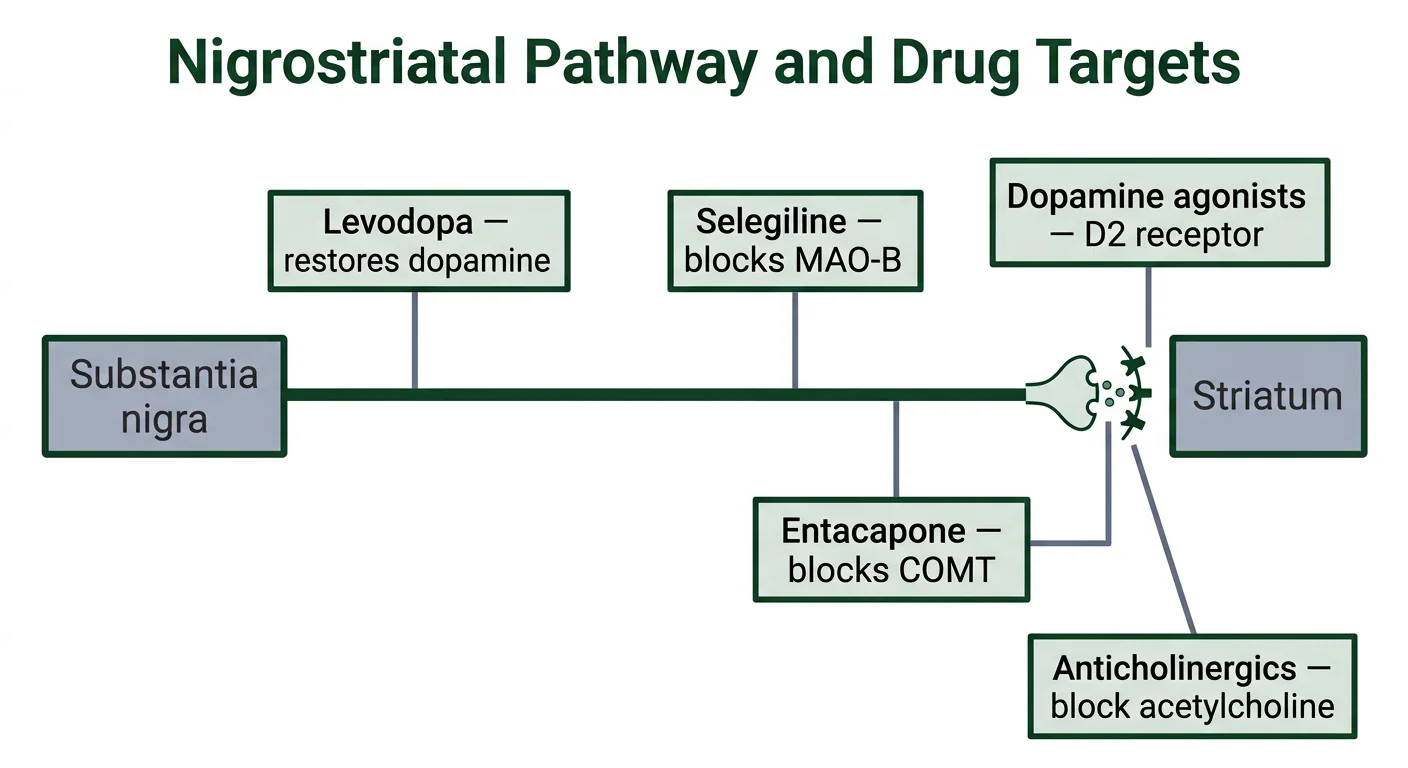
Figure 1 — The nigrostriatal dopamine pathway and drug targets. Diagram of the nigrostriatal dopamine pathway showing levodopa, carbidopa, dopamine agonists, selegiline and anticholinergics at their sites of action in Parkinson disease.
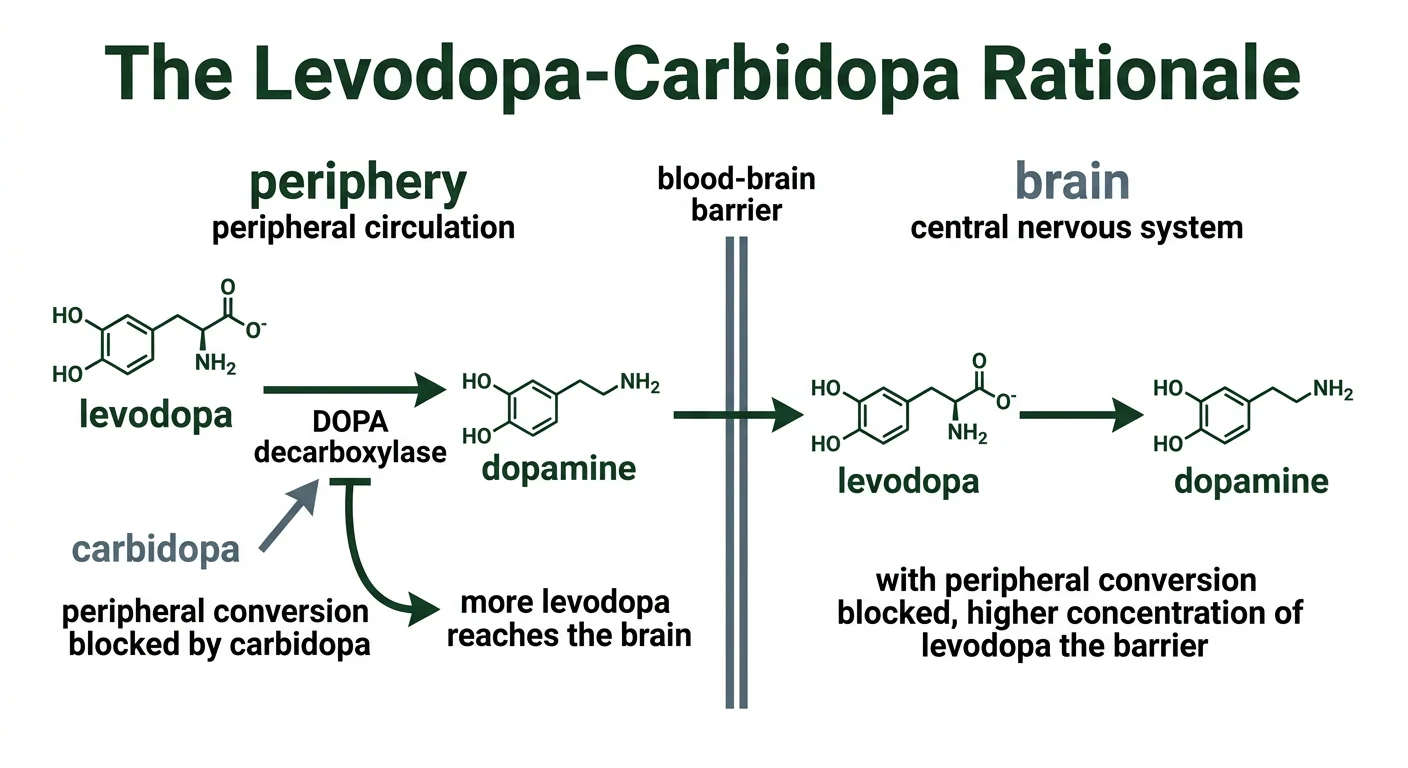
Figure 2 — The levodopa-carbidopa rationale. Diagram showing carbidopa blocking peripheral levodopa conversion so that more levodopa crosses the blood-brain barrier to be converted to dopamine centrally, the rationale for the levodopa-carbidopa combination.
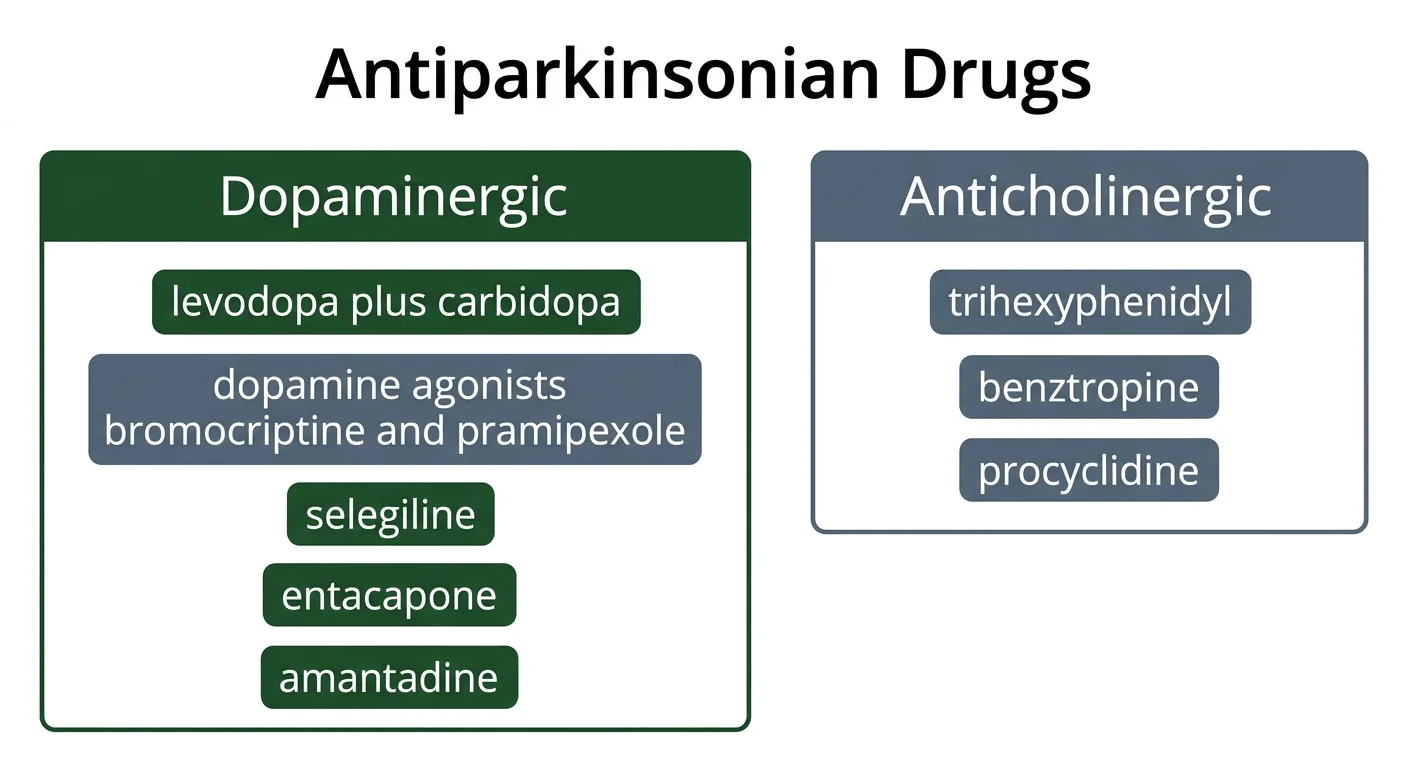
Figure 3 — Antiparkinsonian drug classification. Classification of antiparkinsonian drugs into dopaminergic agents (levodopa, dopamine agonists, selegiline, entacapone, amantadine) and anticholinergic agents (trihexyphenidyl, benztropine, procyclidine).
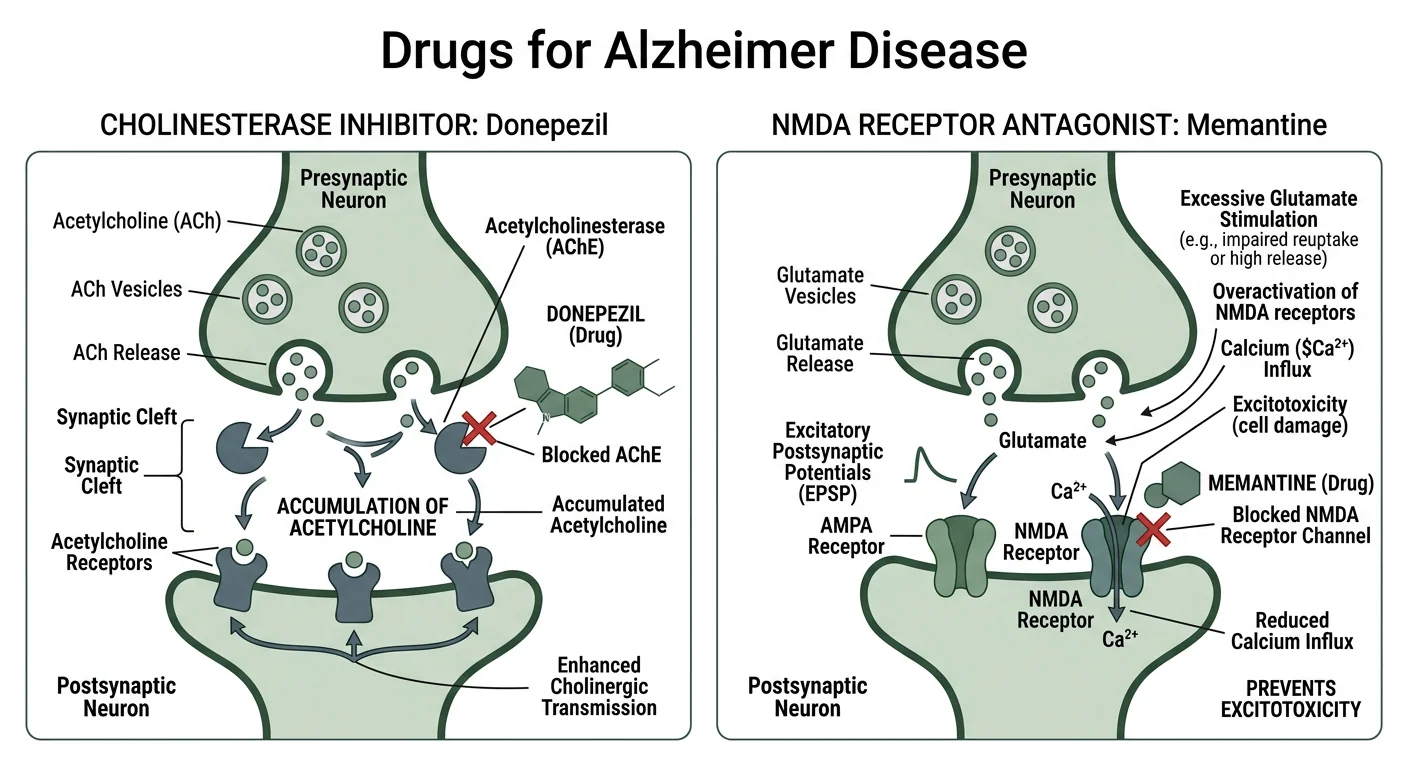
Figure 4 — Drugs for Alzheimer disease. Diagram of the two Alzheimer disease drug mechanisms — cholinesterase inhibitors such as donepezil raising acetylcholine, and memantine blocking the NMDA receptor to reduce glutamate excitotoxicity.
Clinical Correlation
Vignette 1 — Levodopa without carbidopa
A patient is started on levodopa alone for Parkinson disease and develops nausea, vomiting and postural hypotension, with little improvement in tremor.
Reasoning: Without a peripheral decarboxylase inhibitor, most levodopa is converted to dopamine peripherally, causing nausea, vomiting and hypotension, while little reaches the brain. Adding carbidopa blocks this peripheral conversion — allowing a lower levodopa dose, fewer side-effects, and better central delivery. This is the levodopa-carbidopa rationale in action.
Vignette 2 — The on-off phenomenon
A patient on long-term levodopa alternates unpredictably between periods of normal mobility and sudden immobility ("freezing").
Reasoning: This is the on-off phenomenon — unpredictable fluctuations that develop with long-term levodopa. Management includes a COMT inhibitor (entacapone) to prolong each levodopa dose, a dopamine agonist, or dose rescheduling; the wearing-off variant (predictable end-of-dose deterioration) responds similarly. These fluctuations are the major long-term limitation of levodopa.
Vignette 3 — Drug-induced parkinsonism
A patient started on an antipsychotic develops a resting tremor, rigidity and bradykinesia; levodopa is tried without benefit.
Reasoning: This is drug-induced parkinsonism from dopamine-receptor blockade by the antipsychotic. Because the receptor is blocked, levodopa has nothing to act on and is ineffective. The correct management is to withdraw the offending drug (if possible) and use an anticholinergic (trihexyphenidyl, benztropine) for the symptoms. This contrasts with idiopathic Parkinson disease.
Vignette 4 — Selegiline and the cheese reaction
A patient on low-dose selegiline asks whether aged cheese and wine must be avoided, as with the classical MAO inhibitors.
Reasoning: Selegiline at the doses used in Parkinson disease selectively inhibits MAO-B, which metabolises dopamine, and spares MAO-A — so tyramine (an MAO-A substrate) is still metabolised and the cheese reaction does not occur at low doses. At higher doses selectivity is lost and dietary caution returns. This distinguishes selegiline from the non-selective MAO inhibitors (CH23).
Practical Linkage
Managing Parkinson disease
| Stage | Choice | Rationale |
|---|---|---|
| Newly diagnosed, mild | Dopamine agonist or MAO-B inhibitor | Delay levodopa |
| Moderate, functionally impaired | Levodopa + carbidopa | Most effective |
| Wearing-off/on-off | Add entacapone (COMT) or agonist | Prolong levodopa |
| Drug-induced parkinsonism | Withdraw drug + anticholinergic | Receptor is blocked |
| Alzheimer disease | Donepezil ± memantine | Symptomatic benefit |
Exercise (PH1.19 — manage Parkinson disease)
Discussion point
Why is levodopa ineffective in drug-induced parkinsonism?
Expected: the dopamine receptor is blocked by the causative drug, so dopamine (from levodopa) cannot act; an anticholinergic is used instead.
MCQ Bank
35 questions · tagged by topic, exam pattern & difficulty · full explanations
The fundamental biochemical defect in Parkinson disease is:
Rapid Revision
- Parkinson disease — nigrostriatal dopamine deficiency, cholinergic excess
- Levodopa — crosses the blood-brain barrier, dopamine does not
- Carbidopa — peripheral decarboxylase inhibitor, does not cross the barrier
- Levodopa plus carbidopa — lower dose, fewer peripheral side-effects
- Levodopa peripheral effects — nausea, vomiting, hypotension
- Levodopa central long-term effects — dyskinesias, on-off
- Wearing-off — end-of-dose deterioration
- On-off — unpredictable mobility fluctuations
- Entacapone — COMT inhibitor, prolongs levodopa
- Tolcapone — COMT inhibitor, hepatotoxicity
- Selegiline — MAO-B inhibitor, no cheese reaction at low dose
- Dopamine agonists — bromocriptine, pramipexole, ropinirole
- Dopamine agonist adverse effect — impulse-control disorders
- Amantadine — dopamine release, antimuscarinic, NMDA; for dyskinesias
- Trihexyphenidyl — anticholinergic, most useful for tremor
- Drug-induced parkinsonism — antipsychotics, metoclopramide
- Drug-induced parkinsonism — withdraw the drug, anticholinergic, not levodopa
- Levodopa in drug-induced parkinsonism — ineffective (receptor blocked)
- Donepezil — cholinesterase inhibitor for Alzheimer disease
- Rivastigmine and galantamine — cholinesterase inhibitors
- Memantine — NMDA-receptor antagonist
- Alzheimer drugs — symptomatic only
- Rasagiline — MAO-B inhibitor, once daily
- Carbidopa does not reduce — central effects such as dyskinesias
- The most effective antiparkinsonian drug — levodopa with carbidopa
- Metoclopramide — a cause of drug-induced parkinsonism
Viva Questions
- What is the biochemical defect in Parkinson disease — Nigrostriatal dopamine deficiency with cholinergic excess.
- Why is levodopa used rather than dopamine — Levodopa crosses the blood-brain barrier, dopamine does not.
- What is carbidopa — A peripheral DOPA decarboxylase inhibitor that does not cross the blood-brain barrier.
- What is the benefit of adding carbidopa — A lower levodopa dose with fewer peripheral side-effects.
- What are levodopa's adverse effects — Nausea, postural hypotension, dyskinesias and the on-off phenomenon.
- Differentiate wearing-off from on-off — Wearing-off is end-of-dose deterioration; on-off is unpredictable mobility fluctuation.
- How are the fluctuations managed — With a COMT inhibitor (entacapone), a dopamine agonist or dose rescheduling.
- What is selegiline — A selective MAO-B inhibitor.
- Why does selegiline not cause the cheese reaction — At low doses it selectively inhibits MAO-B and spares MAO-A.
- What causes drug-induced parkinsonism — Dopamine-receptor antagonists such as antipsychotics and metoclopramide.
- Why is levodopa ineffective in drug-induced parkinsonism — The dopamine receptor is already blocked.
- How is drug-induced parkinsonism managed — Withdraw the offending drug and give an anticholinergic.
- What is memantine — An NMDA-receptor antagonist for Alzheimer disease.
- What is donepezil — A cholinesterase inhibitor that raises central acetylcholine.
- What is amantadine used for — Mild Parkinson disease and levodopa-induced dyskinesias.
References
- Tripathi KD. Essentials of Medical Pharmacology. 9th ed. New Delhi: Jaypee Brothers Medical Publishers; Chapter 31 (Drugs Used in Parkinsonism and Neurodegenerative Disorders).
- Katzung BG, Vanderah TW (eds). Basic & Clinical Pharmacology. 16th ed. New York: McGraw Hill; Chapter 28 (Pharmacologic Management of Parkinsonism and Other Movement Disorders).
- Brunton LL, Knollmann BC (eds). Goodman & Gilman's The Pharmacological Basis of Therapeutics. 14th ed. New York: McGraw Hill; Chapter 28 (Treatment of Central Nervous System Degenerative Disorders).
- Ritter JM, Flower RJ, Henderson G, et al. Rang & Dale's Pharmacology. 10th ed. Edinburgh: Elsevier; Chapter 47 (Neurodegenerative Diseases).
- National Medical Commission. Competency Based Undergraduate Curriculum for the Indian Medical Graduate, Volume II — Pharmacology (Code: PH), competency PH1.19.
- Connolly BS, Lang AE. Pharmacological treatment of Parkinson disease: a review. JAMA. 2014;311(16):1670–1683.
- Birks J. Cholinesterase inhibitors for Alzheimer's disease. Cochrane Database of Systematic Reviews. 2006;(1):CD005593.
- McShane R, Areosa Sastre A, Minakaran N. Memantine for dementia. Cochrane Database of Systematic Reviews. 2006;(2):CD003154.
Downloads
All deliverables & printable revision sheets for CH21
Printable Chapter Handout & Study Notes
Generate a clean, high-yield PDF or print directly without sidebars and navigation menus.