
Antiepileptics
Learning Objectives
At the end of this chapter, the Phase II MBBS student will be able to:
- Classify seizures into focal and generalised (absence, myoclonic, tonic-clonic) types. (PH1.19 — Knows)
- State the drug of choice for each seizure type and the drugs that worsen specific types. (PH1.19 — Knows)
- Describe the mechanisms of antiepileptic drugs — sodium-channel, T-type calcium-channel, GABAergic and SV2A targets. (PH1.19 — Knows)
- Describe phenytoin's zero-order kinetics and its adverse-effect profile. (PH1.19 — Knows)
- Describe valproate's mechanism, broad spectrum, hepatotoxicity and teratogenicity. (PH1.19 — Knows)
- Describe carbamazepine's auto-induction, hyponatraemia and HLA-B*1502 association. (PH1.19 — Knows)
- Manage status epilepticus with the stepwise protocol. (PH1.19 — Shows-how)
- Explain the teratogenic risks of antiepileptics and the safer alternatives in pregnancy. (PH1.19 — Knows)
- Explain why abrupt withdrawal of antiepileptics precipitates seizures. (PH1.19 — Knows)
- Name the mechanism of levetiracetam and lamotrigine. (PH1.19 — Knows)
Must-Know Summary
The antiepileptics are chosen by seizure type, and that single principle — the drug-of-choice table — drives the entire chapter. Generalised tonic-clonic seizures respond to valproate or phenytoin, absence seizures to ethosuximide, myoclonic to valproate, focal seizures to carbamazepine, and status epilepticus to lorazepam then phenytoin. Two drugs dominate the toxicity examinations: phenytoin, with its zero-order kinetics and gingival hypertrophy, and valproate, the most teratogenic antiepileptic.
In one line each:
- Absence seizures — ethosuximide (valproate as alternative)
- Myoclonic seizures — valproate
- Focal seizures — carbamazepine
- Carbamazepine and phenytoin — worsen absence seizures
- Phenytoin — zero-order (saturable) kinetics
- Phenytoin — gingival hypertrophy, hirsutism, nystagmus, ataxia
- Valproate — the most teratogenic antiepileptic (neural tube defects)
- Carbamazepine — auto-induction and hyponatraemia
- Status epilepticus — lorazepam, then phenytoin
- Levetiracetam — binds SV2A
Classification
Box 1 — Antiepileptic drugs (by mechanism)
- Sodium-channel blockers — phenytoin, carbamazepine, lamotrigine, lacosamide
- T-type calcium-channel blocker — ethosuximide
- GABA enhancers — benzodiazepines, phenobarbitone, valproate, vigabatrin, tiagabine
- SV2A binder — levetiracetam
- Others — topiramate (glutamate), gabapentin/pregabalin (alpha-2-delta)
Box 2 — Drug of choice by seizure type
- Generalised tonic-clonic — valproate, phenytoin, carbamazepine, lamotrigine
- Absence — ethosuximide (or valproate)
- Myoclonic — valproate
- Focal — carbamazepine, phenytoin, lamotrigine
- Status epilepticus — lorazepam, then phenytoin
- Febrile seizures — benzodiazepine
Core Concepts
1. Classification of seizures and rational drug choice
Seizures are classified as focal (partial) — arising in one hemisphere, with or without secondary generalisation — or generalised — involving both hemispheres from onset. The generalised types include absence (petit mal) (brief staring spells with 3-Hz spike-and-wave), myoclonic, tonic-clonic (grand mal), and atonic. The choice of antiepileptic drug follows the seizure type:
- Generalised tonic-clonic — valproate (or phenytoin, carbamazepine, lamotrigine).
- Absence — ethosuximide (valproate as alternative); carbamazepine and phenytoin worsen absence.
- Myoclonic — valproate.
- Focal (partial) — carbamazepine (or phenytoin, lamotrigine).
- Status epilepticus — lorazepam/diazepam, then phenytoin (Section 5).
- Febrile seizures — a benzodiazepine (rectal diazepam or buccal midazolam).
This mapping — and especially the "wrong drug for the wrong seizure type" trap (carbamazepine/phenytoin worsening absence) — is the single most examined content in the chapter.
2. Mechanisms of antiepileptic drug action
Antiepileptic drugs act by reducing neuronal excitability or enhancing inhibition, through four principal mechanisms:
- Voltage-gated sodium-channel blockade (use-dependent, stabilising the inactivated state) — phenytoin, carbamazepine, lamotrigine, valproate, lacosamide.
- T-type calcium-channel blockade (in the thalamus) — ethosuximide (the basis of its specificity for absence seizures).
- Enhancement of GABAergic inhibition — benzodiazepines and phenobarbitone (GABA-A, from CH17), valproate (increases GABA), vigabatrin (inhibits GABA transaminase), tiagabine (blocks GABA reuptake).
- Synaptic vesicle protein SV2A binding — levetiracetam (a novel mechanism), and glutamate inhibition (topiramate, felbamate).
3. Older antiepileptics
Phenytoin — blocks sodium channels (use-dependent). Its defining feature is zero-order (saturable) kinetics: at therapeutic concentrations the metabolising enzymes saturate, so small dose increases produce disproportionately large rises in plasma level and toxicity. Adverse effects include gingival (gum) hypertrophy, hirsutism and coarse facies, nystagmus and ataxia (cerebellar), osteomalacia (vitamin D metabolism), megaloblastic anaemia (folate), and fetal hydantoin syndrome (teratogenicity — CH05/CH07). It induces CYP enzymes (interactions — CH06). Fosphenytoin is the water-soluble prodrug for IV use.
Carbamazepine — sodium-channel blockade; the drug of choice for focal seizures. It undergoes auto-induction (induces its own metabolism, so its half-life falls with continued use), causes hyponatraemia (SIADH-like) and diplopia/ataxia, induces CYP enzymes, and is associated with HLA-B*1502 → Stevens-Johnson syndrome in Han Chinese/Southeast Asians (CH07). It worsens absence seizures.
Valproate (valproic acid / sodium valproate) — multiple mechanisms (sodium-channel blockade, GABA enhancement); the broadest-spectrum agent. Its adverse effects are distinctive: hepatotoxicity (especially in young children), weight gain, tremor, alopecia, pancreatitis, thrombocytopenia, and — critically — it is the most teratogenic antiepileptic (neural tube defects), so it is avoided in women of childbearing age. It inhibits CYP enzymes (raises other AED levels).
Ethosuximide — T-type calcium-channel blockade; the drug of choice for absence seizures, with GI upset as its main adverse effect.
4. Newer antiepileptics
- Levetiracetam — binds SV2A; renally excreted, minimal drug interactions; adverse effects include behavioural changes and somnolence.
- Lamotrigine — sodium-channel blockade; broad-spectrum and relatively safe in pregnancy; requires slow titration to avoid Stevens-Johnson syndrome.
- Topiramate — multiple mechanisms (sodium-channel blockade, glutamate inhibition, carbonic-anhydrase inhibition); causes weight loss, renal stones, word-finding difficulty.
- Gabapentin and pregabalin — bind the alpha-2-delta subunit of calcium channels; used in neuropathic pain as well.
- Vigabatrin — inhibits GABA transaminase; causes visual field loss.
- Lacosamide — enhances the slow inactivation of sodium channels.
5. Status epilepticus protocol
Status epilepticus (seizure activity for >5 minutes, or recurrent seizures without recovery) is a medical emergency, managed stepwise:
- Airway, oxygen, IV access, and check blood glucose (hypoglycaemia is a cause).
- Lorazepam IV (or diazepam IV/rectal) — the first-line benzodiazepine.
- Phenytoin (or fosphenytoin) IV — the second-line agent (if the seizure persists).
- Phenobarbitone IV — the third-line agent.
- Refractory status — midazolam infusion or general anaesthesia (propofol, thiopentone) in intensive care.
6. Antiepileptics in pregnancy and drug interactions
Pregnancy. The antiepileptics are teratogenic, and the risk is greatest with valproate (neural tube defects); phenytoin causes the fetal hydantoin syndrome and carbamazepine neural tube defects (CH05/CH07). Lamotrigine and levetiracetam are relatively safer and are preferred where possible, with folic acid supplementation and the lowest effective dose. The principle is to balance seizure control (maternal seizures also harm the fetus) against teratogenicity.
Withdrawal. Abrupt cessation of antiepileptics can precipitate seizures (and status epilepticus), so they are tapered gradually and never stopped suddenly.
Interactions. The enzyme inducers (phenytoin, carbamazepine, phenobarbitone) reduce the levels of oral contraceptives, warfarin and other drugs; valproate inhibits metabolism and raises the levels of co-administered drugs (CH06).
Tables
Table 1 — Seizure classification
| Type | Features |
|---|---|
| Focal (partial) | One hemisphere; may generalise |
| Generalised tonic-clonic | Bilateral, convulsive |
| Absence | Brief staring, 3-Hz spike-and-wave |
| Myoclonic | Brief jerks |
| Atonic | Loss of tone |
Table 2 — Drug of choice by seizure type
| Seizure type | Drug of choice | Alternatives |
|---|---|---|
| Generalised tonic-clonic | Valproate | Phenytoin, carbamazepine, lamotrigine |
| Absence | Ethosuximide | Valproate |
| Myoclonic | Valproate | — |
| Focal | Carbamazepine | Phenytoin, lamotrigine |
| Status epilepticus | Lorazepam → phenytoin | Phenobarbitone |
| Febrile | Benzodiazepine | — |
Table 3 — Mechanisms of antiepileptics
| Mechanism | Drugs |
|---|---|
| Na+ channel blockade | Phenytoin, carbamazepine, lamotrigine |
| T-type Ca2+ blockade | Ethosuximide |
| GABA enhancement | Benzodiazepines, valproate, vigabatrin |
| SV2A binding | Levetiracetam |
Table 4 — Phenytoin
| Aspect | Detail |
|---|---|
| Kinetics | Zero-order (saturable) |
| Adverse effects | Gum hypertrophy, hirsutism, nystagmus, ataxia |
| Metabolic effects | Osteomalacia (vit D), megaloblastic anaemia (folate) |
| Teratogenicity | Fetal hydantoin syndrome |
| Interactions | Induces CYP |
Table 5 — Carbamazepine and valproate
| Drug | Key features |
|---|---|
| Carbamazepine | Auto-induction, hyponatraemia, HLA-B*1502/SJS, worsens absence |
| Valproate | Broad-spectrum, hepatotoxicity, weight gain, teratogenic |
Table 6 — Newer antiepileptics
| Drug | Mechanism | Distinctive effect |
|---|---|---|
| Levetiracetam | SV2A | Minimal interactions |
| Lamotrigine | Na+ channel | Slow titration, SJS |
| Topiramate | Multiple | Weight loss, renal stones |
| Gabapentin/pregabalin | alpha-2-delta | Neuropathic pain |
| Vigabatrin | GABA-T inhibition | Visual field loss |
Table 7 — Antiepileptics in pregnancy
| Drug | Teratogenicity |
|---|---|
| Valproate | Neural tube defects (worst) |
| Phenytoin | Fetal hydantoin syndrome |
| Carbamazepine | Neural tube defects |
| Lamotrigine/levetiracetam | Relatively safer |
Figures
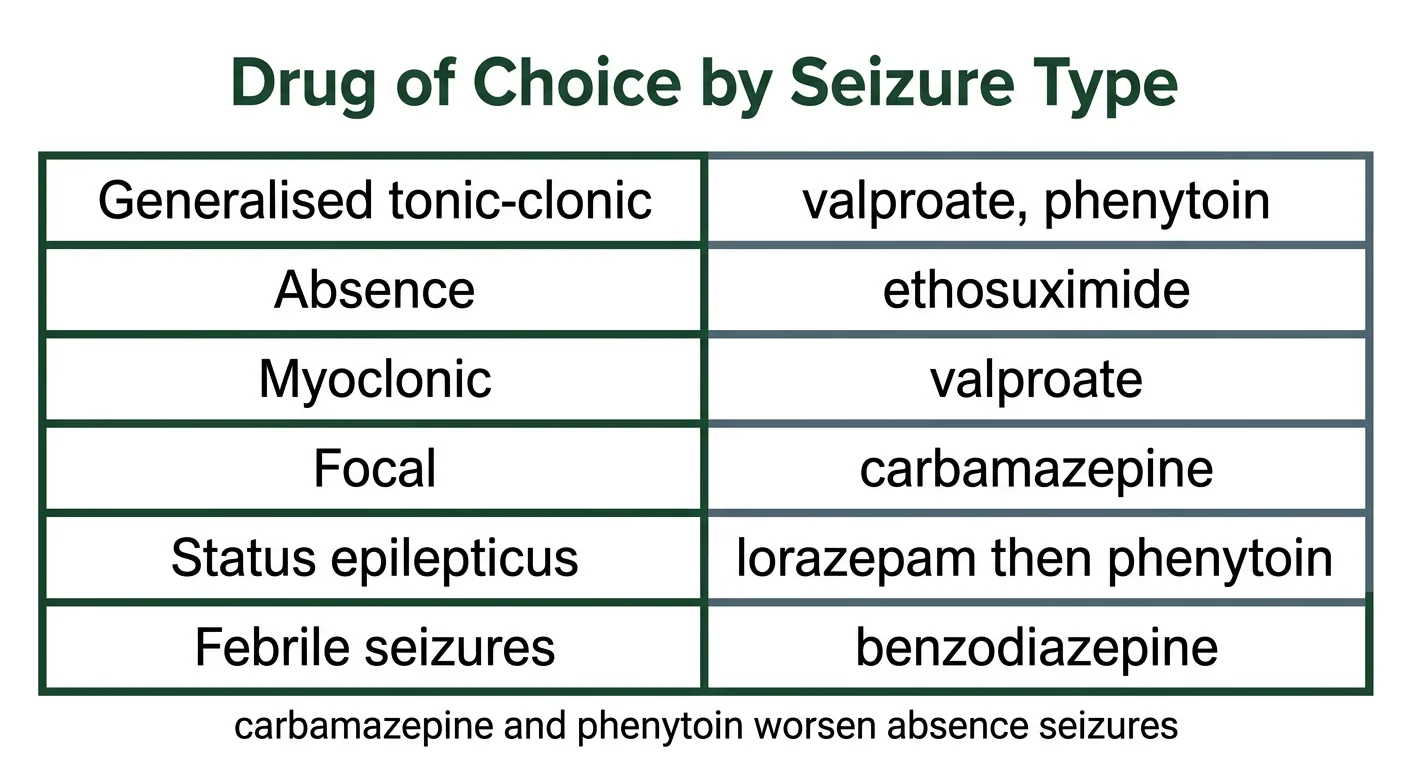
Figure 1 — Drug of choice by seizure type. Chart of the drug of choice for each seizure type — valproate for tonic-clonic and myoclonic, ethosuximide for absence, carbamazepine for focal, lorazepam then phenytoin for status epilepticus — with the warning that carbamazepine and phenytoin worsen absence seizures.
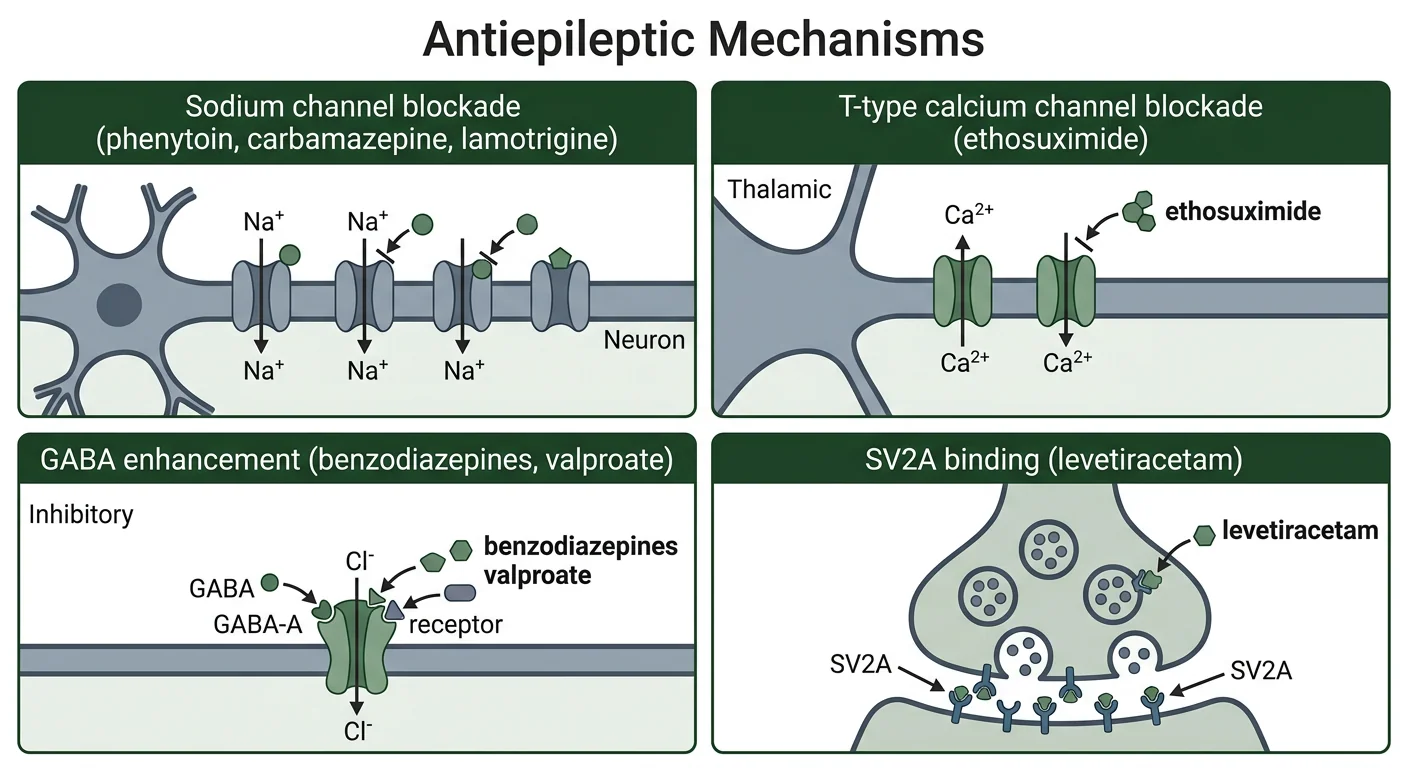
Figure 2 — Antiepileptic mechanisms of action. Diagram of the four main antiepileptic mechanisms — sodium channel blockade, T-type calcium channel blockade, GABA enhancement and SV2A binding — with the drugs acting at each.
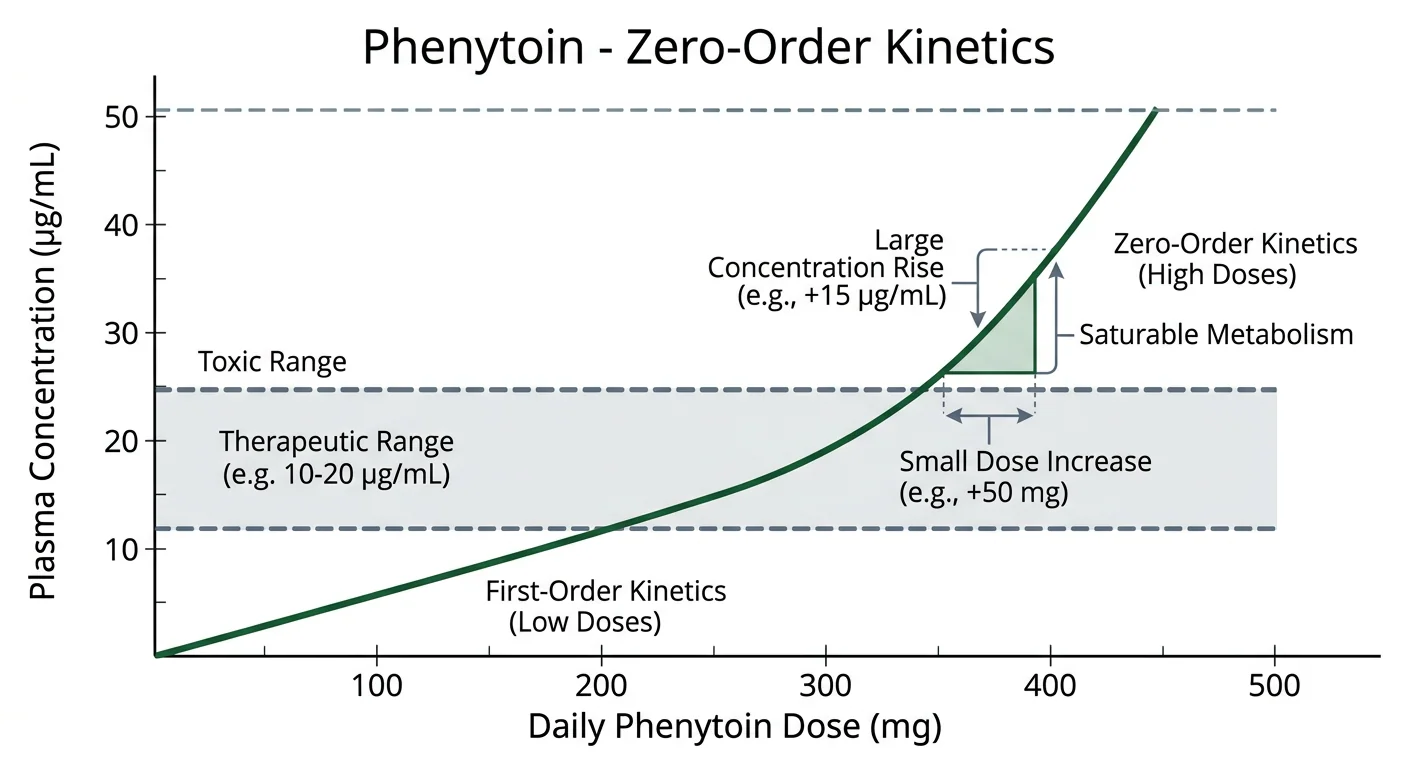
Figure 3 — Phenytoin zero-order kinetics. Graph of phenytoin's zero-order kinetics showing a steep non-linear rise in plasma concentration at higher doses, illustrating how a small dose increase causes a disproportionate increase in concentration and toxicity.
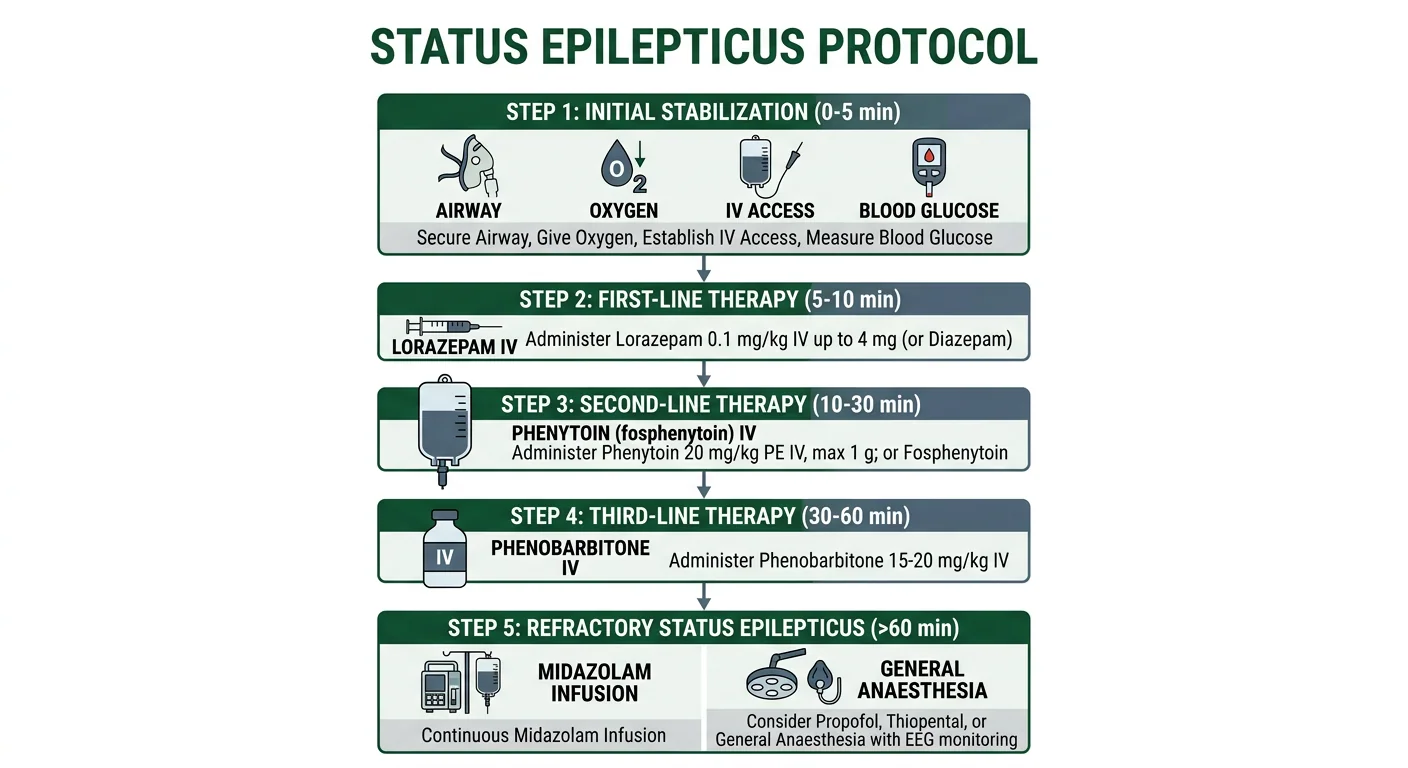
Figure 4 — Status epilepticus protocol. Stepwise diagram of the status epilepticus protocol — airway and glucose first, then lorazepam, phenytoin, phenobarbitone, and finally midazolam infusion or anaesthesia for refractory status.
Clinical Correlation
Vignette 1 — Phenytoin dose increase and toxicity
A patient on phenytoin for tonic-clonic seizures, stable at 300 mg/day, has the dose increased to 400 mg/day and develops ataxia and nystagmus.
Reasoning: Phenytoin follows zero-order (saturable) kinetics — at therapeutic doses the metabolising enzymes are saturated, so the small dose increase produces a disproportionately large rise in the plasma level, causing cerebellar toxicity (ataxia, nystagmus). This is the classic illustration of why phenytoin requires careful, small dose adjustments and level monitoring.
Vignette 2 — Valproate in a woman of childbearing age
A 24-year-old woman with epilepsy is started on valproate, and her neurologist counsels her about pregnancy risk.
Reasoning: Valproate is the most teratogenic antiepileptic, causing neural tube defects (and other malformations) — so it is avoided in women of childbearing age whenever an alternative (lamotrigine, levetiracetam) is suitable. If it must be used, it is given at the lowest effective dose with folic acid supplementation and preconception counselling. This links to the teratogen content of CH05/CH07.
Vignette 3 — Carbamazepine worsening absence seizures
A child with absence seizures is mistakenly started on carbamazepine and the frequency of staring spells increases.
Reasoning: Carbamazepine (and phenytoin) can worsen absence seizures — the "wrong drug for the wrong seizure type" trap. The correct drug is ethosuximide (or valproate). This vignette reinforces the central principle of the chapter: antiepileptic choice is dictated by seizure type, and an inappropriate agent can exacerbate the very seizures it is meant to treat.
Vignette 4 — Status epilepticus
A patient presents in continuous tonic-clonic seizure activity for the past 10 minutes.
Reasoning: Management follows the stepwise protocol: secure the airway, give oxygen, obtain IV access and check blood glucose (hypoglycaemia is a treatable cause), then lorazepam IV as first-line; if the seizure persists, phenytoin (fosphenytoin) IV, then phenobarbitone, and for refractory status a midazolam infusion or general anaesthesia in intensive care. The sequence — benzodiazepine first, then a longer-acting agent — is the key examinable point.
Practical Linkage
Drug of choice by seizure type
| Seizure type | Drug of choice | Drug to avoid |
|---|---|---|
| Absence | Ethosuximide | Carbamazepine, phenytoin |
| Myoclonic | Valproate | — |
| Generalised tonic-clonic | Valproate/phenytoin | — |
| Focal | Carbamazepine | — |
| Status epilepticus | Lorazepam → phenytoin | — |
| Febrile | Rectal diazepam | — |
Exercise (PH1.19 — drug of choice by seizure type)
Discussion point
Why is valproate avoided in women of childbearing age?
Expected: it is the most teratogenic antiepileptic, causing neural tube defects; lamotrigine or levetiracetam are preferred, with folic acid supplementation.
MCQ Bank
40 questions · tagged by topic, exam pattern & difficulty · full explanations
With regard to seizure-specific therapy, the drug of choice for absence seizures is:
Rapid Revision
- Absence seizures — ethosuximide
- Myoclonic seizures — valproate
- Focal seizures — carbamazepine
- Carbamazepine and phenytoin — worsen absence seizures
- Status epilepticus — lorazepam, then phenytoin
- Febrile seizures — a benzodiazepine
- Phenytoin — zero-order saturable kinetics
- Phenytoin — gum hypertrophy, hirsutism, nystagmus, ataxia
- Phenytoin — megaloblastic anaemia from folate
- Phenytoin — osteomalacia from vitamin D
- Phenytoin — fetal hydantoin syndrome
- Valproate — the most teratogenic antiepileptic
- Valproate — neural tube defects
- Valproate — hepatotoxicity, weight gain, tremor, alopecia
- Carbamazepine — auto-induction
- Carbamazepine — hyponatraemia
- Carbamazepine — HLA-B*1502 and SJS
- Ethosuximide — T-type calcium-channel blockade
- Levetiracetam — binds SV2A
- Lamotrigine — slow titration to avoid SJS
- Gabapentin and pregabalin — alpha-2-delta, neuropathic pain
- Vigabatrin — visual field loss
- Topiramate — weight loss, renal stones
- Fosphenytoin — the IV phenytoin prodrug
- Antiepileptics — taper, never stop abruptly
- Lamotrigine and levetiracetam — safer in pregnancy
- Phenytoin and carbamazepine — enzyme inducers
- Valproate — enzyme inhibitor, broad spectrum
- Status epilepticus first step — airway, oxygen, glucose
- Broadest-spectrum antiepileptic — valproate
Viva Questions
- What is the drug of choice for absence seizures — Ethosuximide, with valproate as an alternative.
- Which drugs worsen absence seizures — Carbamazepine and phenytoin.
- What is the drug of choice for myoclonic seizures — Valproate.
- What is the drug of choice for focal seizures — Carbamazepine.
- What is phenytoin's kinetics — Zero-order (saturable) kinetics.
- What are phenytoin's adverse effects — Gingival hypertrophy, hirsutism, nystagmus, ataxia, osteomalacia and megaloblastic anaemia.
- Which is the most teratogenic antiepileptic — Valproate, causing neural tube defects.
- What is carbamazepine's special pharmacokinetic feature — Auto-induction of its own metabolism.
- What electrolyte disturbance does carbamazepine cause — Hyponatraemia.
- What is the status epilepticus protocol — Lorazepam, then phenytoin, then phenobarbitone, then midazolam infusion or anaesthesia.
- What is levetiracetam's mechanism — Binding of synaptic vesicle protein SV2A.
- Why is lamotrigine titrated slowly — To avoid Stevens-Johnson syndrome.
- What is vigabatrin's toxicity — Visual field loss.
- Which antiepileptics are safer in pregnancy — Lamotrigine and levetiracetam.
- Why must antiepileptics be tapered — Abrupt withdrawal precipitates seizures.
References
- Tripathi KD. Essentials of Medical Pharmacology. 9th ed. New Delhi: Jaypee Brothers Medical Publishers; Chapter 30 (Antiepileptic Drugs).
- Katzung BG, Vanderah TW (eds). Basic & Clinical Pharmacology. 16th ed. New York: McGraw Hill; Chapter 24 (Antiseizure Drugs).
- Brunton LL, Knollmann BC (eds). Goodman & Gilman's The Pharmacological Basis of Therapeutics. 14th ed. New York: McGraw Hill; Chapter 21 (Antiseizure Drugs).
- Ritter JM, Flower RJ, Henderson G, et al. Rang & Dale's Pharmacology. 10th ed. Edinburgh: Elsevier; Chapter 48 (Antiepileptic Drugs).
- National Medical Commission. Competency Based Undergraduate Curriculum for the Indian Medical Graduate, Volume II — Pharmacology (Code: PH), competency PH1.19.
- Glauser T, Shinnar S, Gloss D, et al. Evidence-based guideline: treatment of convulsive status epilepticus in children and adults. Epilepsy Currents. 2016;16(1):48–61.
- Tomson T, Battino D. Teratogenic effects of antiepileptic drugs. Lancet Neurology. 2012;11(9):803–813.
- Brodie MJ. Sodium channel blockers in the treatment of epilepsy. CNS Drugs. 2017;31(7):527–534.
Downloads
All deliverables & printable revision sheets for CH20
Printable Chapter Handout & Study Notes
Generate a clean, high-yield PDF or print directly without sidebars and navigation menus.