
General Anaesthetics & Preanaesthetic Medication
Learning Objectives
At the end of this chapter, the Phase II MBBS student will be able to:
- Describe the stages of general anaesthesia and the components of the anaesthetic state. (PH1.18 — Knows)
- Define the minimum alveolar concentration (MAC) and explain its relationship to potency and its determinants. (PH1.18 — Knows)
- Explain the blood:gas partition coefficient and its effect on the speed of induction and recovery. (PH1.18 — Knows)
- Describe the inhalational agents — nitrous oxide, halothane, isoflurane, sevoflurane and desflurane — with their properties and toxicities. (PH1.18 — Knows)
- Compare the intravenous agents propofol, thiopentone, ketamine and etomidate. (PH1.18 — Knows)
- Explain the concept of balanced anaesthesia and the aims of preanaesthetic medication. (PH1.18 — Knows)
- Describe malignant hyperthermia and its management with dantrolene. (PH1.18 — Knows-how)
- State the toxicities of halothane, including hepatotoxicity and arrhythmias. (PH1.18 — Knows)
- Select an appropriate anaesthetic agent for a child, a shocked patient, a day-case and an asthmatic. (PH1.18 — Shows-how)
- Explain why ketamine raises rather than lowers the blood pressure. (PH1.18 — Knows)
Must-Know Summary
General anaesthesia is a reversible state of unconsciousness, amnesia, analgesia and muscle relaxation, produced by inhalational agents (nitrous oxide, halothane, isoflurane, sevoflurane, desflurane) or intravenous agents (propofol, thiopentone, ketamine, etomidate). Two numbers govern the inhalational agents: MAC (minimum alveolar concentration — inversely related to potency) and the blood:gas partition coefficient (which sets the speed of induction). The key contrasts are propofol (rapid, antiemetic, hypotensive), thiopentone (barbiturate, anticonvulsant) and ketamine (dissociative, sympathomimetic — it raises the blood pressure).
In one line each:
- MAC — the alveolar concentration at which 50 percent of patients do not move to surgical stimulus
- MAC is inversely related to potency — a low MAC means a potent agent
- Blood:gas partition coefficient — low means fast induction
- Nitrous oxide — low potency, high MAC, rapid, analgesic
- Sevoflurane — non-pungent, the mask-induction agent of choice in children
- Halothane — hepatotoxicity and adrenaline-sensitisation arrhythmias
- Propofol — rapid onset and recovery, antiemetic, causes hypotension
- Thiopentone — an ultra-short barbiturate, anticonvulsant, no analgesia
- Ketamine — a dissociative anaesthetic that raises blood pressure and heart rate
- Malignant hyperthermia — treated with dantrolene
Classification
Box 1 — General anaesthetics
- Inhalational
- Gases — nitrous oxide
- Volatile liquids — halothane, isoflurane, sevoflurane, desflurane, enflurane
- Intravenous
- Barbiturate — thiopentone, methohexitone
- Non-barbiturate — propofol, etomidate
- Dissociative — ketamine
- Benzodiazepine (adjunct) — midazolam
Box 2 — Preanaesthetic medication (aims and agents)
- Anxiolysis/amnesia — benzodiazepine (midazolam, diazepam)
- Antisialogogue — glycopyrrolate, atropine
- Analgesia — opioid (fentanyl, morphine)
- Antiemetic — ondansetron, metoclopramide
- Aspiration prophylaxis — H2 blocker, antacid
Core Concepts
1. Stages and depth of general anaesthesia
General anaesthesia is a state of reversible depression of the central nervous system producing unconsciousness, amnesia, analgesia and muscle relaxation. Guedel's stages (described with ether, but conceptually useful) describe the depth of anaesthesia:
- Stage I — Analgesia: the patient is conscious but drowsy, with reduced pain perception.
- Stage II — Excitement/delirium: loss of consciousness with irregular respiration and possible struggling or vomiting — the stage to pass through quickly.
- Stage III — Surgical anaesthesia: regular respiration, loss of reflexes, and (in four planes) progressive muscle relaxation — the target stage for surgery.
- Stage IV — Medullary paralysis: respiratory and cardiovascular depression — dangerous, to be avoided.
Modern practice uses balanced anaesthesia — a combination of drugs, each contributing one component (an intravenous induction agent for unconsciousness, an opioid for analgesia, a neuromuscular blocker for relaxation, an inhalational agent for maintenance) — so that no single drug is pushed to a dangerous depth.
2. Inhalational agents — MAC and the blood:gas partition coefficient
Two concepts govern the inhalational anaesthetics:
Minimum alveolar concentration (MAC). The MAC is the alveolar concentration at which 50% of patients do not move in response to a surgical stimulus — a measure of potency. It is inversely related to potency: a drug with a low MAC is potent (halothane ~0.75%), while one with a high MAC is weak (nitrous oxide >100%). MAC is reduced by increasing age, hypothermia, pregnancy, opioids and sedatives, and increased by infancy, chronic alcohol and hyperthermia.
Blood:gas partition coefficient. This coefficient determines how the agent partitions between blood and alveolar gas, and hence the speed of induction and recovery. A low coefficient (nitrous oxide, desflurane, sevoflurane) means the alveolar concentration rises quickly → rapid induction and recovery; a high coefficient (halothane, methoxyflurane) means the agent dissolves in blood → slow induction.
3. Individual inhalational agents
- Nitrous oxide — a gas of low potency (high MAC) and low blood:gas coefficient (rapid). It is a good analgesic with minimal cardiovascular depression, used as an adjunct; its effects include the second-gas effect (accelerating uptake of a co-administered agent), diffusion hypoxia (on withdrawal), and oxidation of vitamin B12 (megaloblastic anaemia with prolonged use).
- Halothane — a potent volatile liquid; its toxicity profile is the most examined: hepatotoxicity (rare "halothane hepatitis"), sensitisation of the myocardium to catecholamines (arrhythmias — avoid adrenaline), uterine relaxation (avoid in obstetrics), and it is a malignant hyperthermia trigger.
- Isoflurane — potent, with cardiovascular stability; it is pungent (not for mask induction).
- Sevoflurane — non-pungent and rapid (low blood:gas), making it the mask-induction agent of choice in children.
- Desflurane — the lowest blood:gas coefficient (most rapid onset/offset), but pungent.
- Enflurane — can precipitate seizure activity (avoid in epilepsy).
4. Intravenous induction agents
- Propofol — the most widely used induction agent. It produces rapid onset and rapid recovery, is antiemetic, but causes hypotension and has no analgesic effect. It is used for induction, maintenance (total intravenous anaesthesia) and sedation; prolonged high-dose infusion can rarely cause the propofol infusion syndrome.
- Thiopentone (thiopental) — an ultra-short-acting barbiturate. It produces rapid induction (terminated by redistribution), is anticonvulsant, but depresses the myocardium and respiration, has no analgesic effect, and may precipitate porphyria and laryngospasm.
- Ketamine — a dissociative anaesthetic acting as an NMDA receptor antagonist. Uniquely, it raises the blood pressure and heart rate (sympathomimetic), preserves airway reflexes, is a bronchodilator and provides analgesia — so it is used in shock, children and asthmatics. Its adverse effect is emergence phenomena (hallucinations, nightmares), reduced by a benzodiazepine.
- Etomidate — cardiovascularly stable (minimal hypotension), but causes adrenal suppression (cortisol inhibition) — limiting repeated use.
5. Balanced anaesthesia and preanaesthetic medication
Balanced anaesthesia combines an induction agent, an opioid (analgesia), a neuromuscular blocker (relaxation) and an inhalational agent (maintenance), achieving all four components of anaesthesia while minimising the dose (and toxicity) of any single agent.
Preanaesthetic medication aims to: relieve anxiety (benzodiazepine — midazolam, diazepam), reduce secretions (antisialogogue — glycopyrrolate or atropine), provide analgesia (opioid), prevent vomiting/aspiration (antiemetic, H2 blocker/antacid), and blunt vagal reflexes. These are given before induction to smooth the anaesthetic course.
6. Complications — malignant hyperthermia and hepatotoxicity
Malignant hyperthermia is a hypermetabolic crisis in patients with ryanodine-receptor (RYR1) mutations (CH07), triggered by succinylcholine and the volatile anaesthetics (halothane, sevoflurane, etc.). It presents with muscle rigidity, rapidly rising temperature, tachycardia and metabolic acidosis. Management is immediate discontinuation of the trigger, cooling, supportive care and dantrolene, which acts on the ryanodine receptor to stop calcium release (CH11).
Halothane hepatotoxicity ("halothane hepatitis") is a rare, immune-mediated liver injury after repeated halothane exposure. Halothane's other liabilities — arrhythmias from catecholamine sensitisation and uterine relaxation — are the reasons it has been largely replaced by the newer volatile agents.
Tables
Table 1 — Guedel's stages of anaesthesia
| Stage | Name | Features |
|---|---|---|
| I | Analgesia | Conscious, drowsy, reduced pain |
| II | Excitement/delirium | Unconscious, irregular respiration, vomiting risk |
| III | Surgical anaesthesia | Regular respiration, loss of reflexes, relaxation |
| IV | Medullary paralysis | Respiratory/cardiovascular depression (danger) |
Table 2 — MAC and blood:gas partition coefficient
| Concept | Definition | Clinical meaning |
|---|---|---|
| MAC | Alveolar concentration at which 50% do not move | Inversely related to potency |
| Blood:gas coefficient | Blood/gas solubility | Low = fast induction |
Table 3 — Inhalational agents compared
| Agent | Potency (MAC) | Blood:gas | Key feature |
|---|---|---|---|
| Nitrous oxide | Low (high MAC) | Very low | Analgesic, rapid |
| Halothane | High | High | Hepatotoxicity, arrhythmias |
| Isoflurane | High | Moderate | Pungent, CVS stable |
| Sevoflurane | Moderate | Low | Non-pungent, children |
| Desflurane | Moderate | Lowest | Most rapid |
Table 4 — Intravenous induction agents
| Agent | Onset | CVS effect | Key point |
|---|---|---|---|
| Propofol | Rapid | Hypotension | Antiemetic |
| Thiopentone | Rapid | Myocardial depression | Anticonvulsant |
| Ketamine | Moderate | Raises BP/HR | Sympathomimetic |
| Etomidate | Rapid | Minimal | Adrenal suppression |
Table 5 — Propofol versus thiopentone versus ketamine
| Feature | Propofol | Thiopentone | Ketamine |
|---|---|---|---|
| Class | Non-barbiturate | Barbiturate | Dissociative |
| Blood pressure | Lowers | Lowers | Raises |
| Analgesia | No | No | Yes |
| Antiemetic | Yes | No | No |
| Adverse | Hypotension | Porphyria, laryngospasm | Emergence phenomena |
Table 6 — Preanaesthetic medication
| Aim | Agent |
|---|---|
| Anxiolysis/amnesia | Midazolam, diazepam |
| Antisialogogue | Glycopyrrolate, atropine |
| Analgesia | Fentanyl, morphine |
| Antiemetic | Ondansetron, metoclopramide |
| Aspiration prophylaxis | Ranitidine, antacid |
Table 7 — Malignant hyperthermia
| Aspect | Detail |
|---|---|
| Trigger | Succinylcholine, volatile agents |
| Basis | Ryanodine-receptor mutation |
| Features | Rigidity, hyperthermia, acidosis |
| Treatment | Dantrolene |
Figures
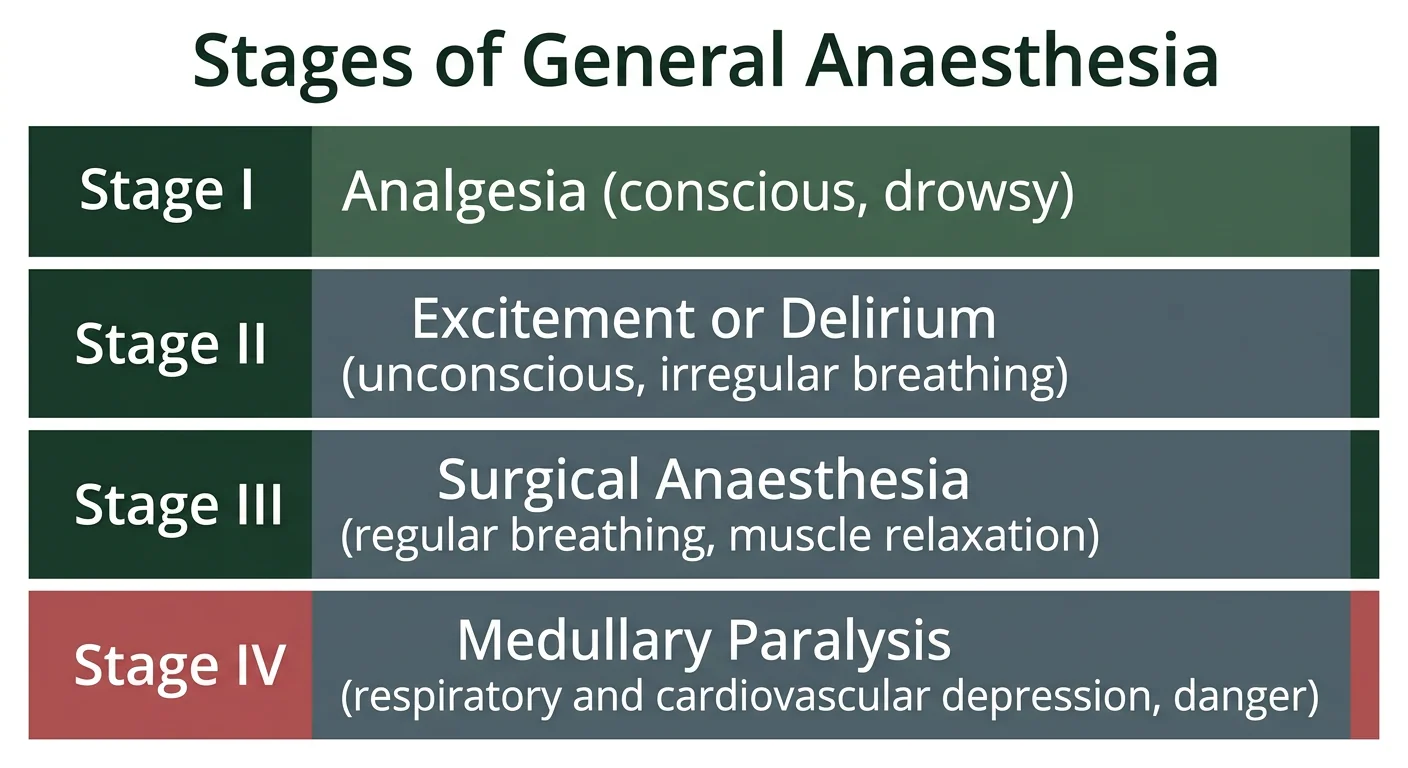
Figure 1 — Stages of general anaesthesia. Diagram of the four stages of general anaesthesia from analgesia through excitement and surgical anaesthesia to medullary paralysis, with the danger of stage four indicated.
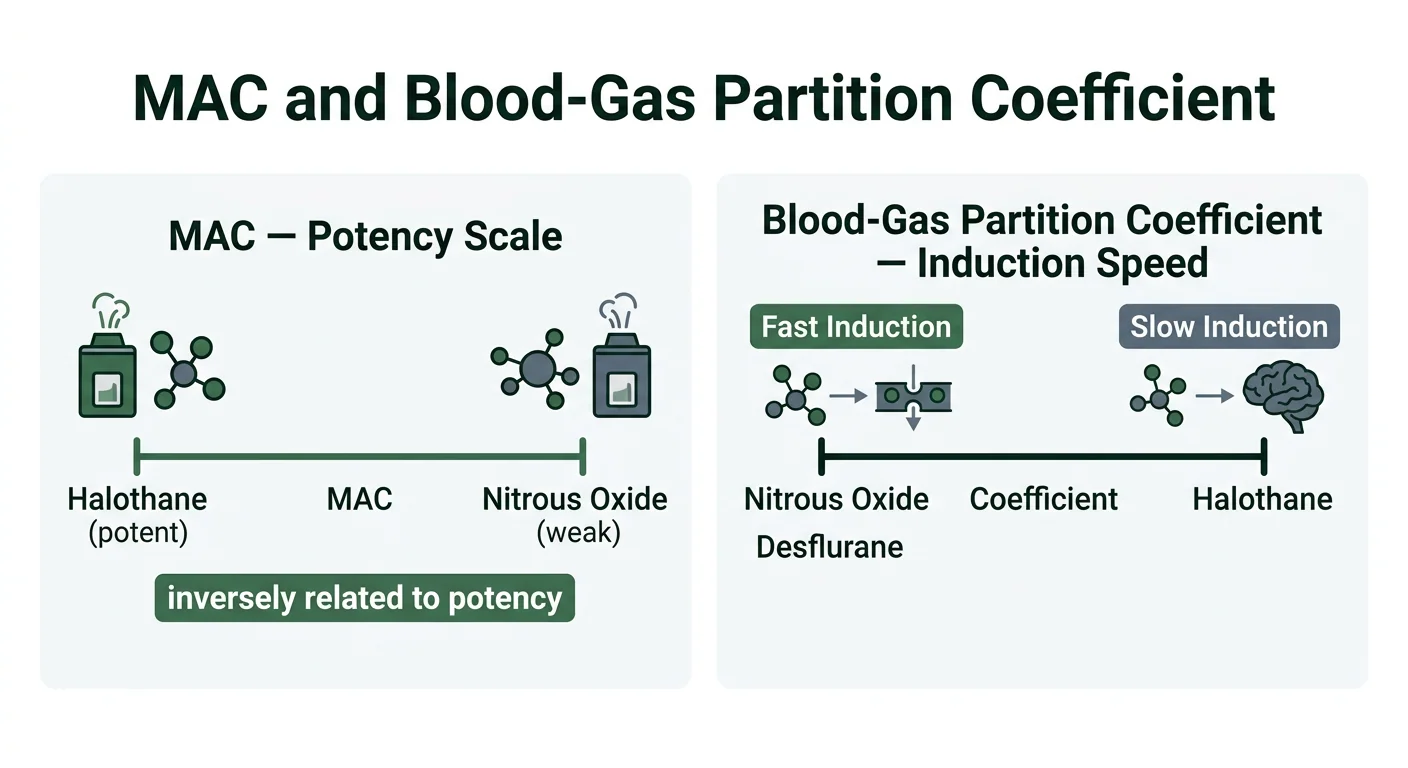
Figure 2 — MAC and blood:gas partition coefficient. Diagram contrasting MAC, which is inversely related to potency, with the blood-gas partition coefficient, which determines the speed of induction, using halothane and nitrous oxide as examples.
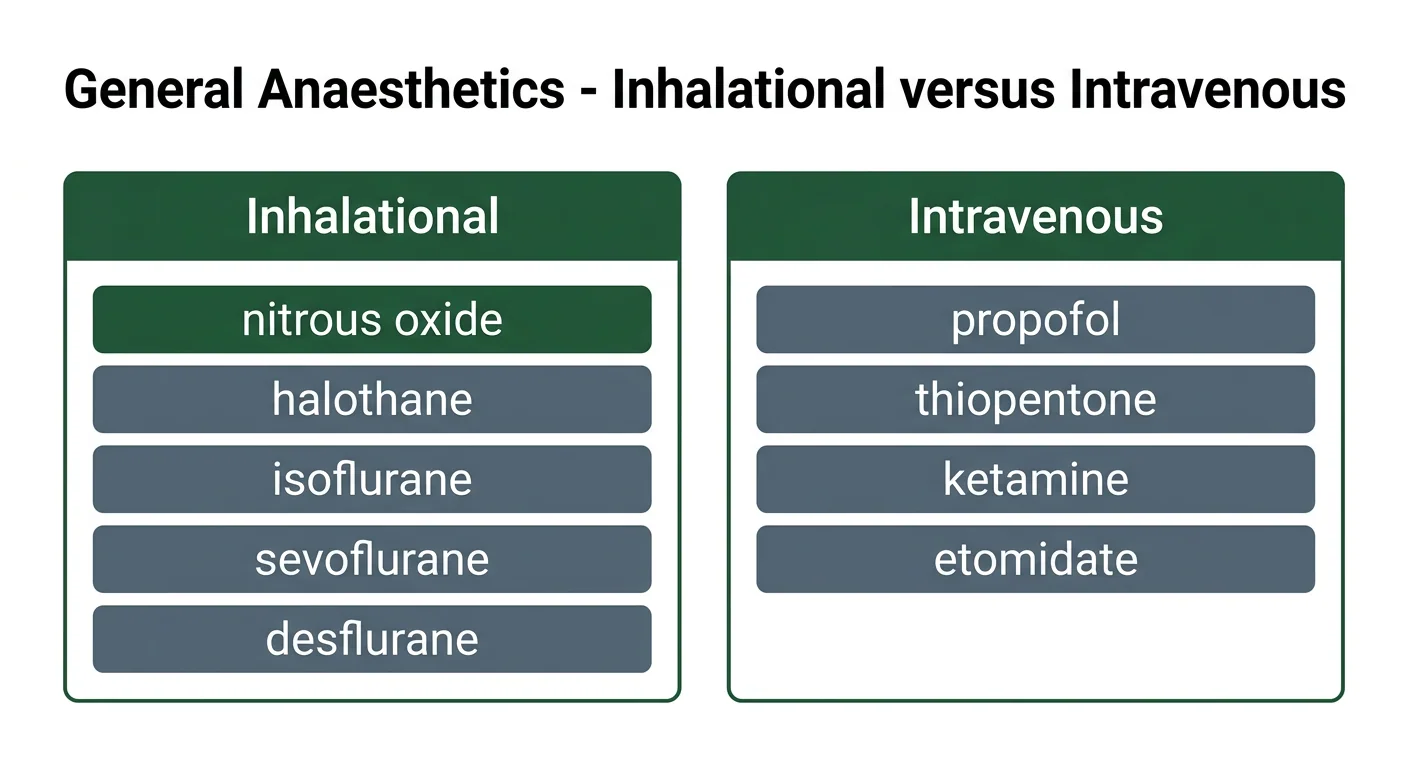
Figure 3 — Inhalational versus intravenous anaesthetics. Classification of general anaesthetics into inhalational agents including nitrous oxide and the volatile liquids, and intravenous agents including propofol, thiopentone, ketamine and etomidate.
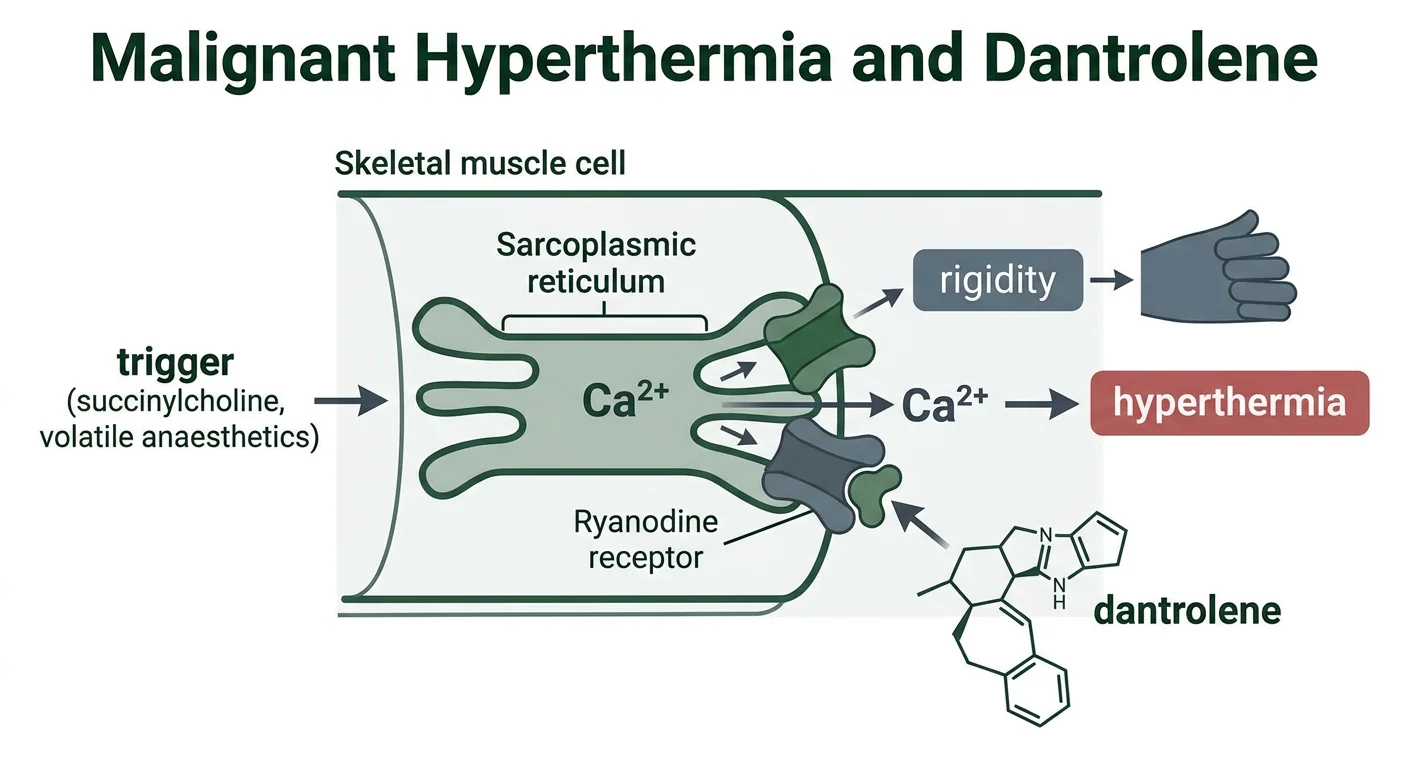
Figure 4 — Malignant hyperthermia and dantrolene. Diagram of malignant hyperthermia showing excessive calcium release from the sarcoplasmic reticulum through an abnormal ryanodine receptor causing rigidity and hyperthermia, with dantrolene binding the receptor to block calcium release.
Clinical Correlation
Vignette 1 — Malignant hyperthermia during anaesthesia
During anaesthesia with sevoflurane and succinylcholine, a patient develops jaw rigidity, a rapidly rising temperature and metabolic acidosis.
Reasoning: This is malignant hyperthermia — a hypermetabolic crisis in a ryanodine-receptor-susceptible patient, triggered by the volatile agent and succinylcholine (CH07/CH11). Management is immediate cessation of the trigger, cooling, supportive care and dantrolene, which blocks calcium release from the sarcoplasmic reticulum. The vignette is the canonical anaesthetic emergency and the reason dantrolene is kept available wherever volatile anaesthetics are used.
Vignette 2 — Ketamine in a shocked patient
A trauma patient with hypotension and a full stomach requires rapid anaesthesia; the anaesthetist selects ketamine.
Reasoning: Ketamine is a dissociative (NMDA antagonist) anaesthetic that, unlike propofol or thiopentone, raises the blood pressure and heart rate through sympathomimetic action — an advantage in the hypotensive shocked patient. It also preserves airway reflexes and is a bronchodilator. Its disadvantage — emergence phenomena (hallucinations) — is reduced by co-administering a benzodiazepine. This is why ketamine is preferred in haemodynamic instability.
Vignette 3 — Halothane and adrenaline
A surgeon infiltrates adrenaline-containing local anaesthetic into the operative field of a patient anaesthetised with halothane, and the patient develops ventricular arrhythmias.
Reasoning: Halothane sensitises the myocardium to catecholamines, so exogenous adrenaline can precipitate ventricular arrhythmias — a classic interaction. This is one of the reasons halothane has been replaced by newer volatile agents (isoflurane, sevoflurane, desflurane), which are less arrhythmogenic, and it explains the caution against adrenaline-containing solutions during halothane anaesthesia.
Vignette 4 — Propofol for day-case surgery
A patient undergoing a brief day-case procedure is induced and maintained with propofol and recovers quickly, without nausea.
Reasoning: Propofol's rapid onset and rapid recovery (with minimal hangover) and its antiemetic effect make it ideal for day-case surgery — the patient can be discharged soon after. Its principal disadvantage is hypotension (and pain on injection), and it has no analgesic effect, so an opioid is usually added. This contrasts with thiopentone (more residual sedation) and ketamine (emergence phenomena).
Practical Linkage
Selecting the anaesthetic agent
| Patient | Choice | Rationale |
|---|---|---|
| Child needing mask induction | Sevoflurane | Non-pungent, rapid |
| Shocked trauma patient | Ketamine | Raises blood pressure |
| Day-case procedure | Propofol | Rapid recovery, antiemetic |
| Asthmatic | Ketamine (or propofol) | Bronchodilator |
| Status epilepticus adjunct | Thiopentone | Anticonvulsant |
Exercise (PH1.18 — select the anaesthetic agent)
Discussion point
Why is a low blood:gas partition coefficient desirable for induction?
Expected: a low coefficient means the agent does not dissolve extensively in blood, so the alveolar (and brain) concentration rises rapidly, giving fast induction and recovery.
MCQ Bank
40 questions · tagged by topic, exam pattern & difficulty · full explanations
The minimum alveolar concentration (MAC) of an inhalational anaesthetic is the concentration at which:
Rapid Revision
- MAC — the concentration at which 50 percent do not move to surgical stimulus
- MAC — inversely related to potency
- Low blood:gas coefficient — rapid induction and recovery
- Nitrous oxide — low potency, high MAC, analgesic
- Second-gas effect — nitrous oxide accelerates uptake of another agent
- Diffusion hypoxia — nitrous oxide dilutes alveolar oxygen on withdrawal
- Nitrous oxide and vitamin B12 — megaloblastic anaemia
- Halothane — hepatotoxicity and adrenaline-sensitisation arrhythmias
- Halothane — relaxes the uterus, avoid in obstetrics
- Sevoflurane — non-pungent, mask induction in children
- Desflurane — lowest blood:gas coefficient, most rapid
- Enflurane — can precipitate seizures
- Propofol — rapid, antiemetic, causes hypotension
- Thiopentone — ultra-short barbiturate, redistribution, anticonvulsant
- Ketamine — dissociative, raises blood pressure, bronchodilator
- Ketamine adverse effect — emergence phenomena
- Etomidate — adrenal suppression
- Malignant hyperthermia — succinylcholine and volatile agents
- Malignant hyperthermia treatment — dantrolene
- Balanced anaesthesia — one drug per component
- Premedication aims — anxiolysis, antisialagogue, analgesia, antiemetic
- Glycopyrrolate — antisialogogue
- Midazolam — anxiolysis and amnesia
- Fentanyl — analgesia in premedication
- Guedel stages — analgesia, excitement, surgical, medullary paralysis
- Propofol has no analgesia — unlike ketamine
- Thiopentone in porphyria — contraindicated
- Propofol infusion syndrome — prolonged high-dose infusion
Viva Questions
- Define MAC — The alveolar concentration at which 50 percent of patients do not move to a surgical stimulus.
- How is MAC related to potency — Inversely; a low MAC means a potent agent.
- What does the blood:gas coefficient determine — The speed of induction and recovery.
- Why is nitrous oxide not used alone — Its potency is too low (high MAC); it is an analgesic adjunct.
- What are halothane's toxicities — Hepatotoxicity, adrenaline-sensitisation arrhythmias and uterine relaxation.
- Why is sevoflurane used for mask induction in children — It is non-pungent and rapid.
- Compare propofol and thiopentone — Both are rapid and lower blood pressure, but propofol is antiemetic while thiopentone is an anticonvulsant barbiturate.
- Why does ketamine raise blood pressure — It has sympathomimetic activity.
- What is ketamine's adverse effect — Emergence phenomena such as hallucinations.
- What triggers malignant hyperthermia — Succinylcholine and the volatile anaesthetics.
- What treats malignant hyperthermia — Dantrolene, which blocks calcium release from the ryanodine receptor.
- What is balanced anaesthesia — Combining agents so each contributes one component.
- What are the aims of premedication — Anxiolysis, antisialagogue, analgesia and antiemesis.
- What is the second-gas effect — Nitrous oxide accelerating the uptake of a co-administered agent.
- Why is halothane avoided in obstetrics — It relaxes the uterus, risking postpartum haemorrhage.
References
- Tripathi KD. Essentials of Medical Pharmacology. 9th ed. New Delhi: Jaypee Brothers Medical Publishers; Chapter 27 (General Anaesthetics).
- Katzung BG, Vanderah TW (eds). Basic & Clinical Pharmacology. 16th ed. New York: McGraw Hill; Chapter 25 (General Anesthetics).
- Brunton LL, Knollmann BC (eds). Goodman & Gilman's The Pharmacological Basis of Therapeutics. 14th ed. New York: McGraw Hill; Chapters 22 and 23 (General Anesthetics).
- Ritter JM, Flower RJ, Henderson G, et al. Rang & Dale's Pharmacology. 10th ed. Edinburgh: Elsevier; Chapter 43 (General Anaesthetic Agents).
- National Medical Commission. Competency Based Undergraduate Curriculum for the Indian Medical Graduate, Volume II — Pharmacology (Code: PH), competency PH1.18.
- Eger EI 2nd. Age, minimum alveolar anesthetic concentration, and minimum alveolar anesthetic concentration-awake. Anesthesia & Analgesia. 2001;93(4):947–953.
- Rosenberg H, Davis M, James D, Pollock N, Stowell K. Malignant hyperthermia. Orphanet Journal of Rare Diseases. 2007;2:21.
- Franks NP. General anaesthesia: from molecular targets to neuronal pathways of sleep and arousal. Nature Reviews Neuroscience. 2008;9(5):370–386.
Downloads
All deliverables & printable revision sheets for CH18
Printable Chapter Handout & Study Notes
Generate a clean, high-yield PDF or print directly without sidebars and navigation menus.