
CNS Neurotransmission, Sedative-Hypnotics & Benzodiazepines
Learning Objectives
At the end of this chapter, the Phase II MBBS student will be able to:
- Describe the excitatory and inhibitory neurotransmitters of the CNS and differentiate GABA-A from GABA-B receptors. (PH1.19 — Knows)
- Describe the structure of the GABA-A receptor and the concept of allosteric modulation. (PH1.19 — Knows)
- Explain the mechanism of benzodiazepines and barbiturates on the chloride channel, and contrast the frequency versus duration effects. (PH1.19 — Knows)
- Classify the benzodiazepines into short- and long-acting agents and explain the metabolic basis of the difference. (PH1.19 — Knows)
- Describe the uses and adverse effects of benzodiazepines, including tolerance, dependence and withdrawal. (PH1.19 — Knows)
- Explain the mechanism and limits of flumazenil in benzodiazepine overdose. (PH1.19 — Knows-how)
- Describe the Z-drugs and their selectivity for the α1 subtype. (PH1.19 — Knows)
- Describe barbiturate toxicity and state that there is no specific antidote. (PH1.19 — Knows)
- Manage insomnia rationally, selecting an appropriate hypnotic for a given patient. (PH1.19 — Shows-how)
- State why benzodiazepines have a ceiling effect and barbiturates do not. (PH1.19 — Knows)
Must-Know Summary
The CNS runs on a balance between excitatory glutamate and inhibitory GABA, and the sedative-hypnotics all act by enhancing GABAergic inhibition at the GABA-A receptor — a chloride channel with binding sites for GABA, the benzodiazepines, the barbiturates and other modulators. The distinction that dominates the examinations is how they enhance it: benzodiazepines increase the frequency of chloride-channel opening (allosteric, requiring GABA, with a ceiling effect), while barbiturates increase the duration (and open the channel directly at high doses, with no ceiling and no antidote).
In one line each:
- GABA-A — a ligand-gated chloride channel
- GABA-B — a G-protein coupled receptor
- Benzodiazepines — increase the frequency of chloride-channel opening
- Barbiturates — increase the duration of chloride-channel opening
- Benzodiazepines have a ceiling effect — barbiturates do not
- Flumazenil — the competitive benzodiazepine antagonist
- Flumazenil — not effective for barbiturate overdose
- Short-acting benzodiazepines — no active metabolites, safer in the elderly
- Z-drugs — bind the alpha-1 subtype, hypnotic without anxiolytic effect
- Barbiturate overdose — no specific antidote
Classification
Box 1 — Sedative-hypnotics
- Benzodiazepines
- Short-acting (no active metabolites) — lorazepam, oxazepam, temazepam, triazolam, midazolam
- Long-acting (active metabolites) — diazepam, chlordiazepoxide, flurazepam, nitrazepam
- Z-drugs — zolpidem, zaleplon, zopiclone (eszopiclone)
- Barbiturates — phenobarbitone, pentobarbitone, thiopentone
- Others — melatonin, ramelteon, chloral hydrate
Box 2 — GABA receptors
- GABA-A — ligand-gated chloride channel (ionotropic); target of benzodiazepines, barbiturates, ethanol, anaesthetics
- GABA-B — G-protein coupled (metabotropic); target of baclofen
Core Concepts
1. CNS neurotransmitters and receptor systems
Central nervous system function is a balance between excitatory and inhibitory neurotransmission. The principal excitatory transmitter is glutamate, acting on ionotropic (AMPA, NMDA, kainate) and metabotropic receptors; the principal inhibitory transmitters are GABA (gamma-aminobutyric acid) and glycine (in the spinal cord and brainstem).
GABA acts on two receptor families, a distinction that recurs throughout the CNS block:
- GABA-A — a ligand-gated chloride channel (ionotropic); opening it permits chloride influx and neuronal hyperpolarisation (inhibition). This is the target of the benzodiazepines, barbiturates, ethanol, neurosteroids and the anaesthetic agents.
- GABA-B — a G-protein coupled receptor (metabotropic), coupled to potassium channels and cAMP; the target of baclofen (CH11).
The inhibitory GABA-A system is the single most important drug target in CNS pharmacology, and the sedative-hypnotics are its most studied modulators.
2. GABA-A receptor and the benzodiazepine site
The GABA-A receptor is a pentameric chloride channel assembled from subunits (most commonly two α, two β and one γ). Its significance lies in the multiple allosteric binding sites on the receptor complex:
- The GABA site (between α and β subunits) — where the endogenous transmitter binds.
- The benzodiazepine site (at the α–γ interface) — where benzodiazepines and the Z-drugs bind.
- The barbiturate site, and sites for ethanol, neurosteroids, picrotoxin (the channel blocker) and general anaesthetics.
Allosteric modulation is the key concept: the benzodiazepines and barbiturates do not themselves open the channel; they enhance the effect of GABA by increasing the affinity of the receptor for GABA (positive allosteric modulation). Because benzodiazepines act only in the presence of GABA, their effect is limited (a ceiling); this is the mechanistic root of their relative safety.
3. Benzodiazepines — pharmacology and classification
Benzodiazepines (BZDs) — diazepam, lorazepam, midazolam, alprazolam, chlordiazepoxide, oxazepam, nitrazepam, flurazepam, triazolam, temazepam, clonazepam — bind the benzodiazepine site and increase the frequency of chloride-channel opening in response to GABA. Because they require GABA, they have a ceiling effect and are relatively safe in overdose (respiratory depression occurs mainly with other depressants).
Classification by duration of action (determined by metabolism):
- Short-acting (no active metabolites) — lorazepam, oxazepam, temazepam, triazolam and midazolam: metabolised directly by conjugation/glucuronidation, so they do not accumulate and are safer in the elderly and in hepatic disease.
- Long-acting (active metabolites) — diazepam, chlordiazepoxide, flurazepam, nitrazepam: metabolised to active compounds (e.g. diazepam → nordazepam, oxazepam, temazepam) with long half-lives, causing cumulation on repeated dosing.
Uses. Anxiety (diazepam, alprazolam), insomnia, status epilepticus (lorazepam/diazepam — CH20), muscle spasm and spasticity, alcohol withdrawal (chlordiazepoxide, diazepam), preanaesthetic medication and procedural sedation (midazolam), and sedation in intensive care.
Adverse effects. Sedation, drowsiness, anterograde amnesia, impaired psychomotor function, tolerance and dependence, and a withdrawal syndrome (anxiety, insomnia, tremor, and seizures on abrupt cessation). Paradoxical reactions (agitation) occur occasionally. They potentiate other CNS depressants.
4. Z-drugs and newer hypnotics
The Z-drugs — zolpidem, zaleplon, zopiclone (eszopiclone) — are non-benzodiazepine hypnotics that bind the α1 (ω1) subtype of the benzodiazepine site on the GABA-A receptor. This subtype selectivity confers hypnotic action with less anxiolytic, anticonvulsant and muscle-relaxant effect than the benzodiazepines. They are short-acting (zolpidem and zaleplon in particular), produce less "hangover" sedation, and cause less disruption of sleep architecture. They remain flumazenil-sensitive. Adverse effects include sleep-related behaviours (sleepwalking) and, rarely, dependence.
Melatonin and the melatonin agonist ramelteon act on melatonin receptors and regulate the circadian rhythm — hypnotics without abuse potential, named for completeness.
5. Barbiturates and their toxicity
Barbiturates — phenobarbitone, pentobarbitone, secobarbitone, thiopentone — also act on the GABA-A receptor, but increase the duration of chloride-channel opening, and at high doses directly open the channel (GABA-independent). This gives them a low therapeutic index, no ceiling effect, and profound respiratory and cardiovascular depression in overdose, with no specific antidote.
They are potent enzyme inducers (cross-ref CH06) and cause tolerance and dependence. Their uses are now largely historical, limited to: phenobarbitone (an anticonvulsant, and for neonatal jaundice — enzyme induction) and thiopentone (intravenous anaesthetic induction — CH18). Barbiturate overdose is managed supportively (airway, ventilation, cardiovascular support), with urinary alkalinisation for the renally-cleared phenobarbitone.
6. Flumazenil and benzodiazepine overdose
Flumazenil is a competitive antagonist at the benzodiazepine site on the GABA-A receptor, rapidly reversing benzodiazepine (and Z-drug) sedation and respiratory depression. It is used for benzodiazepine overdose and to reverse procedural sedation.
Its limits are the key examination points: it is not effective against barbiturates (which act at a different site), and in a benzodiazepine-dependent patient it can precipitate acute withdrawal, including seizures — so it is used cautiously (or avoided) in that setting. It has a short half-life, so re-sedation may occur as it wears off.
7. Rational management of insomnia
Insomnia is best managed by non-pharmacological measures first (sleep hygiene, stimulus control, cognitive-behavioural therapy), with drugs reserved for short-term use at the lowest effective dose. When a hypnotic is needed:
- Situational/transient insomnia — a short course of a short-acting agent (zolpidem, zaleplon) or a short-acting benzodiazepine (temazepam).
- Elderly or hepatic patients — short-acting, no-active-metabolite agents (lorazepam, oxazepam, temazepam) to avoid cumulation and falls.
- Anxiety-associated insomnia — a longer-acting benzodiazepine may address both, at the cost of daytime sedation.
Long-term hypnotic use is avoided because of tolerance, dependence and withdrawal.
Tables
Table 1 — CNS neurotransmitters
| Transmitter | Type | Receptor |
|---|---|---|
| Glutamate | Excitatory | AMPA, NMDA, kainate |
| GABA | Inhibitory | GABA-A (ionotropic), GABA-B (metabotropic) |
| Glycine | Inhibitory (spinal) | Glycine receptor |
| Acetylcholine | Modulatory | Nicotinic, muscarinic |
Table 2 — Benzodiazepines versus barbiturates
| Feature | Benzodiazepines | Barbiturates |
|---|---|---|
| Site | Benzodiazepine site | Barbiturate site |
| Chloride channel | Increase frequency of opening | Increase duration of opening |
| GABA dependence | Require GABA | Direct opening at high dose |
| Ceiling effect | Present | Absent |
| Overdose | Less dangerous | Respiratory depression |
| Antidote | Flumazenil | None |
Table 3 — Short versus long-acting benzodiazepines
| Feature | Short-acting | Long-acting |
|---|---|---|
| Active metabolites | No | Yes |
| Cumulation | No | Yes |
| Safety in elderly/hepatic | Safer | Risk of cumulation |
| Examples | Lorazepam, oxazepam, temazepam, triazolam | Diazepam, chlordiazepoxide, flurazepam |
Table 4 — Benzodiazepine uses
| Use | Agent |
|---|---|
| Anxiety | Diazepam, alprazolam |
| Insomnia | Temazepam, nitrazepam |
| Status epilepticus | Lorazepam, diazepam |
| Alcohol withdrawal | Chlordiazepoxide, diazepam |
| Premedication/sedation | Midazolam |
| Muscle spasm | Diazepam |
Table 5 — Z-drugs versus benzodiazepines
| Feature | Z-drugs | Benzodiazepines |
|---|---|---|
| Receptor | α1 (ω1) subtype | Non-selective |
| Effect | Hypnotic | Anxiolytic + hypnotic + anticonvulsant |
| Hangover | Less | More |
| Flumazenil | Sensitive | Sensitive |
Table 6 — Benzodiazepine adverse effects and withdrawal
| Effect | Detail |
|---|---|
| Sedation | Dose-dependent |
| Anterograde amnesia | Common |
| Tolerance/dependence | With repeated use |
| Withdrawal | Anxiety, insomnia, seizures |
| Paradoxical | Agitation (occasional) |
Table 7 — Barbiturate classification and toxicity
| Class | Duration | Example |
|---|---|---|
| Ultra-short | Minutes | Thiopentone |
| Short | Hours | Pentobarbitone |
| Long | Days | Phenobarbitone |
| Toxicity | Respiratory depression, no antidote | Supportive care |
Figures
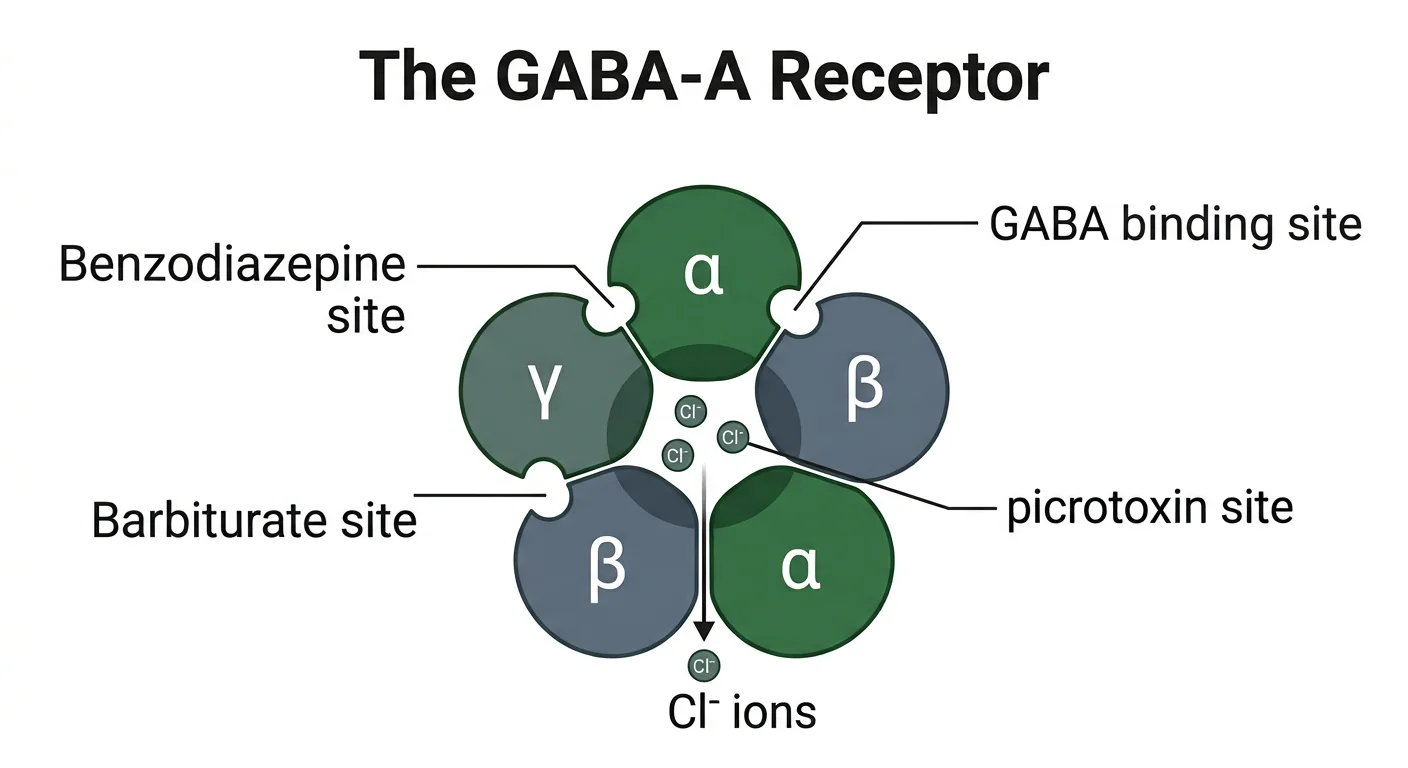
Figure 1 — The GABA-A receptor and its binding sites. Diagram of the pentameric GABA-A receptor chloride channel showing the GABA, benzodiazepine, barbiturate and picrotoxin binding sites and chloride ion influx.
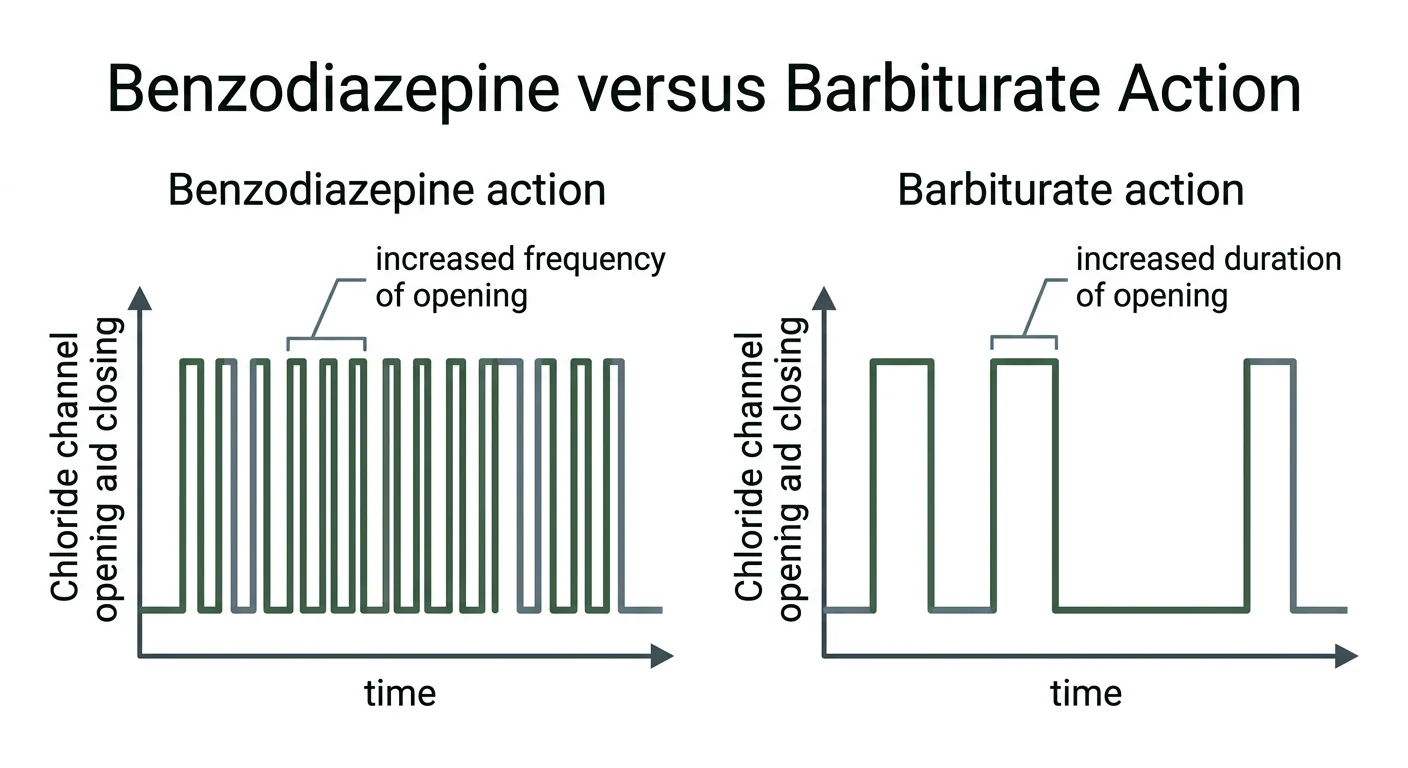
Figure 2 — Benzodiazepine versus barbiturate action on the chloride channel. Comparison showing benzodiazepines increasing the frequency of chloride channel opening against barbiturates increasing the duration of opening, with the corresponding channel traces.
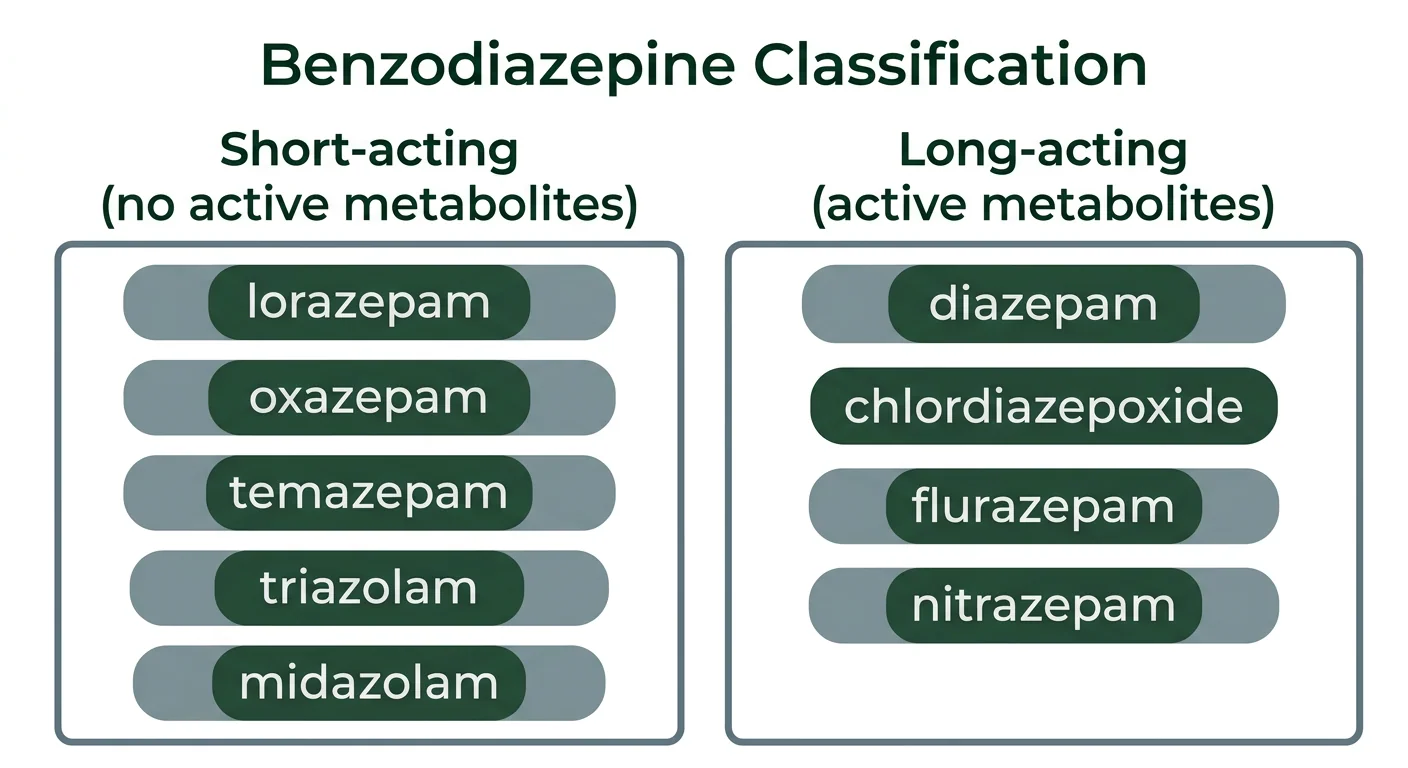
Figure 3 — Benzodiazepine classification by duration. Classification of benzodiazepines into short-acting agents without active metabolites and long-acting agents with active metabolites, with example drugs in each group.
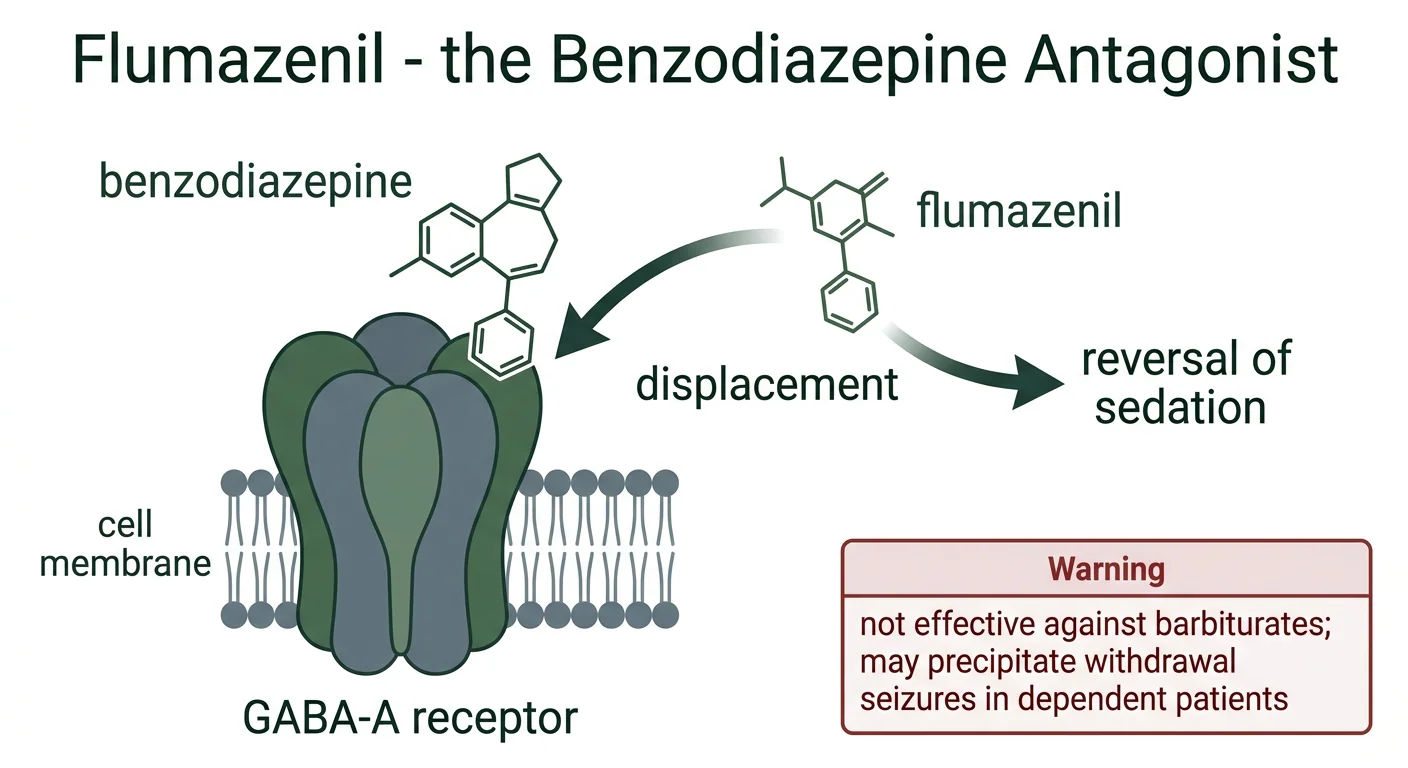
Figure 4 — Flumazenil and benzodiazepine overdose. Diagram showing flumazenil competitively displacing a benzodiazepine from the benzodiazepine site of the GABA-A receptor, with the note that it is ineffective against barbiturates and may precipitate withdrawal seizures.
Clinical Correlation
Vignette 1 — Benzodiazepine overdose
A patient who ingested a large number of diazepam tablets is brought in drowsy with shallow breathing, and the clinician prepares to give flumazenil.
Reasoning: Flumazenil is a competitive antagonist at the benzodiazepine site, rapidly reversing the sedation and respiratory depression of benzodiazepine overdose. However, two cautions apply: it is not effective against barbiturates (which act at a different site), and in a benzodiazepine-dependent patient it can precipitate withdrawal seizures — so it must be used cautiously, with the airway secured and a short duration anticipated (flumazenil has a short half-life and re-sedation may occur).
Vignette 2 — Abrupt benzodiazepine cessation
A patient who has taken diazepam daily for months stops it abruptly and, two days later, has a generalised seizure.
Reasoning: Chronic benzodiazepine use produces tolerance and dependence; abrupt withdrawal unmasks a withdrawal syndrome — anxiety, insomnia, tremor and, dangerously, seizures. Benzodiazepines must be tapered gradually, never stopped suddenly. This mirrors the receptor-adaptation logic of beta-blocker withdrawal (CH13) applied to the GABA system.
Vignette 3 — A barbiturate overdose
A patient who ingested phenobarbitone is brought in comatose with depressed respiration and hypotension.
Reasoning: Barbiturates, at high doses, directly open the chloride channel (GABA-independently), producing profound, dose-related respiratory and cardiovascular depression with no ceiling and no specific antidote. Management is supportive — airway, ventilation, cardiovascular support — plus urinary alkalinisation to enhance the renal elimination of phenobarbitone. This contrasts sharply with the relative safety of benzodiazepine overdose.
Vignette 4 — Insomnia in the elderly
An 80-year-old man with insomnia is prescribed a hypnotic; the clinician deliberately avoids a long-acting agent.
Reasoning: Long-acting benzodiazepines (diazepam, flurazepam) have active metabolites that cumulate in the elderly, causing daytime sedation, falls and confusion. The preferred agents are short-acting, no-active-metabolite drugs (lorazepam, oxazepam, temazepam) or a Z-drug (zolpidem), used at the lowest effective dose for a short course — the standard of rational insomnia management in older patients.
Practical Linkage
Selecting the hypnotic
| Patient | Choice | Rationale |
|---|---|---|
| Young patient, situational insomnia | Zolpidem (short course) | Short-acting, less hangover |
| Elderly with insomnia | Lorazepam/temazepam (short-acting) | No active metabolites, no cumulation |
| Anxiety with insomnia | Longer-acting BZD (diazepam) | Addresses both |
| BZD overdose | Flumazenil | Competitive antagonist |
| Barbiturate overdose | Supportive care | No antidote |
Exercise (PH1.19 — select the hypnotic)
Discussion point
Why do benzodiazepines have a ceiling effect while barbiturates do not?
Expected: benzodiazepines only enhance GABA's action (allosteric, requiring GABA), so their effect plateaus; barbiturates at high doses open the chloride channel directly, so their effect has no ceiling.
MCQ Bank
40 questions · tagged by topic, exam pattern & difficulty · full explanations
Benzodiazepines enhance GABAergic inhibition by:
Rapid Revision
- Glutamate — the principal excitatory CNS transmitter
- GABA and glycine — the inhibitory transmitters
- GABA-A — a ligand-gated chloride channel
- GABA-B — a G-protein coupled receptor
- GABA-A receptor — pentameric with multiple binding sites
- Benzodiazepines — increase the frequency of chloride-channel opening
- Barbiturates — increase the duration of chloride-channel opening
- Benzodiazepines — allosteric, require GABA, ceiling effect
- Barbiturates — open the channel directly at high dose, no ceiling
- Flumazenil — the competitive benzodiazepine antagonist
- Flumazenil — not effective for barbiturates
- Flumazenil — may precipitate withdrawal seizures
- Short-acting benzodiazepines — lorazepam, oxazepam, temazepam, triazolam
- Long-acting benzodiazepines — diazepam, chlordiazepoxide, flurazepam
- Short-acting agents — no active metabolites, safer in the elderly
- Z-drugs — zolpidem, zaleplon, zopiclone
- Z-drugs — bind the alpha-1 subtype
- Benzodiazepine withdrawal — anxiety, insomnia, seizures
- Benzodiazepine adverse effect — anterograde amnesia
- Barbiturate overdose — respiratory depression, no antidote
- Phenobarbitone overdose — urinary alkalinisation
- Barbiturates — enzyme inducers
- Phenobarbitone — still used as an anticonvulsant
- Midazolam — short-acting, for procedural sedation
- Ramelteon — melatonin agonist, no abuse potential
- Benzodiazepine tolerance — receptor adaptation
- Chronic insomnia — sleep hygiene first, drugs short-term
Viva Questions
- What are the principal inhibitory neurotransmitters — GABA (cortex) and glycine (spinal cord).
- Differentiate GABA-A from GABA-B — GABA-A is a ligand-gated chloride channel; GABA-B is G-protein coupled.
- What is the benzodiazepine mechanism — They increase the frequency of GABA-induced chloride-channel opening.
- What is the barbiturate mechanism — They increase the duration of chloride-channel opening and open the channel directly at high doses.
- Why do benzodiazepines have a ceiling effect — They act only in the presence of GABA as allosteric modulators.
- What is flumazenil — A competitive antagonist at the benzodiazepine site.
- Why is flumazenil not used for barbiturate overdose — Barbiturates act at a different site.
- What is the risk of flumazenil in a dependent patient — Precipitation of withdrawal seizures.
- Name short-acting benzodiazepines — Lorazepam, oxazepam, temazepam and triazolam.
- Why are short-acting agents safer in the elderly — They have no active metabolites and do not cumulate.
- What are the Z-drugs — Zolpidem, zaleplon and zopiclone, acting on the alpha-1 subtype.
- What is the benzodiazepine withdrawal syndrome — Anxiety, insomnia, tremor and seizures.
- What is the treatment of barbiturate overdose — Supportive care with urinary alkalinisation; no antidote.
- Why were barbiturates abandoned as hypnotics — Low therapeutic index with no ceiling effect.
- What is anterograde amnesia — Inability to form new memories, a benzodiazepine adverse effect.
References
- Tripathi KD. Essentials of Medical Pharmacology. 9th ed. New Delhi: Jaypee Brothers Medical Publishers; Chapter 29 (Sedative-Hypnotics).
- Katzung BG, Vanderah TW (eds). Basic & Clinical Pharmacology. 16th ed. New York: McGraw Hill; Chapter 22 (Sedative-Hypnotic Drugs).
- Brunton LL, Knollmann BC (eds). Goodman & Gilman's The Pharmacological Basis of Therapeutics. 14th ed. New York: McGraw Hill; Chapter 19 (Hypnotics and Sedatives).
- Ritter JM, Flower RJ, Henderson G, et al. Rang & Dale's Pharmacology. 10th ed. Edinburgh: Elsevier; Chapter 44 (Anxiolytic and Hypnotic Drugs).
- National Medical Commission. Competency Based Undergraduate Curriculum for the Indian Medical Graduate, Volume II — Pharmacology (Code: PH), competency PH1.19.
- Olsen RW, Sieghart W. International Union of Pharmacology. LXX. Subtypes of gamma-aminobutyric acid(A) receptors. Pharmacological Reviews. 2008;60(3):243–260.
- Rudolph U, Möhler H. GABA-based therapeutic approaches: GABAA receptor subtype functions. Current Opinion in Pharmacology. 2006;6(1):18–23.
- Nutt DJ, Stahl SM. Searching for perfect sleep: the continuing evolution of GABAA receptor modulators as hypnotics. Journal of Psychopharmacology. 2010;24(11):1601–1612.
Downloads
All deliverables & printable revision sheets for CH17
Printable Chapter Handout & Study Notes
Generate a clean, high-yield PDF or print directly without sidebars and navigation menus.