
Antirheumatic, Antigout Drugs & DMARDs
Learning Objectives
At the end of this chapter, the Phase II MBBS student will be able to:
- Describe the pathophysiology of gout and the mechanism of colchicine, NSAIDs and corticosteroids in the acute attack. (PH1.16 — Knows)
- Explain the mechanism, specificity and dose-limiting toxicity of colchicine. (PH1.16 — Knows)
- Describe the urate-lowering agents — allopurinol, febuxostat and the uricosurics — and the allopurinol–azathioprine interaction. (PH1.16 — Knows)
- Explain why urate-lowering therapy is not started during an acute attack of gout. (PH1.16 — Knows-how)
- Describe the mechanism, uses and monitoring of methotrexate as the anchor DMARD, including folic acid and leucovorin. (PH1.16 — Knows)
- Describe the conventional DMARDs sulfasalazine, leflunomide and hydroxychloroquine. (PH1.16 — Knows)
- Explain the role of biological DMARDs and JAK inhibitors, and why TB screening is required before anti-TNF therapy. (PH1.16 — Knows)
- Manage an acute attack of gout and plan the subsequent urate-lowering therapy. (PH1.16 — Shows-how)
- State the monitoring required for methotrexate therapy. (PH1.16 — Knows-how)
Must-Know Summary
Gout and rheumatoid arthritis are the two inflammatory joint diseases that close the autacoid story, and their treatment divides cleanly: gout has acute therapy (colchicine, NSAIDs, steroids) and chronic urate-lowering (allopurinol, febuxostat, uricosurics), while rheumatoid arthritis is treated with disease-modifying antirheumatic drugs (DMARDs) led by methotrexate. Three facts dominate the examinations: colchicine is specific for acute gout and causes diarrhoea; allopurinol interacts dangerously with azathioprine; and methotrexate is given with folic acid, with leucovorin as the rescue.
In one line each:
- Colchicine — binds tubulin, blocks neutrophil migration, specific for acute gout
- Colchicine's dose-limiting toxicity — diarrhoea
- Allopurinol — a xanthine oxidase inhibitor, lowers uric acid
- Allopurinol plus azathioprine — dangerous myelosuppression
- Urate-lowering — not started during an acute attack
- Uricosurics — probenecid, increase renal urate excretion
- Methotrexate — the anchor DMARD, a dihydrofolate reductase inhibitor
- Methotrexate is given with — folic acid; overdose rescue is leucovorin
- Anti-TNF biologics — require TB screening before use
- NSAIDs in arthritis — symptomatic only; DMARDs modify disease
Classification
Box 1 — Drugs for gout
- Acute attack
- Colchicine (microtubule inhibitor)
- NSAIDs (indomethacin, naproxen)
- Corticosteroids (intra-articular or systemic)
- Chronic urate-lowering
- Xanthine oxidase inhibitors — allopurinol, febuxostat
- Uricosurics — probenecid, sulfinpyrazone, benzbromarone
- Uricase — pegloticase, rasburicase
Box 2 — DMARDs for rheumatoid arthritis
- Conventional synthetic — methotrexate (anchor), sulfasalazine, leflunomide, hydroxychloroquine
- Biological — anti-TNF (infliximab, etanercept, adalimumab), abatacept, rituximab, tocilizumab
- JAK inhibitors — tofacitinib, baricitinib
Core Concepts
1. Pathophysiology of gout and rheumatoid arthritis
Gout results from hyperuricaemia with deposition of monosodium urate crystals in joints. The crystals are phagocytosed by neutrophils and activate the NLRP3 inflammasome, driving the release of IL-1β and a brisk neutrophil-mediated inflammation — the acute, exquisitely painful attack (classically the first metatarsophalangeal joint). The therapeutic targets follow directly: drugs that block neutrophil migration (colchicine), suppress the inflammation (NSAIDs, corticosteroids), or reduce the urate load (allopurinol, uricosurics).
Rheumatoid arthritis (RA) is a chronic autoimmune synovitis in which T cells, B cells, cytokines (TNF-α, IL-6) and synovial fibroblasts destroy cartilage and bone. The crucial therapeutic distinction is between symptomatic treatment (NSAIDs — relieve pain but do not alter the disease, from CH15) and disease-modifying treatment (the DMARDs, which slow the destructive process). Modern RA management is early, aggressive DMARD therapy, with methotrexate as the anchor.
2. Drugs for acute gout
The acute attack is treated with anti-inflammatory agents, not urate-lowering drugs.
Colchicine — the classic, specific agent. It binds tubulin and inhibits microtubule polymerisation, thereby blocking neutrophil migration, phagocytosis of urate crystals and inflammasome activation. It has no analgesic and no urate-lowering effect — it is specific for the acute gouty inflammation. Its dose-limiting toxicity is diarrhoea (and nausea/vomiting); at higher doses it causes bone-marrow suppression and myopathy. It is most effective early in the attack.
NSAIDs — indomethacin, naproxen and others (CH15) are effective alternatives in acute gout, given in full anti-inflammatory doses.
Corticosteroids — intra-articular (for a single joint) or systemic (prednisolone), especially when NSAIDs and colchicine are contraindicated (renal failure, peptic ulcer).
The key principle — urate-lowering therapy is not started during an acute attack (it can precipitate or prolong the attack by mobilising urate); the attack is treated first, and urate-lowering is begun once it has settled (often with low-dose colchicine cover for the first months).
3. Urate-lowering therapy
Chronic gout requires reducing the urate burden, by either inhibiting production or increasing excretion.
Xanthine oxidase inhibitors — reduce uric acid production:
- Allopurinol — inhibits xanthine oxidase, blocking the conversion of hypoxanthine and xanthine to uric acid. It is the standard urate-lowering drug. Critical interaction: allopurinol is itself metabolised by xanthine oxidase and inhibits the metabolism of azathioprine and 6-mercaptopurine, which are also xanthine-oxidase substrates — co-administration causes severe myelosuppression (the thiopurine dose must be reduced to a quarter). Allopurinol can also cause a hypersensitivity syndrome (rash, fever, eosinophilia, hepatotoxicity) and requires renal dose adjustment.
- Febuxostat — a non-purine xanthine oxidase inhibitor, used when allopurinol is not tolerated.
Uricosurics — increase renal urate excretion by inhibiting tubular reabsorption:
- Probenecid, sulfinpyrazone, benzbromarone — effective in under-excretors with normal renal function, but ineffective in renal failure (where allopurinol is preferred). Aspirin at low dose antagonises uricosurics (its anti-uricosuric effect — CH15).
Uricase enzymes (pegloticase, rasburicase) metabolise urate to allantoin and are named for completeness (severe refractory gout, tumour-lysis prophylaxis).
4. DMARDs — the conventional agents
Methotrexate — the anchor DMARD. Methotrexate inhibits dihydrofolate reductase, depleting reduced folates and inhibiting purine and pyrimidine synthesis; in RA (at low weekly doses) this produces an anti-inflammatory and immunomodulatory effect by increasing adenosine. It is first-line in RA, given once weekly, and is co-administered with folic acid to reduce toxicity (GI upset, stomatitis, myelosuppression) without losing efficacy. Leucovorin (folinic acid) is the rescue in overdose or severe toxicity. Monitoring includes liver function, blood counts and renal function (and pulmonary symptoms, as it can cause pulmonary fibrosis).
Sulfasalazine — a 5-ASA–sulfapyridine conjugate with anti-inflammatory and immunomodulatory activity in RA and inflammatory bowel disease.
Leflunomide — inhibits dihydroorotate dehydrogenase, blocking pyrimidine synthesis in activated lymphocytes; hepatotoxic, needs monitoring.
Hydroxychloroquine — an antimalarial with immunomodulatory effects; its distinctive toxicity is retinopathy, requiring periodic eye examination.
5. Biological DMARDs and JAK inhibitors
Biological DMARDs target specific cytokines or cells:
- Anti-TNF agents — infliximab, etanercept, adalimumab, certolizumab, golimumab: neutralise TNF-α. Because TNF is required to maintain the granuloma that contains latent tuberculosis, anti-TNF therapy can reactivate latent TB — so TB screening (and treatment of latent TB) is mandatory before starting these agents. They also increase the risk of other infections.
- Other biologics — abatacept (T-cell co-stimulation blocker), rituximab (anti-CD20 B-cell depleter), tocilizumab (anti-IL-6 receptor).
JAK inhibitors — tofacitinib, baricitinib: oral small molecules that block Janus-kinase signalling downstream of cytokine receptors, used when conventional DMARDs are inadequate.
The principle throughout is that these agents modify the disease course (unlike NSAIDs) but carry immunosuppressive and infectious risks, so they are used under specialist supervision with screening and monitoring.
Tables
Table 1 — Acute versus chronic gout treatment
| Phase | Drugs | Purpose |
|---|---|---|
| Acute attack | Colchicine, NSAIDs, steroids | Anti-inflammatory |
| Chronic | Allopurinol, febuxostat, uricosurics | Urate-lowering |
| Principle | No urate-lowering during an attack | Avoid worsening |
Table 2 — Acute gout drugs
| Drug | Mechanism | Toxicity |
|---|---|---|
| Colchicine | Microtubule inhibition | Diarrhoea (dose-limiting) |
| NSAIDs | COX inhibition | GI, renal |
| Corticosteroids | Anti-inflammatory | Hyperglycaemia, infection |
Table 3 — Urate-lowering agents
| Drug | Class | Key point |
|---|---|---|
| Allopurinol | Xanthine oxidase inhibitor | Azathioprine interaction, renal dose |
| Febuxostat | Xanthine oxidase inhibitor | Non-purine alternative |
| Probenecid | Uricosuric | Ineffective in renal failure |
| Pegloticase | Uricase | Refractory gout |
Table 4 — Conventional DMARDs
| Drug | Mechanism | Monitoring |
|---|---|---|
| Methotrexate | DHFR inhibitor | LFT, blood counts, renal |
| Sulfasalazine | 5-ASA conjugate | Blood counts |
| Leflunomide | DHODH inhibitor | LFT |
| Hydroxychloroquine | Immunomodulator | Eye (retinopathy) |
Table 5 — Biological DMARDs and JAK inhibitors
| Agent | Target | Special concern |
|---|---|---|
| Infliximab/etanercept/adalimumab | TNF-α | Reactivate latent TB |
| Rituximab | CD20 (B cells) | Infection |
| Tocilizumab | IL-6 receptor | Infection |
| Tofacitinib | JAK | Infection, thrombosis |
Table 6 — Methotrexate
| Aspect | Detail |
|---|---|
| Mechanism | Dihydrofolate reductase inhibition |
| Dosing | Once weekly |
| Coadministration | Folic acid (reduce toxicity) |
| Rescue | Leucovorin (folinic acid) |
| Monitoring | LFT, blood counts, renal, lungs |
Figures
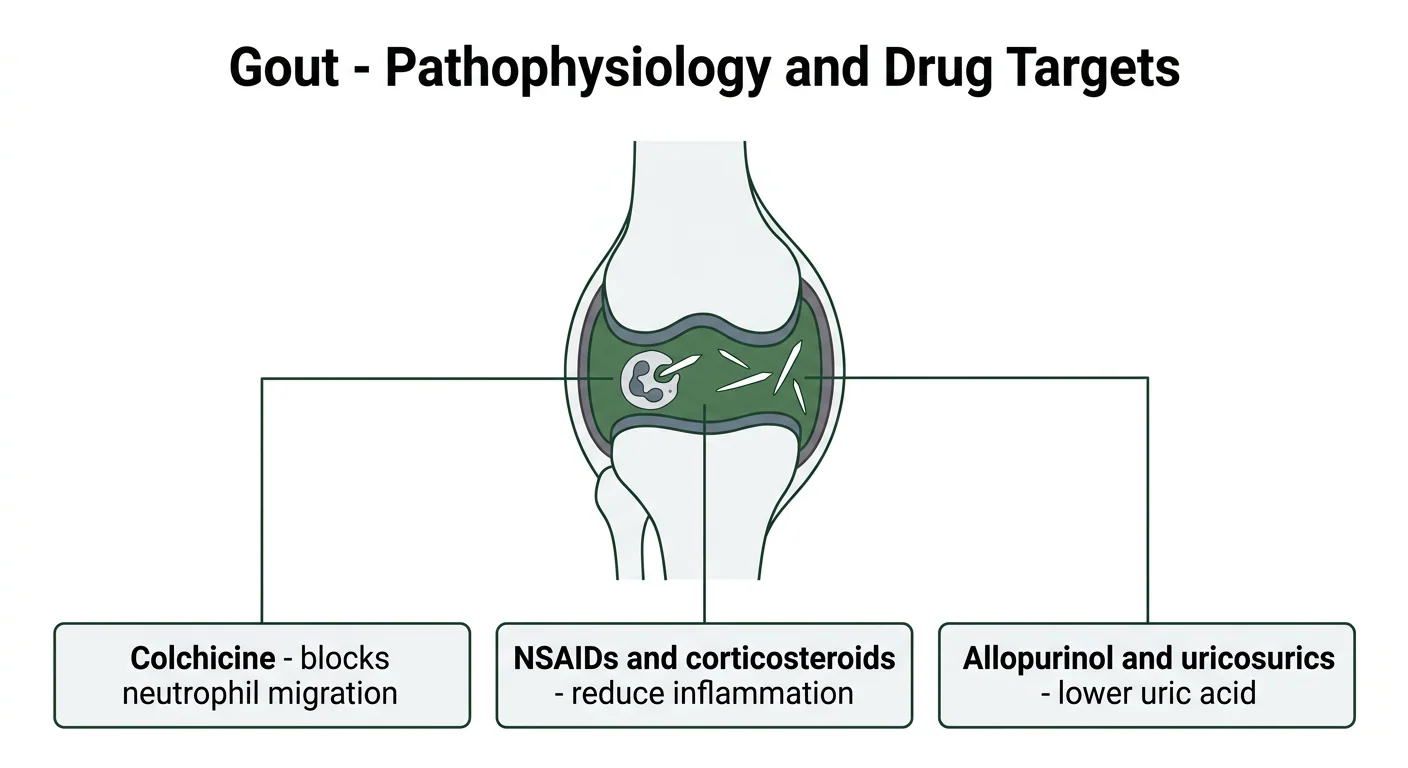
Figure 1 — Gout pathophysiology and drug targets. Diagram of gout pathophysiology showing urate crystals phagocytosed by neutrophils with inflammasome activation and IL-1 beta release, and the drug targets including colchicine, NSAIDs, corticosteroids, allopurinol and uricosurics.
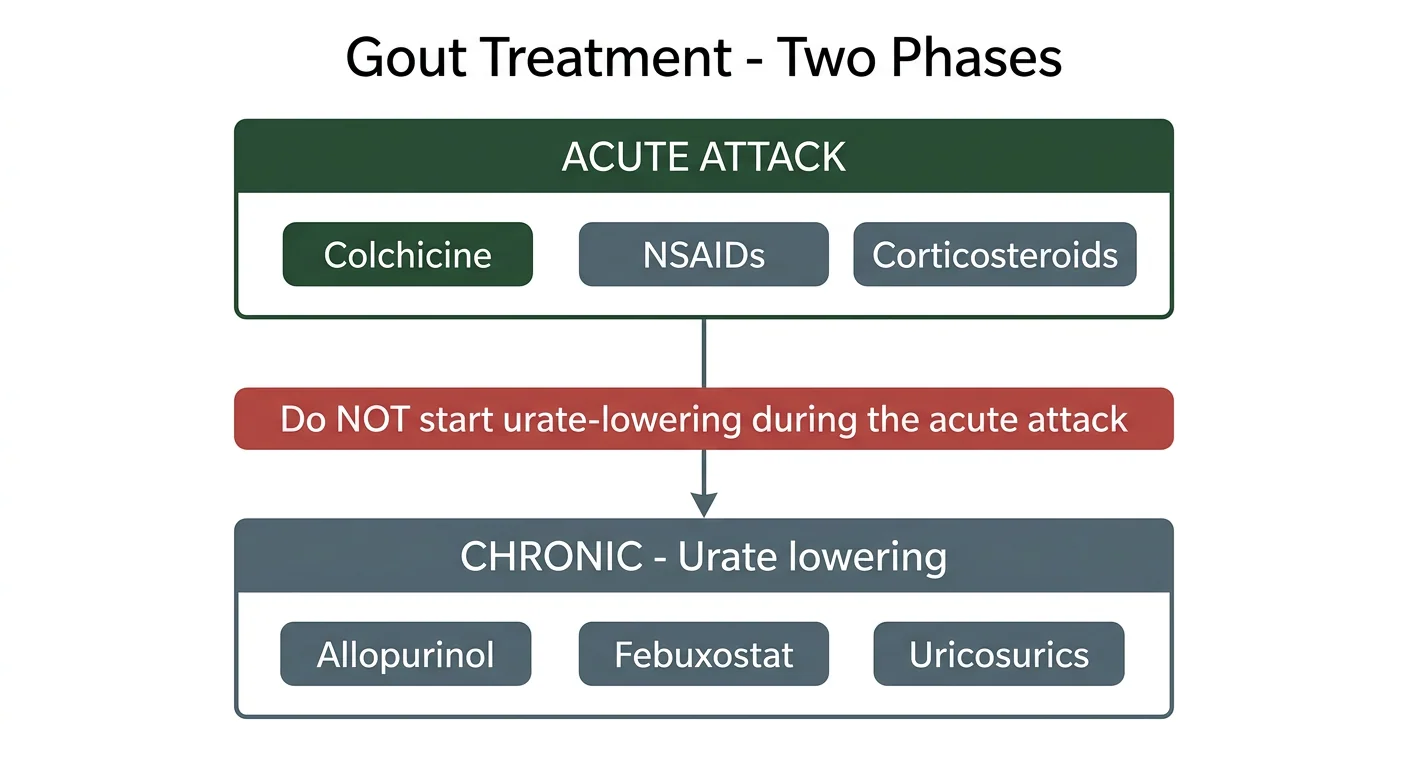
Figure 2 — Acute versus chronic gout treatment. Algorithm showing the acute gout attack treated with colchicine, NSAIDs or corticosteroids, with urate-lowering therapy deferred until the attack settles, then begun with allopurinol or a uricosuric.
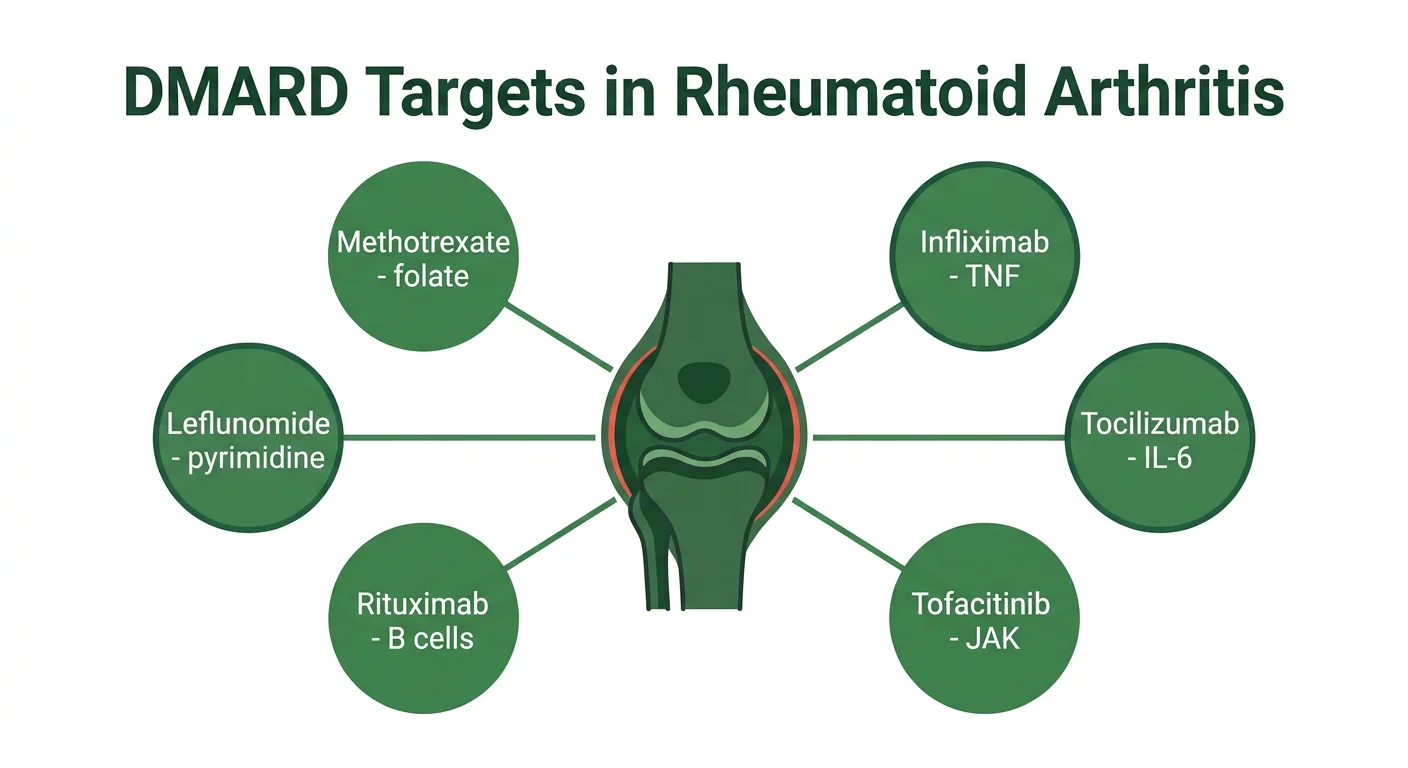
Figure 3 — DMARD targets in rheumatoid arthritis. Diagram of the DMARD targets in rheumatoid arthritis, showing methotrexate and leflunomide acting on lymphocyte metabolism, anti-TNF agents neutralising TNF-alpha, rituximab depleting B cells, tocilizumab blocking IL-6, and JAK inhibitors blocking JAK signalling.
Clinical Correlation
Vignette 1 — Allopurinol added to azathioprine
A patient with rheumatoid arthritis on azathioprine is started on allopurinol for gout, and two weeks later presents with fever, oral ulcers and a falling white-cell count.
Reasoning: This is the allopurinol–azathioprine interaction. Azathioprine is metabolised by xanthine oxidase (and TPMT), and allopurinol — itself a xanthine-oxidase inhibitor — blocks this metabolism, causing the toxic accumulation of 6-mercaptopurine and severe myelosuppression. The combination must be avoided, or the azathioprine dose reduced to a quarter with close monitoring. This is the single most examined drug interaction in this chapter.
Vignette 2 — Colchicine diarrhoea
A patient takes repeated doses of colchicine for an acute gout attack and develops profuse watery diarrhoea and abdominal cramps.
Reasoning: Diarrhoea is the dose-limiting toxicity of colchicine — it results from the drug's effect on the rapidly-dividing intestinal epithelium (microtubule inhibition) and signals that the therapeutic limit has been reached. The drug should be stopped (or the dose reduced) when diarrhoea develops. This toxicity, together with colchicine's lack of analgesic effect, defines its narrow therapeutic window.
Vignette 3 — Methotrexate with folic acid
A patient started on weekly methotrexate for rheumatoid arthritis is also prescribed folic acid, and the rheumatologist explains that a missed high dose would be treated with leucovorin.
Reasoning: Methotrexate inhibits dihydrofolate reductase and depletes folates; folic acid is co-administered to reduce the toxicity (GI upset, stomatitis, myelosuppression) without losing efficacy. In overdose or severe toxicity, leucovorin (folinic acid) bypasses the blocked enzyme and is the specific rescue. The vignette captures the dual pharmacology — the same folate antagonism that treats the disease is the source of its toxicity.
Vignette 4 — Anti-TNF and latent TB
A patient with active rheumatoid arthritis is screened before starting infliximab and is found to have latent tuberculosis, which is treated before the biologic is begun.
Reasoning: TNF-α is essential for maintaining the granuloma that contains latent tuberculosis; blocking it (with infliximab, etanercept or adalimumab) can reactivate latent TB. Hence TB screening (and treatment of latent infection) is mandatory before anti-TNF therapy — the single most examined safety requirement of the biologics, alongside the general risk of infection.
Practical Linkage
Managing gout and monitoring DMARDs
| Scenario | Action |
|---|---|
| Acute gout attack | Colchicine (or NSAID/corticosteroid); no urate-lowering yet |
| After the attack settles | Start allopurinol (or uricosuric), with colchicine cover |
| Patient on allopurinol needs azathioprine | Avoid, or reduce azathioprine to a quarter |
| Methotrexate started for RA | Add folic acid; monitor LFT, blood counts, renal |
Exercise (PH1.16 — manage gout and monitor DMARDs)
Discussion point
Why is methotrexate given with folic acid, and what is leucovorin's role?
Expected: folic acid reduces the folate-depletion toxicity without losing efficacy; leucovorin is the specific rescue that bypasses the inhibited dihydrofolate reductase in overdose.
MCQ Bank
35 questions · tagged by topic, exam pattern & difficulty · full explanations
With regard to its mechanism in gout, colchicine relieves the acute attack by:
Rapid Revision
- Gout — urate crystal deposition and neutrophil inflammation
- Colchicine — binds tubulin, blocks neutrophil migration
- Colchicine — specific for acute gout, no analgesia, no urate-lowering
- Colchicine toxicity — diarrhoea is dose-limiting
- Acute gout — colchicine, NSAIDs or corticosteroids
- Urate-lowering — not started during an acute attack
- Allopurinol — xanthine oxidase inhibitor
- Allopurinol plus azathioprine — severe myelosuppression
- Febuxostat — non-purine xanthine oxidase inhibitor
- Probenecid — uricosuric, ineffective in renal failure
- Pegloticase — uricase for refractory gout
- Methotrexate — the anchor DMARD, dihydrofolate reductase inhibitor
- Methotrexate — given once weekly
- Methotrexate with folic acid — reduces toxicity
- Methotrexate rescue — leucovorin (folinic acid)
- Sulfasalazine — 5-ASA plus sulfapyridine
- Leflunomide — inhibits dihydroorotate dehydrogenase
- Hydroxychloroquine — retinopathy, needs eye monitoring
- Anti-TNF agents — infliximab, etanercept, adalimumab
- Anti-TNF — requires TB screening
- Rituximab — depletes CD20 B cells
- Tocilizumab — blocks the IL-6 receptor
- Tofacitinib — a JAK inhibitor
- NSAIDs in arthritis — symptomatic only, DMARDs modify disease
Viva Questions
- What is colchicine's mechanism — It binds tubulin and inhibits microtubule polymerisation, blocking neutrophil migration and phagocytosis.
- What is colchicine's dose-limiting toxicity — Diarrhoea.
- Is colchicine an analgesic or urate-lowering drug — No, it is specific for acute gout only.
- How is an acute gout attack treated — With colchicine, NSAIDs or corticosteroids, not urate-lowering drugs.
- What is allopurinol's mechanism — Inhibition of xanthine oxidase, reducing uric acid production.
- What is the allopurinol-azathioprine interaction — Allopurinol blocks azathioprine's metabolism, causing severe myelosuppression.
- Why is urate-lowering not started during an acute attack — It can precipitate or prolong the attack.
- What are the uricosurics — Probenecid, sulfinpyrazone and benzbromarone.
- What is methotrexate's mechanism — Inhibition of dihydrofolate reductase.
- Why is folic acid given with methotrexate — To reduce toxicity without losing efficacy.
- What is the rescue for methotrexate toxicity — Leucovorin (folinic acid).
- What is hydroxychloroquine's distinctive toxicity — Retinopathy, requiring eye monitoring.
- Why is TB screening required before anti-TNF therapy — TNF blockade reactivates latent tuberculosis.
- Name the anti-TNF agents — Infliximab, etanercept and adalimumab.
- What is tofacitinib — A JAK inhibitor.
References
- Tripathi KD. Essentials of Medical Pharmacology. 9th ed. New Delhi: Jaypee Brothers Medical Publishers; Chapter 15 (Drugs for Gout and Rheumatoid Arthritis).
- Katzung BG, Vanderah TW (eds). Basic & Clinical Pharmacology. 16th ed. New York: McGraw Hill; Chapter 36 (NSAIDs) and Chapter 54 (DMARDs).
- Brunton LL, Knollmann BC (eds). Goodman & Gilman's The Pharmacological Basis of Therapeutics. 14th ed. New York: McGraw Hill; Chapters 38 and 39 (Immunomodulators; NSAIDs and Gout Drugs).
- Ritter JM, Flower RJ, Henderson G, et al. Rang & Dale's Pharmacology. 10th ed. Edinburgh: Elsevier; Chapters 29 and 30 (Analgesics; Anti-inflammatory and Immunosuppressant Drugs).
- National Medical Commission. Competency Based Undergraduate Curriculum for the Indian Medical Graduate, Volume II — Pharmacology (Code: PH), competency PH1.16.
- Richette P, Doherty M, Pascual E, et al. 2016 updated EULAR evidence-based recommendations for the management of gout. Annals of the Rheumatic Diseases. 2017;76(1):29–42.
- Singh JA, Saag KG, Bridges SL Jr, et al. 2015 American College of Rheumatology guideline for the treatment of rheumatoid arthritis. Arthritis & Rheumatology. 2016;68(1):1–26.
- Dalbeth N, Merriman TR, Stamp LK. Gout. Lancet. 2016;388(10055):2039–2052.
Downloads
All deliverables & printable revision sheets for CH16
Printable Chapter Handout & Study Notes
Generate a clean, high-yield PDF or print directly without sidebars and navigation menus.