
Prostaglandins, NSAIDs, Analgesic-Antipyretics
Learning Objectives
At the end of this chapter, the Phase II MBBS student will be able to:
- Describe the arachidonic acid cascade and the sites of action of corticosteroids and NSAIDs. (PH1.16 — Knows)
- Differentiate COX-1 from COX-2 and explain the clinical consequences of inhibiting each. (PH1.16 — Knows)
- Classify the NSAIDs into non-selective and COX-2 selective agents with examples. (PH1.16 — Knows)
- Describe aspirin's irreversible mechanism, dose-dependent effects, uses and toxicity, including Reye syndrome. (PH1.16 — Knows)
- Describe the pharmacology of paracetamol and manage its overdose with N-acetylcysteine. (PH1.16 — Knows-how)
- Describe the GI, renal and cardiovascular adverse effects of NSAIDs and the triple whammy. (PH1.16 — Knows)
- Explain the cardiovascular risk of selective COX-2 inhibitors. (PH1.16 — Knows)
- Select an appropriate analgesic for a child with fever, a patient with peptic ulcer, and an asthmatic. (PH1.16 — Shows-how)
- Explain why aspirin is contraindicated in children with viral infections. (PH1.16 — Knows)
- State the paradoxical effect of aspirin on uric acid. (PH1.16 — Knows)
Must-Know Summary
The NSAIDs — aspirin, ibuprofen, diclofenac and their congeners — relieve pain, fever and inflammation by inhibiting cyclooxygenase, and that single mechanism explains both their benefit and their harm. The distinction that matters is COX-1 versus COX-2: COX-1 produces the prostaglandins that protect the stomach, support the kidney and activate platelets, while COX-2 produces those that mediate pain and inflammation. Aspirin is unique in being an irreversible inhibitor, giving it dose-dependent effects and a special toxicity profile; paracetamol is the safe analgesic-antipyretic that is not an anti-inflammatory, but whose overdose is hepatotoxic and treated with N-acetylcysteine.
In one line each:
- COX-1 — constitutive; gastric protection, platelets, renal blood flow
- COX-2 — inducible; pain, fever, inflammation
- Aspirin — irreversible COX inhibition, acetylates the enzyme
- Aspirin low dose — antiplatelet; high dose — anti-inflammatory
- Reye syndrome — aspirin in children with viral illness, hepatic encephalopathy
- Paracetamol — analgesic-antipyretic, not anti-inflammatory
- Paracetamol antidote — N-acetylcysteine
- Paracetamol's hepatotoxic metabolite — NAPQI
- Coxibs — less GI ulceration, more cardiovascular risk
- Triple whammy — NSAID plus diuretic plus ACE inhibitor causes renal failure
Classification
Box 1 — NSAIDs
- Non-selective (COX-1 + COX-2)
- Salicylates — aspirin
- Propionic acids — ibuprofen, naproxen, ketoprofen
- Acetic acids — diclofenac, indomethacin, ketorolac
- Oxicams — piroxicam, meloxicam
- Fenamates — mefenamic acid
- COX-2 selective (coxibs) — celecoxib, etoricoxib, parecoxib
- Analgesic-antipyretic (weak anti-inflammatory) — paracetamol
Box 2 — The arachidonic acid cascade
- Membrane phospholipids → arachidonic acid (by phospholipase A2 — inhibited by corticosteroids)
- Arachidonic acid → prostaglandins + thromboxane (by COX — inhibited by NSAIDs)
- Arachidonic acid → leukotrienes (by lipoxygenase)
Core Concepts
1. Prostaglandins, leukotrienes and the arachidonic acid cascade
Prostaglandins (PGs), thromboxanes (TXs) and leukotrienes (LTs) are the eicosanoids — local hormones derived from membrane phospholipids, acting near their site of synthesis. The arachidonic acid cascade has two arms:
- Membrane phospholipids → arachidonic acid by phospholipase A2 — the step inhibited by corticosteroids (which induce lipocortin/annexin).
- Arachidonic acid → prostaglandins and thromboxane by cyclooxygenase (COX) — the step inhibited by NSAIDs; and arachidonic acid → leukotrienes by lipoxygenase.
The corticosteroid (PLA2) versus NSAID (COX) distinction is a classic discriminator: corticosteroids act higher in the cascade and block both prostaglandin and leukotriene production, while NSAIDs block only the COX arm. Prostaglandins (especially PGE2 and PGI2) mediate pain, fever, inflammation, gastric mucosal protection, platelet TXA2 and renal blood flow; leukotrienes mediate bronchoconstriction and inflammation in asthma.
2. NSAID classification and mechanism
The NSAIDs (non-steroidal anti-inflammatory drugs) inhibit cyclooxygenase, reducing prostaglandin synthesis. They are classified by COX selectivity:
- Non-selective (inhibit COX-1 and COX-2): aspirin, ibuprofen, naproxen, diclofenac, indomethacin, piroxicam, ketorolac, mefenamic acid.
- COX-2 selective (coxibs): celecoxib, etoricoxib, parecoxib.
The individual agents differ in potency, half-life and routes: ketorolac is a potent parenteral analgesic (opioid-sparing, limited to 5 days); indomethacin is used for patent ductus arteriosus closure and ankylosing spondylitis; ibuprofen and diclofenac are the common oral analgesics; piroxicam is long-acting; mefenamic acid is used for dysmenorrhoea. All are contraindicated in peptic ulcer, and most are avoided in late pregnancy (premature closure of the ductus arteriosus).
3. COX-1 versus COX-2 selectivity
The two cyclooxygenase isoforms have distinct roles:
- COX-1 (constitutive) — expressed in most tissues; its prostaglandins protect the gastric mucosa, support renal blood flow, and generate platelet thromboxane A2 (platelet aggregation). Inhibiting COX-1 causes the GI, bleeding and renal adverse effects.
- COX-2 (inducible) — induced at sites of inflammation; its prostaglandins mediate pain, fever and inflammation. Inhibiting COX-2 produces the analgesic and anti-inflammatory benefit.
This dichotomy explains the whole NSAID story: non-selective agents relieve inflammation but cause ulcers and bleeding; selective COX-2 inhibitors spare the stomach but (as Section 7 explains) carry a cardiovascular cost.
4. Aspirin — pharmacology, uses and toxicity
Aspirin (acetylsalicylic acid) is the prototype NSAID and is unique in irreversibly acetylating the COX enzyme (other NSAIDs inhibit reversibly). This irreversibility underlies its dose-dependent effects:
- Low dose (75–150 mg/day) — antiplatelet: irreversibly inhibits platelet COX-1, abolishing TXA2 for the platelet's entire life (platelets cannot synthesise new enzyme) — the basis of its antiplatelet use (CH31).
- Analgesic-antipyretic dose (300–600 mg) — pain and fever relief.
- Anti-inflammatory dose (3–5 g/day) — for rheumatic conditions.
- Uric-acid paradox: at low doses aspirin is anti-uricosuric (reduces urate excretion, may precipitate gout), while at high doses (>3 g/day) it is uricosuric — a favourite discriminator.
Adverse effects and toxicity. GI ulceration and bleeding (COX-1); Reye syndrome — hepatic encephalopathy in children given aspirin during a viral illness (aspirin is therefore contraindicated in children); salicylism — tinnitus, vertigo, hyperventilation (respiratory alkalosis) progressing to metabolic acidosis in severe toxicity; hypersensitivity — aspirin-induced asthma (bronchospasm in susceptible patients, linked to leukotriene overproduction); and bleeding (antiplatelet effect). Acute overdose causes initial respiratory alkalosis (direct respiratory-centre stimulation) followed by metabolic acidosis.
5. Paracetamol and its overdose management
Paracetamol (acetaminophen) is an analgesic and antipyretic that is NOT anti-inflammatory — it weakly inhibits peripheral COX but acts centrally (inhibiting COX in the CNS and modulating descending pain pathways). Because it spares peripheral COX-1, it has no significant GI or antiplatelet effect and is the safe analgesic in peptic ulcer, children and aspirin-sensitive asthma.
Overdose. In overdose, the normal glucuronidation and sulfation pathways are saturated, and paracetamol is metabolised by CYP2E1 to the toxic metabolite NAPQI (N-acetyl-p-benzoquinone imine). NAPQI is normally detoxified by glutathione, but when glutathione is depleted, NAPQI binds hepatocyte proteins and causes centrilobular hepatic necrosis. The treatment is N-acetylcysteine (NAC), which replenishes glutathione (and provides a sulfhydryl substrate); it is effective if given early — ideally within 8–10 hours — and dosing is guided by the Rumack-Matthew nomogram (plotting the serum paracetamol level against time).
6. Adverse effects of NSAIDs — GI, renal and cardiovascular
- GI — inhibition of COX-1 removes the gastroprotective prostaglandins, causing dyspepsia, erosions, ulceration and bleeding; risk factors include age, high dose, corticosteroids, and previous ulcer. Prevention is with a proton-pump inhibitor or misoprostol in high-risk patients.
- Renal — COX-derived prostaglandins maintain renal blood flow when it is compromised (hypovolaemia, heart failure, cirrhosis); NSAIDs can precipitate acute renal failure in these patients, and chronic use causes analgesic nephropathy. The triple whammy — an NSAID + a diuretic + an ACE inhibitor/ARB — is a classic cause of acute kidney injury.
- Cardiovascular — NSAIDs (especially the coxibs) raise blood pressure and increase the risk of myocardial infarction and stroke.
- Bronchospasm — aspirin (and other NSAIDs) can precipitate asthma in susceptible patients.
- Hypersensitivity, fluid retention and oedema — the renal COX-1/2 effects.
7. Selective COX-2 inhibitors
The coxibs (celecoxib, etoricoxib, parecoxib) were developed to inhibit COX-2 (inflammation) while sparing COX-1 (gastric protection), thereby reducing GI ulceration. The trade-off is increased cardiovascular risk: because COX-2 inhibition reduces endothelial prostacyclin (PGI2) without reducing platelet thromboxane, the balance shifts toward thrombosis, raising the risk of myocardial infarction and stroke. Rofecoxib was withdrawn for this reason. The coxibs are therefore contraindicated in ischaemic heart disease and cerebrovascular disease — the GI-benefit-versus-cardiovascular-risk trade-off is a recurring examination point.
Tables
Table 1 — COX-1 versus COX-2
| Feature | COX-1 | COX-2 |
|---|---|---|
| Expression | Constitutive | Inducible (inflammation) |
| Function | Gastric protection, platelets, renal | Pain, fever, inflammation |
| Effect of inhibition | GI ulcer, bleeding, renal failure | Analgesia, anti-inflammation |
Table 2 — NSAID classification
| Class | Drugs |
|---|---|
| Salicylates | Aspirin |
| Propionic acids | Ibuprofen, naproxen, ketoprofen |
| Acetic acids | Diclofenac, indomethacin, ketorolac |
| Oxicams | Piroxicam, meloxicam |
| Fenamates | Mefenamic acid |
| Coxibs | Celecoxib, etoricoxib, parecoxib |
Table 3 — Aspirin's dose-dependent effects
| Dose | Effect |
|---|---|
| Low (75–150 mg) | Antiplatelet |
| Moderate (300–600 mg) | Analgesic-antipyretic |
| High (3–5 g) | Anti-inflammatory, uricosuric |
| Low dose urate | Anti-uricosuric (may precipitate gout) |
Table 4 — Aspirin versus paracetamol
| Feature | Aspirin | Paracetamol |
|---|---|---|
| Anti-inflammatory | Yes | No |
| GI toxicity | Yes | No |
| Antiplatelet | Yes | No |
| Hepatotoxicity | Rare | Overdose (NAPQI) |
| Use in children | Avoid (Reye) | Safe |
Table 5 — NSAID adverse effects
| Effect | Mechanism |
|---|---|
| GI ulcer, bleeding | COX-1 inhibition |
| Renal failure | Loss of renal PGs |
| Cardiovascular events | COX-2 inhibition (coxibs) |
| Bronchospasm | Aspirin-sensitive asthma |
| Fluid retention | Renal effects |
Table 6 — Paracetamol overdose
| Step | Event |
|---|---|
| 1 | Saturation of conjugation pathways |
| 2 | NAPQI formation (CYP2E1) |
| 3 | Glutathione depletion |
| 4 | Hepatocyte necrosis |
| Treatment | N-acetylcysteine (replenishes glutathione) |
Table 7 — Selective COX-2 inhibitors
| Feature | Detail |
|---|---|
| GI benefit | Less ulceration (spares COX-1) |
| CV risk | MI and stroke (rofecoxib withdrawn) |
| Contraindication | Ischaemic heart disease, stroke |
| Examples | Celecoxib, etoricoxib |
Figures
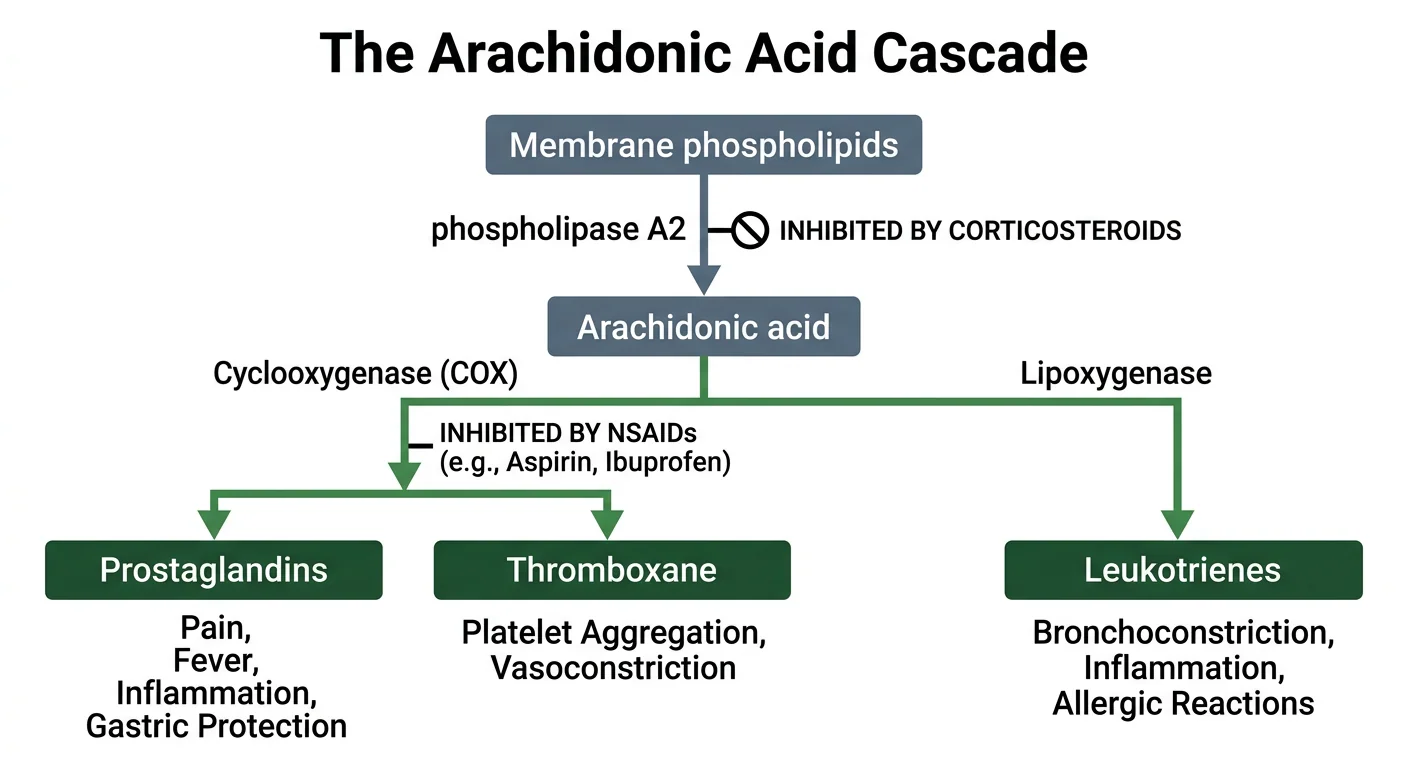
Figure 1 — The arachidonic acid cascade. Diagram of the arachidonic acid cascade showing phospholipase A2 releasing arachidonic acid from membrane phospholipids, then the cyclooxygenase pathway to prostaglandins and thromboxane (inhibited by NSAIDs) and the lipoxygenase pathway to leukotrienes.
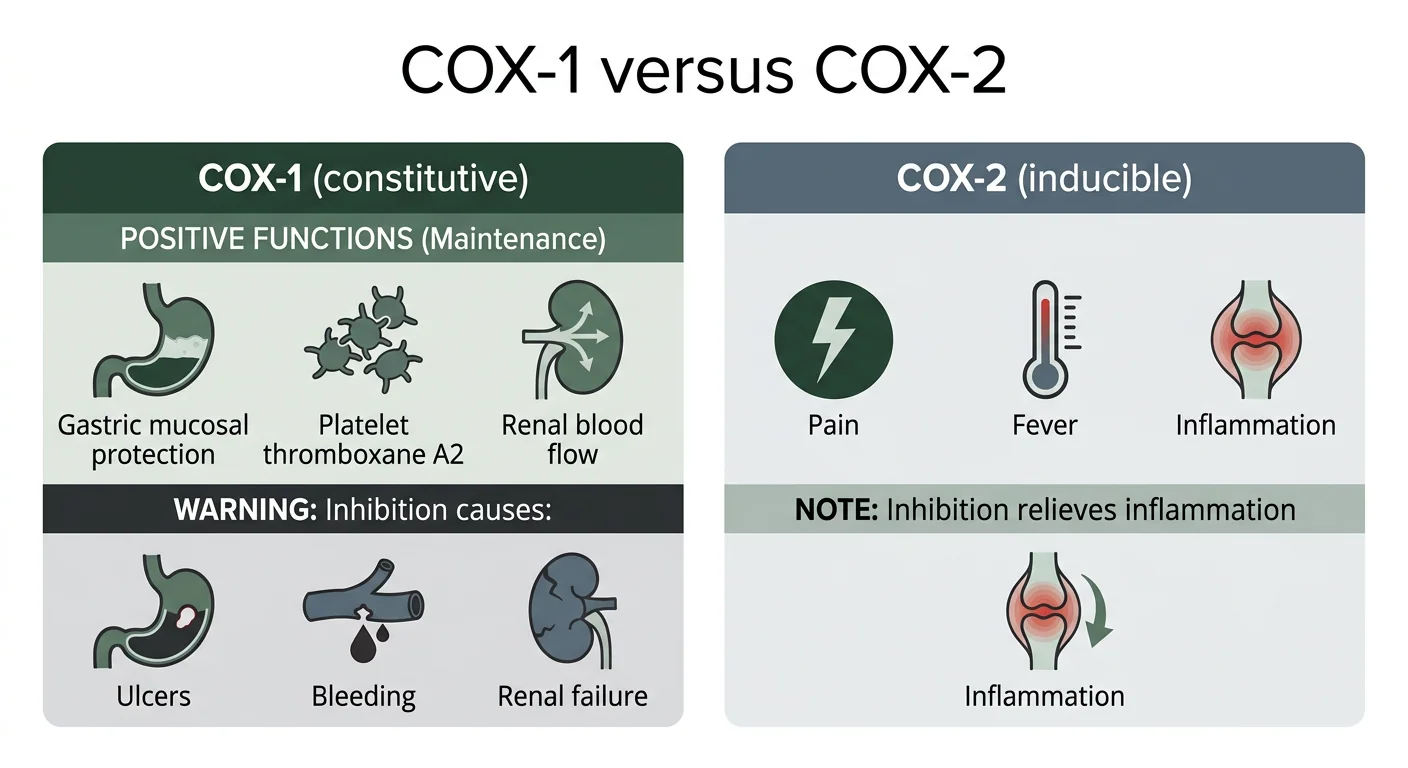
Figure 2 — COX-1 versus COX-2. Comparison of COX-1, which is constitutive and protects the stomach, platelets and kidneys, with COX-2, which is inducible and mediates pain, fever and inflammation, showing the consequences of inhibiting each.
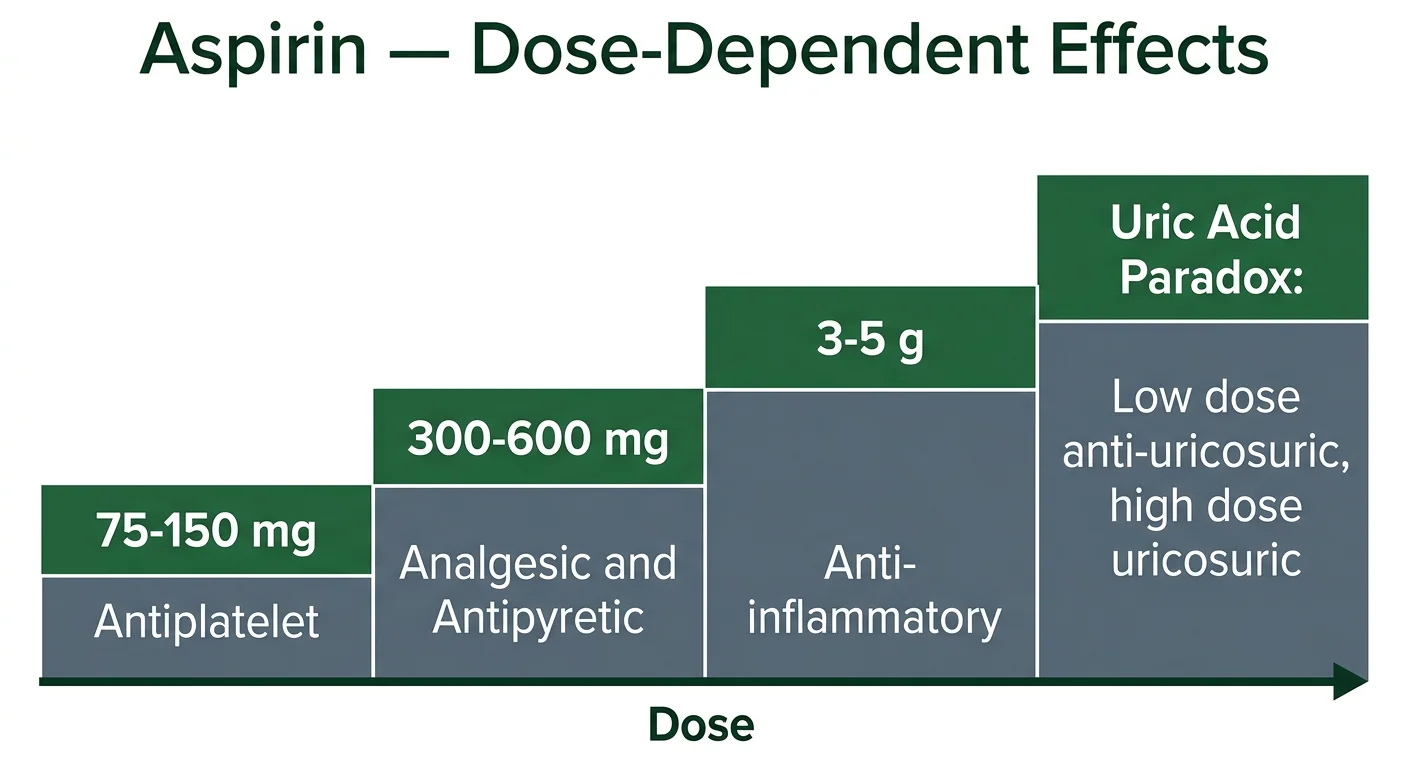
Figure 3 — Aspirin's dose-dependent effects. Diagram of aspirin's dose-dependent effects, showing antiplatelet action at low dose, analgesic-antipyretic action at moderate dose, anti-inflammatory action at high dose, and the paradoxical uric acid effect.
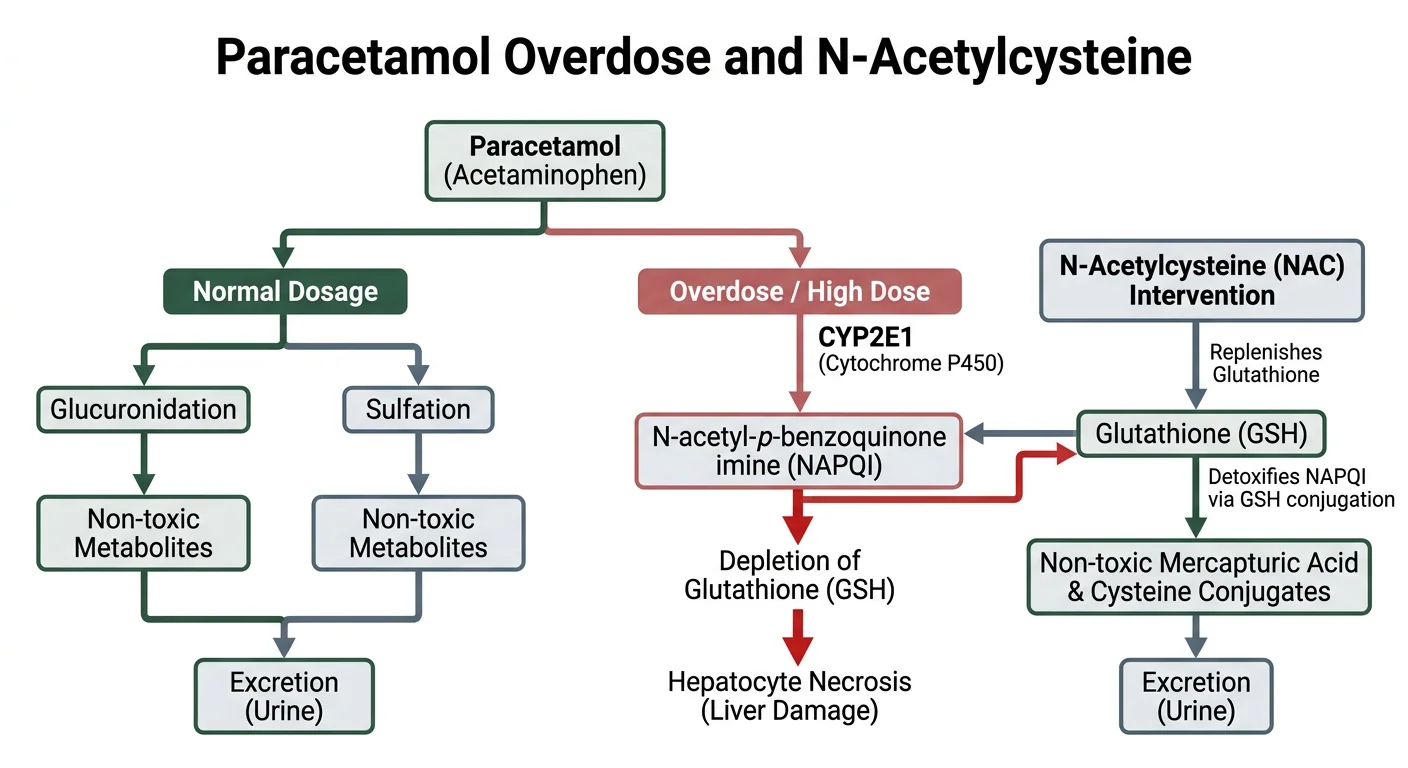
Figure 4 — Paracetamol overdose and N-acetylcysteine. Diagram of paracetamol metabolism showing the safe conjugation pathway and, in overdose, the CYP2E1-mediated formation of NAPQI which depletes glutathione and causes hepatotoxicity, with N-acetylcysteine shown replenishing glutathione.
Clinical Correlation
Vignette 1 — Paracetamol overdose
A 24-year-old woman ingests 30 paracetamol tablets in a deliberate overdose and presents 6 hours later with nausea and right-upper-quadrant pain.
Reasoning: In overdose, the conjugation pathways are saturated and paracetamol is metabolised by CYP2E1 to NAPQI, which depletes glutathione and causes centrilobular hepatic necrosis. The treatment is N-acetylcysteine, which replenishes glutathione and detoxifies NAPQI; it is most effective within 8–10 hours of ingestion. The serum paracetamol level is plotted on the Rumack-Matthew nomogram to decide treatment. This is the single most examined toxicology-antidote pairing in the analgesic chapter.
Vignette 2 — Aspirin in a child with a viral illness
A 6-year-old child with influenza is given aspirin for fever and, a week later, develops vomiting, lethargy and hepatic dysfunction with encephalopathy.
Reasoning: This is Reye syndrome — a rare but often fatal hepatic encephalopathy associated with aspirin use during a viral illness in children. Aspirin is therefore contraindicated in children (paracetamol is used instead). The mechanism is incompletely understood but involves mitochondrial injury. This is the reason the paediatric antipyretic of choice is paracetamol, not aspirin.
Vignette 3 — The triple whammy
An elderly man on an ACE inhibitor and a thiazide diuretic for heart failure is started on ibuprofen for arthritis, and his creatinine rises sharply over the next week.
Reasoning: This is the "triple whammy" — an NSAID + a diuretic + an ACE inhibitor/ARB — which together precipitate acute kidney injury. The NSAID removes the prostaglandin-mediated maintenance of renal blood flow (which the patient, already volume-depleted by the diuretic and with an impaired efferent-vasoconstriction response from the ACE inhibitor, critically depends on). The NSAID should be stopped, and the combination is a canonical, examinable renal interaction.
Vignette 4 — A coxib in ischaemic heart disease
A patient with a history of myocardial infarction is prescribed celecoxib for osteoarthritis and, some months later, presents with an acute coronary syndrome.
Reasoning: Selective COX-2 inhibition reduces endothelial prostacyclin (which normally opposes platelet thromboxane), shifting the balance toward thrombosis and raising the risk of myocardial infarction and stroke — the reason rofecoxib was withdrawn. The coxibs are therefore contraindicated in ischaemic heart disease; a non-selective NSAID (with gastroprotection) or paracetamol is preferred. This is the GI-benefit-versus-cardiovascular-risk trade-off.
Practical Linkage
Selecting the analgesic
| Patient | Choice | Rationale |
|---|---|---|
| Child with fever | Paracetamol | Safe, no Reye risk |
| Peptic ulcer needing analgesia | Paracetamol | No GI toxicity |
| Post-operative pain | Ketorolac (short course) | Potent parenteral |
| Aspirin-sensitive asthma | Paracetamol | No bronchospasm |
| Rheumatoid arthritis | NSAID (e.g. naproxen) | Anti-inflammatory |
| IHD patient with osteoarthritis | Non-selective NSAID + PPI, or paracetamol | Avoid coxibs |
Exercise (PH1.16 — select the analgesic)
Discussion point
Outline the management of a paracetamol overdose.
Expected: gastric decontamination if within 1 hour, measure the serum paracetamol level, plot on the Rumack-Matthew nomogram, and give N-acetylcysteine — most effective within 8–10 hours.
MCQ Bank
40 questions · tagged by topic, exam pattern & difficulty · full explanations
A patient develops gastric ulceration and bleeding while on ibuprofen. This is due to inhibition of:
Rapid Revision
- COX-1 — constitutive; gastric protection, platelets, renal blood flow
- COX-2 — inducible; pain, fever, inflammation
- Corticosteroids inhibit phospholipase A2 — NSAIDs inhibit cyclooxygenase
- Aspirin — irreversibly acetylates COX
- Aspirin low dose — antiplatelet; high dose — anti-inflammatory
- Aspirin uric acid paradox — low dose anti-uricosuric, high dose uricosuric
- Reye syndrome — aspirin in children with viral illness
- Salicylism — tinnitus, vertigo, hyperventilation
- Early aspirin overdose — respiratory alkalosis, then metabolic acidosis
- Paracetamol — analgesic-antipyretic, not anti-inflammatory
- Paracetamol overdose metabolite — NAPQI
- Paracetamol antidote — N-acetylcysteine, within 8 to 10 hours
- Rumack-Matthew nomogram — plots paracetamol level against time
- Paracetamol is safe in — peptic ulcer, children, asthma
- Triple whammy — NSAID plus diuretic plus ACE inhibitor
- Coxibs — less GI ulceration, more cardiovascular risk
- Rofecoxib — withdrawn for myocardial infarction and stroke
- Ketorolac — potent parenteral NSAID, 5-day limit
- Indomethacin — closes patent ductus arteriosus
- Piroxicam — long-acting oxicam
- Mefenamic acid — dysmenorrhoea
- Misoprostol — replaces gastric prostaglandins
- NSAIDs in late pregnancy — premature ductus closure
- Aspirin-induced asthma — leukotriene shunt
- NSAID renal failure — in hypovolaemic patients
Viva Questions
- Differentiate COX-1 from COX-2 — COX-1 is constitutive (gastric, platelets, renal); COX-2 is inducible (pain, fever, inflammation).
- Where do corticosteroids act in the cascade — They inhibit phospholipase A2, upstream of the NSAIDs.
- How does aspirin differ from other NSAIDs — It irreversibly acetylates the COX enzyme.
- What are aspirin's dose-dependent effects — Antiplatelet at low dose, analgesic-antipyretic at moderate dose, anti-inflammatory at high dose.
- What is the uric acid paradox of aspirin — Low dose is anti-uricosuric, high dose is uricosuric.
- What is Reye syndrome — Hepatic encephalopathy in children given aspirin during a viral illness.
- Why is paracetamol not anti-inflammatory — It weakly inhibits peripheral COX and acts centrally.
- What is the toxic metabolite of paracetamol — NAPQI, formed by CYP2E1 in overdose.
- What is the antidote for paracetamol overdose — N-acetylcysteine, which replenishes glutathione.
- What is the triple whammy — NSAID plus diuretic plus ACE inhibitor, causing acute kidney injury.
- Why were the coxibs a cardiovascular concern — COX-2 inhibition lowers prostacyclin, shifting the balance toward thrombosis.
- Which coxib was withdrawn — Rofecoxib.
- Why is aspirin contraindicated in children — The risk of Reye syndrome.
- What is salicylism — Tinnitus, vertigo and hyperventilation from aspirin toxicity.
- Which NSAID is used to close a patent ductus arteriosus — Indomethacin (or ibuprofen).
References
- Tripathi KD. Essentials of Medical Pharmacology. 9th ed. New Delhi: Jaypee Brothers Medical Publishers; Chapters 13 and 14 (Nonsteroidal Anti-inflammatory Drugs and Antipyretic-Analgesics).
- Katzung BG, Vanderah TW (eds). Basic & Clinical Pharmacology. 16th ed. New York: McGraw Hill; Chapter 36 (Nonsteroidal Anti-inflammatory Drugs).
- Brunton LL, Knollmann BC (eds). Goodman & Gilman's The Pharmacological Basis of Therapeutics. 14th ed. New York: McGraw Hill; Chapter 39 (Anti-inflammatory, Antipyretic and Analgesic Agents).
- Ritter JM, Flower RJ, Henderson G, et al. Rang & Dale's Pharmacology. 10th ed. Edinburgh: Elsevier; Chapter 29 (Non-steroidal Anti-inflammatory Drugs).
- National Medical Commission. Competency Based Undergraduate Curriculum for the Indian Medical Graduate, Volume II — Pharmacology (Code: PH), competency PH1.16.
- Dart RC, Erdman AR, Olson KR, et al. Acetaminophen poisoning: an evidence-based consensus guideline for out-of-hospital management. Clinical Toxicology. 2006;44(1):1–18.
- Fitzgerald GA. Coxibs and cardiovascular disease. New England Journal of Medicine. 2004;351(17):1709–1711.
- Wallace JL. Prostaglandins, NSAIDs and gastric mucosal protection: why doesn't the stomach digest itself? Physiological Reviews. 2008;88(4):1547–1565.
Downloads
All deliverables & printable revision sheets for CH15
Printable Chapter Handout & Study Notes
Generate a clean, high-yield PDF or print directly without sidebars and navigation menus.