
Histamine, Antihistaminics & 5-HT Drugs; Antimigraine
Learning Objectives
At the end of this chapter, the Phase II MBBS student will be able to:
- Describe the synthesis, release and receptor subtypes (H1–H4) of histamine with their locations and effects. (PH1.16 — Knows)
- Differentiate first-generation from second-generation H1 antihistaminics by blood-brain-barrier penetration, sedation and antimuscarinic activity. (PH1.16 — Knows)
- Describe the therapeutic uses of H1 antihistaminics and H2 blockers, and explain the terfenadine QT lesson. (PH1.16 — Knows)
- Describe the 5-HT receptor subtypes and the drugs acting on them, including ondansetron and cyproheptadine. (PH1.16 — Knows)
- Explain the mechanism of triptans in migraine and state their contraindications. (PH1.16 — Knows)
- Differentiate acute from prophylactic treatment of migraine and name the agents for each. (PH1.16 — Knows-how)
- Recognise serotonin syndrome and describe its management with cyproheptadine. (PH1.16 — Knows-how)
- Select an appropriate antihistamine for a driver, an elderly patient and a child with motion sickness. (PH1.16 — Shows-how)
- Explain why antihistamines are second-line in anaphylaxis. (PH1.16 — Knows)
- Describe the mechanism of H2 blockers and the special problems of cimetidine. (PH1.16 — Knows)
Must-Know Summary
Histamine and serotonin (5-HT) are the two autacoids — local hormones — that frame this chapter, and their antagonists are among the most widely used drugs in medicine. The key distinction is between first-generation (sedating) antihistaminics, which cross the blood-brain barrier, and second-generation (non-sedating) ones, which do not. Serotonin's pharmacology drives the triptans — the specific treatment of migraine — and the 5-HT3 antagonist ondansetron, the antiemetic. Two safety lessons dominate the examinations: the terfenadine QT-prolongation withdrawal, and the serotonin syndrome from excessive serotonergic drive.
In one line each:
- H1 receptor — smooth muscle, bronchi, endothelium, itch, wakefulness — Gq
- H2 receptor — gastric acid secretion — Gs
- First-generation antihistaminics — cross the blood-brain barrier, sedating
- Second-generation antihistaminics — do not cross, non-sedating
- Terfenadine and astemizole — withdrawn for QT prolongation
- Ondansetron — a 5-HT3 antagonist antiemetic
- Sumatriptan — a 5-HT1D/1B agonist, cranial vasoconstriction
- Triptans — contraindicated in ischaemic heart disease
- Serotonin syndrome — hyperthermia, clonus, autonomic instability
- Cyproheptadine — an H1 antagonist that also blocks 5-HT2
Classification
Box 1 — Histamine receptors and antagonists
- H1 — smooth muscle, endothelium, nerves, CNS — Gq — blocked by antihistaminics
- First-generation (sedating): diphenhydramine, chlorpheniramine, promethazine, cyproheptadine
- Second-generation (non-sedating): loratadine, cetirizine, fexofenadine, desloratadine
- H2 — gastric parietal cells — Gs — blocked by cimetidine, ranitidine, famotidine
- H3 — presynaptic CNS — Gi
- H4 — immune cells
Box 2 — 5-HT receptors and drugs
- 5-HT1D/1B — cranial vessels — agonists: triptans (sumatriptan)
- 5-HT2 — platelets, smooth muscle — antagonist: cyproheptadine
- 5-HT3 — CTZ, gut — antagonists: ondansetron, granisetron
- 5-HT4 — gut — agonists: cisapride, prucalopride
Core Concepts
1. Histamine and histaminergic receptors
Histamine is synthesised from the amino acid histidine by histidine decarboxylase, stored in mast cells and basophils, and released by IgE-mediated degranulation (allergy), drugs, and mechanical or chemical injury. It acts on four receptor subtypes:
- H1 — on smooth muscle (bronchoconstriction), vascular endothelium (vasodilation, increased permeability → oedema), sensory nerves (itch, pain), and the CNS (wakefulness); coupling Gq → IP3/DAG. H1 blockade is the basis of the antihistaminics.
- H2 — on gastric parietal cells (acid secretion), the heart, and blood vessels; coupling Gs → ↑cAMP. H2 blockade (ranitidine, famotidine, cimetidine) reduces gastric acid.
- H3 — presynaptic in the CNS, inhibiting histamine release (Gi); a research target.
- H4 — on immune cells (eosinophils, mast cells); involved in inflammation.
The physiological effects of histamine are therefore bronchoconstriction, vasodilation with hypotension, increased capillary permeability (urticaria, angioedema), stimulation of gastric acid, and — in anaphylaxis — the systemic picture that histamine contributes to (with other mediators).
2. H1 antihistaminics — first and second generation
H1 antihistaminics competitively block H1 receptors; they do not prevent histamine release but oppose its effects. They divide into two generations by their blood-brain-barrier penetration, which determines the sedation.
First-generation (sedating) agents — diphenhydramine, chlorpheniramine, promethazine, hydroxyzine, cyproheptadine, dimenhydrinate. Being lipophilic and non-selective, they cross the blood-brain barrier, producing sedation; they also have antimuscarinic (dry mouth, urinary retention, blurred vision) and antiemetic effects. Uses: allergic rhinitis, urticaria, pruritus, motion sickness (dimenhydrinate, promethazine), sedation (diphenhydramine), and as premedication.
Second-generation (non-sedating) agents — loratadine, desloratadine, cetirizine (mildly sedating at higher doses), levocetirizine, fexofenadine, bilastine. They are peripherally selective (substrates for, or poor penetrants of, the CNS), so they cause little or no sedation and no antimuscarinic effect. Uses: allergic rhinitis and chronic urticaria.
The terfenadine/astemizole lesson. Terfenadine and astemizole — early second-generation agents — were withdrawn because they caused QT prolongation and torsades de pointes, especially when their CYP3A4 metabolism was inhibited (by ketoconazole, erythromycin, or grapefruit juice) and the parent drug accumulated. Their safer active metabolites (fexofenadine, desloratadine) replaced them. This remains the canonical example of a drug-interaction-induced cardiotoxicity and a recurring examination item.
Position in anaphylaxis. Antihistamines are adjuncts, never first-line, in anaphylaxis — adrenaline (CH12) is the life-saving drug; antihistamines address only the histamine-mediated component.
3. H2 blockers and their uses
H2 receptor antagonists — cimetidine, ranitidine, famotidine — block the H2 receptor on gastric parietal cells, reducing basal and stimulated gastric acid secretion. Uses: peptic ulcer disease, gastro-oesophageal reflux, and stress-ulcer prophylaxis (now largely superseded by proton-pump inhibitors, CH35).
Cimetidine is the notable one for two reasons: it inhibits hepatic CYP enzymes (raising warfarin, phenytoin, theophylline levels — the CH06 interaction), and it has antiandrogenic effects (gynaecomastia, impotence) at high doses. Ranitidine and famotidine are cleaner.
4. 5-HT — physiology and receptor subtypes
Serotonin (5-hydroxytryptamine, 5-HT) is synthesised from tryptophan, stored in enterochromaffin cells of the gut and platelets, and in the CNS (raphe nuclei). It acts on a large family of receptors; the clinically important ones are:
- 5-HT1 (especially 5-HT1D/1B) — mediate cranial vasoconstriction and inhibit trigeminal pain transmission — the triptan target in migraine; 5-HT1A is the anxiety target (buspirone, CH23).
- 5-HT2 — platelets (aggregation) and smooth muscle; antagonised by cyproheptadine.
- 5-HT3 — the chemoreceptor trigger zone and gut — the ondansetron (antiemetic) target.
- 5-HT4 — gut motility — the target of cisapride/prucalopride (prokinetics).
5. 5-HT agonists and antagonists
- Triptans — sumatriptan, rizatriptan, zolmitriptan, naratriptan: 5-HT1D/1B agonists that cause cranial vasoconstriction and inhibit the release of vasoactive peptides (CGRP) from trigeminal endings — the specific mechanism of migraine relief.
- Ergotamine — a non-selective 5-HT1 agonist with potent vasoconstriction; historical for migraine, with a risk of ergotism and coronary spasm.
- Ondansetron, granisetron, palonosetron — 5-HT3 antagonists acting at the CTZ and gut, the antiemetics of choice for chemotherapy-induced nausea.
- Cyproheptadine — an H1 antihistamine that also blocks 5-HT2; used in serotonin syndrome and as an appetite stimulant.
- Ketanserin (5-HT2 antagonist), pizotifen (5-HT2 antagonist, migraine prophylaxis), methysergide (5-HT2 antagonist, historical).
Serotonin syndrome. Excessive serotonergic activity — typically from combining an SSRI with a MAOI, tramadol, a triptan or linezolid — produces the triad of altered mental status, autonomic instability (hyperthermia, tachycardia, sweating) and neuromuscular hyperactivity (clonus, rigidity, tremor). Management is withdrawal of the serotonergic drugs, supportive care, and cyproheptadine as the 5-HT antagonist (links CH06/CH23).
6. Pharmacotherapy of migraine
Migraine treatment divides into acute and prophylactic:
Acute (abortive) treatment. For mild attacks, NSAIDs or paracetamol (CH15). For moderate–severe attacks, the triptans (sumatriptan, orally/subcutaneously/nasally) are the specific therapy, often combined with an antiemetic (metoclopramide, domperidone) to treat the associated nausea and aid absorption. Triptan contraindications are critical: ischaemic heart disease, Prinzmetal (variant) angina, uncontrolled hypertension, peripheral vascular disease, and a history of cerebrovascular disease — because 5-HT1B-mediated coronary vasoconstriction can precipitate myocardial ischaemia. Triptans must not be combined with ergotamine (within 24 hours) or MAOIs (within 2 weeks).
Prophylactic treatment (for frequent or disabling attacks): propranolol (CH13), amitriptyline, flunarizine, topiramate and valproate. The newer CGRP-pathway agents — the gepants (rimegepant, ubrogepant) and CGRP monoclonal antibodies (erenumab) — are named for completeness.
Tables
Table 1 — Histamine receptors
| Receptor | Location | Coupling | Effect |
|---|---|---|---|
| H1 | Smooth muscle, endothelium, nerves, CNS | Gq | Bronchoconstriction, vasodilation, itch, wakefulness |
| H2 | Gastric parietal cells, heart | Gs | Gastric acid secretion |
| H3 | Presynaptic CNS | Gi | Inhibits histamine release |
| H4 | Immune cells | Gi | Inflammation |
Table 2 — First versus second-generation H1 antihistaminics
| Feature | First-generation | Second-generation |
|---|---|---|
| BBB penetration | Crosses | Does not cross |
| Sedation | Present | Absent/minimal |
| Antimuscarinic | Present | Absent |
| Examples | Diphenhydramine, promethazine | Loratadine, fexofenadine |
| Use | Allergy + motion sickness + sedation | Allergic rhinitis, urticaria |
Table 3 — Individual H1 antihistaminics
| Drug | Sedation | Special use |
|---|---|---|
| Diphenhydramine | Marked | Sedation, allergy |
| Promethazine | Marked | Antiemetic, motion sickness |
| Dimenhydrinate | Moderate | Motion sickness |
| Chlorpheniramine | Moderate | Allergy |
| Cyproheptadine | Moderate | 5-HT2 blockade, appetite |
| Loratadine | Minimal | Allergy |
| Fexofenadine | Minimal | Allergy |
Table 4 — H1 versus H2 blockers
| Feature | H1 antihistaminics | H2 blockers |
|---|---|---|
| Target | H1 receptor | H2 receptor |
| Effect | Anti-allergic | ↓ gastric acid |
| Examples | Loratadine, diphenhydramine | Ranitidine, famotidine, cimetidine |
| Use | Allergy, urticaria | Peptic ulcer, reflux |
Table 5 — 5-HT receptor subtypes
| Receptor | Location | Drug target |
|---|---|---|
| 5-HT1D/1B | Cranial vessels | Triptans (agonist) |
| 5-HT2 | Platelets, smooth muscle | Cyproheptadine (antagonist) |
| 5-HT3 | CTZ, gut | Ondansetron (antagonist) |
| 5-HT4 | Gut | Cisapride, prucalopride (agonist) |
Table 6 — Acute versus prophylactic migraine treatment
| Treatment | Agents |
|---|---|
| Acute (mild) | NSAIDs, paracetamol |
| Acute (moderate–severe) | Triptans (sumatriptan) ± antiemetic |
| Prophylactic | Propranolol, amitriptyline, flunarizine, topiramate, valproate |
| Newer | CGRP antagonists (gepants), CGRP mAbs |
Table 7 — Triptan contraindications
| Contraindication | Rationale |
|---|---|
| Ischaemic heart disease | Coronary vasoconstriction |
| Prinzmetal angina | Coronary spasm |
| Uncontrolled hypertension | Vasoconstriction |
| Peripheral vascular disease | Vasoconstriction |
| With ergotamine | Additive vasoconstriction (24 h) |
| With MAOIs | Serotonergic excess (2 weeks) |
Figures
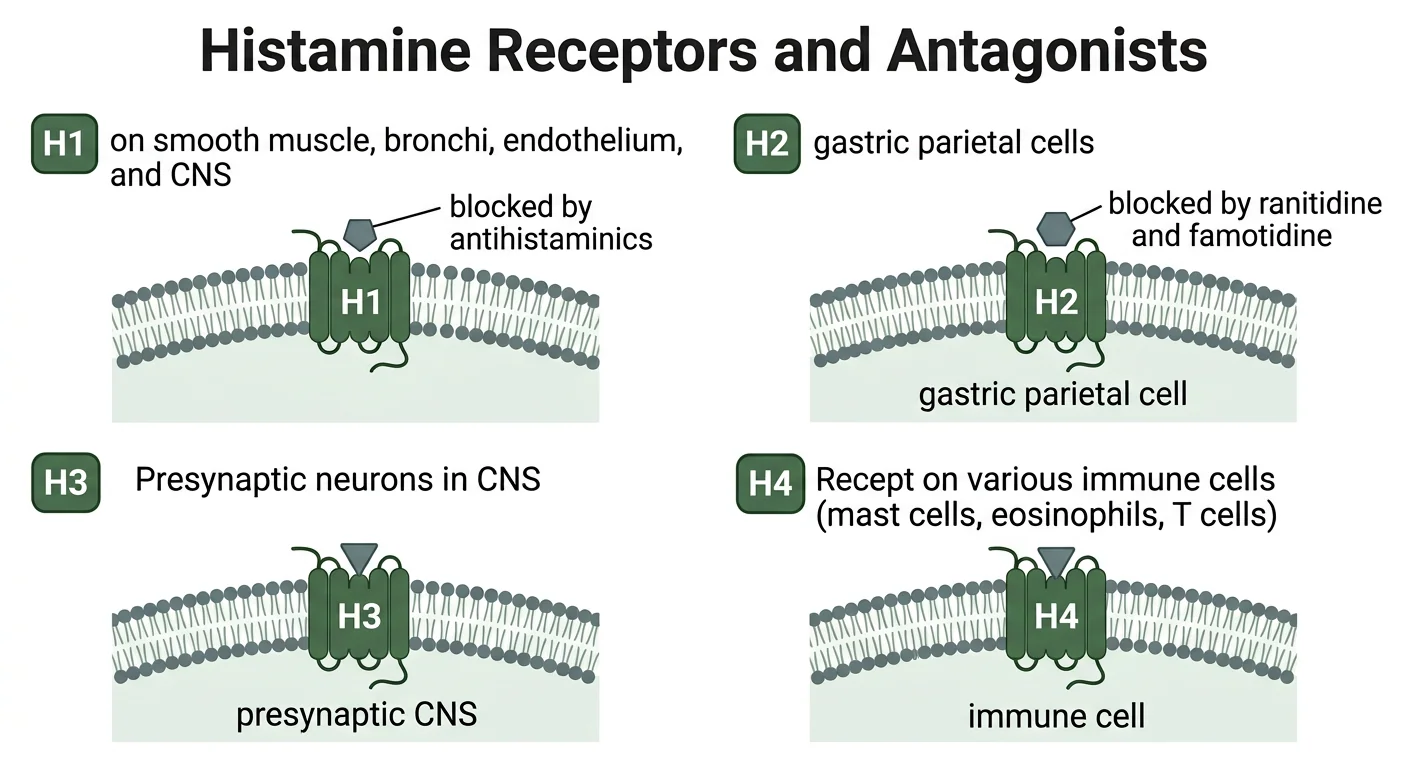
Figure 1 — Histamine receptors and their antagonists. Diagram of the four histamine receptors H1 through H4 with their locations and the antagonists that block H1 (antihistaminics) and H2 (ranitidine, famotidine).
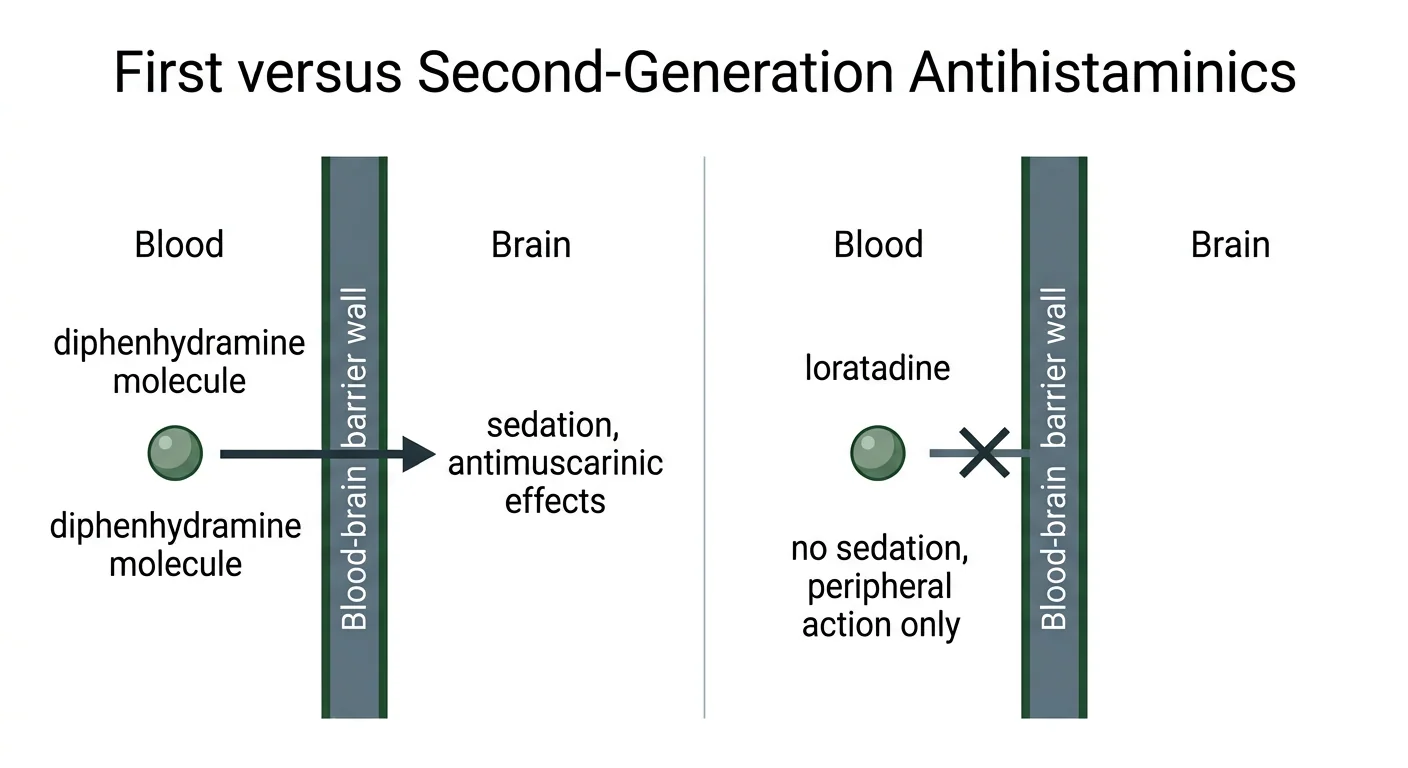
Figure 2 — First versus second-generation antihistaminics. Two-panel diagram showing first-generation antihistamines crossing the blood-brain barrier to cause sedation, contrasted with second-generation antihistamines that are excluded by the barrier and act only peripherally.
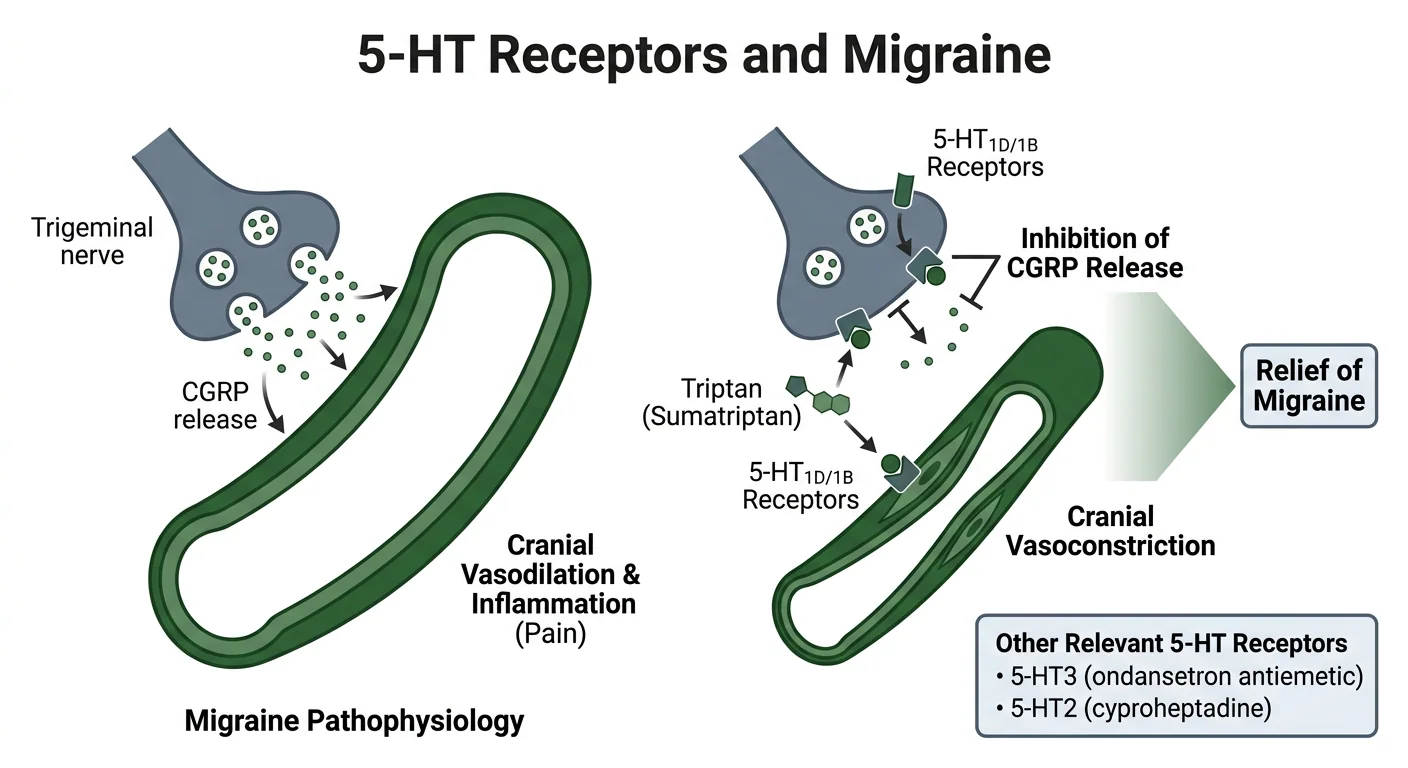
Figure 3 — 5-HT receptors and the triptan mechanism in migraine. Diagram showing the triptan mechanism in migraine — sumatriptan binding 5-HT1D/1B receptors to constrict dilated cranial vessels and inhibit CGRP release, with insets for the 5-HT3 and 5-HT2 drug targets.
Clinical Correlation
Vignette 1 — A triptan in a patient with angina
A 52-year-old man with a history of exertional angina presents with a severe migraine and is about to be given sumatriptan by a junior doctor.
Reasoning: Sumatriptan is a 5-HT1B/1D agonist, and the 5-HT1B receptors are also present on coronary arteries; its vasoconstricting action can precipitate myocardial ischaemia, so triptans are contraindicated in ischaemic heart disease, Prinzmetal angina, uncontrolled hypertension and peripheral vascular disease. The patient should instead receive an NSAID (and an antiemetic), with prophylaxis considered. This is the single most examined triptan safety point.
Vignette 2 — Serotonin syndrome
A patient on fluoxetine is started on tramadol for pain and, within hours, develops agitation, sweating, hyperthermia, tremor and lower-limb clonus.
Reasoning: This is serotonin syndrome — excessive serotonergic activity from combining the SSRI with tramadol (a serotonin-reuptake inhibitor). The triad is altered mental status, autonomic instability and neuromuscular hyperactivity (clonus). Management is to stop the serotonergic drugs, give supportive care (cooling, benzodiazepines for agitation), and administer cyproheptadine, a 5-HT2 antagonist. The case links to the drug-interaction content of CH06 and the antidepressant content of CH23.
Vignette 3 — Terfenadine and QT prolongation
Years ago, a patient taking terfenadine for hay fever also drank grapefruit juice daily and developed palpitations and syncope, with torsades de pointes on the monitor.
Reasoning: Terfenadine, an early second-generation antihistamine, was a CYP3A4 substrate; when its metabolism was inhibited (grapefruit juice, ketoconazole, erythromycin), the parent drug accumulated and blocked cardiac potassium channels, causing QT prolongation and torsades de pointes. This led to its withdrawal and replacement by its active metabolite fexofenadine. The vignette is the canonical example of an interaction-induced cardiotoxicity and explains why "non-sedating" is not synonymous with "safe".
Vignette 4 — Migraine with vomiting
A woman with a throbbing hemi-cranial headache, nausea and vomiting is treated with oral sumatriptan but vomits the tablet within minutes.
Reasoning: Nausea and vomiting accompany migraine and impair oral absorption, so the triptan should be given by a route that bypasses the gut — subcutaneous or intranasal sumatriptan — or an antiemetic (metoclopramide or domperidone) given first to permit oral therapy. This illustrates the practical principle of route selection in migraine (and links to CH01's route-of-administration content).
Practical Linkage
Selecting the antihistamine and migraine therapy
| Patient | Choice | Rationale |
|---|---|---|
| Truck driver with allergic rhinitis | Loratadine/fexofenadine (non-sedating) | No sedation |
| Child with motion sickness | Dimenhydrinate/promethazine | Antiemetic + sedating |
| Elderly with urticaria | Second-generation | Avoid antimuscarinic effects |
| Migraine with nausea, no cardiac disease | Sumatriptan SC + antiemetic | Bypass gut, specific therapy |
| Migraine in a patient with angina | NSAID + antiemetic (not triptan) | Triptan contraindicated |
Exercise (PH1.16 — select the antihistamine and migraine therapy)
Discussion point
Why are antihistamines second-line in anaphylaxis?
Expected: they block only the histamine-mediated component and act slowly; adrenaline reverses the life-threatening hypotension and bronchospasm immediately.
MCQ Bank
35 questions · tagged by topic, exam pattern & difficulty · full explanations
A patient develops drowsiness after taking diphenhydramine for urticaria. The sedation is due to:
Rapid Revision
- H1 receptor — smooth muscle, endothelium, itch, wakefulness — Gq
- H2 receptor — gastric acid — Gs
- H3 receptor — presynaptic, inhibits histamine release
- First-generation antihistaminics — cross the blood-brain barrier, sedating
- Second-generation antihistaminics — do not cross, non-sedating
- Terfenadine and astemizole — withdrawn for QT prolongation
- Fexofenadine — the safe active metabolite of terfenadine
- H2 blockers — ranitidine, famotidine, cimetidine reduce gastric acid
- Cimetidine — inhibits CYP enzymes, antiandrogenic
- Ondansetron — a 5-HT3 antagonist antiemetic
- Sumatriptan — a 5-HT1D/1B agonist, cranial vasoconstriction
- Triptans — contraindicated in ischaemic heart disease
- Triptans and ergotamine — separate by 24 hours
- Triptans and MAOIs — separate by 2 weeks
- Serotonin syndrome — hyperthermia, clonus, autonomic instability
- Cyproheptadine — an H1 antagonist that also blocks 5-HT2
- Serotonin syndrome treatment — cyproheptadine
- Dimenhydrinate and promethazine — for motion sickness
- Propranolol and amitriptyline — migraine prophylaxis
- Adrenaline — first-line in anaphylaxis, antihistamines are adjuncts
- Histamine is stored in — mast cells and basophils
- 5-HT4 receptor — the prokinetic target
- Ergotamine — risk of ergotism and coronary spasm
- Gepants and erenumab — target the CGRP pathway
- Ketotifen — mast-cell stabiliser with antihistamine activity
- Cyproheptadine as an appetite stimulant — 5-HT2 antagonism
Viva Questions
- Name the histamine receptors — H1, H2, H3 and H4.
- What does H1 mediate — Bronchoconstriction, vasodilation, increased permeability and itch.
- What does H2 mediate — Gastric acid secretion.
- Differentiate first and second-generation antihistaminics — First-generation cross the blood-brain barrier and sedate; second-generation do not cross and are non-sedating.
- Why was terfenadine withdrawn — QT prolongation and torsades de pointes, especially with CYP3A4 inhibition.
- What is ondansetron — A 5-HT3 antagonist antiemetic for chemotherapy-induced nausea.
- What is sumatriptan's mechanism — A 5-HT1D/1B agonist causing cranial vasoconstriction.
- What are the triptan contraindications — Ischaemic heart disease, Prinzmetal angina, uncontrolled hypertension, peripheral vascular disease.
- What is serotonin syndrome — A triad of altered mental status, autonomic instability and clonus from excessive serotonergic activity.
- What is cyproheptadine used for — Serotonin syndrome (5-HT2 blockade) and as an appetite stimulant.
- Which antihistamine for motion sickness — Dimenhydrinate or promethazine.
- Which drugs are used for migraine prophylaxis — Propranolol, amitriptyline, flunarizine, topiramate and valproate.
- Why are antihistamines second-line in anaphylaxis — They block only the histamine component; adrenaline is life-saving.
- What is the problem with cimetidine — It inhibits CYP enzymes and has antiandrogenic effects.
- What is the 5-HT4 receptor's role — Gut motility, the target of prokinetics.
References
- Tripathi KD. Essentials of Medical Pharmacology. 9th ed. New Delhi: Jaypee Brothers Medical Publishers; Chapters 11 and 12 (Autacoids: Histamine and 5-Hydroxytryptamine).
- Katzung BG, Vanderah TW (eds). Basic & Clinical Pharmacology. 16th ed. New York: McGraw Hill; Chapter 16 (Histamine, Serotonin and the Ergot Alkaloids) and Chapter 40 (Drugs Used in Migraine).
- Brunton LL, Knollmann BC (eds). Goodman & Gilman's The Pharmacological Basis of Therapeutics. 14th ed. New York: McGraw Hill; Chapter 41 (Histamine, Bradykinin and Their Antagonists).
- Ritter JM, Flower RJ, Henderson G, et al. Rang & Dale's Pharmacology. 10th ed. Edinburgh: Elsevier; Chapters 17 and 15 (5-Hydroxytryptamine; Local Hormones).
- National Medical Commission. Competency Based Undergraduate Curriculum for the Indian Medical Graduate, Volume II — Pharmacology (Code: PH), competency PH1.16.
- Boyer EW, Shannon M. The serotonin syndrome. New England Journal of Medicine. 2005;352(11):1112–1120.
- Goadsby PJ. Recent advances in understanding migraine mechanisms, molecules and therapeutics. Trends in Molecular Medicine. 2007;13(1):39–44.
- Wooltorton E. Terfenadine and astemizole: the cardiotoxic antihistamines. CMAJ. 2002;166(6):762.
Downloads
All deliverables & printable revision sheets for CH14
Printable Chapter Handout & Study Notes
Generate a clean, high-yield PDF or print directly without sidebars and navigation menus.