
Alpha & Beta Adrenergic Blockers
Learning Objectives
At the end of this chapter, the Phase II MBBS student will be able to:
- Classify the alpha adrenergic blockers into irreversible, competitive, selective α1 and α1A-selective groups, with examples. (PH1.13 — Knows)
- Describe the first-dose phenomenon of prazosin and its prevention. (PH1.13 — Knows)
- Explain the use of alpha blockers in BPH and the alpha-before-beta rule in phaeochromocytoma. (PH1.13 — Knows-how)
- Classify the beta blockers by cardioselectivity, intrinsic sympathomimetic activity, membrane-stabilising activity and combined α+β action. (PH1.13 — Knows)
- Describe the therapeutic uses of beta blockers and their receptor basis. (PH1.13 — Knows)
- Explain why beta blockers are hazardous in asthma and can mask hypoglycaemia in diabetes. (PH1.13 — Knows)
- Describe the adverse effects, withdrawal syndrome and overdose management (glucagon) of beta blockers. (PH1.13 — Knows)
- Describe the drug classes used in glaucoma and their mechanisms. (PH1.13 — Knows)
- Select an appropriate beta blocker for a given patient profile (asthmatic, diabetic, heart failure). (PH1.13 — Shows-how)
- Differentiate propranolol from atenolol by lipophilicity and its consequences. (PH1.13 — Knows)
Must-Know Summary
The adrenergic antagonists — alpha and beta blockers — are the mirror image of CH12's agonists, and their clinical value is enormous: alpha blockers for hypertension and BPH, beta blockers for hypertension, angina, arrhythmias, heart failure, migraine and glaucoma. The pharmacology turns on a few distinctions: cardioselective (β1) versus non-selective (β1+β2) blockers, the presence of intrinsic sympathomimetic activity (ISA) or membrane-stabilising activity (MSA), and lipophilicity. Two rules dominate the examinations: block alpha before beta in phaeochromocytoma, and never give a non-selective beta blocker to an asthmatic.
In one line each:
- Phenoxybenzamine — irreversible, non-selective alpha blocker
- Prazosin — selective α1, first-dose syncope
- Tamsulosin — α1A-selective for BPH
- Cardioselective beta blockers — atenolol, metoprolol, bisoprolol, esmolol
- Propranolol — non-selective, lipophilic, with membrane-stabilising activity
- Pindolol — has intrinsic sympathomimetic activity
- Esmolol — ultra-short acting, esterase-metabolised
- Alpha before beta — the phaeochromocytoma rule
- Non-selective beta blocker in asthma — precipitates bronchospasm
- Timolol — beta blocker that reduces aqueous production in glaucoma
Classification
Box 1 — Alpha adrenergic blockers
- Non-selective, irreversible — phenoxybenzamine (pre-operative phaeochromocytoma)
- Non-selective, competitive — phentolamine (acute hypertensive crisis)
- Selective α1 — prazosin, terazosin, doxazosin (hypertension, BPH; first-dose syncope)
- α1A-selective — tamsulosin, silodosin (BPH, less hypotension)
Box 2 — Beta adrenergic blockers
- Cardioselective (β1) — atenolol, metoprolol, bisoprolol, esmolol
- Non-selective (β1+β2) — propranolol, nadolol, timolol, sotalol
- With ISA (partial agonist) — pindolol, acebutolol
- With MSA — propranolol (high dose)
- Combined α+β — labetalol, carvedilol
- Ultra-short acting — esmolol
Core Concepts
1. Alpha adrenergic blockers — classification and pharmacology
Alpha blockers antagonise the α1 (and sometimes α2) adrenergic receptors, opposing the vasoconstriction and smooth-muscle contraction of α1 stimulation. They are classified by selectivity and reversibility:
- Non-selective, irreversible — phenoxybenzamine. It binds covalently to both α1 and α2 receptors, producing a long-lasting (irreversible) blockade that persists until new receptors are synthesised. It is used pre-operatively in phaeochromocytoma to control blood pressure before surgery. Its α2 blockade increases noradrenaline release (loss of presynaptic inhibition), causing reflex tachycardia.
- Non-selective, competitive — phentolamine. A short-acting competitive α1/α2 antagonist used in the acute hypertensive crisis of phaeochromocytoma and in local extravasation of noradrenaline.
- Selective α1 — prazosin, terazosin, doxazosin. These block α1 (vasodilation, relaxation of the bladder neck and prostate) without the α2-mediated tachycardia. Prazosin is the prototype and is known for the first-dose phenomenon — a marked postural hypotension and syncope after the first dose, prevented by starting with a low dose at bedtime.
- α1A-selective — tamsulosin, silodosin. These preferentially block the α1A receptor of the prostate and bladder neck, so they treat BPH with less hypotension than the non-selective α1 blockers.
2. Uses of alpha blockers — BPH and phaeochromocytoma
Benign prostatic hyperplasia (BPH). α1 blockade relaxes the smooth muscle of the bladder neck and prostate, relieving the obstructive symptoms of BPH. Tamsulosin (α1A-selective) is preferred for its uroselectivity and lesser blood-pressure effect; prazosin, terazosin and doxazosin are alternatives (also useful when hypertension coexists).
Phaeochromocytoma. This catecholamine-secreting tumour produces dangerous hypertension. The cardinal rule is "alpha before beta": an alpha blocker (phenoxybenzamine pre-operatively, phentolamine acutely) must be given before any beta blocker. The reason is that beta-blockade alone removes β2-mediated vasodilation while leaving the tumour's α-mediated vasoconstriction unopposed, precipitating a hypertensive crisis. Once alpha blockade is established, a beta blocker is added to control the reflex tachycardia.
3. Beta blockers — classification and pharmacokinetics
Beta blockers are classified by several overlapping properties:
- Cardioselective (β1-selective) — atenolol, metoprolol, bisoprolol, esmolol: at usual doses they block cardiac β1 with relative sparing of bronchial/vascular β2, making them safer in asthma and diabetes.
- Non-selective (β1+β2) — propranolol, nadolol, timolol, sotalol: block both subtypes.
- With intrinsic sympathomimetic activity (ISA — partial agonist) — pindolol, acebutolol: they partially stimulate the receptor while blocking full agonists, so they cause less bradycardia.
- With membrane-stabilising activity (MSA — a quinidine-like, local-anaesthetic effect) — propranolol (at high doses); this is not the therapeutic antiarrhythmic mechanism.
- Combined α+β blockade — labetalol, carvedilol: useful in hypertensive emergencies (labetalol) and heart failure (carvedilol).
- Ultra-short acting — esmolol: metabolised by red-cell esterases (half-life ~9 minutes), given intravenously for perioperative and supraventricular tachyarrhythmias.
Pharmacokinetic distinction: propranolol is lipophilic — well absorbed, high first-pass metabolism, crosses the blood-brain barrier (CNS effects, nightmares), and hepatic clearance; atenolol is hydrophilic — renally excreted, less CNS penetration. This lipophilicity difference is a recurring discriminator.
4. Beta-blocker pharmacological properties and the asthma/diabetes problem
Beta blockade has three principal cardiovascular effects: β1 blockade reduces heart rate, contractility and conduction, and lowers renin release; this reduces myocardial oxygen demand (the basis of the anti-anginal and antihypertensive effect). The β2 blockade of non-selective agents underlies their two most important hazards:
- Asthma/COPD — blocking bronchial β2 removes the dilator pathway, so non-selective beta blockers can precipitate bronchospasm in asthmatics; cardioselective agents are preferred (and even they are used cautiously).
- Diabetes — β-blockers mask the warning signs of hypoglycaemia (tremor, palpitations, anxiety, sweating are adrenergic), so a diabetic on insulin may not recognise an impending hypoglycaemic episode; non-selective agents also impair glycogenolysis. Cardioselective agents are preferred.
5. Therapeutic uses of beta blockers
- Hypertension — reduce cardiac output and renin (first-line in younger patients, CH26).
- Angina — reduce heart rate and contractility, lowering myocardial oxygen demand (CH27).
- Arrhythmias — slow conduction (rate control in atrial fibrillation, supraventricular tachycardia).
- Post-myocardial infarction — reduce mortality by reducing reinfarction and arrhythmic risk.
- Heart failure — carvedilol, bisoprolol, metoprolol (the mortality-reducing agents) given in stable, compensated heart failure (CH28).
- Migraine prophylaxis — propranolol.
- Glaucoma — timolol reduces aqueous humour production (see Section 7).
- Hyperthyroidism — propranolol controls the sympathetic symptoms and blocks the peripheral conversion of T4 to T3.
- Essential tremor and performance anxiety — propranolol.
- Portal hypertension — propranolol reduces portal pressure in variceal prophylaxis.
6. Adverse effects, overdose and withdrawal
Adverse effects reflect the receptor blockade: bradycardia and heart block (β1), bronchospasm (β2, in asthmatics), cold extremities (peripheral β2 blockade), fatigue, depression and sexual dysfunction, masked hypoglycaemia (diabetics), and — with non-selective agents — an unfavourable lipid profile (raised triglycerides). Propranolol's CNS penetration adds nightmares and insomnia.
Withdrawal. Abrupt cessation of chronic beta-blockade causes a rebound tachycardia, hypertension and angina from up-regulation of β receptors during therapy. Beta blockers are therefore tapered over 1–2 weeks, never stopped suddenly.
Overdose. Severe beta-blocker overdose produces bradycardia, hypotension and heart block. Management includes atropine (for bradycardia), glucagon (which stimulates the heart by activating adenylate cyclase independently of the β receptor, the specific antidote), and inotropic/pacing support.
7. Drugs used in glaucoma
Glaucoma is managed by reducing intraocular pressure, and the drug classes act by either reducing aqueous production or increasing its outflow:
- Beta blockers — timolol (and betaxolol): reduce aqueous production by blocking ciliary-body β receptors; a mainstay, given as eye drops.
- Prostaglandin analogues — latanoprost, bimatoprost, travoprost: increase uveoscleral outflow; now the first-line agents for open-angle glaucoma.
- Alpha agonists — brimonidine, apraclonidine: reduce aqueous production and increase uveoscleral outflow.
- Carbonic anhydrase inhibitors — dorzolamide, brinzolamide (topical), acetazolamide (systemic): reduce aqueous production by inhibiting carbonic anhydrase in the ciliary body.
- Cholinergic — pilocarpine (CH10): increases trabecular outflow by ciliary-muscle contraction.
- Osmotic — mannitol: used in acute angle-closure glaucoma to rapidly lower pressure.
Tables
Table 1 — Alpha blockers
| Drug | Selectivity | Key feature | Use |
|---|---|---|---|
| Phenoxybenzamine | α1+α2, irreversible | Long-acting | Pre-op phaeochromocytoma |
| Phentolamine | α1+α2, competitive | Short-acting | Acute crisis |
| Prazosin | α1 | First-dose syncope | Hypertension, BPH |
| Tamsulosin | α1A | Uroselective | BPH |
Table 2 — Beta-blocker classification
| Property | Drugs |
|---|---|
| Cardioselective (β1) | Atenolol, metoprolol, bisoprolol, esmolol |
| Non-selective (β1+β2) | Propranolol, nadolol, timolol, sotalol |
| ISA | Pindolol, acebutolol |
| MSA | Propranolol |
| α+β | Labetalol, carvedilol |
| Ultra-short | Esmolol |
Table 3 — Cardioselective versus non-selective
| Feature | Cardioselective (β1) | Non-selective (β1+β2) |
|---|---|---|
| Bronchial effect | Spared at low dose | Bronchospasm risk |
| Hypoglycaemia | Less masking | Masks warning signs |
| Example | Atenolol, metoprolol | Propranolol, timolol |
| Use in asthma | Preferred | Avoid |
Table 4 — Beta-blocker uses
| Use | Rationale |
|---|---|
| Hypertension | ↓ cardiac output, ↓ renin |
| Angina | ↓ myocardial oxygen demand |
| Arrhythmias | ↓ conduction |
| Post-MI | ↓ mortality |
| Heart failure | Carvedilol, bisoprolol, metoprolol |
| Migraine | Prophylaxis (propranolol) |
| Glaucoma | ↓ aqueous production (timolol) |
| Hyperthyroidism | Symptom control, ↓ T4→T3 |
Table 5 — Beta-blocker adverse effects
| Effect | Mechanism |
|---|---|
| Bradycardia, heart block | β1 blockade |
| Bronchospasm | β2 blockade |
| Cold extremities | β2 (peripheral) blockade |
| Masked hypoglycaemia | β2 (adrenergic warning) blockade |
| Fatigue, depression | CNS (lipophilic agents) |
| Rebound on withdrawal | Receptor up-regulation |
Table 6 — Glaucoma drug classes
| Class | Mechanism | Example |
|---|---|---|
| Beta blocker | ↓ aqueous production | Timolol |
| Prostaglandin analogue | ↑ uveoscleral outflow | Latanoprost |
| Alpha agonist | ↓ production, ↑ outflow | Brimonidine |
| Carbonic anhydrase inhibitor | ↓ aqueous production | Dorzolamide |
| Cholinergic | ↑ trabecular outflow | Pilocarpine |
| Osmotic | Rapid ↓ pressure | Mannitol |
Table 7 — Phaeochromocytoma management
| Step | Action | Rationale |
|---|---|---|
| 1 | Alpha blockade | Phenoxybenzamine — prevent unopposed α |
| 2 | Beta blockade | Control reflex tachycardia |
| 3 | Surgery | Tumour resection |
| Rule | Alpha before beta | Avoid hypertensive crisis |
Figures
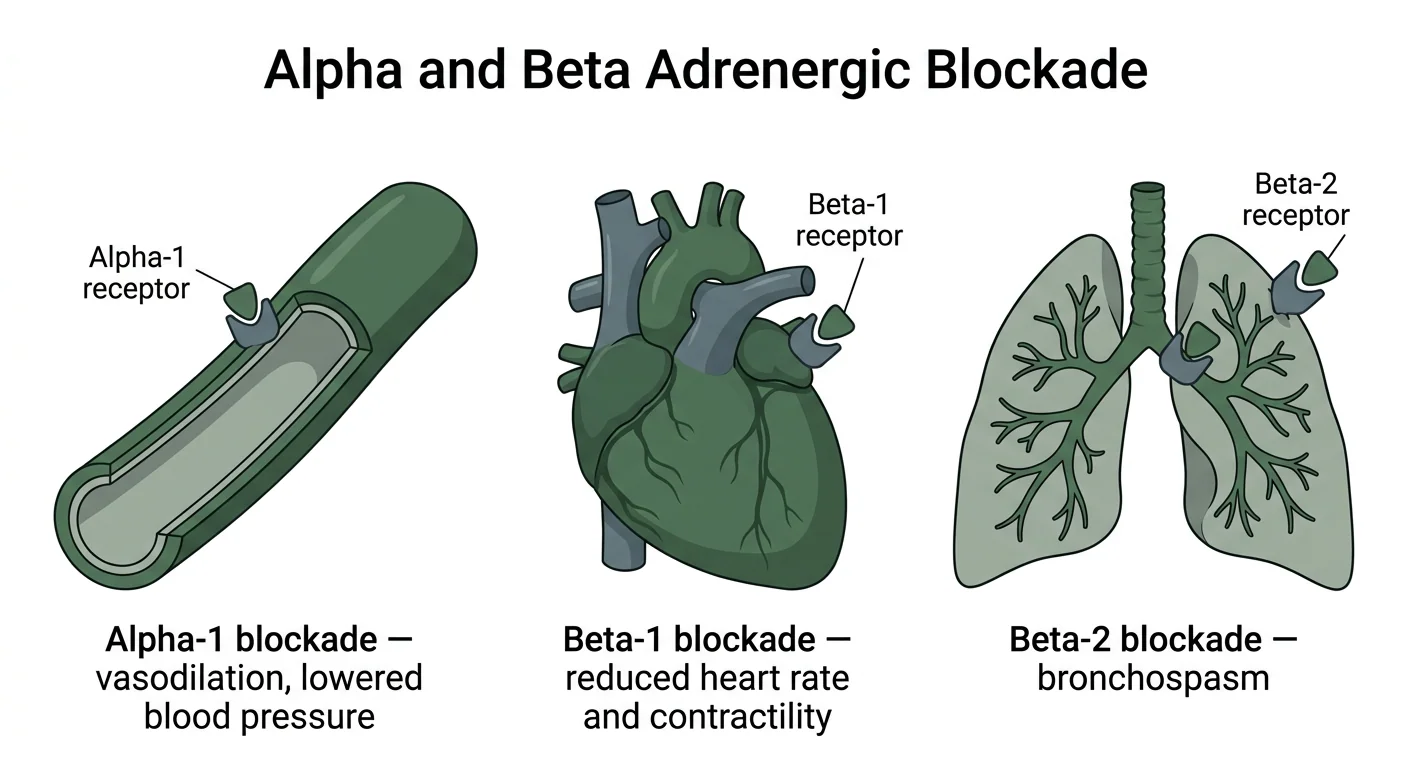
Figure 1 — Alpha and beta adrenergic blockade. Diagram contrasting alpha-1 blockade, which causes vasodilation and lowers blood pressure, with beta-1 blockade, which slows the heart, and beta-2 blockade, which can cause bronchospasm.
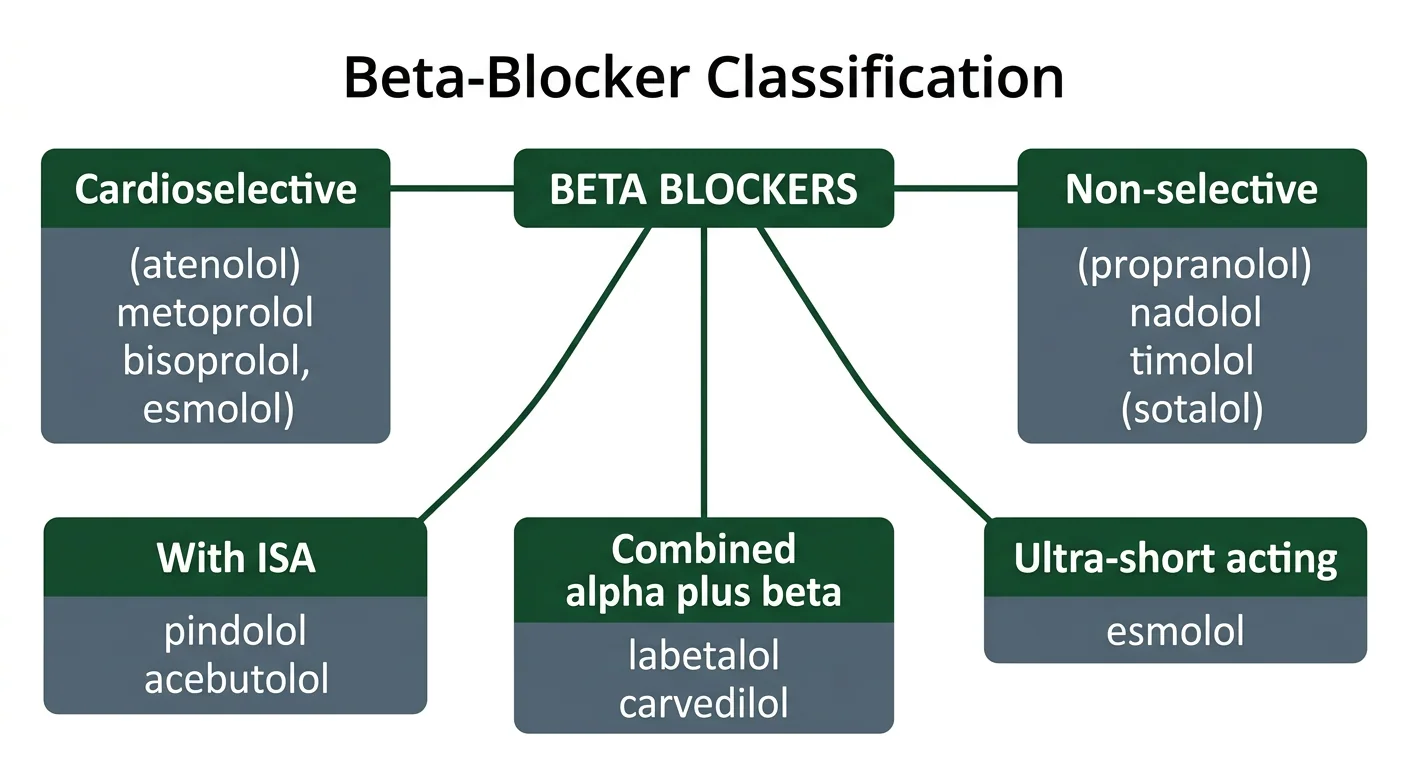
Figure 2 — Beta-blocker classification. Classification map of beta blockers into cardioselective, non-selective, intrinsic sympathomimetic activity, combined alpha plus beta, and ultra-short acting groups, with example drugs in each.
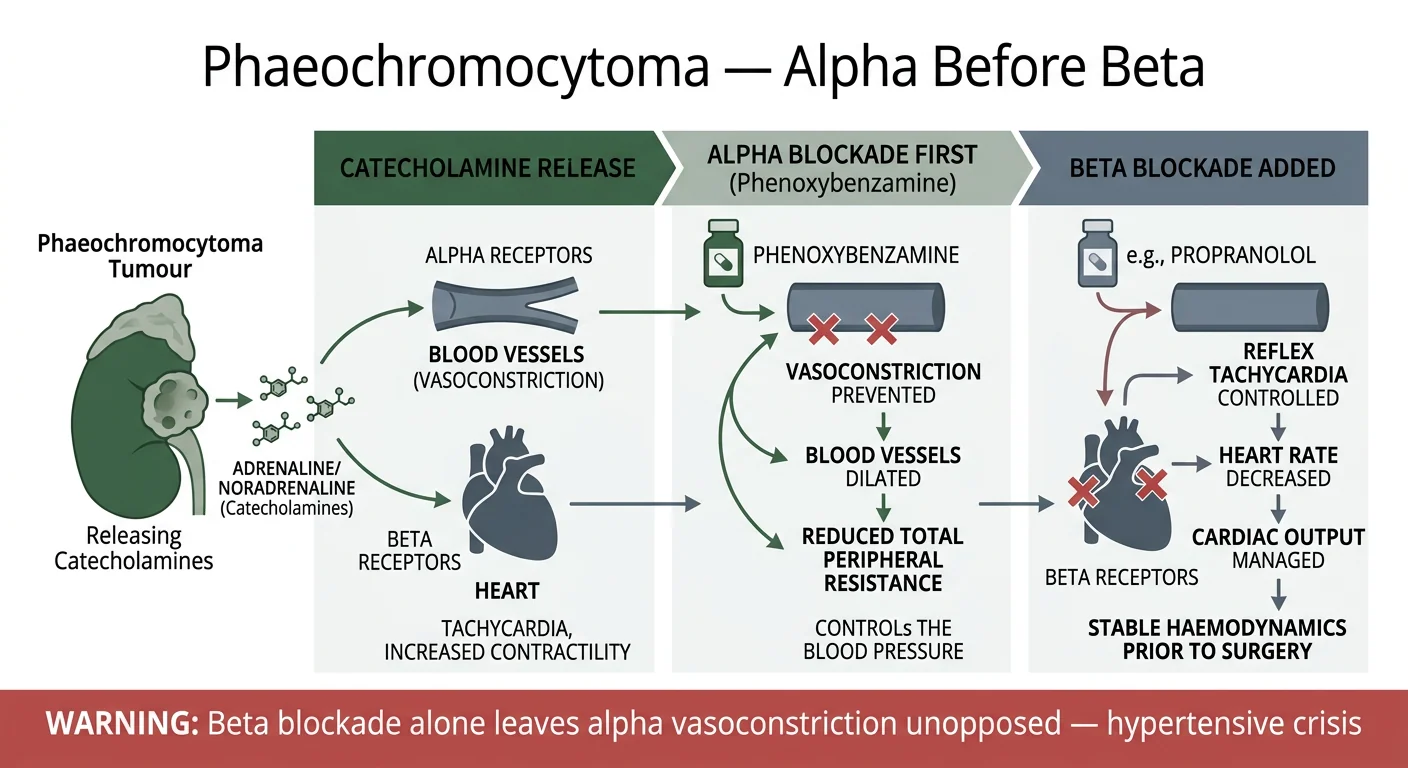
Figure 3 — The alpha-before-beta rule. Sequence diagram showing that in phaeochromocytoma the alpha blocker must be given before the beta blocker, because beta blockade alone would leave alpha-mediated vasoconstriction unopposed and precipitate a hypertensive crisis.
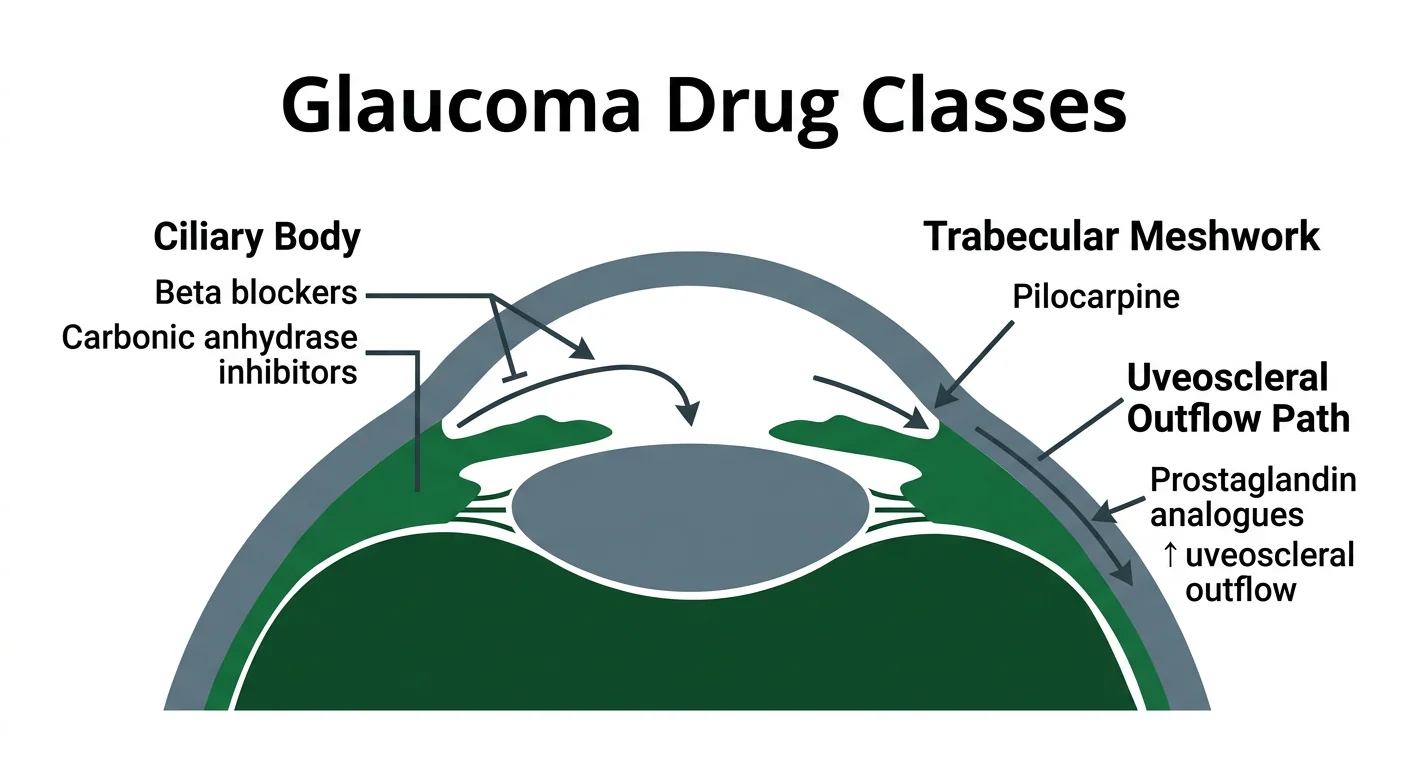
Figure 4 — Glaucoma drug classes. Diagram of the eye showing the glaucoma drug classes and their sites of action — beta blockers and carbonic anhydrase inhibitors reducing aqueous production, pilocarpine increasing trabecular outflow, and prostaglandin analogues increasing uveoscleral outflow.
Clinical Correlation
Vignette 1 — Phaeochromocytoma before surgery
A 45-year-old woman with a phaeochromocytoma is being prepared for surgery. The anaesthetist insists on starting phenoxybenzamine before adding any beta blocker.
Reasoning: This is the "alpha before beta" rule. The tumour releases large amounts of catecholamines; if a beta blocker is given first, it removes the β2-mediated vasodilation while leaving the tumour's α-mediated vasoconstriction unopposed, precipitating a hypertensive crisis. Therefore an alpha blocker (phenoxybenzamine) is given first to control the blood pressure, and only then is a beta blocker added for the reflex tachycardia. This sequence is the single most examined point in phaeochromocytoma pharmacology.
Vignette 2 — Propranolol in an asthmatic
A patient with asthma is inadvertently given propranolol for migraine prophylaxis and develops acute wheezing and breathlessness.
Reasoning: Propranolol is a non-selective beta blocker; its β2 blockade removes the bronchodilator pathway, precipitating bronchospasm in the asthmatic. The correct approach is to avoid non-selective beta blockers entirely in asthma and, if a beta blocker is truly needed (e.g. post-MI), to use a cardioselective (β1) agent such as metoprolol or bisoprolol with caution. This vignette is the clinical face of the β1-versus-β2 selectivity distinction.
Vignette 3 — Abrupt beta-blocker cessation
A patient on long-term atenolol stops it abruptly before a minor procedure and develops severe chest pain, tachycardia and a blood pressure of 190/110 mmHg.
Reasoning: Chronic beta-blockade causes up-regulation of β receptors; when the drug is withdrawn abruptly, the now-supersensitive receptors respond to circulating catecholamines, producing a rebound tachycardia, hypertension and angina — potentially precipitating myocardial infarction. Beta blockers must be tapered over 1–2 weeks, and the vignette illustrates the hazard of sudden discontinuation.
Vignette 4 — First-dose prazosin syncope
A patient started on prazosin for hypertension takes the first dose in the morning and collapses on standing, with a transient loss of consciousness.
Reasoning: This is the first-dose phenomenon of prazosin — a marked postural hypotension and syncope after the first dose of an α1 blocker, due to pronounced vasodilation before tolerance develops. It is prevented by starting with a low dose at bedtime and rising slowly. The phenomenon is specific to the α1 blockers and is a recurring examination point.
Practical Linkage
Selecting the beta blocker
| Patient | Choice | Rationale |
|---|---|---|
| Asthmatic needing post-MI protection | Metoprolol (cardioselective) | Spares β2 |
| Diabetic on insulin | Bisoprolol (cardioselective) | Less masking of hypoglycaemia |
| Stable heart failure | Carvedilol | Mortality reduction, α+β |
| Perioperative SVT | Esmolol | Ultra-short acting |
| Hypertensive crisis in pregnancy | Labetalol | α+β blockade |
Exercise (PH1.13 — select the beta blocker)
For each patient, choose the appropriate beta blocker (or alternative) and justify.
Discussion point
Why is glucagon used in severe beta-blocker overdose?
Expected: glucagon activates adenylate cyclase through its own receptor, bypassing the blocked β receptor, and restores cardiac contractility and rate.
MCQ Bank
40 questions · tagged by topic, exam pattern & difficulty · full explanations
Phenoxybenzamine differs from phentolamine in that phenoxybenzamine:
Rapid Revision
- Phenoxybenzamine — irreversible non-selective alpha blocker
- Phentolamine — short-acting competitive alpha blocker
- Prazosin — selective alpha-1, first-dose syncope
- Tamsulosin — alpha-1A selective, for BPH
- Alpha before beta — the phaeochromocytoma rule
- Cardioselective beta blockers — atenolol, metoprolol, bisoprolol, esmolol
- Non-selective beta blockers — propranolol, nadolol, timolol, sotalol
- ISA — pindolol and acebutolol, less bradycardia
- MSA — propranolol at high doses
- Alpha plus beta — labetalol and carvedilol
- Esmolol — ultra-short, esterase-metabolised
- Propranolol — lipophilic, crosses the blood-brain barrier
- Atenolol — hydrophilic, renally excreted
- Non-selective beta blocker in asthma — precipitates bronchospasm
- Beta blockers in diabetes — mask the warning signs of hypoglycaemia
- Mortality-reducing beta blockers in heart failure — carvedilol, bisoprolol, metoprolol
- Timolol — reduces aqueous production in glaucoma
- Latanoprost — increases uveoscleral outflow, first-line glaucoma drug
- Dorzolamide — carbonic anhydrase inhibitor for glaucoma
- Mannitol — osmotic, for acute angle-closure
- Beta-blocker withdrawal — rebound from receptor up-regulation
- Glucagon — the antidote for beta-blocker overdose
- Propranolol in hyperthyroidism — blocks T4 to T3 conversion
- Sotalol — non-selective beta blocker with Class III action
- Beta blockers reduce myocardial oxygen demand — by lowering heart rate and contractility
Viva Questions
- Classify the alpha blockers — Irreversible (phenoxybenzamine), competitive (phentolamine), selective alpha-1 (prazosin), alpha-1A (tamsulosin).
- What is the first-dose phenomenon — Marked postural hypotension and syncope after the first dose of prazosin.
- What is the alpha-before-beta rule — In phaeochromocytoma, give the alpha blocker before the beta blocker to avoid unopposed alpha vasoconstriction.
- Name the cardioselective beta blockers — Atenolol, metoprolol, bisoprolol and esmolol.
- What is intrinsic sympathomimetic activity — Partial agonist activity (pindolol), producing less bradycardia.
- What is membrane-stabilising activity — A quinidine-like local anaesthetic effect of propranolol at high doses.
- Why are non-selective beta blockers dangerous in asthma — They block beta-2 bronchodilation, precipitating bronchospasm.
- How do beta blockers mask hypoglycaemia — They blunt the adrenergic warning signs such as tremor and palpitations.
- Which beta blockers reduce mortality in heart failure — Carvedilol, bisoprolol and metoprolol.
- What is timolol's mechanism in glaucoma — Reduction of aqueous humour production.
- What is latanoprost's mechanism — Increase in uveoscleral outflow.
- Why is mannitol used in acute angle-closure — Its osmotic effect rapidly lowers intraocular pressure.
- What causes beta-blocker withdrawal rebound — Up-regulation of beta receptors during therapy.
- What is the antidote for beta-blocker overdose — Glucagon, which bypasses the beta receptor.
- Differentiate propranolol from atenolol — Propranolol is lipophilic and crosses the blood-brain barrier; atenolol is hydrophilic and renally excreted.
References
- Tripathi KD. Essentials of Medical Pharmacology. 9th ed. New Delhi: Jaypee Brothers Medical Publishers; Chapter 12 (Adrenergic Antagonists).
- Katzung BG, Vanderah TW (eds). Basic & Clinical Pharmacology. 16th ed. New York: McGraw Hill; Chapter 10 (Adrenoceptor Antagonist Drugs).
- Brunton LL, Knollmann BC (eds). Goodman & Gilman's The Pharmacological Basis of Therapeutics. 14th ed. New York: McGraw Hill; Chapters 12 and 13 (Adrenergic Agonists and Antagonists).
- Ritter JM, Flower RJ, Henderson G, et al. Rang & Dale's Pharmacology. 10th ed. Edinburgh: Elsevier; Chapter 14 (Noradrenergic Transmission).
- National Medical Commission. Competency Based Undergraduate Curriculum for the Indian Medical Graduate, Volume II — Pharmacology (Code: PH), competency PH1.13.
- Frishman WH. Beta-adrenergic blockers: a 50-year historical perspective. American Journal of Therapeutics. 2008;15(6):565–576.
- European Glaucoma Society. Terminology and Guidelines for Glaucoma. 4th ed. Savona: PubliComm; 2014.
- Prichard BNC, Owens CWI. Beta-adrenoceptor blocking drugs. In: Handbook of Hypertension. Amsterdam: Elsevier.
Downloads
All deliverables & printable revision sheets for CH13
Printable Chapter Handout & Study Notes
Generate a clean, high-yield PDF or print directly without sidebars and navigation menus.