
Adrenergic System, Sympathomimetics & Shock
Learning Objectives
At the end of this chapter, the Phase II MBBS student will be able to:
- Describe the adrenergic receptor subtypes α1, α2, β1, β2 and β3 with their locations, G-protein coupling and effects. (PH1.13 — Knows)
- Describe the synthesis, storage, release and termination of the catecholamines, naming the enzymes and drug targets at each step. (PH1.13 — Knows)
- Classify sympathomimetics into direct-acting, indirect-acting and mixed, with examples. (PH1.13 — Knows)
- Describe the pharmacology, uses and adverse effects of adrenaline, noradrenaline, dopamine and dobutamine. (PH1.13 — Knows)
- Explain the dose-dependent effects of dopamine and the rationale for dobutamine as an inotrope. (PH1.13 — Knows-how)
- Manage anaphylaxis with intramuscular adrenaline, stating the dose, route and repeat interval. (PH1.13 — Shows-how)
- Select the appropriate vasopressor for septic, cardiogenic, hypovolaemic and neurogenic shock. (PH1.13 — Knows-how)
- Describe the selective agonists phenylephrine and isoprenaline, and name the β2 agonists used in asthma. (PH1.13 — Knows)
- Explain why β2 stimulation causes hypokalaemia and uterine relaxation. (PH1.13 — Knows)
- Outline the adverse effects of catecholamine therapy in critical care. (PH1.13 — Knows)
Must-Know Summary
The adrenergic system is the sympathetic motor of the body, and its pharmacology is dominated by a simple receptor map: α1 constricts, α2 inhibits release, β1 stimulates the heart, β2 relaxes smooth muscle, β3 lipolysis. The catecholamines — adrenaline, noradrenaline, dopamine and dobutamine — are the clinical expression of this map, and their mastery is inseparable from the management of shock: adrenaline for anaphylaxis, noradrenaline for septic shock, dobutamine for cardiogenic shock. Adrenaline is the single most examined drug: given intramuscularly into the anterolateral thigh in anaphylaxis, it combines α1 vasoconstriction, β1 cardiac stimulation and β2 bronchodilation in one molecule.
In one line each:
- α1 — vasoconstriction, mydriasis, Gq
- α2 — presynaptic inhibition of noradrenaline release, Gi
- β1 — cardiac stimulation and renin release, Gs
- β2 — bronchodilation, vasodilation, uterine relaxation, Gs
- Tyrosine hydroxylase — the rate-limiting step of catecholamine synthesis
- Adrenaline — α1 plus β1 plus β2, the drug of choice for anaphylaxis
- Anaphylaxis — adrenaline 0.5 mg of 1:1000 intramuscularly into the anterolateral thigh
- Noradrenaline — α1 vasopressor, first-line in septic shock
- Dobutamine — β1 inotrope for cardiogenic shock
- Dopamine — dose-dependent: D1 then β1 then α1
Classification
Box 1 — Sympathomimetics
I. Direct-acting
- Catecholamines — adrenaline, noradrenaline, dopamine, dobutamine, isoprenaline
- Selective — phenylephrine (α1), clonidine (α2), salbutamol/terbutaline (β2), mirabegron (β3)
II. Indirect-acting — amphetamine, tyramine
III. Mixed-acting — ephedrine, dopamine
Box 2 — Adrenergic receptors
- α1 — vascular smooth muscle, radial muscle of iris, bladder sphincter — Gq — vasoconstriction, mydriasis
- α2 — presynaptic, CNS — Gi — inhibits noradrenaline release
- β1 — heart, juxtaglomerular cells — Gs — cardiac stimulation, renin release
- β2 — bronchi, vessels, uterus, liver, muscle — Gs — bronchodilation, vasodilation, uterine relaxation
- β3 — adipose, bladder — Gs — lipolysis
Core Concepts
1. Adrenergic neurotransmission and receptor subtypes
The sympathetic postganglionic fibres (CH09) release noradrenaline, which acts on adrenergic receptors — the G-protein coupled receptors divided into alpha and beta families:
- α1 — on vascular smooth muscle (vasoconstriction), the radial muscle of the iris (mydriasis), the bladder sphincter and prostate (contraction), and the vas deferens. Coupling Gq → IP3/DAG → ↑Ca²⁺.
- α2 — presynaptic autoreceptors on the nerve terminal and central sites; coupling Gi → inhibits noradrenaline release and produces central sympatholysis (the basis of clonidine, CH13).
- β1 — the heart (increased rate, contractility and conduction) and juxtaglomerular cells (renin release); coupling Gs → ↑cAMP.
- β2 — bronchial, vascular and uterine smooth muscle (bronchodilation, vasodilation, uterine relaxation), the liver (glycogenolysis), and skeletal muscle (tremor, and K⁺ uptake into cells producing hypokalaemia); coupling Gs.
- β3 — adipose tissue (lipolysis) and the bladder (relaxation).
The physiological consequences are the "fight-or-flight" response: α1-mediated vasoconstriction raises blood pressure and shunts blood from skin and splanchnic beds, β1 raises cardiac output, and β2 dilates bronchi and skeletal-muscle vessels while mobilising glucose.
2. Catecholamine synthesis, storage, release and reuptake
The catecholamines are synthesised from tyrosine:
- Tyrosine → DOPA by tyrosine hydroxylase — the rate-limiting step, inhibited by metyrosine (alpha-methyltyrosine).
- DOPA → dopamine by DOPA decarboxylase.
- Dopamine → noradrenaline by dopamine β-hydroxylase (inside the vesicle).
- Noradrenaline → adrenaline by phenylethanolamine-N-methyltransferase (PNMT), in the adrenal medulla.
Noradrenaline is stored in vesicles by the vesicular monoamine transporter (VMAT); reserpine blocks VMAT and depletes the stores (once used as an antihypertensive). Release is calcium-dependent exocytosis. The action is terminated chiefly by neuronal reuptake through the noradrenaline transporter (NET) — blocked by cocaine and the tricyclic antidepressants, which thereby potentiate noradrenaline — and by metabolism through monoamine oxidase (MAO) and catechol-O-methyltransferase (COMT). Tyramine (CH06) enters the nerve terminal via NET and displaces stored noradrenaline — the mechanism of the MAOI-cheese reaction. Guanethidine and bretylium displace and deplete noradrenaline from sympathetic nerve endings.
3. Classification of sympathomimetics
Sympathomimetics (adrenergic agonists) are classified by their mode of action:
- Direct-acting — stimulate the receptor directly: adrenaline, noradrenaline, dopamine, dobutamine, isoprenaline, and the selective agonists (phenylephrine α1; salbutamol, terbutaline β2).
- Indirect-acting — release or potentiate endogenous noradrenaline: amphetamine, tyramine, ephedrine (also direct).
- Mixed-acting — both direct and indirect: ephedrine, and dopamine (which also releases noradrenaline).
Chemically they divide into catecholamines (adrenaline, noradrenaline, dopamine, dobutamine, isoprenaline — inactive orally, short-acting, do not cross the BBB) and non-catecholamines (ephedrine, amphetamine, phenylephrine, salbutamol — orally active, longer-acting, some cross the BBB).
4. Adrenaline, noradrenaline, dopamine and dobutamine
Adrenaline (epinephrine) — an α1 + β1 + β2 agonist. It raises blood pressure (α1 vasoconstriction) while β1 increases cardiac output and β2 bronchodilates. It is the drug of choice for anaphylaxis (given IM — see Section 6), used in cardiac arrest, and added to local anaesthetics (α1 vasoconstriction prolongs the block and reduces bleeding). Adverse effects are the predictable ones: tachycardia, arrhythmias, hypertension, tremor, anxiety and hyperglycaemia.
Noradrenaline (norepinephrine) — α1 > α2 > β1, with little β2 activity. It is a pure vasopressor, raising blood pressure by intense vasoconstriction with a reflex bradycardia (vagal). It is the first-line agent in septic shock (and neurogenic shock), where the problem is vasodilation. It is not used for bronchospasm or anaphylaxis (no β2).
Dopamine — acts on D1, β1 and α1 receptors in a dose-dependent cascade: at low doses D1 stimulation dilates renal, mesenteric and coronary vessels; at moderate doses β1 stimulation increases cardiac output; at high doses α1 stimulation causes vasoconstriction. It also releases noradrenaline. Historically used for cardiogenic shock, the "renal-dose dopamine" concept has been largely abandoned in modern critical care, but the receptor cascade remains a standard examination item.
Dobutamine — a β1 (with some β2) agonist with little α effect, given as a continuous infusion. It is the inotrope of choice for cardiogenic shock and acute decompensated heart failure, increasing cardiac contractility without significant vasoconstriction; it can cause tachycardia and arrhythmias.
Isoprenaline (isoproterenol) — a pure β1 + β2 agonist. It stimulates the heart but β2 vasodilation causes hypotension, so it is not used in shock; its remaining use is complete heart block (temporary pacing is preferred). It illustrates why a pure β-agonist is a poor pressor.
5. Selective alpha and beta agonists
- Phenylephrine — a selective α1 agonist used as a nasal decongestant (vasoconstriction) and for hypotension (e.g. spinal-anaesthesia hypotension); also a mydriatic (without cycloplegia).
- Clonidine and alpha-methyldopa — central α2 agonists that reduce sympathetic outflow; their antihypertensive use is developed in CH13 and CH26.
- Salbutamol, terbutaline, salmeterol, formoterol — selective β2 agonists for asthma (bronchodilation) and preterm labour (uterine relaxation) — developed in CH33.
- Mirabegron — a β3 agonist for overactive bladder (named for completeness).
6. Pharmacotherapy of shock and anaphylaxis
Shock is classified by cause, and the vasopressor choice follows the pathophysiology:
- Anaphylactic shock — adrenaline IM: 0.5 mg of 1:1000 into the anterolateral thigh, repeated every 5 minutes as needed. The intramuscular route into a large, well-perfused muscle gives rapid, reliable absorption; the subcutaneous route is unreliable (peripheral vasoconstriction), and IV adrenaline is reserved for monitored peri-arrest. Adjuncts (antihistamines, hydrocortisone, fluids, oxygen) are second-line.
- Septic shock — noradrenaline is first-line (α1 vasoconstriction restores perfusion pressure), with vasopressin as an adjunct; the goal is a target mean arterial pressure.
- Cardiogenic shock — dobutamine (β1 inotrope) improves contractility, often with noradrenaline to support the blood pressure.
- Hypovolaemic shock — fluids first, not vasopressors; vasopressors are only a temporising adjunct.
- Neurogenic shock — noradrenaline or phenylephrine (α1) to counter the loss of sympathetic vasomotor tone.
The principle throughout is to match the receptor profile to the defect: a vasodilated, hypotensive patient needs α1 (noradrenaline); a failing pump needs β1 (dobutamine); anaphylaxis — where vasodilation, bronchospasm and hypotension coincide — needs the combined α1 + β1 + β2 of adrenaline.
Tables
Table 1 — Adrenergic receptor subtypes
| Receptor | Location | G-protein | Effect |
|---|---|---|---|
| α1 | Vascular smooth muscle, iris, bladder sphincter | Gq | Vasoconstriction, mydriasis |
| α2 | Presynaptic, CNS | Gi | Inhibits NA release |
| β1 | Heart, JG cells | Gs | Cardiac stimulation, renin |
| β2 | Bronchi, vessels, uterus, liver | Gs | Bronchodilation, vasodilation, uterine relaxation |
| β3 | Adipose, bladder | Gs | Lipolysis |
Table 2 — Catecholamine pathway and drug targets
| Step | Enzyme/transporter | Drug acting there |
|---|---|---|
| Synthesis (rate-limiting) | Tyrosine hydroxylase | Metyrosine inhibits |
| Storage | VMAT | Reserpine depletes |
| Release | Ca²⁺-dependent exocytosis | — |
| Reuptake | NET | Cocaine, TCAs block |
| Metabolism | MAO, COMT | MAOIs, entacapone |
Table 3 — Direct, indirect and mixed sympathomimetics
| Type | Mechanism | Examples |
|---|---|---|
| Direct | Receptor agonist | Adrenaline, noradrenaline, phenylephrine |
| Indirect | Release/potentiate NA | Amphetamine, tyramine |
| Mixed | Both | Ephedrine, dopamine |
Table 4 — The clinical catecholamines compared
| Drug | Receptors | Principal effect | Main use |
|---|---|---|---|
| Adrenaline | α1, β1, β2 | Vasoconstriction + cardiac + bronchodilation | Anaphylaxis, cardiac arrest |
| Noradrenaline | α1 > β1 | Vasoconstriction | Septic shock |
| Dopamine | D1/β1/α1 (dose) | Dose-dependent | Cardiogenic (historical) |
| Dobutamine | β1 | Inotropy | Cardiogenic shock |
| Isoprenaline | β1, β2 | Cardiac + vasodilation | Heart block (historical) |
Table 5 — Dopamine dose-dependent effects
| Dose | Receptor | Effect |
|---|---|---|
| Low | D1 | Renal/mesenteric vasodilation |
| Moderate | β1 | Increased cardiac output |
| High | α1 | Vasoconstriction |
Table 6 — Vasopressor selection by shock type
| Shock type | First-line | Rationale |
|---|---|---|
| Anaphylactic | Adrenaline IM | α1 + β1 + β2 |
| Septic | Noradrenaline | α1 vasoconstriction |
| Cardiogenic | Dobutamine | β1 inotropy |
| Hypovolaemic | Fluids first | Restore volume |
| Neurogenic | Noradrenaline/phenylephrine | α1 vasoconstriction |
Table 7 — Anaphylaxis management
| Step | Action |
|---|---|
| 1 | Adrenaline 0.5 mg (1:1000) IM anterolateral thigh |
| 2 | Repeat every 5 minutes as needed |
| 3 | Oxygen, supine with legs raised |
| 4 | IV fluids |
| 5 | Adjuncts: antihistamine, hydrocortisone |
Figures
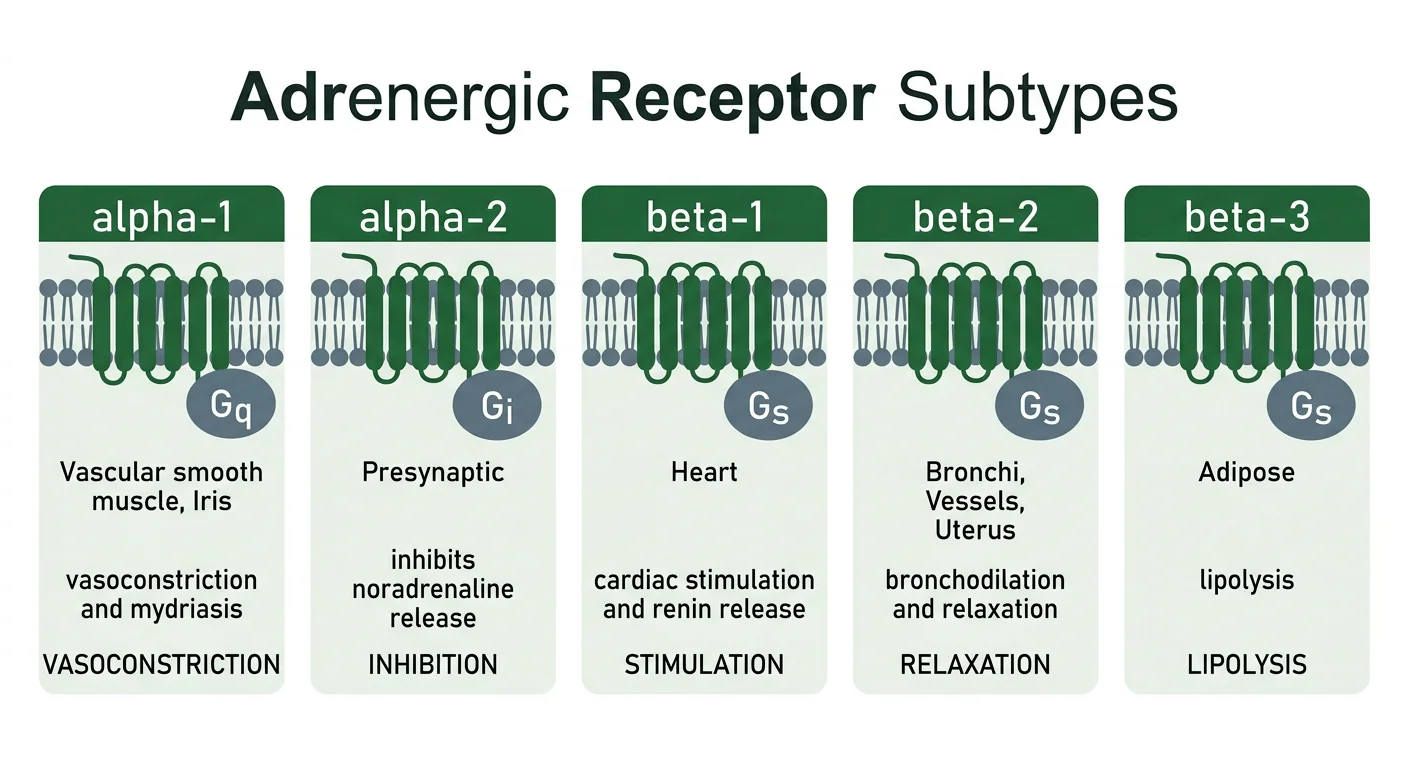
Figure 1 — Adrenergic receptor subtypes and their effects. Diagram of the five adrenergic receptor subtypes alpha-1, alpha-2, beta-1, beta-2 and beta-3 with their locations, G-protein coupling and principal effects such as vasoconstriction, cardiac stimulation and bronchodilation.
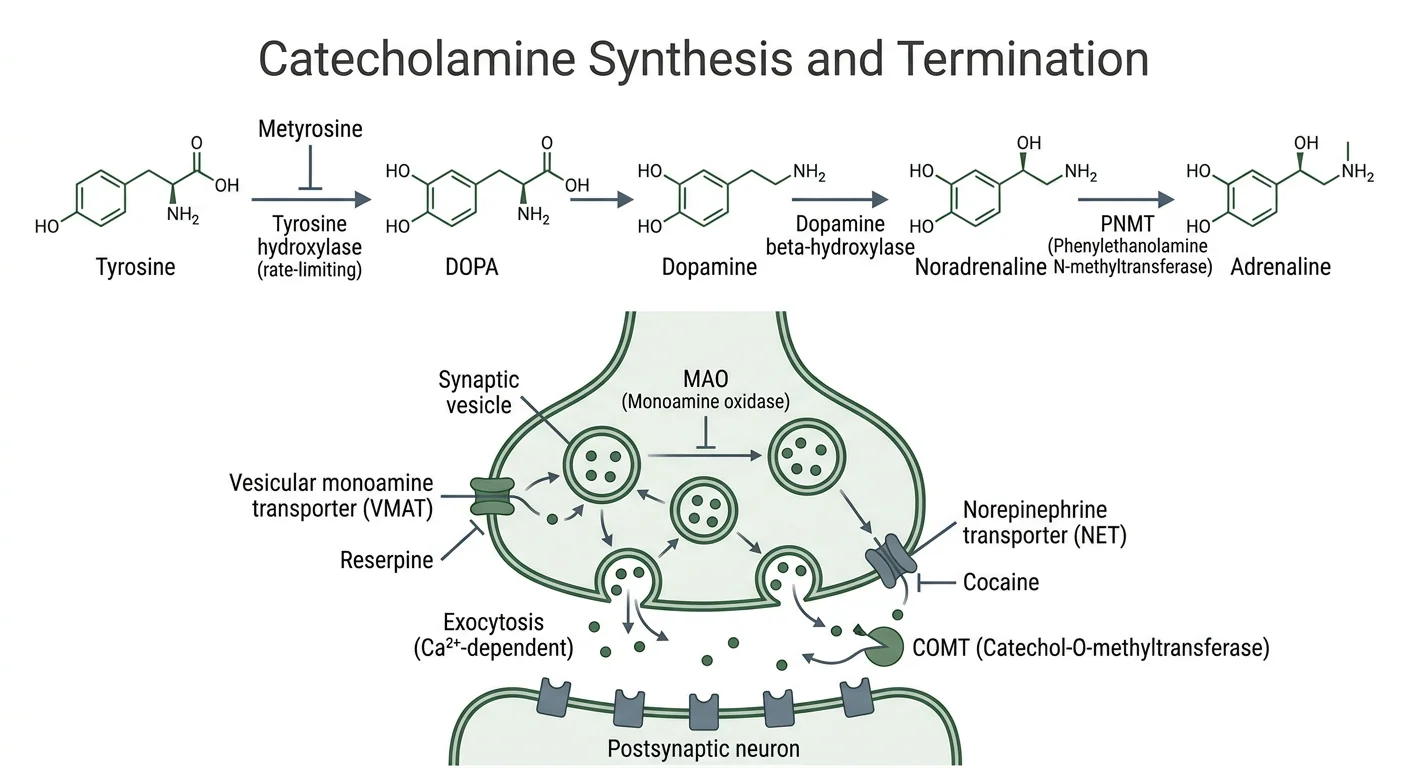
Figure 2 — Catecholamine synthesis, storage, release and termination. Diagram of catecholamine biosynthesis from tyrosine through DOPA, dopamine, noradrenaline and adrenaline, and the storage, release, reuptake and metabolism steps with their enzyme and drug targets including tyrosine hydroxylase, reserpine and cocaine.
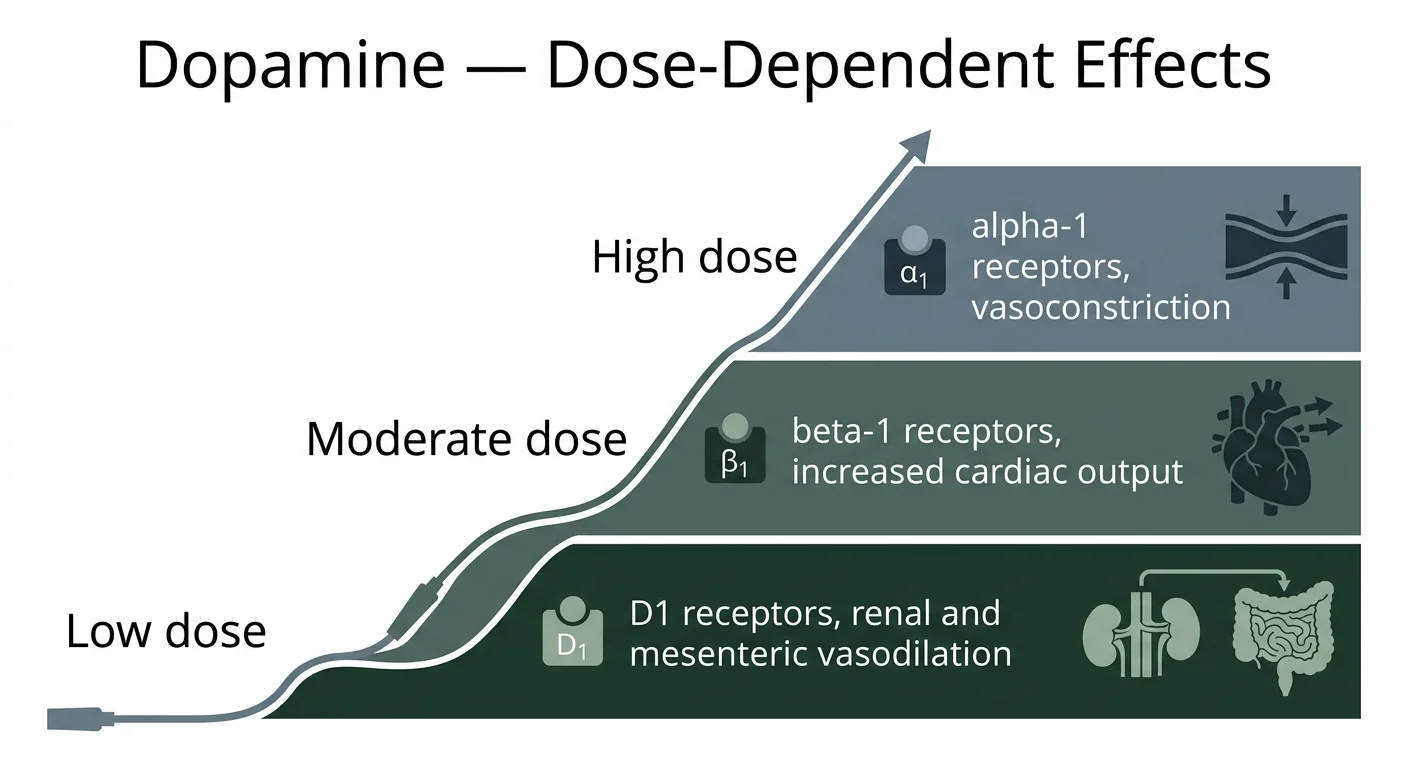
Figure 3 — Dopamine's dose-dependent effects. Diagram showing the dose-dependent effects of dopamine — low dose stimulating D1 receptors for renal vasodilation, moderate dose stimulating beta-1 for inotropy, and high dose stimulating alpha-1 for vasoconstriction.
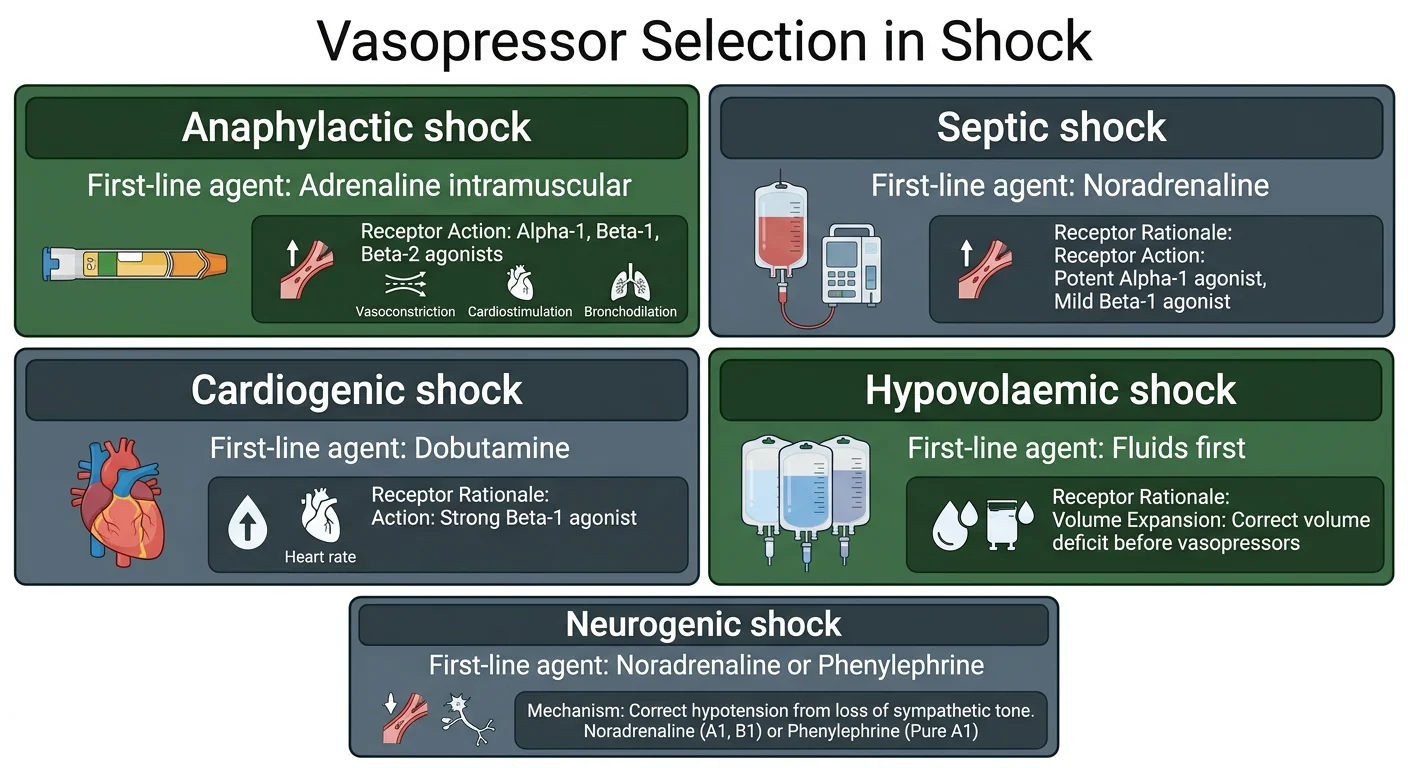
Figure 4 — Vasopressor selection in shock. Diagram of vasopressor selection by shock type, showing adrenaline for anaphylaxis, noradrenaline for septic and neurogenic shock, dobutamine for cardiogenic shock, and fluids first for hypovolaemic shock.
Clinical Correlation
Vignette 1 — Anaphylaxis after an antibiotic
Minutes after an intravenous cephalosporin, a patient develops urticaria, stridor, wheeze and a blood pressure of 70/40 mmHg. The nurse asks whether to give adrenaline subcutaneously.
Reasoning: The answer is adrenaline 0.5 mg (0.5 mL of 1:1000) intramuscularly into the anterolateral thigh, repeated every 5 minutes until improvement. Adrenaline is the drug of choice because it addresses all three components of anaphylaxis simultaneously — α1 vasoconstriction reverses the hypotension, β1 supports the heart, and β2 relieves bronchospasm and inhibits further mediator release. The subcutaneous route is wrong because anaphylactic shock causes peripheral vasoconstriction, making SC absorption slow and unreliable; IV adrenaline is reserved for monitored peri-arrest. This is the single most examined clinical point in the adrenergic block.
Vignette 2 — Septic shock
A patient with urosepsis has a blood pressure of 78/45 mmHg despite adequate fluid resuscitation, with warm peripheries and a low systemic vascular resistance.
Reasoning: This is septic (distributive) shock — the primary defect is vasodilation, so the first-line vasopressor is noradrenaline, whose dominant α1 agonism restores vascular tone and perfusion pressure (with some β1 support); vasopressin is added as an adjunct if needed. Dobutamine would worsen the situation by causing further vasodilation through β2, and dopamine is no longer first-line. The vignette teaches the core principle: match the receptor profile to the haemodynamic defect.
Vignette 3 — Cardiogenic shock after myocardial infarction
After a large anterior myocardial infarction, a patient has a low cardiac output, cool peripheries and pulmonary oedema, but a blood pressure that is only mildly reduced.
Reasoning: The defect is a failing pump, not vasodilation, so the agent of choice is dobutamine — a β1 inotrope that raises cardiac contractility and output without significant vasoconstriction (it has little α effect). It may be combined with noradrenaline if the blood pressure also needs support. The contrast with the previous vignette — vasodilated septic shock needs α1 (noradrenaline), pump failure needs β1 (dobutamine) — is the clinical expression of the receptor map.
Vignette 4 — A dopamine infusion at increasing doses
A patient on an escalating dopamine infusion is noted first to have an improved urine output, then a rising cardiac output, and finally cold extremities with hypertension at high doses.
Reasoning: This is dopamine's dose-dependent receptor cascade in action: at low doses D1 stimulation dilates the renal and mesenteric vessels (improved urine output); at moderate doses β1 stimulation raises cardiac output; at high doses α1 stimulation causes vasoconstriction (cold extremities, hypertension). While "renal-dose dopamine" has been largely abandoned in modern practice, the cascade is the standard examination model, and the vignette illustrates how a single drug's effect changes qualitatively with dose.
Practical Linkage
Vasopressor selection
| Scenario | Agent | Receptor rationale |
|---|---|---|
| Anaphylaxis with stridor and hypotension | Adrenaline IM | α1 + β1 + β2 |
| Septic shock after fluids | Noradrenaline | α1 vasoconstriction |
| Cardiogenic shock after MI | Dobutamine | β1 inotropy |
| Haemorrhagic shock | Fluids first | Restore volume |
| Spinal-anaesthesia hypotension | Phenylephrine | α1 vasoconstriction |
Exercise (PH1.13 — select the vasopressor)
For each scenario, name the first-line agent and its receptor rationale.
The anaphylaxis protocol
Write the anaphylaxis protocol stepwise.
Expected: adrenaline 0.5 mg 1:1000 IM anterolateral thigh, repeat every 5 minutes; oxygen; supine with legs raised; IV fluids; adjuncts — antihistamine and hydrocortisone.
MCQ Bank
40 questions · tagged by topic, exam pattern & difficulty · full explanations
Vasoconstriction and mydriasis are mediated by which adrenergic receptor subtype?
Rapid Revision
- α1 — vasoconstriction and mydriasis, Gq
- α2 — presynaptic inhibition of noradrenaline release, Gi
- β1 — heart and renin release, Gs
- β2 — bronchodilation, vasodilation, uterine relaxation, Gs
- β3 — lipolysis in adipose tissue
- Tyrosine hydroxylase — the rate-limiting step of catecholamine synthesis
- Adrenaline is formed from noradrenaline — by PNMT in the adrenal medulla
- Reserpine — depletes vesicular noradrenaline
- Cocaine and tricyclics — block noradrenaline reuptake
- MAO and COMT — metabolise the catecholamines
- Adrenaline — α1 plus β1 plus β2, the drug of choice for anaphylaxis
- Anaphylaxis dose — 0.5 mg of 1:1000 intramuscularly into the anterolateral thigh
- Noradrenaline — α1 vasopressor, first-line in septic shock
- Noradrenaline — causes reflex bradycardia
- Dobutamine — β1 inotrope for cardiogenic shock
- Isoprenaline — pure β1 plus β2, causes hypotension, not for shock
- Dopamine — dose-dependent, D1 then β1 then α1
- Renal-dose dopamine — low-dose D1 vasodilation, now abandoned
- Phenylephrine — selective α1, nasal decongestant
- Salbutamol — selective β2 for asthma
- β2 hypokalaemia — potassium shift into cells
- β2 uterine relaxation and tremor — the non-selective adverse effects
- Septic shock — warm vasodilated, needs noradrenaline
- Hypovolaemic shock — fluids first, not vasopressors
- Adrenaline in local anaesthetics — prolongs the block by vasoconstriction
- Metyrosine — inhibits tyrosine hydroxylase
- Ephedrine — mixed-acting sympathomimetic
Viva Questions
- Name the five adrenergic receptors — α1, α2, β1, β2 and β3.
- What does α1 stimulation do — Vasoconstriction and mydriasis, via Gq.
- What is the role of α2 receptors — Presynaptic inhibition of noradrenaline release.
- Where are β1 receptors — The heart and juxtaglomerular cells.
- What does β2 stimulation cause — Bronchodilation, vasodilation, uterine relaxation and hypokalaemia.
- What is the rate-limiting enzyme of catecholamine synthesis — Tyrosine hydroxylase.
- Which enzyme makes adrenaline — PNMT, in the adrenal medulla.
- What is the drug of choice for anaphylaxis — Adrenaline, 0.5 mg of 1:1000 intramuscularly into the anterolateral thigh.
- Why is adrenaline given IM rather than SC in anaphylaxis — Peripheral vasoconstriction makes subcutaneous absorption slow and unreliable.
- What is the first-line vasopressor in septic shock — Noradrenaline, for its α1 vasoconstriction.
- Why does noradrenaline cause bradycardia — A vagal baroreceptor reflex to the raised blood pressure.
- What is dobutamine used for — Cardiogenic shock, as a β1 inotrope.
- Describe dopamine's dose-dependent effects — Low dose D1 vasodilation, moderate β1 inotropy, high dose α1 vasoconstriction.
- Why is isoprenaline not used in shock — Its β2 vasodilation causes hypotension.
- What are the adverse effects of salbutamol — Tremor, tachycardia and hypokalaemia from β2 stimulation.
References
- Tripathi KD. Essentials of Medical Pharmacology. 9th ed. New Delhi: Jaypee Brothers Medical Publishers; Chapter 11 (Adrenergic System and Drugs).
- Katzung BG, Vanderah TW (eds). Basic & Clinical Pharmacology. 16th ed. New York: McGraw Hill; Chapters 9 and 10 (Adrenoceptor Agonists and Antagonists).
- Brunton LL, Knollmann BC (eds). Goodman & Gilman's The Pharmacological Basis of Therapeutics. 14th ed. New York: McGraw Hill; Chapter 12 (Adrenergic Agonists and Antagonists).
- Ritter JM, Flower RJ, Henderson G, et al. Rang & Dale's Pharmacology. 10th ed. Edinburgh: Elsevier; Chapter 14 (Noradrenergic Transmission).
- National Medical Commission. Competency Based Undergraduate Curriculum for the Indian Medical Graduate, Volume II — Pharmacology (Code: PH), competency PH1.13.
- Rhodes A, Evans LE, Alhazzani W, et al. Surviving Sepsis Campaign: International Guidelines for Management of Sepsis and Septic Shock. Critical Care Medicine. 2017;45(3):486–552.
- Simons FER, Ebisawa M, Sanchez-Borges M, et al. 2015 update of the evidence base: World Allergy Organization anaphylaxis guidelines. World Allergy Organization Journal. 2015;8(1):32.
- De Backer D, Biston P, Devriendt J, et al. Comparison of dopamine and norepinephrine in the treatment of shock. New England Journal of Medicine. 2010;362(9):779–789.
Downloads
All deliverables & printable revision sheets for CH12
Printable Chapter Handout & Study Notes
Generate a clean, high-yield PDF or print directly without sidebars and navigation menus.