
Antimuscarinics & Skeletal Muscle Relaxants
Learning Objectives
At the end of this chapter, the Phase II MBBS student will be able to:
- Describe the mechanism of action and organ effects of antimuscarinic drugs as the inverse of muscarinic stimulation. (PH1.14 — Knows)
- Describe the pharmacology, uses and toxidrome of atropine, and manage belladonna poisoning with physostigmine. (PH1.14 — Knows-how)
- Differentiate atropine, hyoscine, ipratropium, glycopyrrolate, pirenzepine and oxybutynin by selectivity, blood-brain-barrier penetration and use. (PH1.14 — Knows)
- Classify skeletal muscle relaxants into depolarising, non-depolarising, central and direct-acting groups. (PH1.15 — Knows)
- Compare depolarising and non-depolarising neuromuscular blockade with their reversal characteristics. (PH1.15 — Knows)
- Describe the complications of succinylcholine and their mechanisms. (PH1.15 — Knows)
- Explain the reversal of neuromuscular blockade with neostigmine versus sugammadex. (PH1.15 — Knows-how)
- Describe the centrally-acting muscle relaxants (baclofen, tizanidine, diazepam) and dantrolene, including its role in malignant hyperthermia. (PH1.15 — Knows)
- Select an appropriate muscle relaxant for a patient with hepatic or renal failure. (PH1.15 — Shows-how)
- Explain why glycopyrrolate is preferred over atropine in some settings. (PH1.14 — Knows)
Must-Know Summary
Antimuscarinics are the antagonists to the cholinergic agonists of CH10, and their organ effects are simply the inverse of the muscarinic map — tachycardia, dry mouth, mydriasis, bronchodilation, urinary retention. Atropine is the prototype, and its toxidrome ("hot as a hare, blind as a bat, dry as a bone, red as a beet, mad as a hatter") is reversed by physostigmine. The skeletal muscle relaxants divide into the neuromuscular blockers — depolarising succinylcholine versus the non-depolarising tubocurarine family — and the centrally-acting spasmolytics plus dantrolene, which acts directly on the ryanodine receptor and is the specific treatment of malignant hyperthermia.
In one line each:
- Atropine — competitive muscarinic antagonist, tertiary amine, crosses the blood-brain barrier
- Atropine effects — tachycardia, dry mouth, mydriasis, bronchodilation, urinary retention
- Atropine toxidrome — hot, blind, dry, red and mad, reversed by physostigmine
- Hyoscine — sedative antimuscarinic, used for motion sickness
- Ipratropium and tiotropium — quaternary, inhaled bronchodilators
- Succinylcholine — depolarising blocker, metabolised by plasma cholinesterase
- Succinylcholine apnoea — pseudocholinesterase deficiency
- Succinylcholine hyperkalaemia — avoid in burns, trauma and denervation
- Non-depolarising block — reversed by neostigmine; depolarising block is potentiated
- Sugammadex — a cyclodextrin that encapsulates rocuronium and vecuronium
- Atracurium — Hofmann elimination, safe in hepatic and renal failure
- Dantrolene — acts on the ryanodine receptor, treats malignant hyperthermia
Classification
Box 1 — Antimuscarinic drugs
- Natural alkaloids (tertiary) — atropine (CNS stimulant), hyoscine/scopolamine (CNS depressant)
- Quaternary (peripheral only) — ipratropium, tiotropium (inhaled bronchodilators); glycopyrrolate (antisecretory)
- M1-selective — pirenzepine, telenzepine
- Bladder M3-selective — oxybutynin, tolterodine, solifenacin, darifenacin
- Short-acting ocular — tropicamide, cyclopentolate
Box 2 — Skeletal muscle relaxants
- Peripheral (neuromuscular blockers)
- Depolarising — succinylcholine, decamethonium
- Non-depolarising (competitive) — tubocurarine, pancuronium, vecuronium, atracurium, cisatracurium, mivacurium, rocuronium
- Central (spasmolytics) — baclofen, tizanidine, diazepam
- Direct-acting — dantrolene (ryanodine receptor), botulinum toxin (blocks ACh release)
Core Concepts
1. Antimuscarinic drugs — pharmacology and classification
Antimuscarinic (anticholinergic, parasympatholytic) drugs competitively block the actions of acetylcholine at muscarinic receptors; they do not block nicotinic receptors (that requires ganglion or neuromuscular blockers). Their organ effects are therefore the exact inverse of the muscarinic map developed in CH09:
- Heart (M2) — blockade removes vagal tone → tachycardia.
- Eye (M3) — relaxation of the sphincter pupillae and ciliary muscle → mydriasis and cycloplegia (blurred near vision).
- Glands (M3) — dry mouth, dry skin, dry bronchi (reduced secretions).
- Bronchi (M3) — bronchodilation.
- Gut and bladder (M3) — reduced motility, constipation and urinary retention.
- CNS — depends on the drug: the tertiary amines (atropine, hyoscine) cross the blood-brain barrier; atropine stimulates, hyoscine depresses.
Antimuscarinics are classified by source and selectivity: natural alkaloids (atropine, hyoscine), quaternary derivatives (ipratropium, tiotropium, glycopyrrolate — which do not enter the CNS), selective agents (pirenzepine — M1; oxybutynin/tolterodine — bladder M3), and short-acting ocular agents (tropicamide, cyclopentolate).
2. Atropine — pharmacology, uses and the toxidrome
Atropine (from Atropa belladonna, with hyoscine from Datura stramonium) is a tertiary amine and therefore crosses the blood-brain barrier. It is a non-selective competitive muscarinic antagonist, well absorbed orally and acting for about 4–6 hours (mydriasis longer).
Uses. Atropine is used as preanaesthetic medication (to dry secretions and prevent vagal bradycardia during intubation), for bradycardia and heart block (to raise the heart rate), in organophosphate poisoning (CH10), as an antispasmodic (gut and biliary colic, historically), and as eye drops for mydriasis and cycloplegia (though tropicamide is preferred for its shorter action). It was formerly used in peptic ulcer disease (superseded by the M1-selective pirenzepine, then by H2 blockers/PPIs).
Adverse effects and the toxidrome. In excess, atropine produces the antimuscarinic toxidrome classically described as "hot as a hare, blind as a bat, dry as a bone, red as a beet, mad as a hatter" — hyperthermia (blocked sweating), mydriasis, dry mouth, flushed skin, and central excitation with delirium — together with tachycardia and urinary retention. Belladonna (Datura) poisoning presents this full picture. Management is supportive, with physostigmine (the tertiary anticholinesterase that crosses the blood-brain barrier — CH10) as the specific antidote for both central and peripheral effects, given cautiously for severe delirium or hyperthermia.
3. Atropine substitutes and selective agents
- Hyoscine (scopolamine) — a tertiary amine like atropine, but a CNS depressant; more potent antisecretory action. Used for motion sickness (as a transdermal patch) and to produce sedation and amnesia in premedication. Its central depression (not excitation) distinguishes it from atropine.
- Ipratropium and tiotropium — quaternary amines given by inhalation for bronchodilation in asthma and COPD; being quaternary they do not enter the CNS and have minimal systemic effects. Tiotropium is long-acting (once daily).
- Glycopyrrolate — a quaternary antimuscarinic, peripheral only; a potent antisecretory agent used in premedication and — because it does not cross the placenta or the BBB, and causes less tachycardia — preferred over atropine when co-administered with neostigmine for reversing neuromuscular block.
- Pirenzepine and telenzepine — M1-selective; formerly for peptic ulcer (reduce gastric acid without the other antimuscarinic effects).
- Oxybutynin, tolterodine, solifenacin, darifenacin — M3 (bladder)-selective agents for overactive bladder and urge incontinence.
- Tropicamide and cyclopentolate — short-acting ocular antimuscarinics for diagnostic mydriasis and cycloplegia; tropicamide acts for hours (preferred), cyclopentolate for a day.
4. Neuromuscular blockers — depolarising and non-depolarising
Neuromuscular blockers produce skeletal-muscle paralysis by acting at the nicotinic Nm receptor of the neuromuscular junction. They are of two types.
Non-depolarising (competitive) blockers — tubocurarine, pancuronium, vecuronium, atracurium, cisatracurium, mivacurium, rocuronium — occupy the receptor without activating it, preventing acetylcholine from binding and producing flaccid paralysis without fasciculations. Their block is surmountable: raising junctional acetylcholine (with neostigmine) reverses it. They differ in histamine release (tubocurarine and atracurium cause hypotension), vagal blockade (pancuronium causes tachycardia), and elimination (see below).
Depolarising blockers — succinylcholine (suxamethonium) and decamethonium — are agonists at the Nm receptor. They first depolarise the muscle, causing transient fasciculations, then produce a persistent depolarisation that leaves the membrane refractory — a depolarisation block. The block is not reversed by anticholinesterases (which raise acetylcholine and potentiate it); recovery depends on metabolism of the drug.
Elimination. Succinylcholine and mivacurium are hydrolysed by plasma (pseudo)cholinesterase; atracurium and cisatracurium undergo Hofmann elimination (spontaneous, pH- and temperature-dependent, independent of liver and kidney) and are therefore safe in hepatic and renal failure; the others (vecuronium, rocuronium, pancuronium) depend on hepatic and renal clearance.
5. Succinylcholine and its complications
Succinylcholine's ultra-rapid onset (30–60 seconds) and short duration (3–5 minutes) make it the agent of choice for rapid-sequence intubation, but its pharmacology produces a characteristic list of complications:
- Prolonged apnoea — in pseudocholinesterase deficiency (CH07), the drug is not hydrolysed, and paralysis persists for hours, requiring ventilation and family screening.
- Hyperkalaemia — depolarisation releases potassium; in patients with burns, major trauma, denervation, or prolonged immobilisation, the muscle has upregulated extrajunctional receptors, and succinylcholine causes a dangerous, sometimes fatal potassium surge — a contraindication.
- Malignant hyperthermia — in susceptible patients (ryanodine-receptor mutations, CH07), succinylcholine (especially with halothane) triggers a hypermetabolic crisis; treated with dantrolene.
- Bradycardia — from direct muscarinic stimulation, especially in children or on a repeat dose (prevented by atropine).
- Raised intraocular, intragastric and intracranial pressure — contraindicated in penetrating eye injury and raised ICP.
- Postoperative muscle pain — from the fasciculations; reduced by pre-treatment with a small dose of a non-depolarising blocker.
- Masseter spasm and myotonia — avoid in myotonic disorders.
6. Reversal agents and the Hofmann agents
Neostigmine (with atropine or glycopyrrolate to block the muscarinic effects — CH10) reverses non-depolarising block by inhibiting acetylcholinesterase and raising junctional acetylcholine; it is ineffective (indeed harmful) in depolarising block.
Sugammadex is a modified gamma-cyclodextrin that encapsulates and inactivates the steroidal relaxants rocuronium and vecuronium, reversing even deep block rapidly and predictably without anticholinesterase or antimuscarinic drugs. It does not reverse succinylcholine, atracurium or cisatracurium (which are not steroidal). The neostigmine versus sugammadex contrast — mechanism, speed, depth of block reversed, and side-effects (sugammadex avoids the muscarinic effects) — is a current examination favourite.
Atracurium and cisatracurium deserve note for their Hofmann elimination — spontaneous non-enzymatic breakdown that makes them the relaxants of choice in hepatic and renal failure; atracurium (but much less cisatracurium) releases histamine, causing hypotension and bronchospasm.
7. Centrally acting muscle relaxants and dantrolene
Spasmolytics reduce pathological muscle spasm without producing paralysis, acting in the CNS:
- Baclofen — a GABA-B agonist that inhibits spinal reflexes; the mainstay for spasticity in spinal cord injury and multiple sclerosis (oral or intrathecal).
- Tizanidine — a central alpha-2 adrenergic agonist reducing spinal excitability; for spasticity.
- Diazepam — a benzodiazepine (GABA-A) used for acute muscle spasm and spasticity.
Dantrolene is unique: it acts directly on skeletal muscle, blocking calcium release from the sarcoplasmic reticulum through the ryanodine receptor — it does not affect the neuromuscular junction or the CNS. Its single most important use is the treatment of malignant hyperthermia (and neuroleptic malignant syndrome). Botulinum toxin (CH09) blocks acetylcholine release at the neuromuscular junction and is used for focal dystonias, spasticity and blepharospasm.
Tables
Table 1 — Antimuscarinic organ effects
| Organ | Receptor | Effect of blockade |
|---|---|---|
| Heart (SA node) | M2 | Tachycardia |
| Eye (iris, ciliary) | M3 | Mydriasis, cycloplegia |
| Glands | M3 | Dry mouth, dry skin, dry bronchi |
| Bronchi | M3 | Bronchodilation |
| Gut | M3 | Reduced motility, constipation |
| Bladder | M3 | Urinary retention |
| CNS | — | Excitation (atropine) or depression (hyoscine) |
Table 2 — Antimuscarinic agents compared
| Drug | Selectivity | BBB | Principal use |
|---|---|---|---|
| Atropine | Non-selective | Crosses (stimulant) | Premedication, bradycardia, OP poisoning |
| Hyoscine | Non-selective | Crosses (depressant) | Motion sickness, sedation |
| Ipratropium/tiotropium | Non-selective | Does not cross | Inhaled bronchodilation |
| Glycopyrrolate | Non-selective | Does not cross | Antisecretory, with neostigmine |
| Pirenzepine | M1 | — | Peptic ulcer (historical) |
| Oxybutynin | M3 (bladder) | — | Overactive bladder |
Table 3 — Atropine/belladonna poisoning
| Feature | Finding |
|---|---|
| Skin | Dry, flushed (red as a beet) |
| Pupils | Dilated (blind as a bat) |
| Mouth | Dry (dry as a bone) |
| Temperature | Hyperthermia (hot as a hare) |
| CNS | Delirium (mad as a hatter) |
| Heart | Tachycardia |
| Antidote | Physostigmine |
Table 4 — Depolarising versus non-depolarising block
| Feature | Depolarising (succinylcholine) | Non-depolarising (tubocurarine) |
|---|---|---|
| Mechanism | Persistent depolarisation | Competitive receptor blockade |
| Fasciculations | Present | Absent |
| Anticholinesterase | Potentiates the block | Reverses the block |
| Histamine release | No | Yes (tubocurarine, atracurium) |
| Elimination | Plasma cholinesterase | Hepatic/renal or Hofmann |
| Prototype | Succinylcholine | Tubocurarine |
Table 5 — Succinylcholine complications
| Complication | Mechanism |
|---|---|
| Prolonged apnoea | Pseudocholinesterase deficiency |
| Hyperkalaemia | Upregulated receptors in burns/denervation |
| Malignant hyperthermia | Ryanodine-receptor susceptibility |
| Bradycardia | Direct muscarinic stimulation |
| Raised IOP/ICP/gastric pressure | Muscle depolarisation |
| Muscle pain | Fasciculations |
Table 6 — Reversal agents
| Feature | Neostigmine (+ atropine) | Sugammadex |
|---|---|---|
| Class | Anticholinesterase | Cyclodextrin |
| Reverses | Non-depolarising (shallow) block | Rocuronium/vecuronium (deep) block |
| Mechanism | Raises ACh | Encapsulates the relaxant |
| Muscarinic effects | Needs atropine | None |
Table 7 — Central relaxants and dantrolene
| Drug | Site | Use |
|---|---|---|
| Baclofen | GABA-B agonist | Spasticity |
| Tizanidine | Alpha-2 agonist | Spasticity |
| Diazepam | GABA-A | Acute spasm, spasticity |
| Dantrolene | Ryanodine receptor (muscle) | Malignant hyperthermia |
| Botulinum toxin | Blocks ACh release | Focal dystonia, spasticity |
Figures
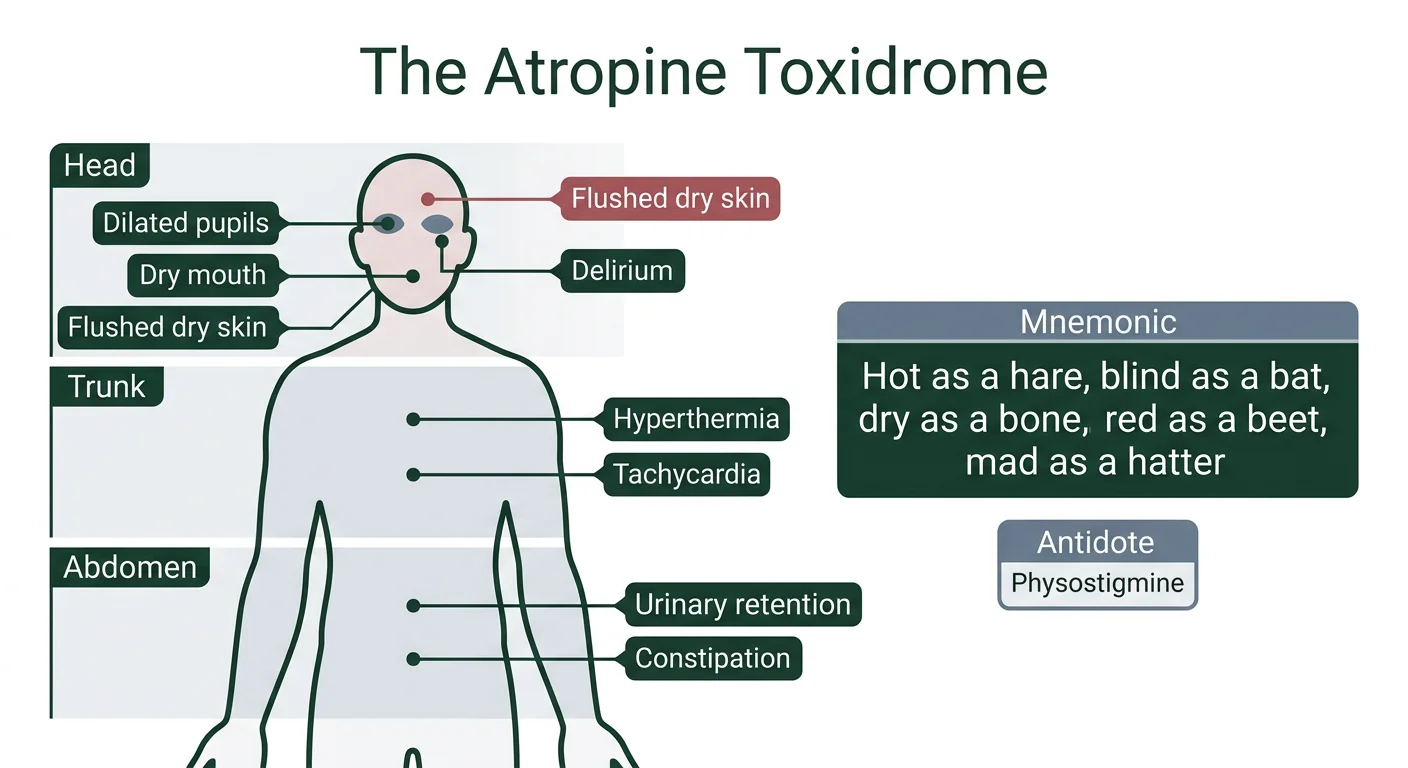
Figure 1 — The atropine toxidrome. Diagram of the atropine toxidrome showing dilated pupils, dry mouth, flushed dry skin, hyperthermia, tachycardia, delirium and urinary retention, with the mnemonic and the antidote physostigmine indicated.
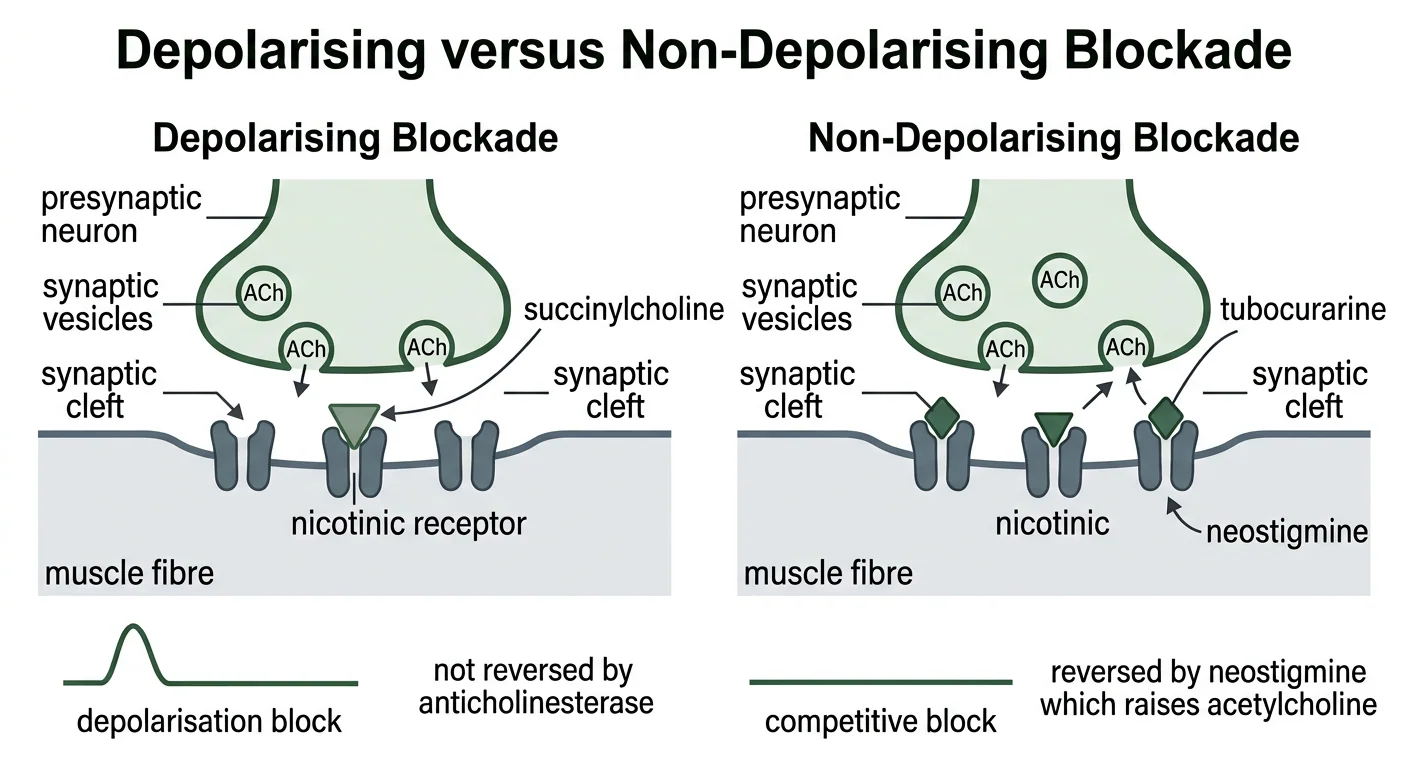
Figure 2 — Depolarising versus non-depolarising neuromuscular blockade. Two-panel comparison of depolarising blockade by succinylcholine, which holds the receptor open causing fasciculations then paralysis, against competitive non-depolarising blockade by tubocurarine, which is reversed by neostigmine.
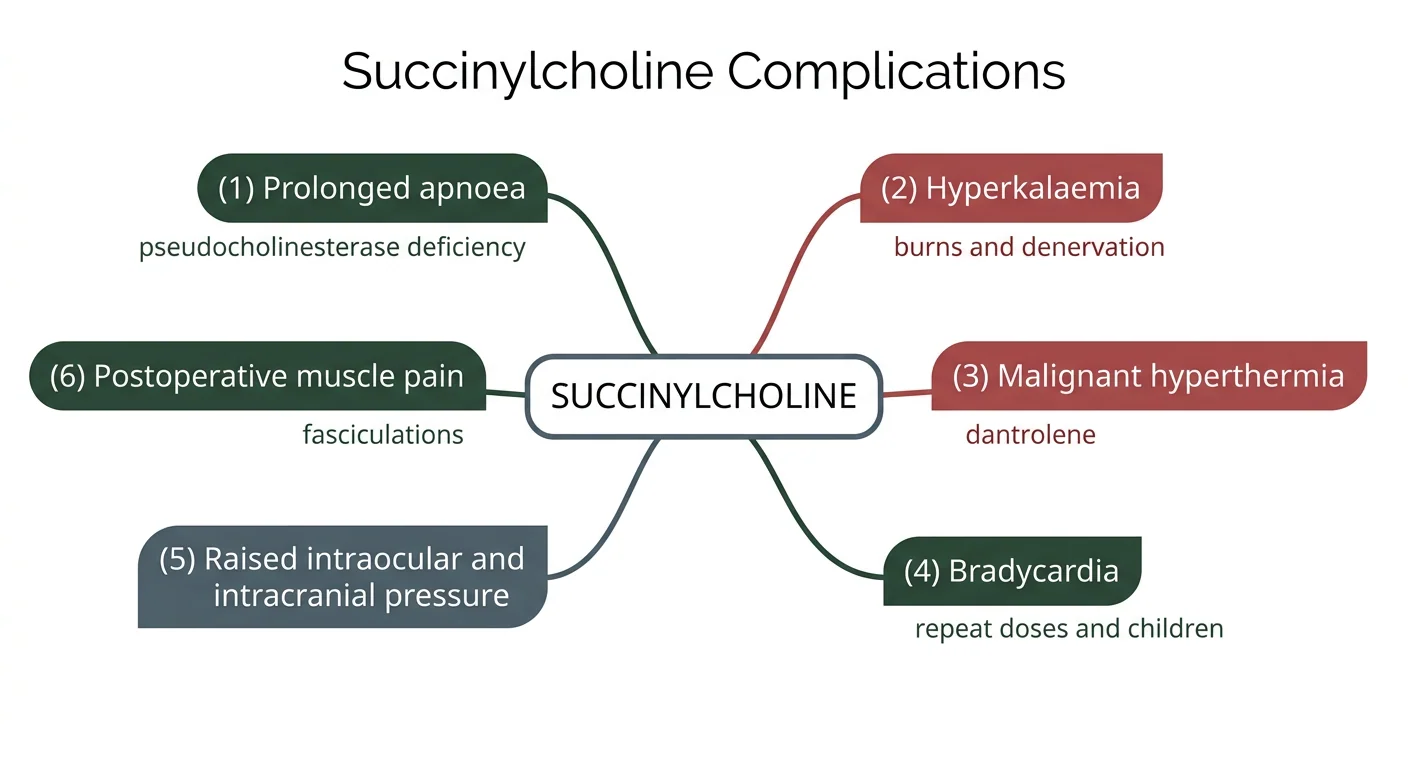
Figure 3 — Succinylcholine complications. Mind-map of the complications of succinylcholine including prolonged apnoea, hyperkalaemia, malignant hyperthermia, bradycardia, raised pressures and muscle pain, each with its mechanism.
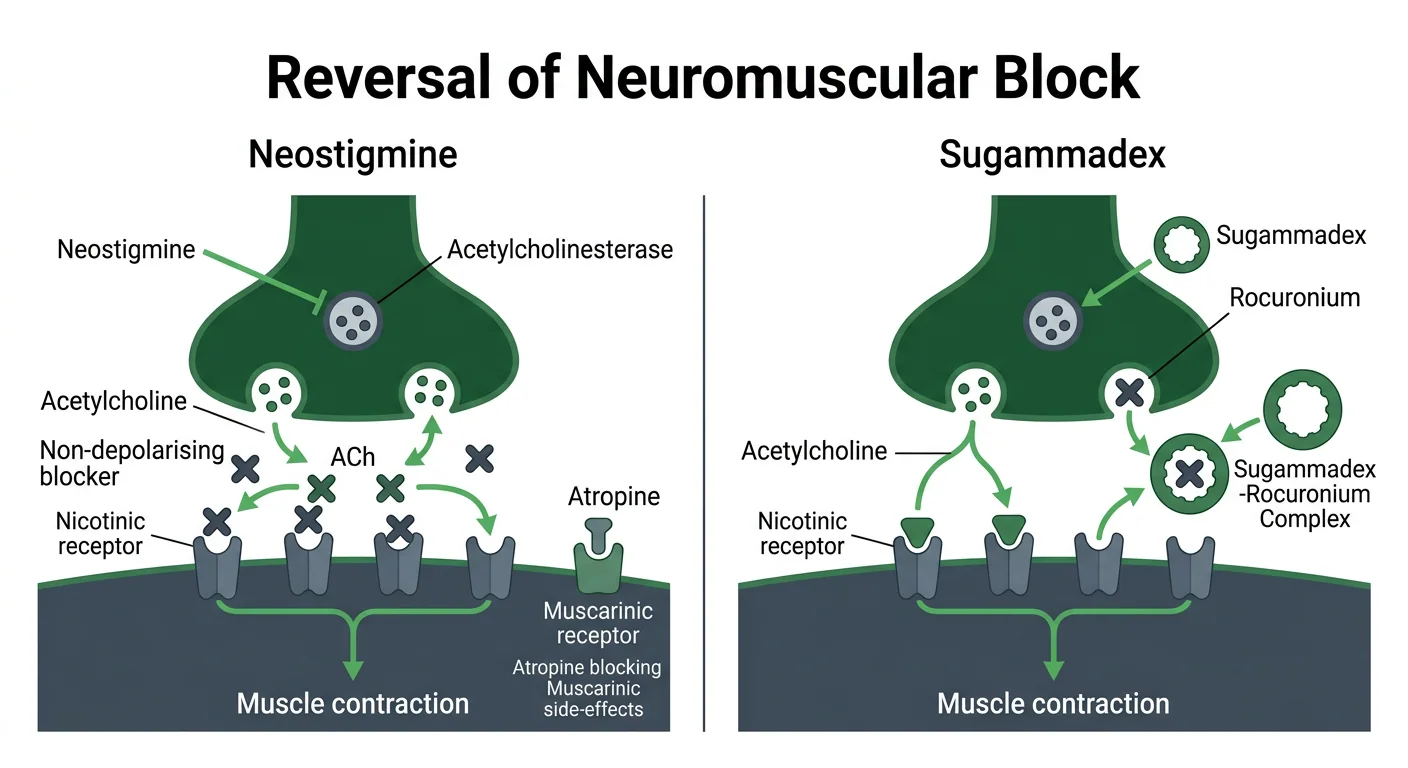
Figure 4 — Reversal of neuromuscular block. Comparison of the two reversal mechanisms — neostigmine raising acetylcholine to displace a non-depolarising blocker with atropine for muscarinic effects, against sugammadex encapsulating rocuronium to remove it from the receptor.
Clinical Correlation
Vignette 1 — Datura (belladonna) poisoning
A teenager who ingested Datura seeds is brought in agitated and hallucinating, with dry flushed skin, dilated pupils, a temperature of 39.5°C, and a heart rate of 120/minute; he is unable to pass urine.
Reasoning: This is the antimuscarinic toxidrome from the atropine and hyoscine in Datura — "hot as a hare, blind as a bat, dry as a bone, red as a beet, mad as a hatter" — with tachycardia and urinary retention. Management is supportive (cooling, fluids, catheterisation, sedation) and, for severe central effects or dangerous hyperthermia, physostigmine — the tertiary anticholinesterase that crosses the blood-brain barrier and reverses both central and peripheral muscarinic blockade. Physostigmine is used cautiously (it can cause bradycardia and seizures), and the case illustrates the direct clinical application of the antimuscarinic organ map.
Vignette 2 — Succinylcholine apnoea
A healthy patient given succinylcholine for intubation fails to regain muscle power after 30 minutes and requires continued ventilation.
Reasoning: The most likely diagnosis is pseudocholinesterase deficiency (CH07) — an inherited reduction of the plasma enzyme that normally hydrolyses succinylcholine within minutes. The block therefore persists for hours, and management is supportive ventilation until recovery, followed by family screening and documentation (with the dibucaine number) for all future anaesthesia. The vignette is the canonical example of a pharmacogenetic defect revealed by an anaesthetic.
Vignette 3 — Malignant hyperthermia
During anaesthesia with halothane and succinylcholine, a patient develops jaw rigidity, a rapidly rising temperature, tachycardia and metabolic acidosis.
Reasoning: This is malignant hyperthermia, a hypermetabolic crisis in patients with ryanodine-receptor (RYR1) mutations, triggered by volatile anaesthetics and succinylcholine. Management is immediate discontinuation of the trigger, cooling, supportive care, and dantrolene — which acts on the ryanodine receptor to stop calcium release from the sarcoplasmic reticulum. The case links the pharmacogenomics of CH07 to a specific antidote, and it explains why dantrolene, uniquely, acts directly on muscle rather than the CNS.
Vignette 4 — Reversing rocuronium
At the end of surgery, a patient paralysed with rocuronium is reversed rapidly and completely with a single dose of sugammadex, without any atropine.
Reasoning: Sugammadex is a modified gamma-cyclodextrin that encapsulates the steroidal relaxant rocuronium (and vecuronium), pulling it off the receptor and reversing even deep block within minutes. Unlike neostigmine — which raises acetylcholine and therefore requires atropine/glycopyrrolate to block the muscarinic effects, and is limited to shallow block — sugammadex is selective, rapid and free of muscarinic side-effects. It does not reverse succinylcholine or the benzylisoquinolines (atracurium/cisatracurium), a distinction that is increasingly examined.
Practical Linkage
Comparing the neuromuscular blockers
| Feature | Depolarising | Non-depolarising |
|---|---|---|
| Prototype | Succinylcholine | Tubocurarine |
| Fasciculations | Present | Absent |
| Effect of neostigmine | Potentiates | Reverses |
| Histamine release | No | Yes (tubocurarine) |
| Elimination | Plasma cholinesterase | Hepatic/renal or Hofmann |
Exercise (PH1.15 — compare the neuromuscular blockers)
Complete the comparison table, then answer the clinical-selection question.
Discussion point
Which muscle relaxant would you choose for a patient with both hepatic and renal failure, and why?
Expected: atracurium or cisatracurium, because they undergo Hofmann elimination — spontaneous, non-enzymatic degradation independent of liver and kidney function.
MCQ Bank
40 questions · tagged by topic, exam pattern & difficulty · full explanations
A patient given atropine develops tachycardia, dry mouth and dilated pupils. The tachycardia results from blockade of which receptor?
Rapid Revision
- Antimuscarinic effects — the inverse of muscarinic stimulation
- Atropine — tachycardia (M2), mydriasis (M3), dry mouth (M3), bronchodilation, urinary retention
- Atropine toxidrome — hot, blind, dry, red and mad
- Atropine antidote — physostigmine
- Hyoscine — CNS depressant, used for motion sickness
- Ipratropium and tiotropium — quaternary inhaled bronchodilators
- Glycopyrrolate — quaternary, no CNS, preferred with neostigmine
- Pirenzepine — M1-selective, peptic ulcer
- Oxybutynin — M3 bladder-selective, overactive bladder
- Tropicamide — short-acting ocular mydriatic
- Succinylcholine — depolarising blocker, rapid onset, short duration
- Succinylcholine apnoea — pseudocholinesterase deficiency
- Succinylcholine hyperkalaemia — burns, trauma, denervation
- Succinylcholine bradycardia — repeat doses and children
- Non-depolarising block — reversed by neostigmine plus atropine
- Depolarising block — potentiated by neostigmine
- Atracurium and cisatracurium — Hofmann elimination, safe in liver and kidney failure
- Sugammadex — cyclodextrin encapsulating rocuronium and vecuronium
- Pancuronium — vagolytic, causes tachycardia
- Baclofen — GABA-B agonist for spasticity
- Tizanidine — central alpha-2 agonist
- Dantrolene — acts on the ryanodine receptor, treats malignant hyperthermia
- Botulinum toxin — blocks acetylcholine release
- Malignant hyperthermia — triggered by succinylcholine and volatile anaesthetics
- Atropine cycloplegia — paralysis of accommodation
- Phase I block — depolarising; Phase II block — desensitising
Viva Questions
- What is the mechanism of atropine — Competitive antagonism at muscarinic receptors.
- Name the atropine toxidrome features — Hot (hyperthermia), blind (mydriasis), dry (xerostomia), red (flushed), mad (delirium), with tachycardia and urinary retention.
- What is the antidote for atropine poisoning — Physostigmine, a tertiary anticholinesterase that crosses the blood-brain barrier.
- How does hyoscine differ from atropine — It is a CNS depressant (sedation, amnesia) and more potent antisecretory, used for motion sickness.
- Why is ipratropium used by inhalation — It is a quaternary antimuscarinic that bronchodilates without systemic or central effects.
- Differentiate depolarising from non-depolarising block — Depolarising (succinylcholine) causes fasciculations and is potentiated by neostigmine; non-depolarising has no fasciculations and is reversed by neostigmine.
- What causes succinylcholine apnoea — Pseudocholinesterase deficiency, prolonging paralysis.
- Why is succinylcholine avoided in burns — Upregulated receptors cause dangerous hyperkalaemia.
- How is malignant hyperthermia treated — With dantrolene, which blocks the ryanodine receptor.
- What is sugammadex — A cyclodextrin that encapsulates rocuronium and vecuronium, reversing deep block.
- Why is neostigmine given with atropine — To block the muscarinic effects of the raised acetylcholine during reversal.
- Which relaxant is safe in liver and kidney failure — Atracurium or cisatracurium, by Hofmann elimination.
- What is dantrolene's site of action — The ryanodine receptor of the sarcoplasmic reticulum.
- What is baclofen — A GABA-B agonist used for spasticity.
- What is cycloplegia — Paralysis of accommodation from ciliary-muscle blockade.
References
- Tripathi KD. Essentials of Medical Pharmacology. 9th ed. New Delhi: Jaypee Brothers Medical Publishers; Chapters 10 and 16 (Anticholinergic Drugs; Skeletal Muscle Relaxants).
- Katzung BG, Vanderah TW (eds). Basic & Clinical Pharmacology. 16th ed. New York: McGraw Hill; Chapter 8 (Cholinoceptor-Blocking Drugs) and Chapter 27 (Skeletal Muscle Relaxants).
- Brunton LL, Knollmann BC (eds). Goodman & Gilman's The Pharmacological Basis of Therapeutics. 14th ed. New York: McGraw Hill; Chapter 11 (Muscarinic Receptor Antagonists).
- Ritter JM, Flower RJ, Henderson G, et al. Rang & Dale's Pharmacology. 10th ed. Edinburgh: Elsevier; Chapters 13 and 14 (Cholinergic Transmission; Neuromuscular Blockers).
- National Medical Commission. Competency Based Undergraduate Curriculum for the Indian Medical Graduate, Volume II — Pharmacology (Code: PH), competencies PH1.14 and PH1.15.
- Naguib M. Sugammadex: another milestone in clinical neuromuscular pharmacology. Anesthesia & Analgesia. 2007;104(3):575–581.
- Miller RD (ed). Miller's Anesthesia. 8th ed. Philadelphia: Elsevier; chapter on neuromuscular blocking agents.
- Rosenberg H, Davis M, James D, Pollock N, Stowell K. Malignant hyperthermia. Orphanet Journal of Rare Diseases. 2007;2:21.
Downloads
All deliverables & printable revision sheets for CH11
Printable Chapter Handout & Study Notes
Generate a clean, high-yield PDF or print directly without sidebars and navigation menus.