
Essential Medicines, Rational Prescribing, P-Drug, Drug Regulation
Learning Objectives
At the end of this chapter, the Phase II MBBS student will be able to:
- Describe the parts of a correct, complete and legible generic prescription and write one for a given condition. (PH1.10 — Shows-how)
- Identify common prescription errors — including ambiguous abbreviations and look-alike sound-alike pairs — and correct them. (PH1.10 — Knows-how)
- Explain the concept of rational prescribing, the WHO six-step process and the P-drug concept with its four selection criteria. (PH1.59 — Knows)
- Define essential medicines, describe the criteria for their selection, and outline the NLEM and the Jan Aushadhi scheme. (PH1.59 — Knows)
- Distinguish rational from irrational fixed-dose combinations, and discuss OTC drugs and the hazards of self-medication. (PH1.59 — Knows)
- Calculate drug doses using Young's rule, Clark's rule, body surface area and the Cockcroft–Gault creatinine clearance, with correct unit handling. (PH1.12 — Knows-how)
- Describe the Drugs and Cosmetics Act 1940, the CDSCO/DCGI, the Indian Pharmacopoeia, and the Pharmacy and NDPS Acts. (PH1.63 — Knows)
- Differentiate the drug schedules H, H1, X and G with their regulatory meaning and examples. (PH1.63 — Knows)
- Audit a given prescription, identify its errors and rewrite it correctly and legibly. (PH1.10, PH3.1 — Shows-how)
- Explain the concept of an essential medicines list for a healthcare facility. (PH1.59 — Knows)
Must-Know Summary
CH08 turns the science of pharmacology into the daily act of prescribing. A correct prescription has a recognisable anatomy — superscription, inscription, subscription, signatura and signature — and must be legible, complete and preferably generic. Rational prescribing follows a disciplined process and rests on the P-drug: the personal drug a doctor knows thoroughly, chosen on efficacy, safety, suitability and cost. What the doctor prescribes should, wherever possible, come from the essential medicines list (NLEM), supported by the Jan Aushadhi scheme. Dose calculation in children, the elderly and renal failure is a core skill with named formulae, and the whole enterprise is governed by law — the Drugs and Cosmetics Act 1940, the CDSCO/DCGI, and the schedules (H, H1, X, G) that separate prescription-only from restricted and narcotic medicines.
In one line each:
- The five parts of a prescription — superscription, inscription, subscription, signatura, signature
- P-drug — chosen on efficacy, safety, suitability and cost
- Essential medicines — satisfy the priority health needs of the population
- NLEM — the National List of Essential Medicines; Jan Aushadhi supplies them cheaply
- Young's rule — age over age plus 12, times the adult dose
- Clark's rule — weight in kg over 70, times the adult dose
- Cockcroft–Gault — estimates creatinine clearance for renal dosing
- Schedule H — prescription-only; Schedule H1 — restricted antibiotics
- Schedule X — narcotics and psychotropics under special licence
Classification
Box 1 — Parts of a prescription
- Superscription — the Rx symbol
- Inscription — drug name (generic), dose and dosage form
- Subscription — directions to the pharmacist (quantity to dispense)
- Signatura / transcription — directions to the patient (Sig.)
- Signature and identification — prescriber's signature, name, registration number, date; patient's name, age and weight
Box 2 — Drug schedules
- Schedule H — prescription-only; "to be sold on the prescription of a registered medical practitioner"
- Schedule H1 — restricted antibiotics (anti-TB drugs, 3rd/4th-gen cephalosporins); red-box label, not OTC
- Schedule X — narcotics and psychotropics (amphetamines, methaqualone); special licence, duplicate prescription
- Schedule G — labelled warning drugs ("dangerous except under medical supervision")
- OTC — over-the-counter, sold without prescription
Core Concepts
1. The prescription — parts and principles
A prescription is the written instruction from a registered medical practitioner to a pharmacist to supply a medicine and to the patient on how to use it. It is a medicolegal document, and its classical anatomy has five parts:
- Superscription — the symbol Rx (from the Latin recipe, "take thou"), the traditional invocation at the head of the prescription.
- Inscription — the body of the prescription: the name of the drug (ideally the generic name), its dose and the dosage form (e.g. "Tab. Amlodipine 5 mg"). This is the core therapeutic instruction.
- Subscription — the directions to the pharmacist: the quantity to dispense and any compounding instruction (e.g. "Dispense 30 tablets").
- Signatura (transcription) — the directions to the patient: how and when to take the medicine, often prefixed "Sig." (e.g. "one tablet once daily at bedtime").
- Signature and identification — the prescriber's signature, name, qualification, registration number, the date, and (ideally) the patient's name, age and weight.
A prescription should be correct (right drug, dose, route, frequency and duration), complete (all parts present, including patient and prescriber identifiers and the date), and legible. India mandates generic prescribing — writing the international non-proprietary (generic) name — to make medicines affordable and interchangeable, supported by the Jan Aushadhi scheme of low-cost generic outlets. Poor legibility and brand-name reliance are both correctable sources of error and cost.
2. Prescription errors and their prevention
Prescription errors are a major, preventable cause of harm. The common types are: wrong drug (look-alike sound-alike confusion), wrong dose (decimal and trailing-zero errors), wrong route or frequency, illegibility, omission of strength or duration, and dangerous abbreviations.
Dangerous abbreviations — "U" for units can be misread as a zero (10 U → 100); "q.d." (daily) can be misread as "q.i.d." (four times daily); a trailing zero ("5.0 mg") can be misread as "50 mg" if the decimal point is missed, whereas a leading zero ("0.5 mg", never ".5 mg") protects against this. Look-alike sound-alike (LASA) pairs — such as chlorpromazine/chlorpropamide, or celecoxib/celebrex confusion — are a standing hazard. Prevention combines standardisation (approved abbreviation lists), electronic prescribing, independent checking, writing legibly in block capitals, and always stating the dose in clear units.
3. Rational prescribing and the P-drug
Rational drug use means the right drug, in the right dose, for the right patient, for the right duration, at the right cost. The WHO six-step process disciplines the prescriber: (1) define the patient's problem, (2) specify the therapeutic objective, (3) verify the suitability of the treatment for this patient, (4) write the prescription, (5) give the patient clear information, and (6) monitor the result.
The P-drug (personal drug) operationalises this. A P-drug is the single drug a prescriber selects for a given condition and knows thoroughly — its dose, kinetics, interactions and adverse effects — so that it can be prescribed almost reflexively and safely. It is chosen on four criteria: efficacy (is it effective), safety (are its adverse effects acceptable), suitability (form, route, dosing frequency, and fitness for this patient), and cost (affordable and available). The P-drug is then individualised for the specific patient — a pregnant woman, a child, a patient with renal failure — which is where the dose-calculation skills of this chapter apply. Having a small repertoire of P-drugs, rather than a long list of half-known alternatives, is the mark of rational prescribing.
4. Essential medicines and the NLEM
Essential medicines (WHO) are those that satisfy the priority health care needs of the population, selected on the basis of disease prevalence, evidence of efficacy and safety, and comparative cost-effectiveness; they should be available at all times, in adequate amounts, in the appropriate dosage forms, at a price the community can afford. The concept focuses limited resources on a restricted list, improving access, quality and rational use.
In India the National List of Essential Medicines (NLEM), issued by the Ministry of Health and Family Welfare, enumerates these medicines and is revised periodically; drugs on the NLEM are subject to price control. The Jan Aushadhi (Pradhan Mantri Bhartiya Janaushadhi Pariyojana) scheme makes generic equivalents available through dedicated low-cost outlets. For a primary health centre, a facility's own essential medicines list is derived from the NLEM and standard treatment guidelines — the practical skill tested in the undergraduate practicals.
5. Fixed-dose combinations, OTC drugs and self-medication
A fixed-dose combination (FDC) contains two or more drugs in a single formulation. Rational FDCs improve adherence (antihypertensive combinations), exploit synergy (trimethoprim–sulfamethoxazole, amoxicillin–clavulanate, anti-TB regimens) or simplify dosing. Irrational FDCs combine drugs with no added benefit, incompatible kinetics or additive toxicity — and India has repeatedly banned such combinations (for example, nimesulide with paracetamol, withdrawn over additive hepatotoxicity with no demonstrated advantage) after regulatory review. The examination point is the reasoning: an FDC is rational only if each component is needed, the doses are appropriate, and the combination is safer or more effective than the components alone.
OTC (over-the-counter) drugs are medicines that can be sold without a prescription — antipyretics, antacids, some antihistaminics — distinguished from prescription-only (Schedule H) drugs. Self-medication with OTC drugs is convenient but hazardous when it delays diagnosis, masks serious disease, causes interactions or permits misuse; the pharmacist and the doctor both share responsibility for counselling.
6. Dose calculation in special populations
Children, the elderly and patients with renal impairment cannot simply receive a scaled-down adult dose; several formulae are standard.
- Young's rule (for children): Child's dose = [age / (age + 12)] × adult dose (age in years). It is simple but crude, ignoring weight.
- Clark's rule (weight-based): Child's dose = [weight (kg) / 70] × adult dose (equivalently weight in pounds/150). Weight-based dosing is generally more accurate.
- Body surface area (BSA): the Du Bois formula — BSA (m²) = 0.007184 × weight^0.425 × height^0.725 — is the basis of cytotoxic chemotherapy dosing, since metabolic rate correlates better with surface area than with weight.
- Cockcroft–Gault (creatinine clearance, for renal dosing): CrCl (mL/min) = [(140 − age) × weight (kg)] / (72 × serum creatinine mg/dL), multiplied by 0.85 in women. The result guides dose reduction for renally cleared drugs such as digoxin and the aminoglycosides.
Unit discipline is decisive: weight in kg (not pounds) in Clark's rule and Cockcroft–Gault, serum creatinine in mg/dL, and attention to mg versus µg conversions — a recurring source of error in calculation questions. Drip-rate calculation (drops per minute = volume × drop factor ÷ time in minutes) completes the practical set.
7. Drug regulations and the legal framework
Indian drug regulation rests on the Drugs and Cosmetics Act 1940 and the Drugs and Cosmetics Rules 1945, which govern the manufacture, sale, import and distribution of drugs. The Central Drugs Standard Control Organization (CDSCO) is the national regulatory authority, headed by the Drugs Controller General of India (DCGI), and it licenses drugs, approves clinical trials, and oversees quality. The Indian Pharmacopoeia (IP) is the official compendium of drug standards. The Pharmacy Act 1948 regulates the profession and registration of pharmacists. The Narcotic Drugs and Psychotropic Substances (NDPS) Act 1985 controls narcotics and psychotropic substances, imposing strict possession, prescription and record-keeping requirements. These instruments, together with the schedules described below, define what a doctor may prescribe and how.
8. Drug schedules and prescribing categories
Drugs are classified into schedules that determine the conditions of their supply:
- Schedule H — prescription-only drugs: they cannot be sold without a valid prescription, and the label must carry the warning "To be sold by retail on the prescription of a Registered Medical Practitioner only." Most antibiotics and prescription medicines are Schedule H.
- Schedule H1 — a stricter subcategory introduced for restricted antibiotics (anti-tubercular drugs and third/fourth-generation cephalosporins, among others) to combat antimicrobial resistance: labelled with a distinctive red box warning, sold only on prescription, and with additional record-keeping; these are not to be dispensed over the counter.
- Schedule X — narcotics and psychotropics (amphetamines, methaqualone, and other substances of abuse): requiring a special licence, prescriptions in duplicate, and strict retention of records.
- Schedule G — drugs whose label must carry a specified warning (e.g. "caution: it is dangerous to take this preparation except under medical supervision").
The practical meaning for the prescriber is clear: Schedule H drugs need a prescription, Schedule H1 restricted antibiotics need one too and must not be treated as OTC, and Schedule X substances need the highest level of control.
Tables
Table 1 — The parts of a prescription
| Part | Content | Example |
|---|---|---|
| Superscription | The Rx symbol | Rx |
| Inscription | Drug, dose, dosage form | Tab. Amlodipine 5 mg |
| Subscription | Directions to pharmacist | Dispense 30 tablets |
| Signatura | Directions to patient | One tablet once daily |
| Signature | Prescriber identification | Signature, name, registration number, date |
Table 2 — Common prescription errors and their prevention
| Error | Example | Prevention |
|---|---|---|
| Dangerous abbreviation | "U" for units | Write "units" in full |
| Trailing zero | "5.0 mg" | Omit trailing zero; use leading zero (0.5 mg) |
| Frequency confusion | "q.d." vs "q.i.d." | Spell out frequency |
| LASA confusion | Chlorpromazine / chlorpropamide | Legible capitals; check indication |
| Omitted strength | Drug name only | Always state dose and unit |
| Illegibility | Cursive smudge | Block capitals, electronic prescribing |
Table 3 — The P-drug selection criteria
| Criterion | Question |
|---|---|
| Efficacy | Is the drug effective for the condition? |
| Safety | Are its adverse effects acceptable? |
| Suitability | Right form, route, frequency for this patient? |
| Cost | Affordable and available? |
Table 4 — Essential medicines, NLEM and Jan Aushadhi
| Term | Meaning |
|---|---|
| Essential medicines (WHO) | Satisfy the priority health needs of the population |
| NLEM | National List of Essential Medicines, India |
| Price control | NLEM drugs are price-controlled |
| Jan Aushadhi | Low-cost generic medicine outlets |
| Facility EML | Local list derived from NLEM and STGs |
Table 5 — Dose-calculation formulae
| Formula | Use | Expression |
|---|---|---|
| Young's rule | Child (age) | Dose = age/(age+12) × adult dose |
| Clark's rule | Child (weight) | Dose = weight (kg)/70 × adult dose |
| Du Bois BSA | Cytotoxics | BSA = 0.007184 × W^0.425 × H^0.725 |
| Cockcroft–Gault | Renal dosing | CrCl = (140−age)×W/(72×SCr); ×0.85 in women |
| Drip rate | IV infusion | drops/min = volume × drop factor / time |
Table 6 — Drug schedules and their meaning
| Schedule | Category | Key feature |
|---|---|---|
| H | Prescription-only | Sold only on prescription |
| H1 | Restricted antibiotics | Red-box label; anti-TB drugs, 3rd/4th-gen cephalosporins |
| X | Narcotics/psychotropics | Special licence, duplicate prescription |
| G | Warning-labelled | "Dangerous except under medical supervision" |
| OTC | Over-the-counter | No prescription required |
Table 7 — Rational versus irrational fixed-dose combinations
| Feature | Rational FDC | Irrational FDC |
|---|---|---|
| Benefit | Improved compliance, synergy | No added benefit |
| Dosing | Appropriate for each component | Inflexible or inappropriate |
| Toxicity | No additive hazard | Additive or masked toxicity |
| Example | Amoxicillin–clavulanate, anti-TB | Nimesulide + paracetamol (banned) |
Figures
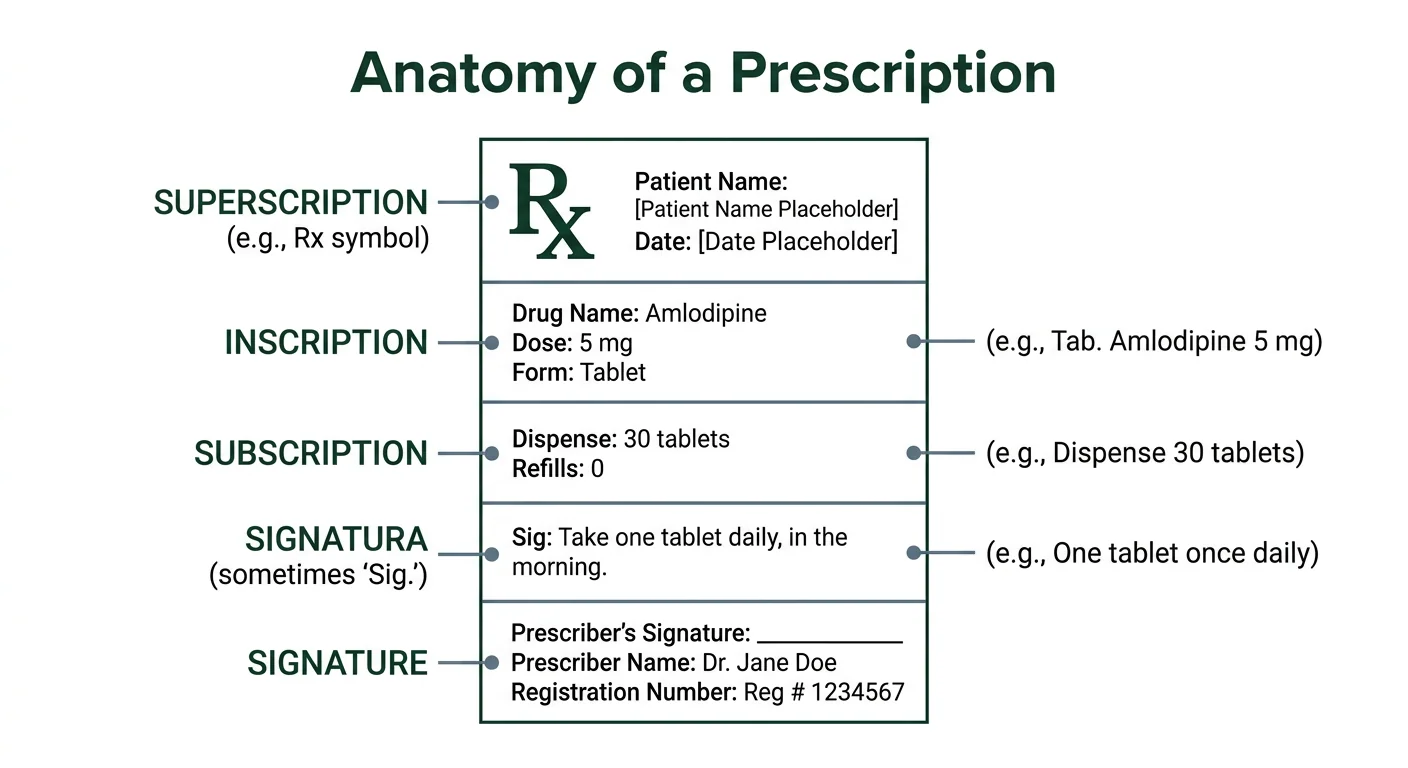
Figure 1 — Anatomy of a prescription. Labelled diagram of a prescription showing its five parts — superscription, inscription, subscription, signatura and signature — each with a short example such as the drug name and dose, quantity to dispense, and directions to the patient.
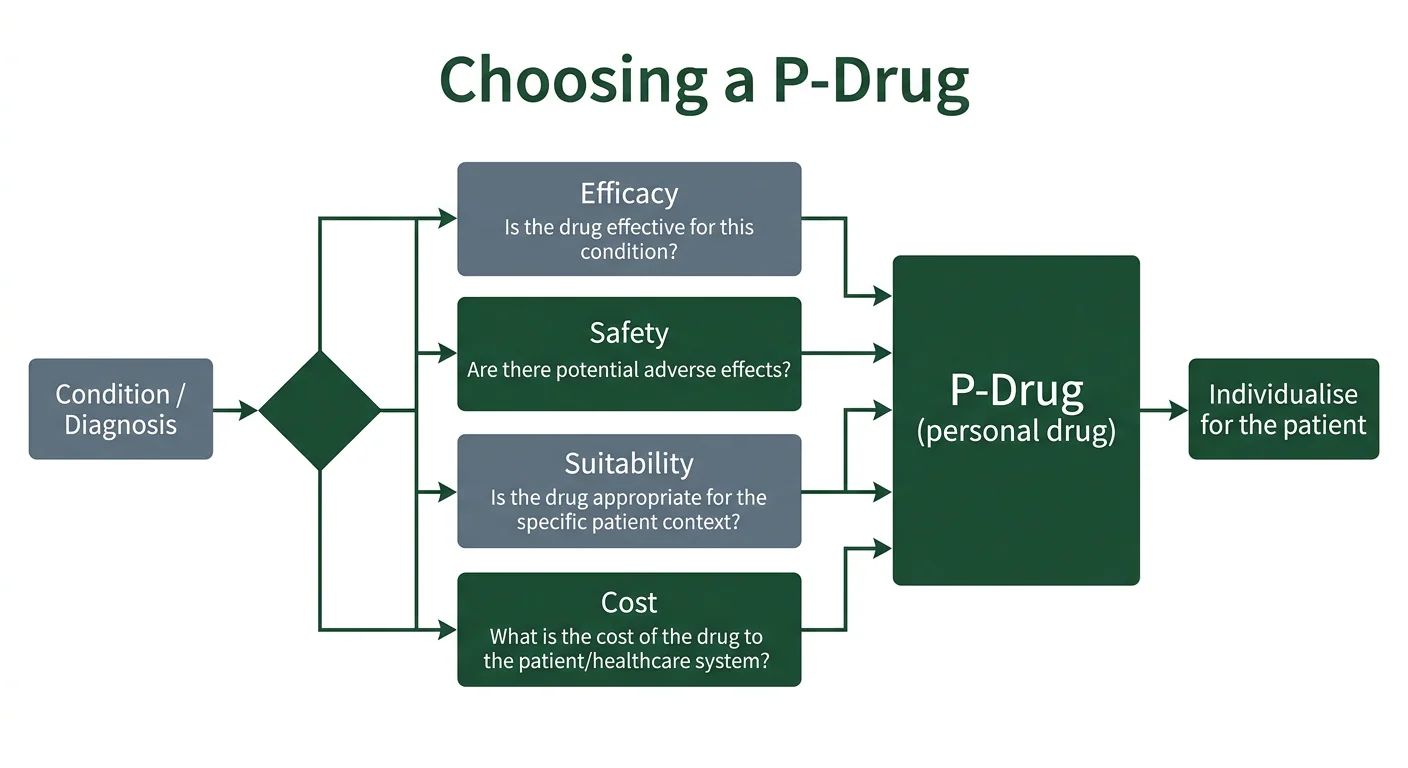
Figure 2 — The P-drug selection process. Flow diagram of P-drug selection, showing a diagnosis evaluated against the four criteria of efficacy, safety, suitability and cost to choose a personal drug, which is then individualised for the specific patient.
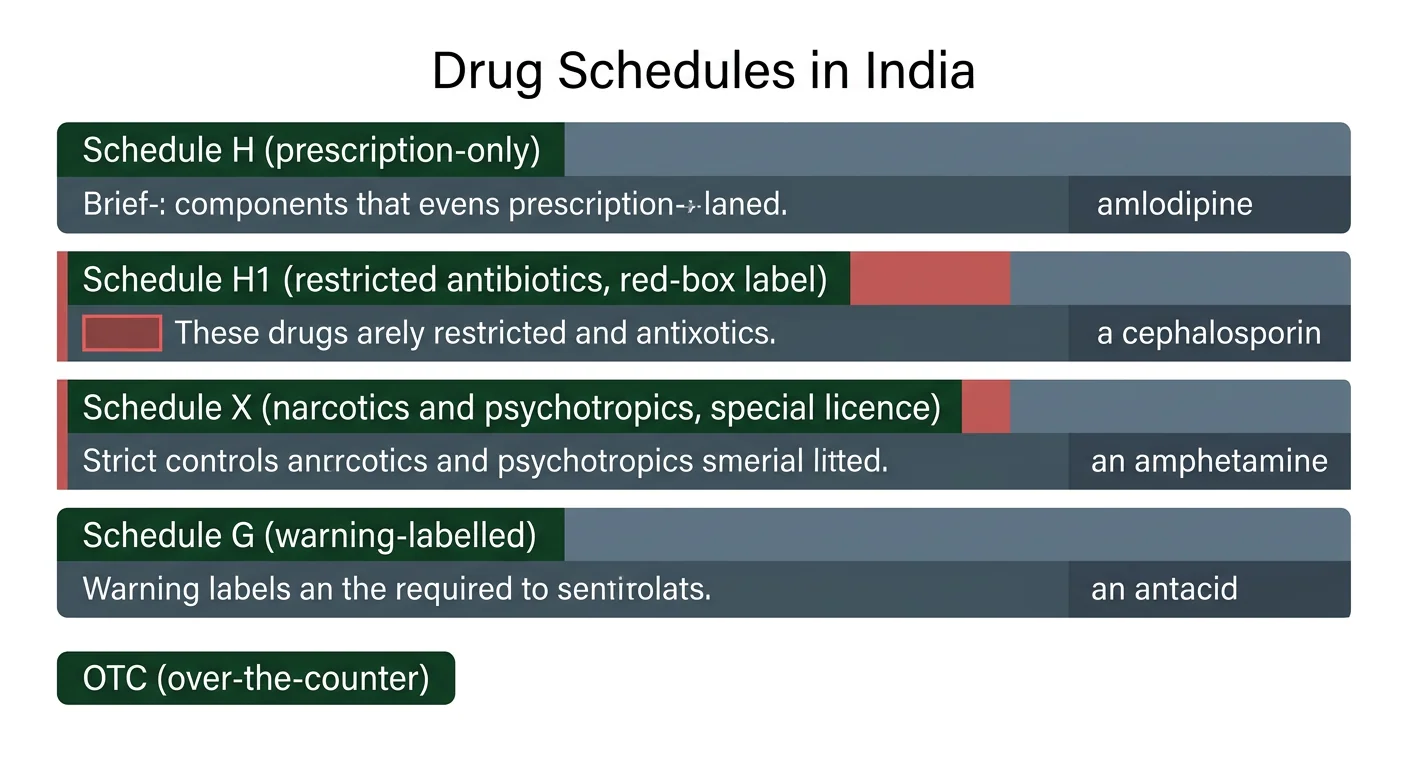
Figure 3 — Drug schedules and prescribing categories. Classification diagram of Indian drug schedules — H prescription-only, H1 restricted antibiotics, X narcotics and psychotropics, and G warning-labelled drugs — with over-the-counter medicines shown separately, each with a representative example.
Clinical Correlation
Vignette 1 — An ambiguous prescription
A prescription reads "Insulin 10 U subcutaneously at bedtime". The dispensing pharmacist misreads "10 U" as "100" and the patient receives ten times the intended dose, developing severe hypoglycaemia.
Reasoning: This is a dangerous-abbreviation error. The abbreviation "U" for units can be misread as a zero, and — combined with any illegibility — turns 10 units into 100 units. The correct prescription writes "10 units" in full, with a clear leading zero where relevant. The case illustrates why "U", "IU" and trailing zeros are prohibited in safe prescribing, and why every prescription should be legible, unambiguous and checked independently before dispensing.
Vignette 2 — Dosing a child
A 6-year-old child weighing 20 kg needs a drug whose adult dose is 300 mg. Two doctors calculate the paediatric dose by different methods.
Reasoning: By Young's rule, the dose is [6/(6+12)] × 300 = 100 mg. By Clark's rule, it is [20/70] × 300 = 85.7 mg. The two methods give different answers because Young's rule uses age (ignoring the child's weight) while Clark's rule uses weight, which is more accurate — a 6-year-old weighing 20 kg is lighter than average, so Clark's rule gives the safer, smaller dose. The teaching point is that weight-based dosing (Clark's rule) is preferred over age-based (Young's rule) when the weight is known, and that unit discipline (kg, not pounds) is essential.
Vignette 3 — Renal dose adjustment in the elderly
An 80-year-old woman weighing 60 kg, with a serum creatinine of 1.5 mg/dL, is prescribed an aminoglycoside for a serious infection. The housestaff wonder how to adjust the dose.
Reasoning: The aminoglycoside is renally cleared, so the dose depends on creatinine clearance. By Cockcroft–Gault: CrCl = [(140 − 80) × 60] / (72 × 1.5) = 3600/108 ≈ 33 mL/min, multiplied by 0.85 for a woman ≈ 28 mL/min — markedly reduced. The aminoglycoside must be given at a reduced dose or extended interval, guided by therapeutic drug monitoring (peak and trough levels, as in CH03). The case shows why age alone is a poor guide to renal function — an apparently normal serum creatinine can conceal a much-reduced clearance in a small, elderly woman.
Vignette 4 — A withdrawn combination
A patient is offered a fixed-dose combination of nimesulide and paracetamol that was available cheaply over the counter.
Reasoning: Nimesulide–paracetamol was among the irrational FDCs banned in India after regulatory review: the combination offered no proven advantage over paracetamol alone, while adding the risk of nimesulide hepatotoxicity — additive harm without additive benefit. The case teaches the principle behind FDC evaluation: a combination is justified only when it improves efficacy, safety or adherence, not merely for marketing convenience, and patients should be counselled to avoid self-medication with unproven combinations.
Practical Linkage
Writing a complete prescription
| Step | Task | Expected response |
|---|---|---|
| 1 | Superscription | Rx |
| 2 | Inscription | Tab. Amlodipine 5 mg (generic name) |
| 3 | Subscription | Dispense 30 tablets |
| 4 | Signatura | One tablet once daily |
| 5 | Signature | Prescriber signature, name, registration number, date; patient name, age |
Exercise (PH3.1 — write a rational, correct, legible generic prescription)
A 45-year-old man with newly diagnosed hypertension (blood pressure 150/95 mmHg) needs treatment. Write a complete, generic, legible prescription using all five parts, then audit the flawed prescription below.
Dose-calculation worksheet
(i) Calculate the dose for a 4-year-old child when the adult dose is 200 mg, by Young's rule.
Answer: 200 × 4/16 = 50 mg.
(ii) Recalculate for a child weighing 14 kg by Clark's rule.
Answer: 200 × 14/70 = 40 mg.
(iii) Estimate creatinine clearance by Cockcroft–Gault for a 70-year-old man weighing 70 kg with serum creatinine 1.4 mg/dL.
Answer: [(140−70)×70]/(72×1.4) = 4900/100.8 ≈ 48.6 mL/min.
Audit
A prescription reads "Tab. digoxin .25 mg QD". Identify two errors and rewrite correctly.
Errors: missing leading zero (".25" should be "0.25"); ambiguous "QD" (write "once daily"); add route, duration and prescriber identification.
MCQ Bank
35 questions · tagged by topic, exam pattern & difficulty · full explanations
In a prescription, the part that contains the name, dose and dosage form of the drug is the:
Rapid Revision
- Five parts of a prescription — superscription, inscription, subscription, signatura, signature
- Inscription — the drug name, dose and dosage form
- Signatura — the directions to the patient
- P-drug — the personal drug, chosen on efficacy, safety, suitability and cost
- WHO prescribing process — define, specify, verify, write, inform, monitor
- Essential medicines — satisfy the priority health needs of the population
- NLEM — the National List of Essential Medicines, price-controlled
- Jan Aushadhi — low-cost generic medicine outlets
- Rational FDC — improved efficacy, safety or adherence
- Irrational FDC — nimesulide plus paracetamol, banned for additive hepatotoxicity
- Young's rule — age over age plus 12, times adult dose
- Clark's rule — weight in kg over 70, times adult dose
- Du Bois BSA — 0.007184 times weight to the 0.425 times height to the 0.725
- Cockcroft–Gault — creatinine clearance, times 0.85 in women
- Dangerous abbreviation — "U" misread as zero
- Trailing zero — avoid it; use a leading zero
- LASA pair — chlorpromazine and chlorpropamide
- Drugs and Cosmetics Act — 1940, Rules 1945
- CDSCO — headed by the DCGI, the national drug regulator
- Indian Pharmacopoeia — the official compendium of drug standards
- Pharmacy Act — 1948, regulates pharmacists
- NDPS Act — 1985, narcotics and psychotropics
- Schedule H — prescription-only
- Schedule H1 — restricted antibiotics, red-box label
- Schedule X — narcotics, special licence, duplicate prescription
- Schedule G — warning-labelled drugs
- OTC — sold without a prescription
- Cytotoxic dosing — by body surface area
Viva Questions
- Name the five parts of a prescription — Superscription, inscription, subscription, signatura and signature.
- What is the inscription — The part containing the drug name, dose and dosage form.
- What is a P-drug — The single drug a prescriber selects for a condition and knows thoroughly, chosen on efficacy, safety, suitability and cost.
- What are the four P-drug selection criteria — Efficacy, safety, suitability and cost.
- Define essential medicines — Medicines that satisfy the priority health needs of the population, available at all times at an affordable price.
- What is the NLEM — The National List of Essential Medicines, which guides procurement and price control in India.
- What is the Jan Aushadhi scheme — A network of low-cost generic medicine outlets.
- When is a fixed-dose combination rational — When it improves efficacy, safety or adherence over the components given separately.
- Why was nimesulide plus paracetamol banned — An irrational FDC with additive hepatotoxicity and no added benefit.
- State Young's rule — Child dose equals age over age plus 12, times the adult dose.
- State Clark's rule — Child dose equals weight in kg over 70, times the adult dose.
- What does the Cockcroft–Gault formula estimate — Creatinine clearance, used to adjust renally cleared drug doses.
- Why is creatinine clearance multiplied by 0.85 in women — Lower average muscle mass and creatinine production.
- Differentiate Schedule H from Schedule H1 — Schedule H is prescription-only; Schedule H1 is a stricter category for restricted antibiotics with a red-box label.
- Give an example of a Schedule X drug — Amphetamines, requiring a special licence and duplicate prescriptions.
References
- Tripathi KD. Essentials of Medical Pharmacology. 9th ed. New Delhi: Jaypee Brothers Medical Publishers; Chapter 8 (Rational Use of Medicines; Essential Medicines; Drug Regulation).
- Katzung BG, Vanderah TW (eds). Basic & Clinical Pharmacology. 16th ed. New York: McGraw Hill; Chapter 5 (Therapeutic Choices) and Chapter 65 (Rational Prescribing).
- Brunton LL, Knollmann BC (eds). Goodman & Gilman's The Pharmacological Basis of Therapeutics. 14th ed. New York: McGraw Hill; Chapter 5 (Drug Regulation and Development).
- Ritter JM, Flower RJ, Henderson G, et al. Rang & Dale's Pharmacology. 10th ed. Edinburgh: Elsevier; Chapter 60 (Drug Regulation and Prescribing).
- National Medical Commission. Competency Based Undergraduate Curriculum for the Indian Medical Graduate, Volume II — Pharmacology (Code: PH), competencies PH1.10, PH1.12, PH1.59, PH1.63 and PH3.1.
- World Health Organization. Guide to Good Prescribing: A Practical Manual. Geneva: WHO/DAP.
- Ministry of Health and Family Welfare, Government of India. National List of Essential Medicines (NLEM), current edition, and the Drugs and Cosmetics Act 1940 and Rules 1945.
- Government of India. Narcotic Drugs and Psychotropic Substances Act 1985.
Downloads
All deliverables & printable revision sheets for CH08
Printable Chapter Handout & Study Notes
Generate a clean, high-yield PDF or print directly without sidebars and navigation menus.